
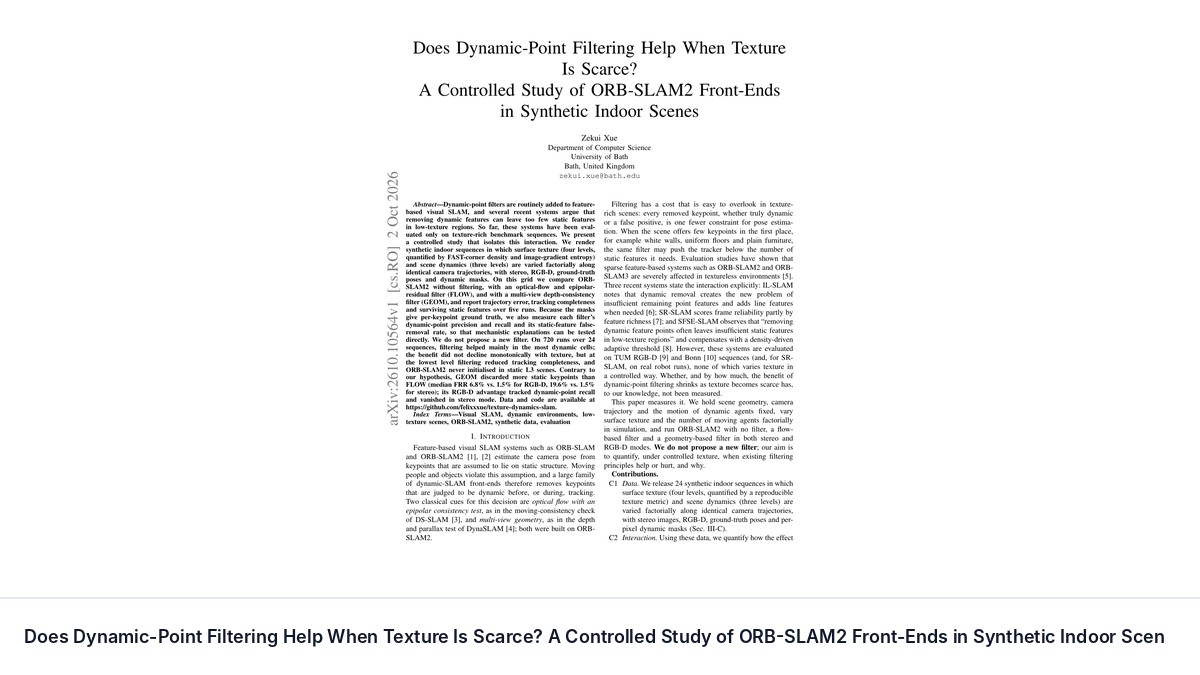
Does Dynamic-Point Filtering Help When Texture Is Scarce? A Controlled Study of ORB-SLAM2 Front-Ends in Synthetic Indoor Scenes
Zekui Xue · N/A · 2026
Framework
N/A
License
N/A
Stars
N/A
Summary
Dynamic-point filters are routinely added to feature-based visual SLAM, and several recent systems argue that removing dynamic features can leave too few static features in low-texture regions. So far, these systems have been evaluated only on texture-rich benchmark sequences.
Abstract Summary
Key Points
- Dynamic-point filters are routinely added to feature-based visual SLAM, and several recent systems argue that removing dynamic features can leave too few static features in low-texture regions.
- So far, these systems have been evaluated only on texture-rich benchmark sequences
- We present a controlled study that isolates this interaction
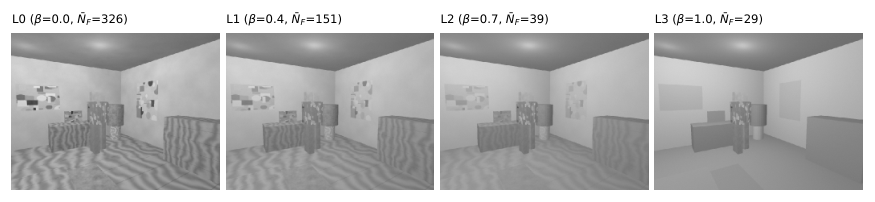
- We render synthetic indoor sequences in which surface texture (four levels, quantified by FAST-corner density and image-gradient entropy) and scene dynamics (three levels) are varied factorially along identical camera trajectories, with stereo, RGB-D, ground-truth poses and dynamic masks.
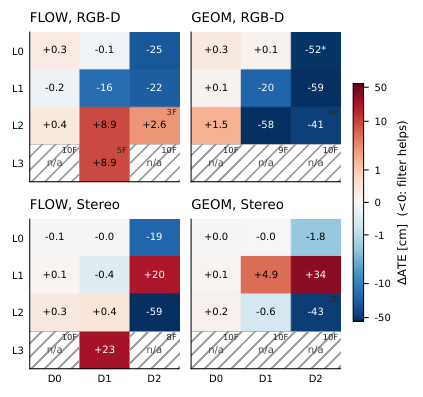
- On this grid we compare ORB-SLAM2 without filtering, with an optical-flow and epipolar-residual filter (FLOW), and with a multi-view depth-consistency filter (GEOM), and report trajectory error, tracking completeness and surviving static features over five runs.
Study Design
We use the public ORB-SLAM2 implementation [ 2 ] in its stereo and RGB-D modes with the default tracking, local-mapping and loop-closing threads and with $N_{f}=1000$ ORB features [ 33 ] per frame (scale factor 1.2, 8 levels, FAST thresholds 20/7, close/far depth threshold 40 baselines); all other parameters are left at their defaults.
Experiments
Hypotheses. The design is built to test three pre-stated hypotheses; each may be refuted, and refutations will be reported as such. The accuracy benefit of dynamic-point filtering ($-\Delta\mathrm{ATE}_{f}$) decreases as texture decreases, and may become negative at the lowest texture level, because filtering removes a larger share of the scarce static keypoints.
Geom has a lower static-feature false-removal rate than Flow , and the gap widens as texture decreases, because $\mathbf{F}_{t}$ in Eq.
Sources and Demonstrations
Figures are reproduced from Xue See the full paper for experimental details and the project page, when the paper links one, for demonstrations and videos.
Related Papers

Aim Short to Reach Far: Your Frozen World Model Can Plan Better Than You Think
Xvyuan Liu, Jianjie Fang, Chen Gao et al.
Planners built on visual world models commonly score each predicted outcome by its distance to the encoded goal image. We show that this target can limit control even with exact dynamics and globally optimal short-horizon search: reaching a goal may require actions that initially move away from it.
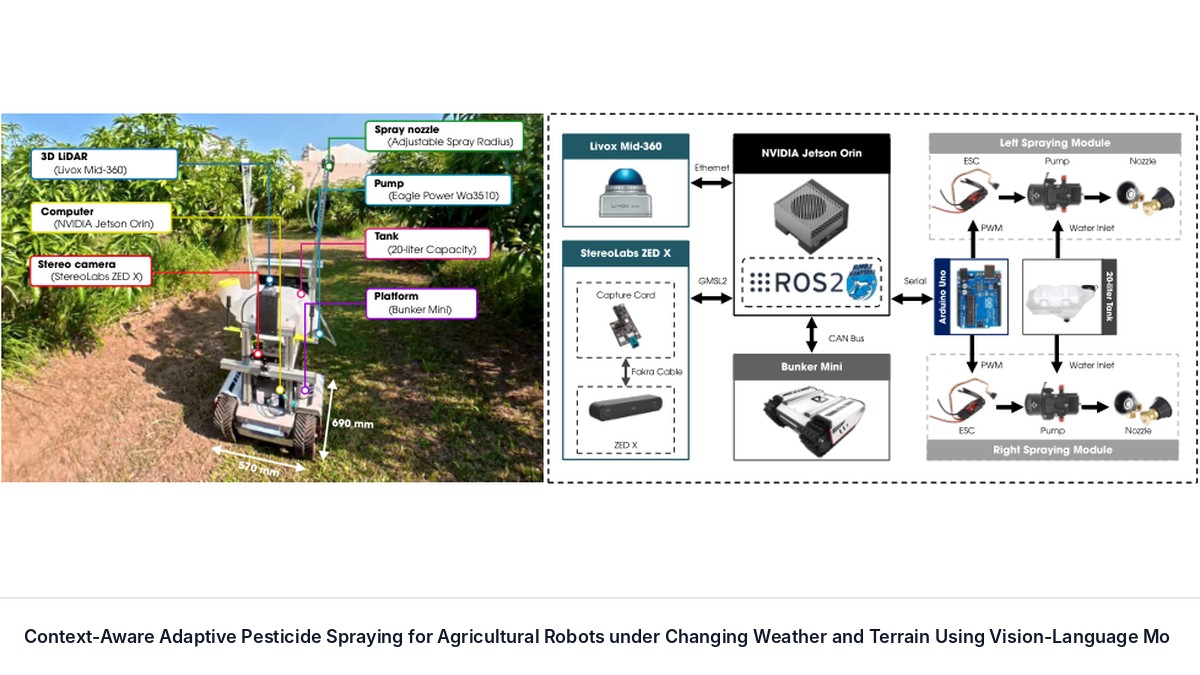
Context-Aware Adaptive Pesticide Spraying for Agricultural Robots under Changing Weather and Terrain Using Vision-Language Models
Cong-Thanh Vu, Yen-Chen Liu
Precision pesticide spraying is essential for optimizing application efficiency and ensuring uniform chemical distribution.

DuoMind: Enabling Distributed Multi-Robot Coordination with Semantic Communication
Hanchu Zhou, Dechen Gao, Hang Wang et al.
Vision-language models (VLMs) and vision-language-action models (VLAs) have recently driven rapid progress in general-purpose robots, yet most progress has focused on single-robot settings.

End-to-End Vision-Language-Action Policies for Autonomous Lunar Rover Docking
Sitan Huang, Grace Gao
Surface navigation on the Moon is subject to extreme illumination contrast and deployment-time perceptual disturbances.