
From Pretraining to Proficiency: Real-World Subtask RL for Long-Horizon Manipulation with Minimal Human Intervention
Sichang Su, Benjamin Yang, Zhiyun Deng, Boyuan Liang, Yip Fun Yeung, Zelin Wang, Lingfeng Sun · N/A · 2026
Framework
N/A
License
N/A
Stars
N/A
Summary
A pretrained robot foundation policy may execute most of a long-horizon task yet repeatedly fail at a few critical subtasks. Collecting additional full-task demonstrations for supervised fine-tuning (SFT) requires operators to repeat behaviors the policy already performs well.
Abstract Summary
Key Points
- A pretrained robot foundation policy may execute most of a long-horizon task yet repeatedly fail at a few critical subtasks.
- Collecting additional full-task demonstrations for supervised fine-tuning (SFT) requires operators to repeat behaviors the policy already performs well.
- Reinforcement learning (RL) fine-tuning offers a promising path to bridge this gap, but existing approaches struggle to solve long-horizon tasks using only sparse rewards.
- We present PARTS (Policy Adaptation with RL on Targeted Subtasks), a real-world subtask RL framework that concentrates practice at these bottlenecks while allowing training rollouts to proceed with minimal human intervention.
- The frozen pretrained policy supplies nominal actions throughout execution, while agent-generated selectors and success verifiers activate residual corrections and provide local outcome rewards.
Method
We consider fine-tuning a pretrained VLA policy $\pi_{\mathrm{VLA}}$ ($\pi_{0.5}$ in this work) with real-world RL. $\pi_{\mathrm{VLA}}$ is a generalist trained on a diverse demonstration corpus and conditioned on a language instruction [ 1 ] .
Like most modern VLAs, it uses action chunking: at each replan it predicts a chunk $\bar{A}_{t}=(\bar{a}_{t},\ldots,\bar{a}_{t+C-1})$ of $C$ future actions and executes a prefix of $E\leq C$ actions before predicting again [ 1 ] .
Real-World Experiments
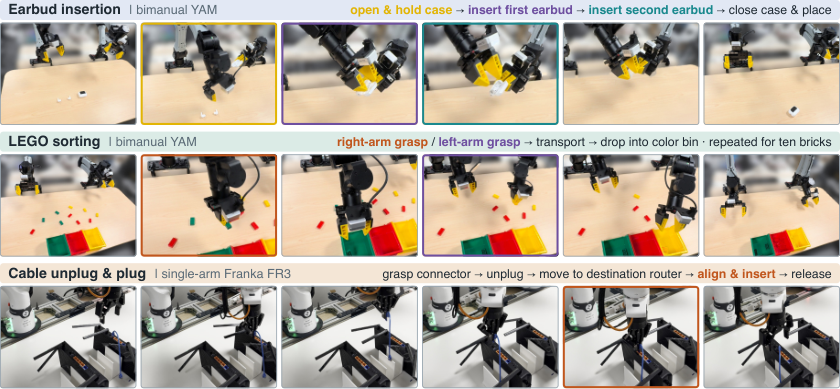
Our experiments address three questions. Q1. Does targeted subtask RL improve a pretrained VLA on complete long-horizon tasks? Q2. Under a matched robot-rollout budget, how does PARTS compare with RL fine-tuning methods that train on the full task? Q3. Does success-reweighted retraining matter? We evaluate PARTS on three long-horizon tasks across two real-robot platforms (Fig. 3 ). Earbud insertion (bimanual YAM).
The robot opens a charging case, holds it in the left gripper, inserts two earbuds with the right arm, and closes the case.
Sources and Demonstrations
Figures are reproduced from Su et al. See the full paper for experimental details and the project page, when the paper links one, for demonstrations and videos.
Related Papers
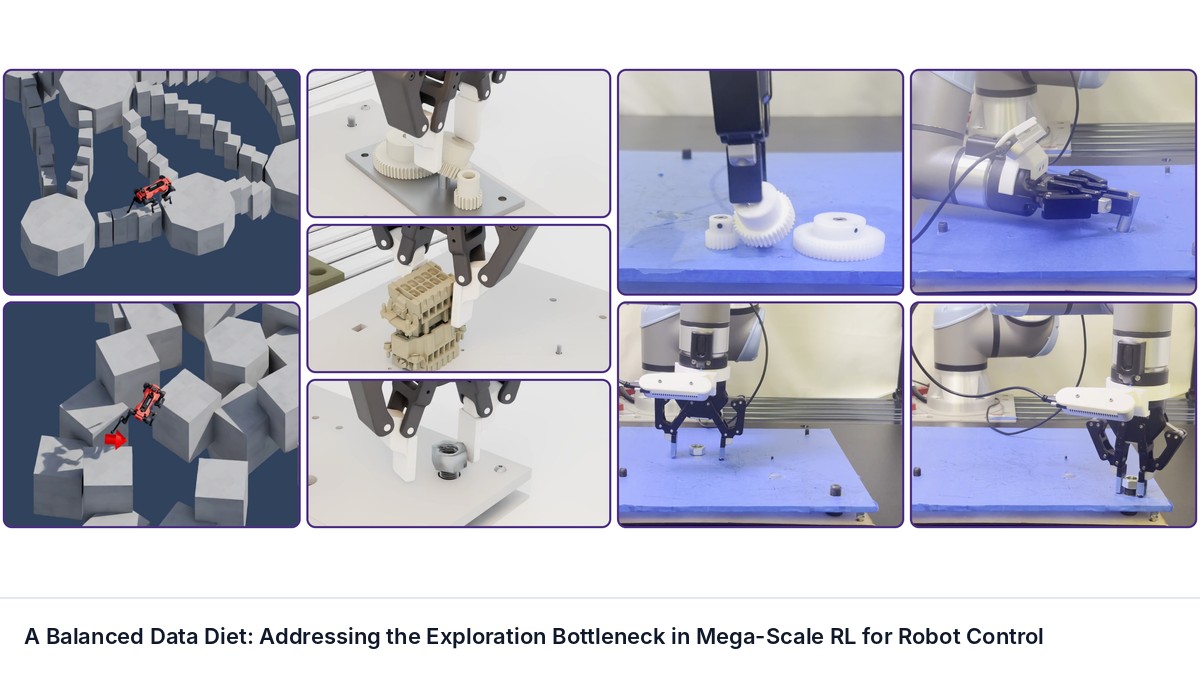
A Balanced Data Diet: Addressing the Exploration Bottleneck in Mega-Scale RL for Robot Control
Octi Zhang, Mateo Guaman Castro, Patrick Yin et al.
General-purpose robots must perform a wide range of tasks from agile locomotion to dexterous manipulation.

A Sim-to-Real Integration Pipeline for Training and Deployment of Chunk-Based VLA Manipulation Policies
Mathilde Kappel, Clémence Grislain, Mohamed Chetouani et al.
Vision-Language-Action (VLA) models have become a prominent paradigm for mapping multimodal inputs, including semantic instructions, visual observations of the scene, and proprioceptive observations, to robot actions.
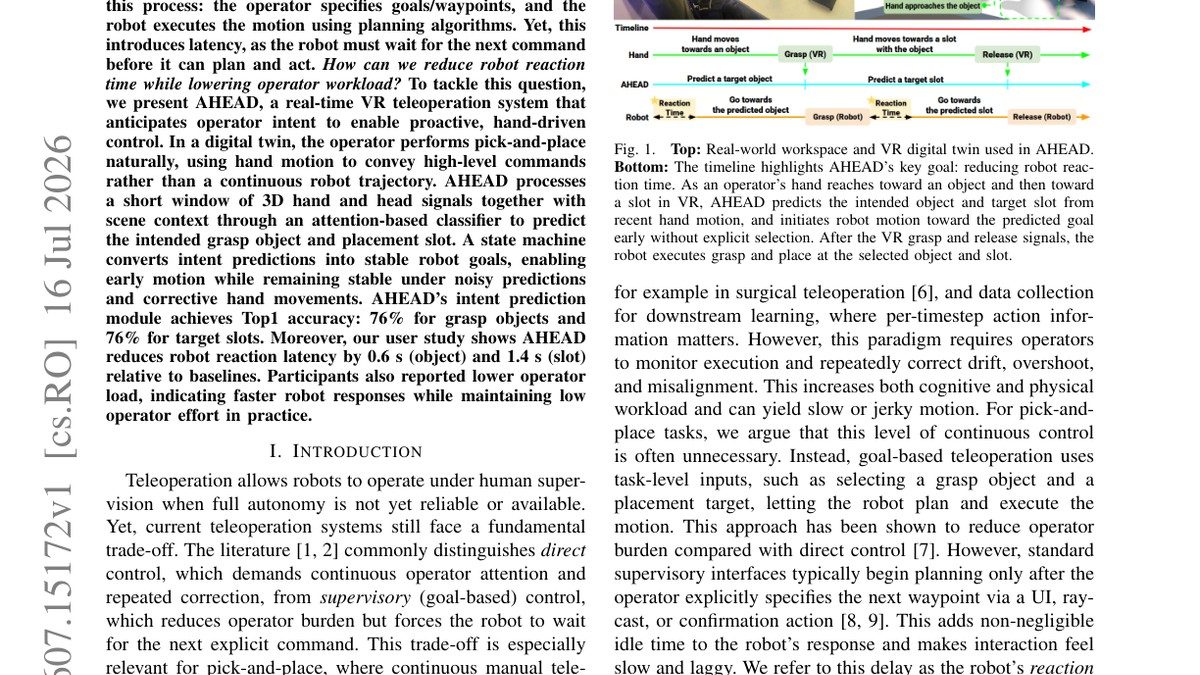
AHEAD: Anticipatory Hand-Driven Teleoperation via Human Intent Prediction
Seok Joon Kim, Junho Lee, Federica Spinola et al.
Direct hand-driven teleoperation maps an operator's hand motion to robot end-effector commands at every frame, enabling precise control, but it requires constant monitoring and correction during approach, grasp, and placement, which can be slow and fatiguing.
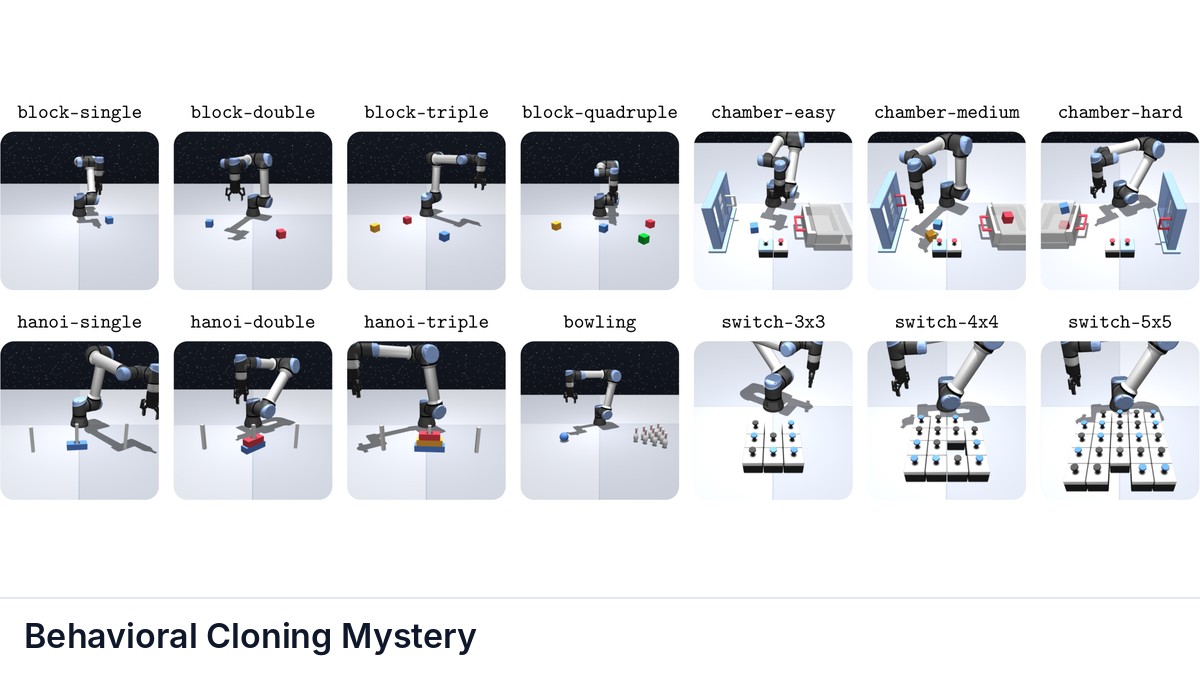
Behavioral Cloning Mystery
Seohong Park, Sergey Levine
Behavioral cloning (BC), despite its simplicity, exhibits many counterintuitive phenomena in the real world. For example, the performance of BC often keeps increasing as the model overfits more to the dataset, and fully closed-loop policies often completely fail without action chunking.