
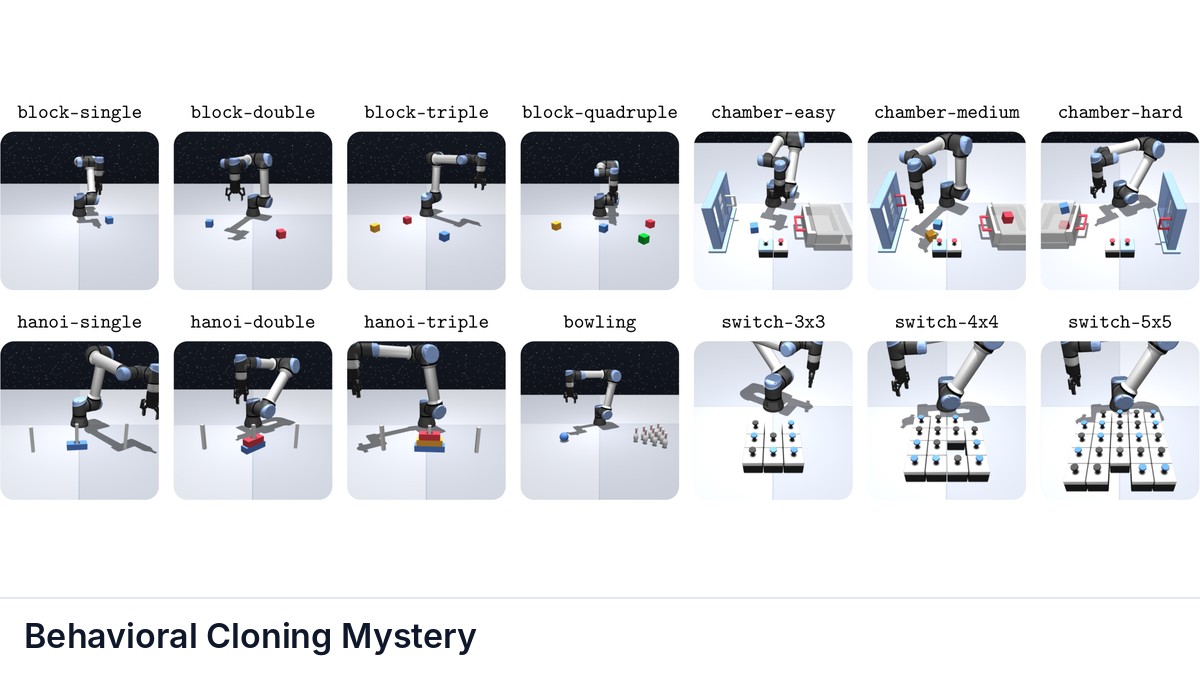
Behavioral Cloning Mystery
Seohong Park, Sergey Levine · N/A · 2026
Framework
N/A
License
N/A
Stars
N/A
Summary
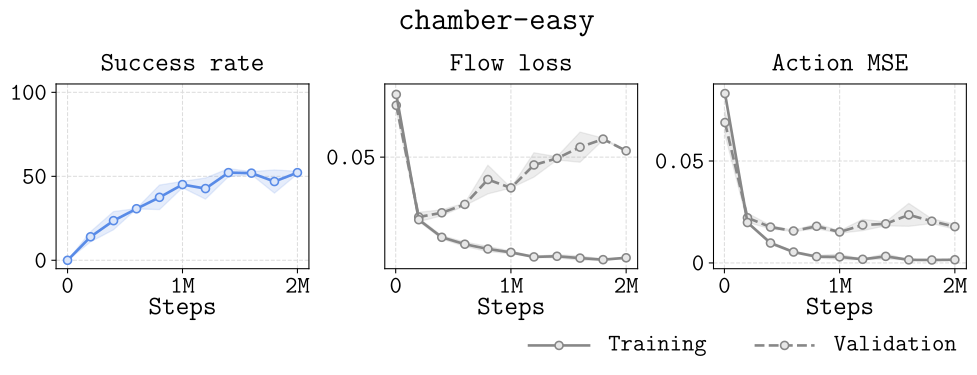
Behavioral cloning (BC), despite its simplicity, exhibits many counterintuitive phenomena in the real world. For example, the performance of BC often keeps increasing as the model overfits more to the dataset, and fully closed-loop policies often completely fail without action chunking.
Abstract Summary
Key Points
- Behavioral cloning (BC), despite its simplicity, exhibits many counterintuitive phenomena in the real world.
- For example, the performance of BC often keeps increasing as the model overfits more to the dataset, and fully closed-loop policies often completely fail without action chunking.
- Unfortunately, properly studying these anecdotal phenomena ("behavioral cloning mysteries") is challenging: in the real world, datasets and experiments are costly and not fully controllable; in simulation with synthetic data, these phenomena are often not easily observed partly due to the discrepancy between scripted policies and human demonstrations.
- In this work, we propose OCBench, a robotic manipulation benchmark with controllable scripted policies that have similar properties to human demonstrations.
- We show that, by mimicking key properties of human demonstrations, OCBench reproduces many anecdotal BC-related phenomena in controlled settings.
Motivation
Behavioral cloning, despite its simplicity, exhibits several counterintuitive phenomena (“mysteries”), especially when using real-world data in robotics and autonomous driving. Below are some of these phenomena that have been anecdotally reported in the literature. Mystery 1: Overfitting is not necessarily bad.
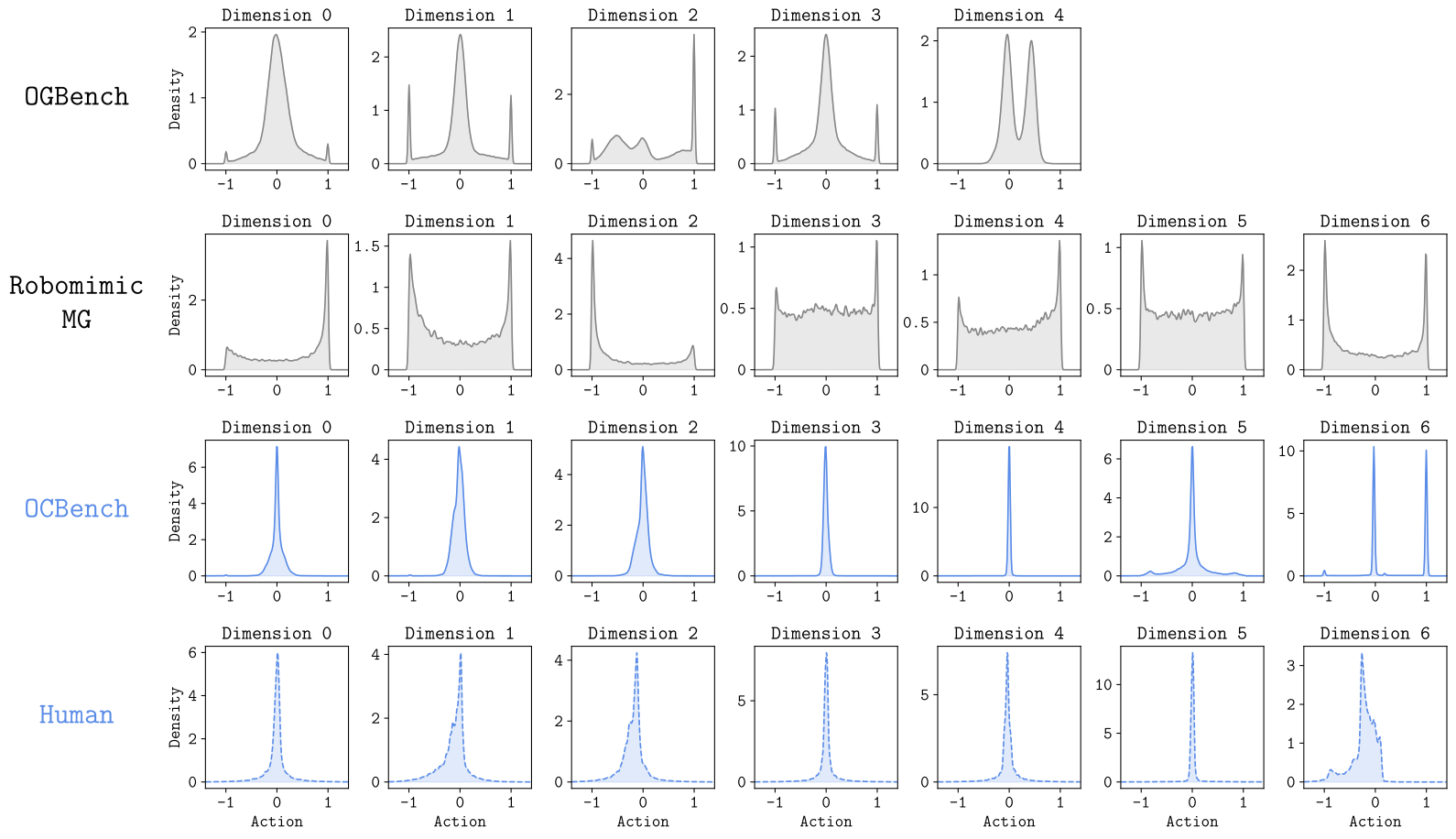
OCBench: A controllable robotic manipulation benchmark
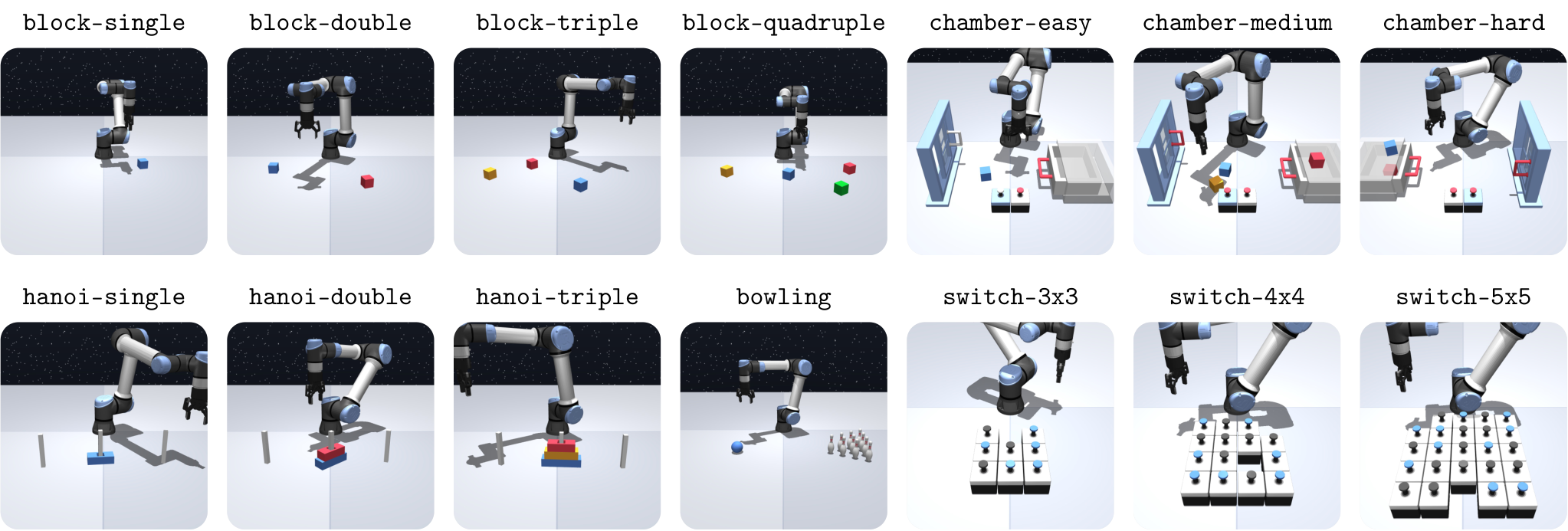
The main goal of OCBench is to provide a diverse set of tasks and datasets generated by controllable scripted policies that have similar structural properties to human demonstrations, so that researchers can scientifically study diverse BC- (and potentially RL-) related phenomena in this benchmark.
Moreover, we aim to implement both the tasks and data-generating scripts of OCBench in GPU-accelerated MuJoCo (MJWarp) to enable highly efficient data generation and simulation.
Studying behavioral cloning in OCBench
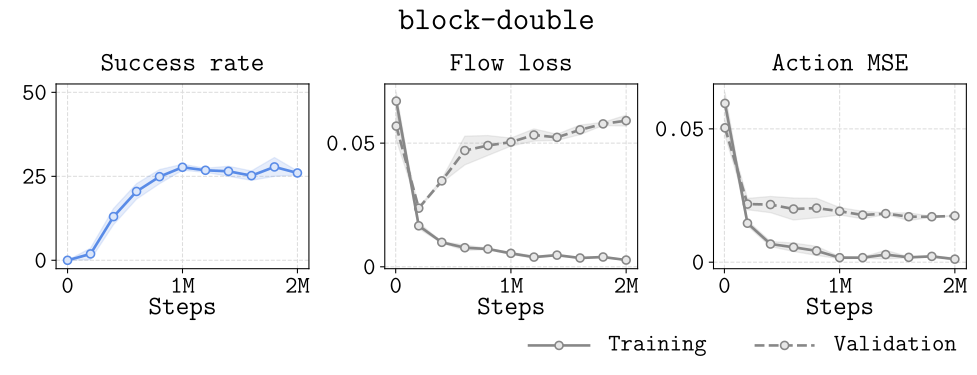
Now, we study the four mysteries mentioned in Section 3 , based on our reproductions in OCBench. Here, our goal is not to completely demystify these phenomena, which we leave for future work on OCBench. Rather, we aim to demonstrate examples of how OCBench’s controlled, GPU-accelerated scripts enable scientific studies of them. Behavioral cloning methodology.
Closing remarks
In this work, we have introduced OCBench, a controllable robotic manipulation benchmark, accompanied by GPU-accelerated scripted policies that have similar structural properties to human demonstrations. Throughout our analyses, we have experimentally shown that OCBench reproduces diverse real-world BC-related phenomena and enables their scientific studies via its controllable and efficient data generation scripts.
Sources and Demonstrations
Figures are reproduced from Park et al. See the full paper for experimental details and the project page, when the paper links one, for demonstrations and videos.
Related Papers

A Sim-to-Real Integration Pipeline for Training and Deployment of Chunk-Based VLA Manipulation Policies
Mathilde Kappel, Clémence Grislain, Mohamed Chetouani et al.
Vision-Language-Action (VLA) models have become a prominent paradigm for mapping multimodal inputs, including semantic instructions, visual observations of the scene, and proprioceptive observations, to robot actions.

Capability-Aware Arbitration for Semantic Intent-Based Shared Control
Zhaoda Du, Michael Bowman, Xiaoli Zhang
Shared control often allocates robot authority based on confidence in inferred human intent, assuming reliable autonomous execution. When this assumption fails, high intent confidence can cause over-helping.
Design and Evaluation of a Touchscreen-Based Teleoperation Interface for Robotic Manipulators
Juan José García Cárdenas, Alperen Kenan, Hamidreza Raei et al.
Intuitive teleoperation interfaces are crucial for the safe and effective operation of robotic manipulators in challenging environments.
Dexterity from Supervised Play
Botao He, Yiming Dou, Yiannis Aloimonos et al.
How can robots autonomously collect the contact-rich experience needed to learn dexterous manipulation?