
Towards Physical Underwater Robotic Assistance for Scuba Diver Movement in Confined Spaces
Demetrious T. Kutzke, Junaed Sattar · N/A · 2026
Framework
N/A
License
N/A
Stars
N/A
Summary
Scuba divers are taught to control their depth to avoid rapid ascents and descents, which could result in serious injuries such as gas embolisms and barotrauma.
Abstract Summary
Key Points
- Scuba divers are taught to control their depth to avoid rapid ascents and descents, which could result in serious injuries such as gas embolisms and barotrauma.
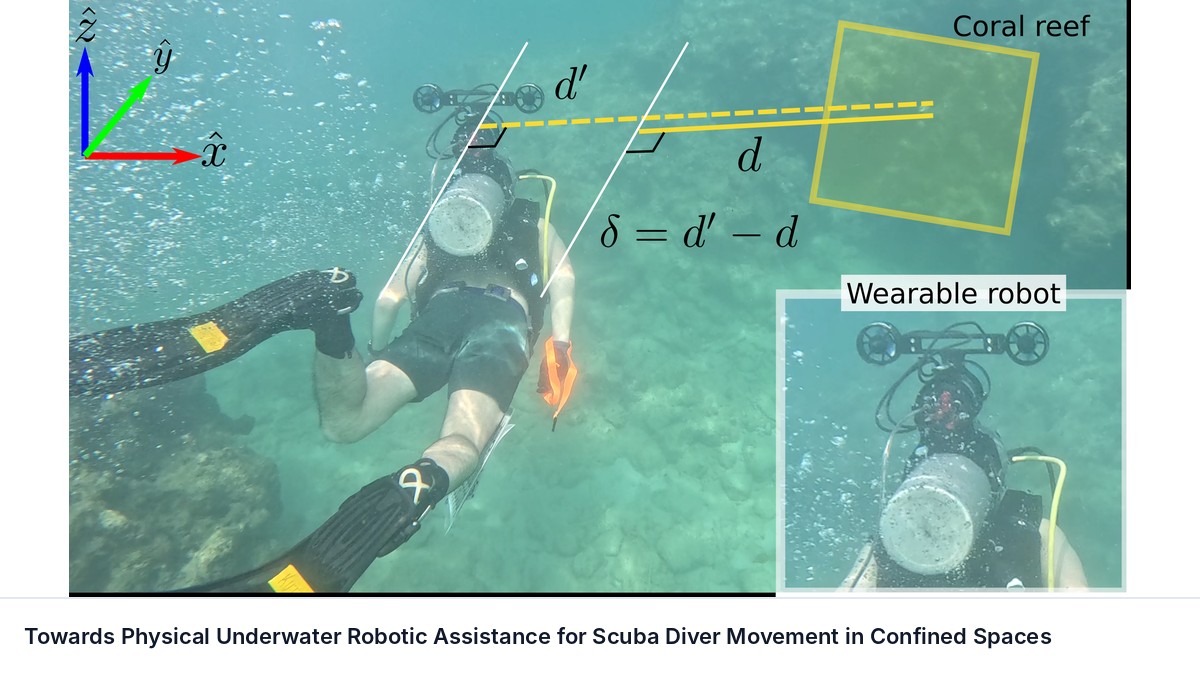
- However, many underwater tasks necessitate lateral control, maintaining distance between subsea structures such as coral reefs, submerged drilling instrumentation, or unexploded ordnance.
- In this work, we discuss a first-of-its-kind wearable robotic solution providing thruster-actuated directional guidance to a diver, as distinct from prior propulsive-assistance exoskeletons.
- We introduce ``Robotic Assisted Diver Movement in Confined Spaces'' (RADMCS), a wearable robot that assists divers in maintaining a fixed distance from subsea structures by leveraging perception techniques in monocular depth estimation and force-feedback from submersible thrusters to provide haptic feedback.
- Its small and compact form factor creates a foundational platform that could be expanded to include more sophisticated control and navigation behaviors.
Literature Review
This work draws from both wearable guidance in haptics, which is the study of navigation using physical perturbation, and physical underwater human-robot interaction. Wearable Guidance and Assistive Technology . Global positioning systems promise precise localization in areas where signals are present.
System Design
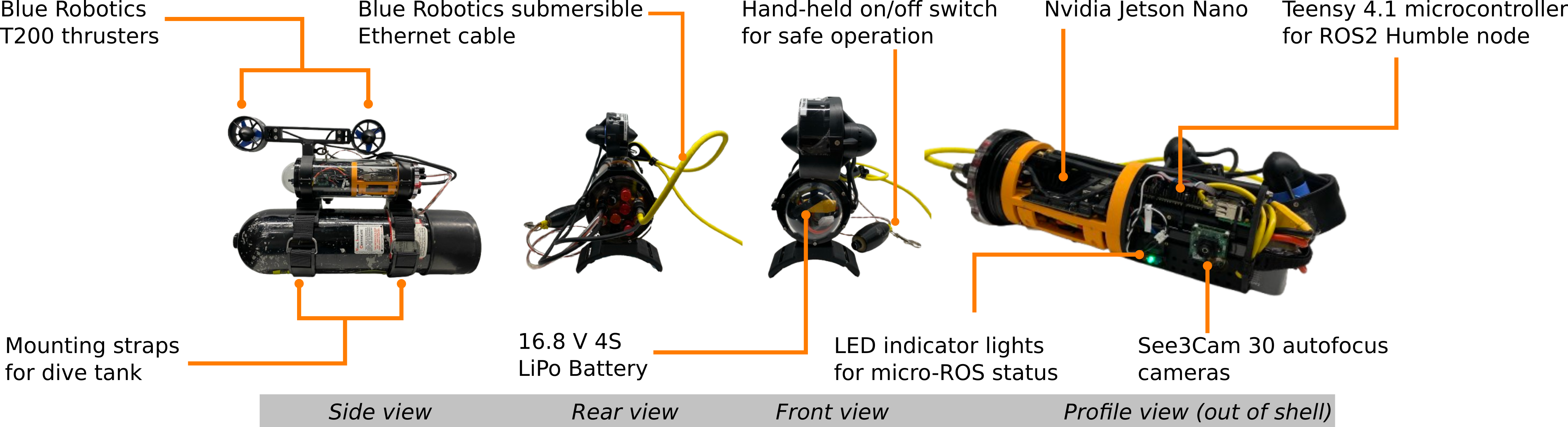
Unlike exoskeletons that attach to the diver’s body directly, the proposed design of the RADMCS robot enables a less invasive integration with existing scuba diving technology. Namely, the RADMCS robot mounts onto the diver’s scuba tank using strapping mechanisms already employed by open-water scuba divers.
The design comprises two primary components: the external assembly, which has the mechanism for strapping to the diver; and the internal assembly, which houses the electronics subassembly and sensing technology. Fig.
Visual Control Methodology
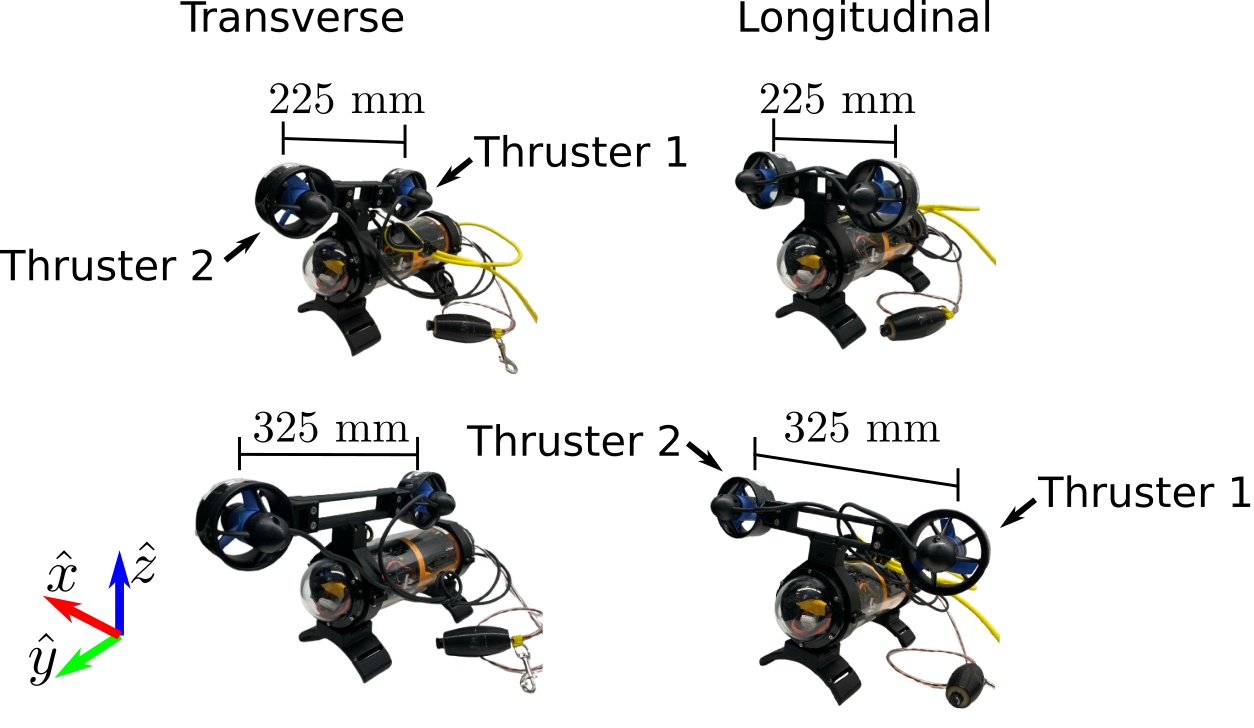
We employ a linear control algorithm with saturation to limit our thruster outputs after a certain distance. Alg. 1 outlines the pseudocode for the control algorithm. The goal of the algorithm is to produce thruster PWM values in microseconds for $T1$ and $T2$. Let $I$ be an image of arbitrary dimensions.
Our control algorithm computes the distance $d^{i}$ between the camera and the target using the FindDistance function. A target can be any specific object or feature from which the algorithm can extract distance.
Human Study Evaluations
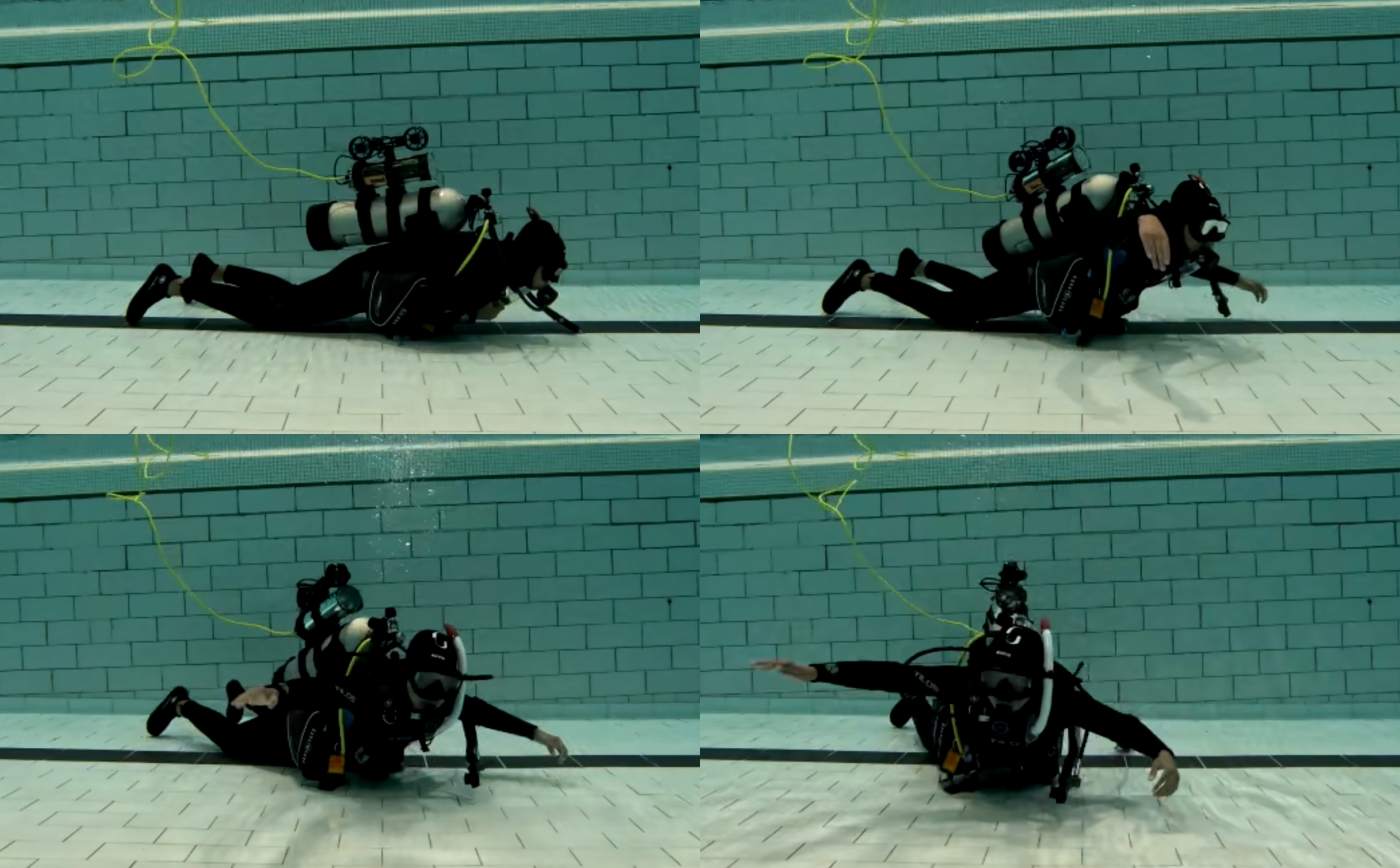
Under Institutional Review Board (IRB) approval, we conducted in-water human studies to evaluate the RADMCS system. Eight people with varying levels of scuba diving experience participated in a variety of in-water experiments to gauge TS and single-sided distance-maintaining wall following.
While the number of participants is lower compared to terrestrial haptics studies (see [ 7 ] which used $12$ participants), conducting underwater human studies creates a significant barrier to entry compared to its terrestrial counterpart.
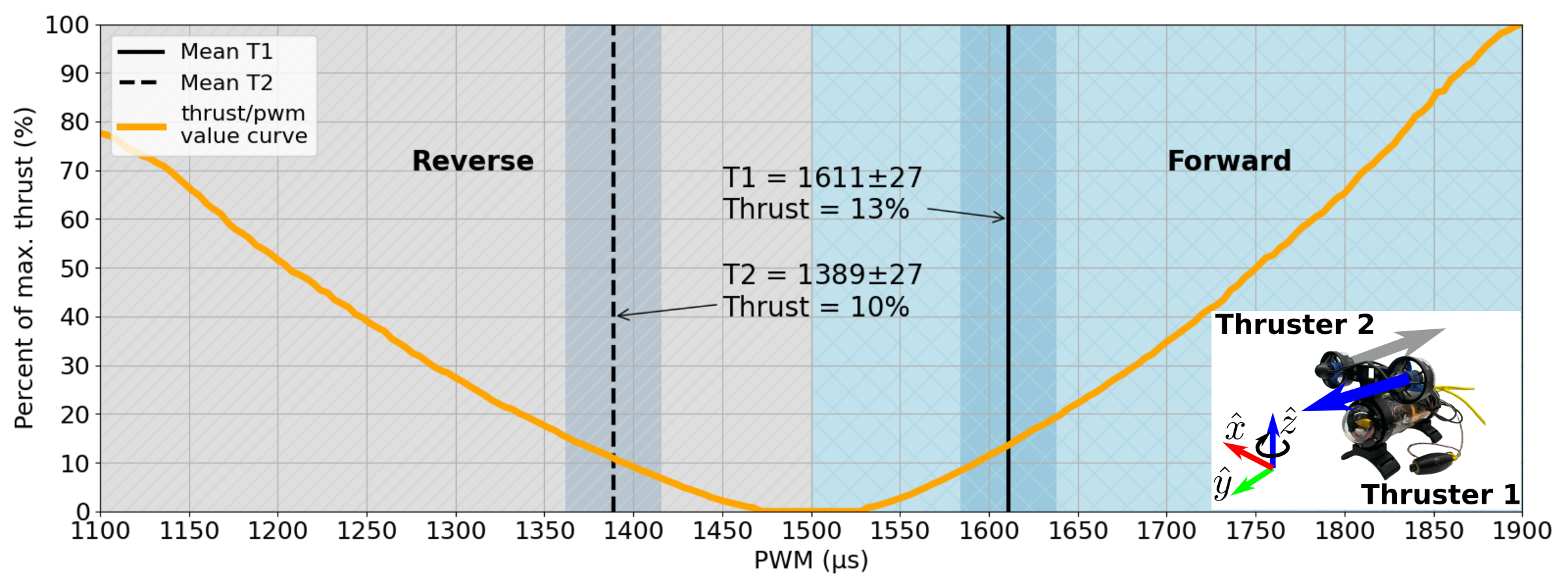
Sources and Demonstrations
Figures are reproduced from Kutzke et al. See the full paper for experimental details and the project page, when the paper links one, for demonstrations and videos.
Related Papers
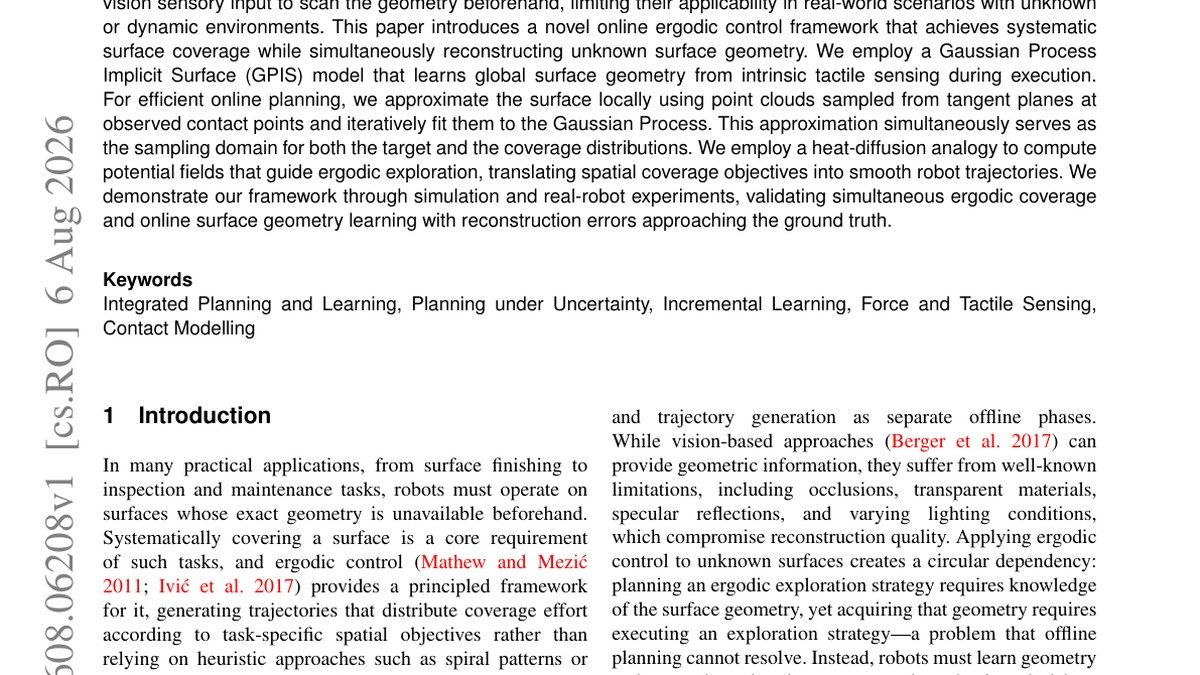
ErgoSurf: Ergodic Control for the Coverage of Unknown Surfaces
Stefan Schneyer, Timo Bachmann, Maged Iskandar et al.
Contact-centric tasks on surfaces, ranging from inspection and cleaning to sanding and polishing, require robots to systematically cover the surface while maintaining stable contact.
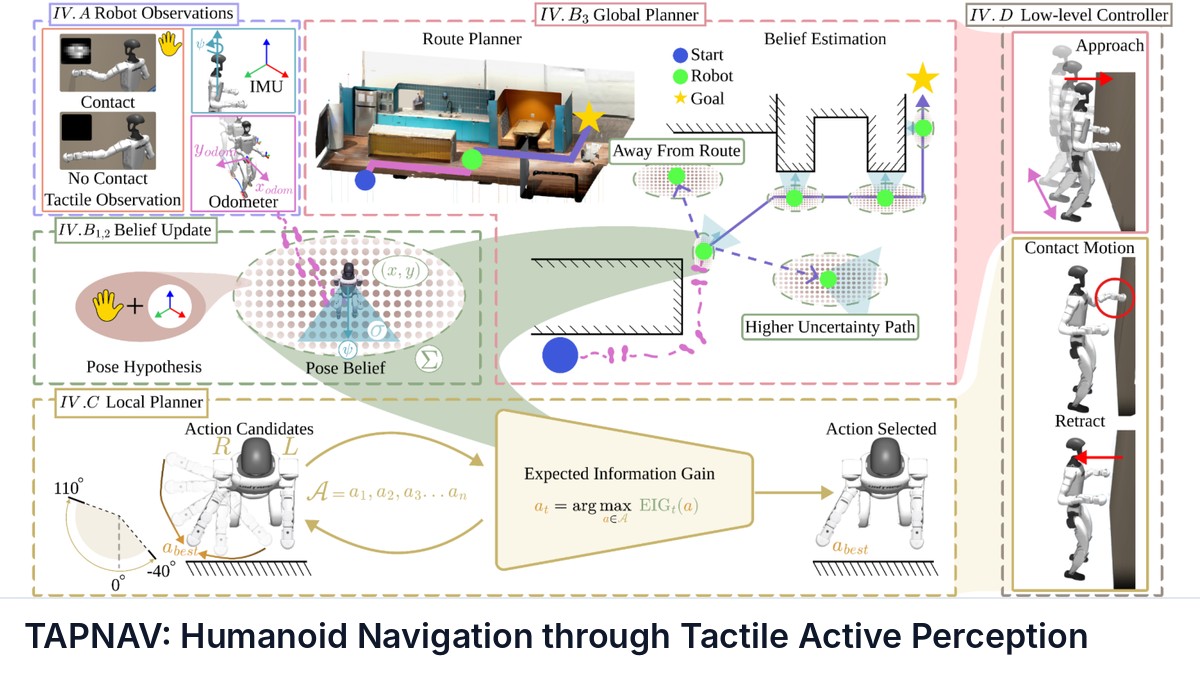
TAPNAV: Humanoid Navigation through Tactile Active Perception
Huaze Liu, Zhenyu Wu, Jaehwi Jang et al.
Navigation in vision-denied environments is challenging for humanoid robots because proprioceptive odometry drifts and localization uncertainty accumulates rapidly.
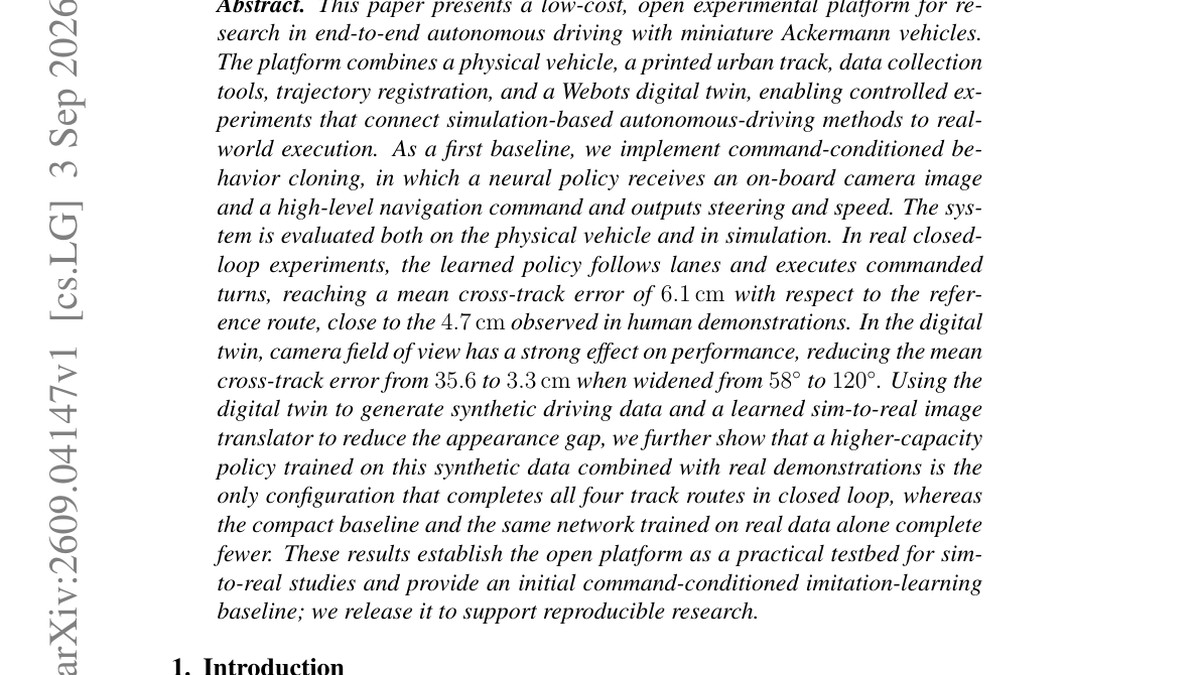
A Low-Cost, Open Platform for End-to-End Autonomous Driving on a Miniature Ackermann Vehicle
Gustavo Claudio Karl Couto, Eric Aislan Antonelo, Gabriel George Zipperer
This paper presents a low-cost, open experimental platform for research in end-to-end autonomous driving with miniature Ackermann vehicles.
Adaptation Needs in Robotic Systems: Assessing Behavior Trees and Their Enhancement
Mehran Rostamnia, Gianluca Filippone, Ricardo Caldas et al.
Robotic systems increasingly operate in dynamic, uncertain, and open-ended environments, where design-time assumptions may no longer hold, and adaptation becomes necessary to maintain effective and safe operation.