
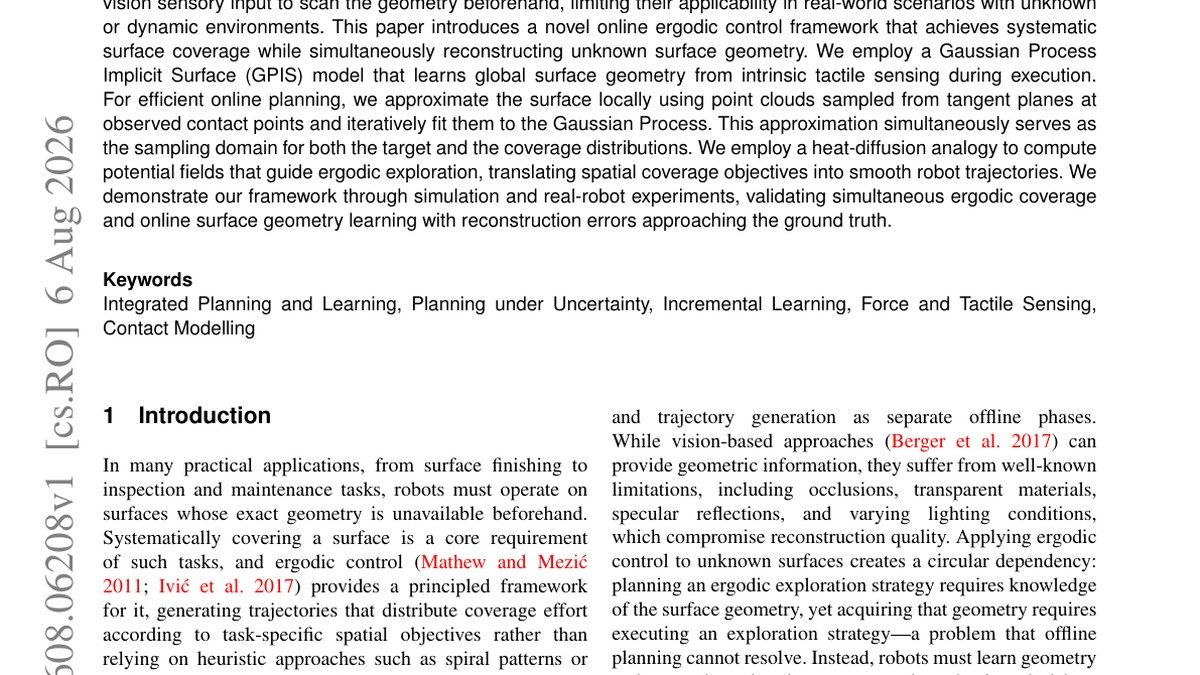
ErgoSurf: Ergodic Control for the Coverage of Unknown Surfaces
Stefan Schneyer, Timo Bachmann, Maged Iskandar, Korbinian Nottensteiner, Alin Albu-Schäffer, Freek Stulp, João Silvério · N/A · 2026
Framework
N/A
License
N/A
Stars
N/A
Summary
Contact-centric tasks on surfaces, ranging from inspection and cleaning to sanding and polishing, require robots to systematically cover the surface while maintaining stable contact.
Abstract Summary
Key Points
- Contact-centric tasks on surfaces, ranging from inspection and cleaning to sanding and polishing, require robots to systematically cover the surface while maintaining stable contact.
- Ergodic control generates trajectories that spend time at a location proportional to a desired, task-specific spatial distribution, enabling efficient information gathering and coverage.
- However, traditional ergodic control methods rely on prior knowledge of surface geometry or require a vision sensory input to scan the geometry beforehand, limiting their applicability in real-world scenarios with unknown or dynamic environments.
- This paper introduces a novel online ergodic control framework that achieves systematic surface coverage while simultaneously reconstructing unknown surface geometry.
- We employ a Gaussian Process Implicit Surface (GPIS) model that learns global surface geometry from intrinsic tactile sensing during execution.
Proposed Approach
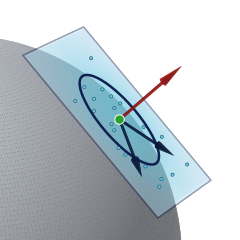
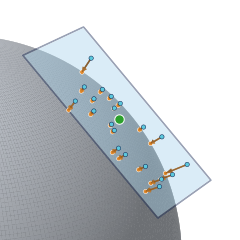
This section presents ErgoSurf, our ergodic control approach on surfaces with unknown geometry. Let $\Omega\subset\mathbb{R}^{3}$ denote the domain space of interest (see Fig. 3 ), and let the agent’s task space be represented as the surface set $\mathcal{S}\subset\Omega$.
For in-contact tasks, $\mathcal{S}$ comprises all feasible contact points within $\Omega$, constraining the robot’s motion to this subset during environment interaction.
Experiments and Results
We validate the proposed framework through simulation and real-world experiments with a single agent, demonstrating simultaneous surface reconstruction and ergodic coverage of unknown surfaces without prior geometric knowledge. The bunny, chair, and backpanel experiments are shown in the supplementary video. We assess performance using three different metrics across the experiments.
The ergodic cost $\epsilon_{k}$ ( 10 ) quantifies coverage quality relative to the target distribution.
Sources and Demonstrations
Figures are reproduced from Schneyer et al. See the full paper for experimental details and the project page, when the paper links one, for demonstrations and videos.
Related Papers
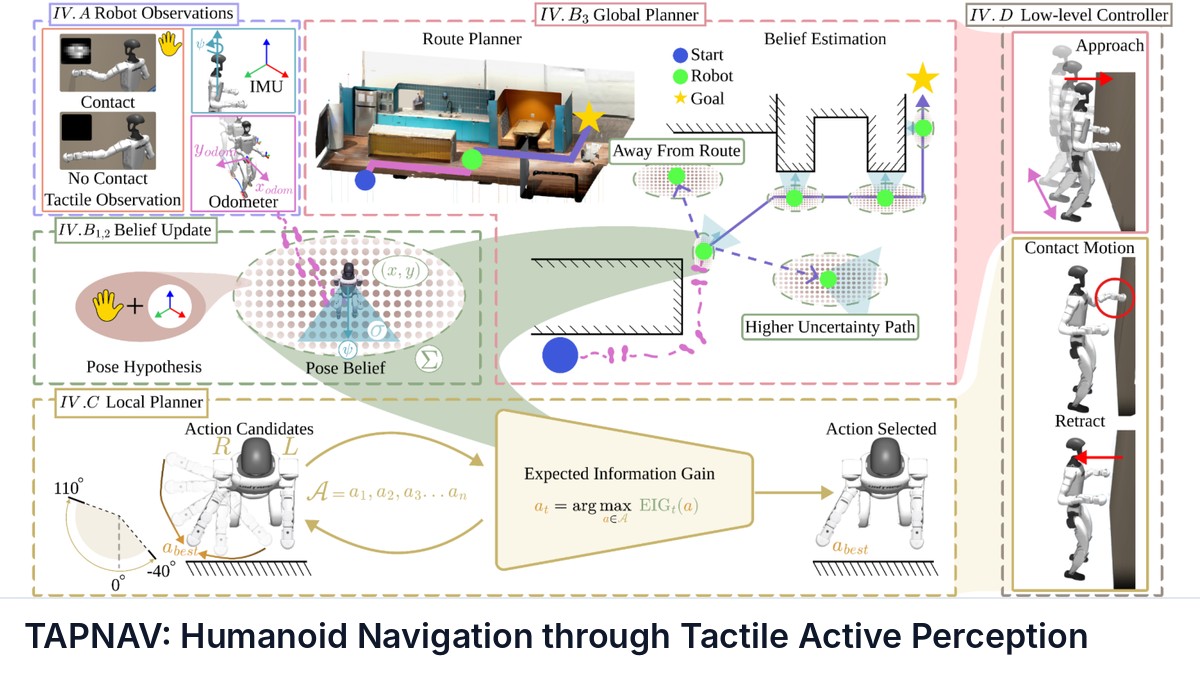
TAPNAV: Humanoid Navigation through Tactile Active Perception
Huaze Liu, Zhenyu Wu, Jaehwi Jang et al.
Navigation in vision-denied environments is challenging for humanoid robots because proprioceptive odometry drifts and localization uncertainty accumulates rapidly.
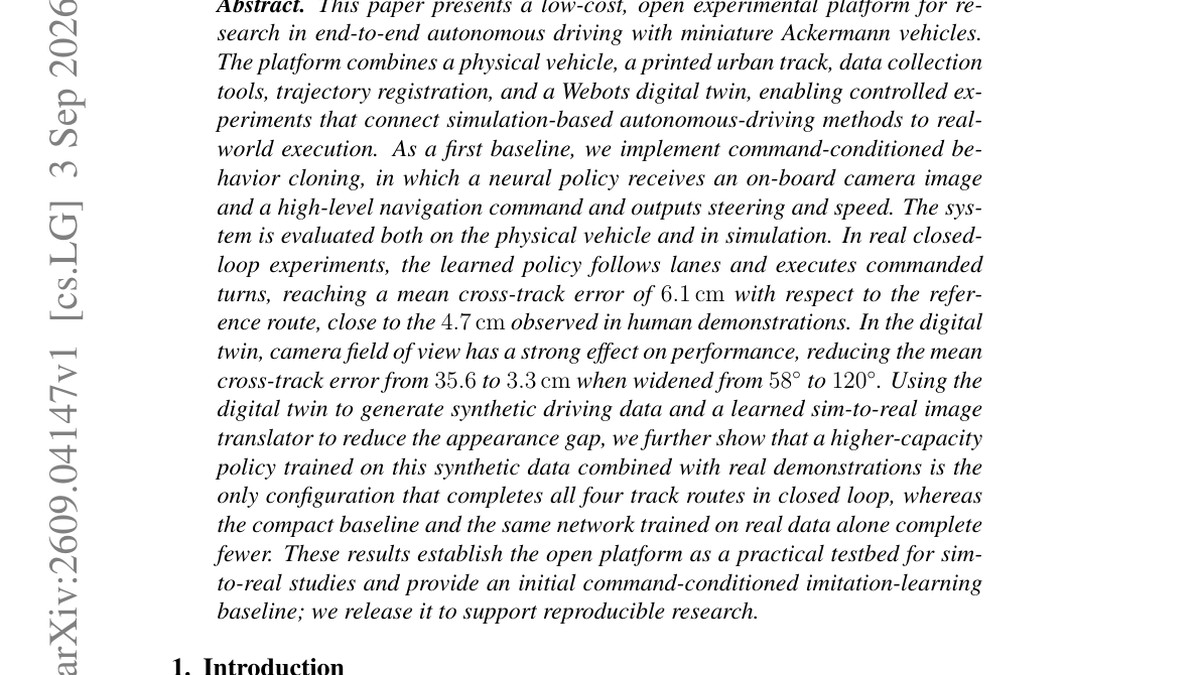
A Low-Cost, Open Platform for End-to-End Autonomous Driving on a Miniature Ackermann Vehicle
Gustavo Claudio Karl Couto, Eric Aislan Antonelo, Gabriel George Zipperer
This paper presents a low-cost, open experimental platform for research in end-to-end autonomous driving with miniature Ackermann vehicles.

Aim Short to Reach Far: Your Frozen World Model Can Plan Better Than You Think
Xvyuan Liu, Jianjie Fang, Chen Gao et al.
Planners built on visual world models commonly score each predicted outcome by its distance to the encoded goal image. We show that this target can limit control even with exact dynamics and globally optimal short-horizon search: reaching a goal may require actions that initially move away from it.
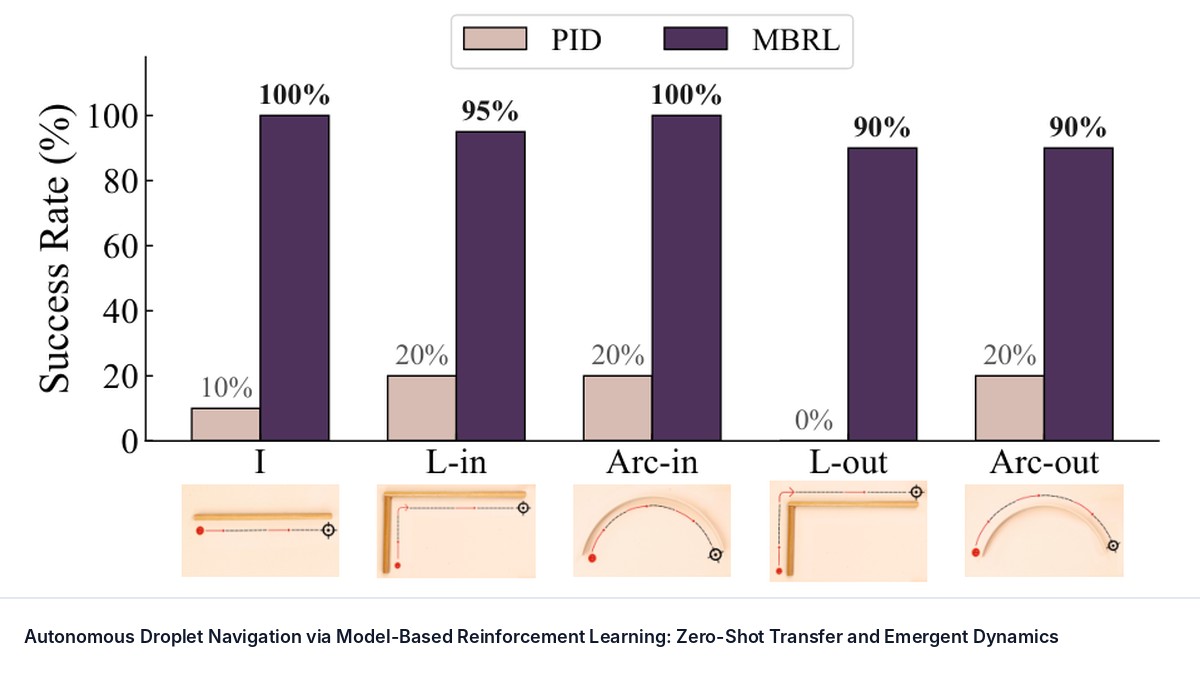
Autonomous Droplet Navigation via Model-Based Reinforcement Learning: Zero-Shot Transfer and Emergent Dynamics
Rajneesh Anand, Mayuresh V. Kothare
Self-driving laboratories (SDLs) are transforming chemical and materials discovery through closed-loop automation, yet automated infrastructure for physical manipulation of soft, deformable matter remains beyond current robotic platforms.