
TAPNAV: Humanoid Navigation through Tactile Active Perception
Huaze Liu, Zhenyu Wu, Jaehwi Jang, Junjie Sheng, Andrew Collins, Aaron Xie, Zhaoyuan Gu, Kaijie Zhu, Ding Jiang, Kevin Cai, Ye Zhao · N/A · 2026
Framework
N/A
License
N/A
Stars
N/A
Summary
Navigation in vision-denied environments is challenging for humanoid robots because proprioceptive odometry drifts and localization uncertainty accumulates rapidly.
Abstract Summary
Key Points
- Navigation in vision-denied environments is challenging for humanoid robots because proprioceptive odometry drifts and localization uncertainty accumulates rapidly.
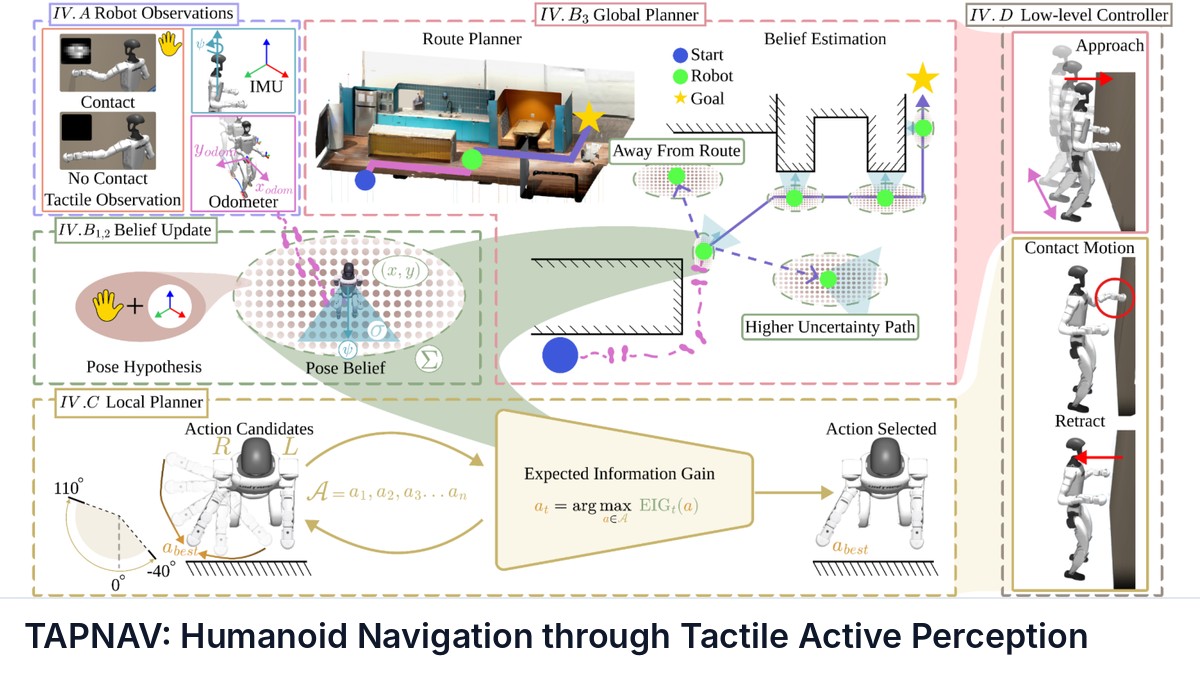
- We present TAPNAV, a tactile active-perception framework that enables humanoid navigation toward a goal by actively probing surrounding structures without relying on vision.
- TAPNAV maintains a pose belief from odometry, IMU, and tactile contact observations, and couples uncertainty-aware global route planning with information-gain-driven local probing.
- The global planner searches for routes that keep predicted localization uncertainty bounded by exploiting opportunities for tactile correction, while the local planner selects probe actions that maximize expected information gain.
- A whole-body controller coordinates the humanoid's locomotion and end-effector contact to execute the planned navigation and probe motions.
System Overview
We formulate the problem as a vision-denied humanoid navigation task on a known and static map $M$. The robot starts from a known initial state $\mathbf{x}_{0}$, its state at time $t$ is represented by $\mathbf{x}_{t}=(p^{x}_{t},p^{y}_{t},\psi_{t})\in\mathrm{SE}(2)$ . We localize the robot using odometry, an IMU-based heading estimate, and tactile contact with mapped surface.
The goal is to reach a target region $\mathcal{X}_{g}$ while balancing route progress with active tactile probing to control localization uncertainty.
Method
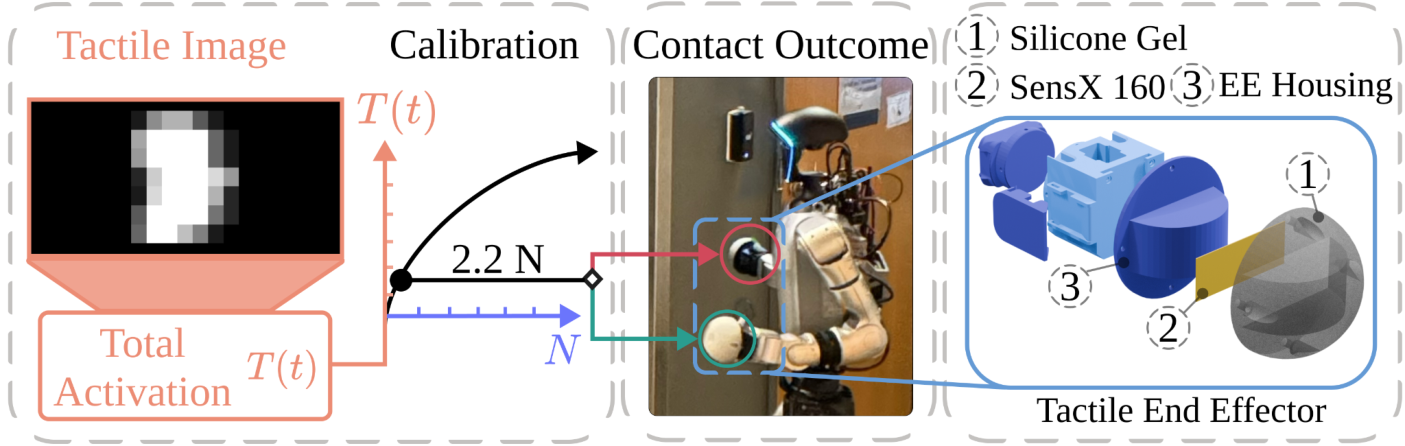
The Unitree G1 is equipped with custom tactile end-effectors to detect contact with the environment, as shown in Fig. 3 . Each end-effector integrates a TouchTronix SensX 160 tactile sensor covered by a silicone pad made from Ecoflex 00-50 [ 22 ] . The SensX 160 consists of a $20\times 8$ taxel array with an active sensing area of $20\times 50$ mm and a force range of up to 100 N.
The sensor is mounted on a curved, rigid housing to enable contact sensing across a range of approach angles.
Experiments
We evaluate TapNav in simulation and on a Unitree G1 humanoid using the parameters in Table I . The experiments address three questions: Q1 : Does TapNav provide reliable and safely bounded state estimation throughout navigation across different maps? Q2 : How accurately does the low-level controller adjust the robot’s position throughout navigation? Q3 : Can TapNav perform reliably in real-world navigation tasks?
All simulation experiments are conducted in MuJoCo. To address Q1 , TapNav is evaluated on four layouts in Fig.
Sources and Demonstrations
Figures are reproduced from Liu et al. See the full paper for experimental details and the project page, when the paper links one, for demonstrations and videos.
Related Papers
DUET: Decoupled Upper- and Lower-Body Execution for Task-Agnostic Humanoid Loco-Manipulation
Kapalik Khanal, Biswash Khatiwada, Stephen Afrifa et al.
Changing a humanoid robot's manipulation policy should not require retraining the controller that maintains the robot's balance.
ErgoSurf: Ergodic Control for the Coverage of Unknown Surfaces
Stefan Schneyer, Timo Bachmann, Maged Iskandar et al.
Contact-centric tasks on surfaces, ranging from inspection and cleaning to sanding and polishing, require robots to systematically cover the surface while maintaining stable contact.
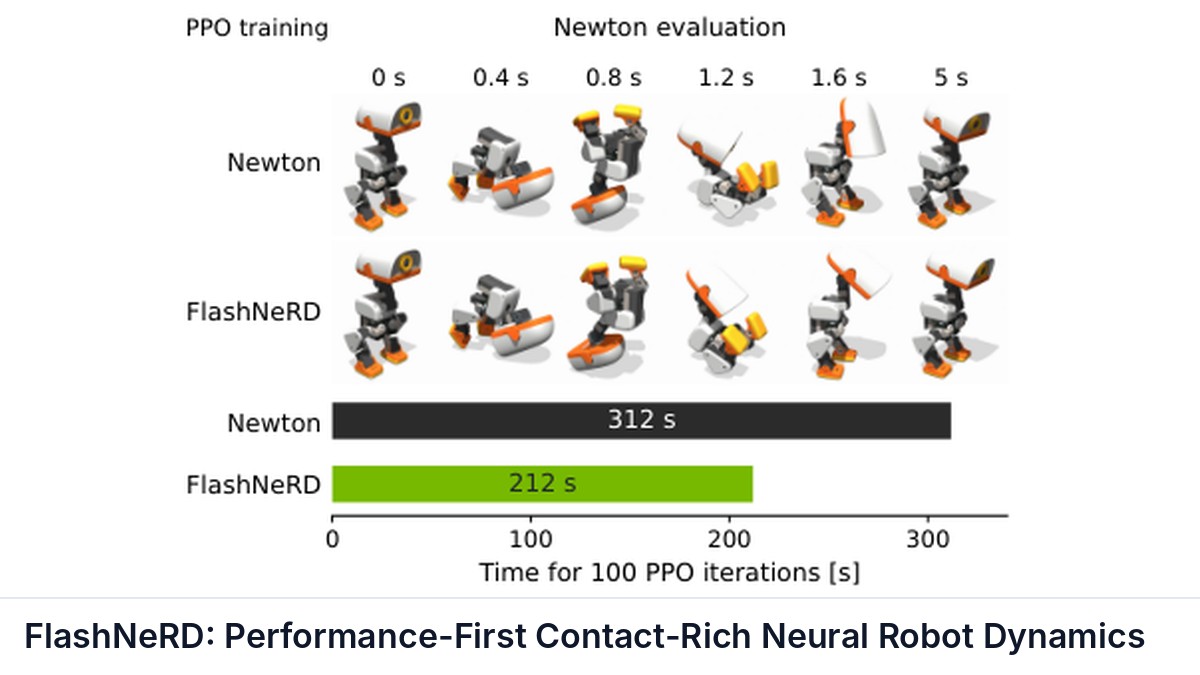
FlashNeRD: Performance-First Contact-Rich Neural Robot Dynamics
Mohammadmehdi Ataei, Mohammad Amin Nabian, Jie Xu et al.
Compared with analytical physics, learned dynamics models promise robot simulation that is faster, inherently differentiable, and easily adaptable to real data.
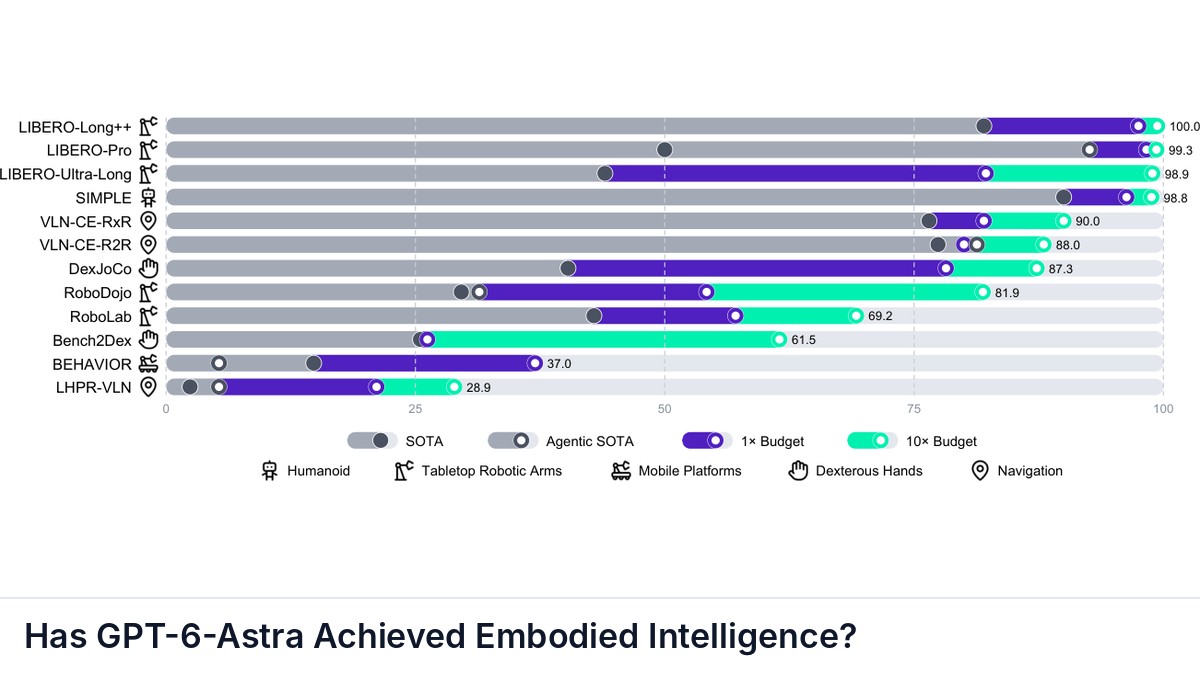
Has GPT-6-Astra Achieved Embodied Intelligence?
SenseNova, Joint Research Team, : et al.
GPT-6-Astra demonstrates a level of competence in robotic manipulation and navigation that challenges the conventional paradigm of building specialized models for individual tasks and embodiments.