
FlashNeRD: Performance-First Contact-Rich Neural Robot Dynamics
Mohammadmehdi Ataei, Mohammad Amin Nabian, Jie Xu, Miles Macklin, Yashraj Narang, Eric Heiden, Octi Zhang, Yunrong Guo, Ruben D'Sa, Oliver Hennigh, Gavriel State, Sanjay Choudhry · N/A · 2026
Framework
N/A
License
N/A
Stars
N/A
Summary
Compared with analytical physics, learned dynamics models promise robot simulation that is faster, inherently differentiable, and easily adaptable to real data.
Abstract Summary
Key Points
- Compared with analytical physics, learned dynamics models promise robot simulation that is faster, inherently differentiable, and easily adaptable to real data.
- Neural Robot Dynamics (NeRD) pursues this by keeping collision detection analytical and replacing a simulator's numerical dynamics for the robot with a learned model.
- Three limitations remain
- NeRD offers little speedup over the simulator it learned from, accepts contact only at predefined points, and has no two-way coupling with objects it manipulates.
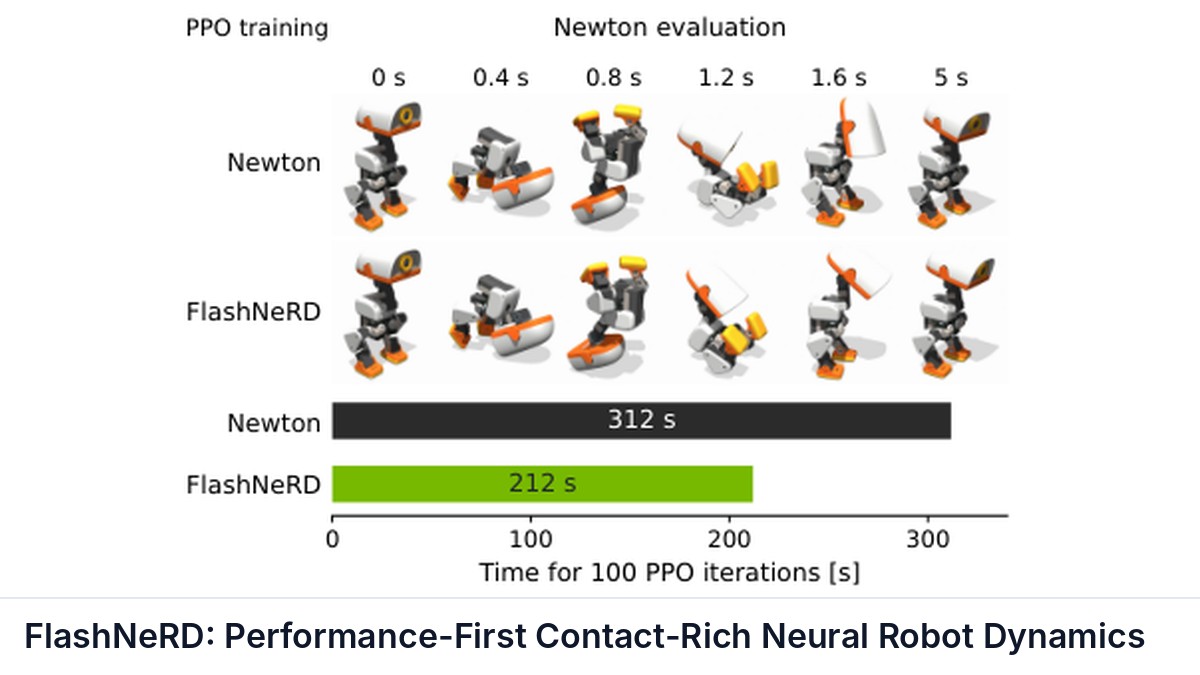
- FlashNeRD removes all three with a parallel streaming architecture that makes each prediction faster and more accurate, an encoder that accepts contacts wherever they occur, and two-way coupling with objects simulated by analytical solvers.
Method
FlashNeRD has three components, one per limitation above, all built on the shared transition-learning problem of Sec. III-A . The first is a transformer that evaluates attention and feedforward branches in parallel within each block and caches past keys and values, so each rollout step encodes only the newest frame (Secs. III-B and III-C ).
The second is a contact encoder that accepts contacts wherever the collision detector finds them (Sec. III-D ).
Results
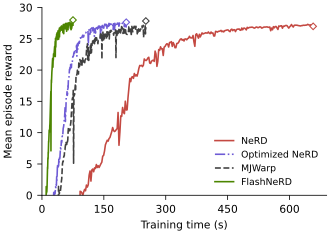
NeRD has already shown zero-shot sim-to-real transfer and fine-tuning on real data [ 4 ] , so the experiments below focus on what FlashNeRD adds. Section IV-A measures the transition model alone, Secs. IV-B and IV-C place it inside policy learning and planning, and Sec. IV-D couples it to an analytically simulated object.
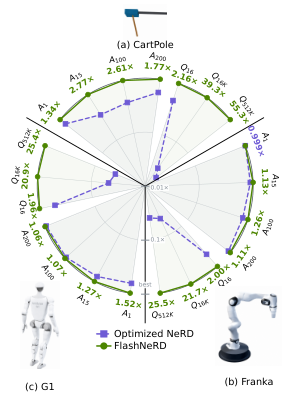
We show that FlashNeRD increases model-only inference throughput while improving prediction accuracy over recursive rollouts, where predictions become inputs and errors compound.
Sources and Demonstrations
Figures are reproduced from Ataei et al. See the full paper for experimental details and the project page, when the paper links one, for demonstrations and videos.
Related Papers
Has GPT-6-Astra Achieved Embodied Intelligence?
SenseNova, Joint Research Team, : et al.
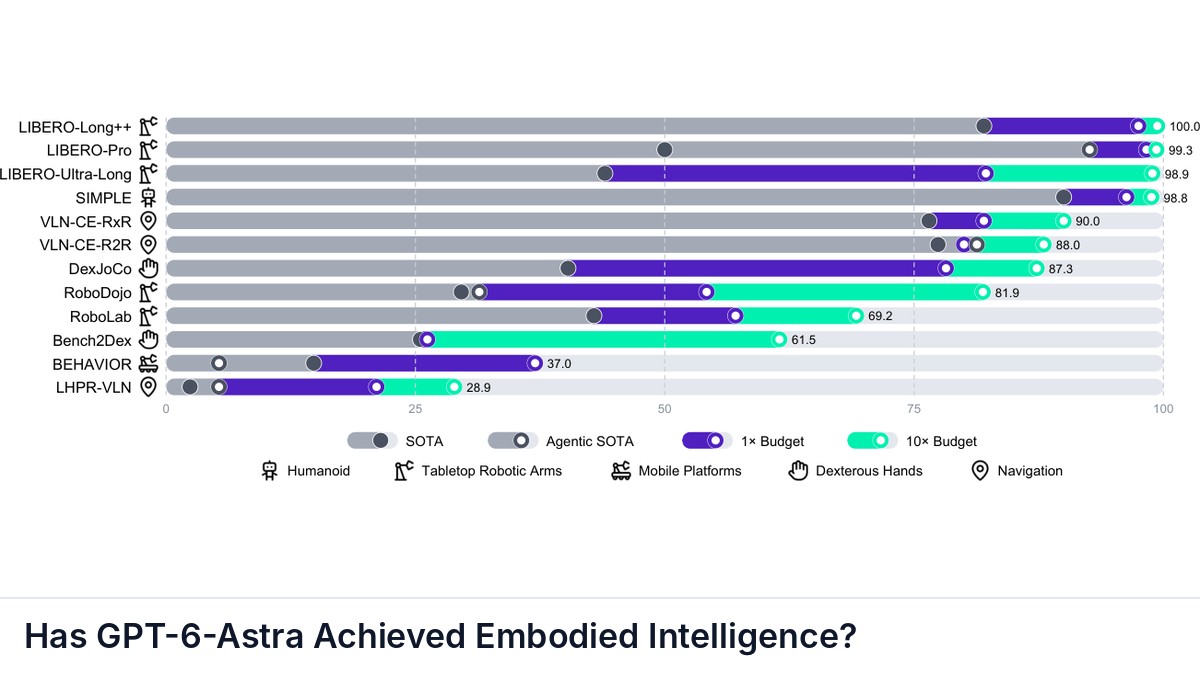
GPT-6-Astra demonstrates a level of competence in robotic manipulation and navigation that challenges the conventional paradigm of building specialized models for individual tasks and embodiments.
TACET: Context-Appropriate Acoustic-Social Navigation for Quadrupeds
Sungsan Park, Young-Sik Shin, Sanghyun Kim
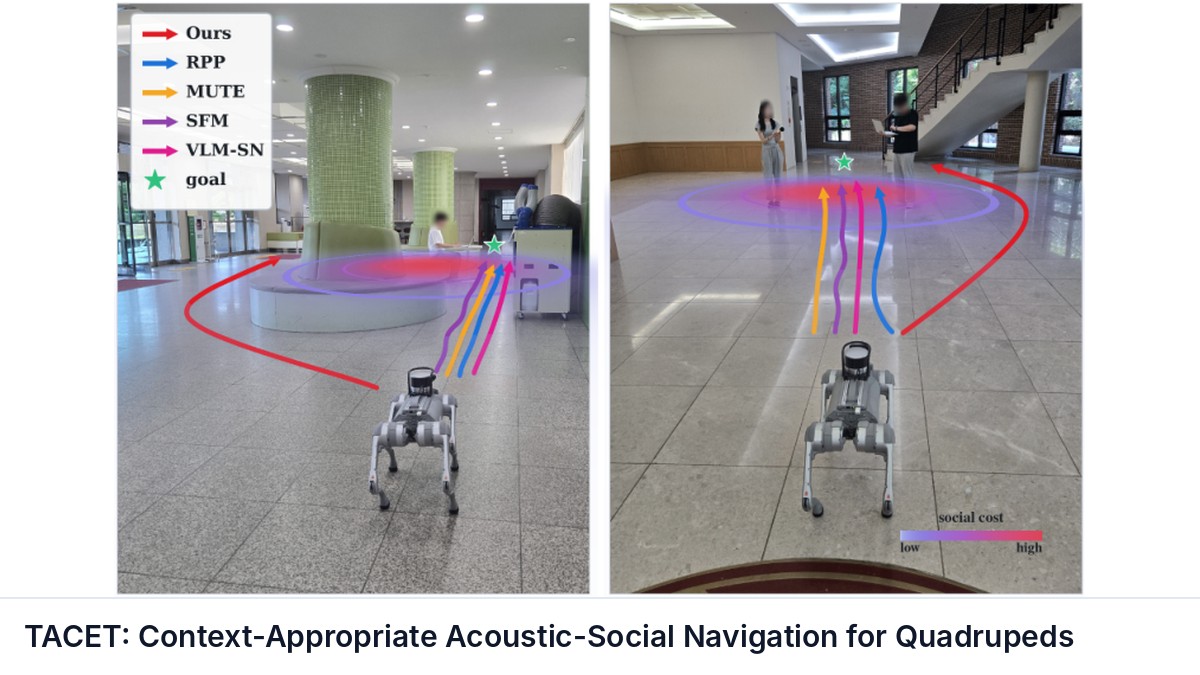
Quadruped robots entering hospitals, care homes, and quiet offices must be context-appropriate not only in where they move but in how loudly they move: a legged robot's locomotion noise, dominated by foot-ground impacts, is itself a social variable.
TAPNAV: Humanoid Navigation through Tactile Active Perception
Huaze Liu, Zhenyu Wu, Jaehwi Jang et al.
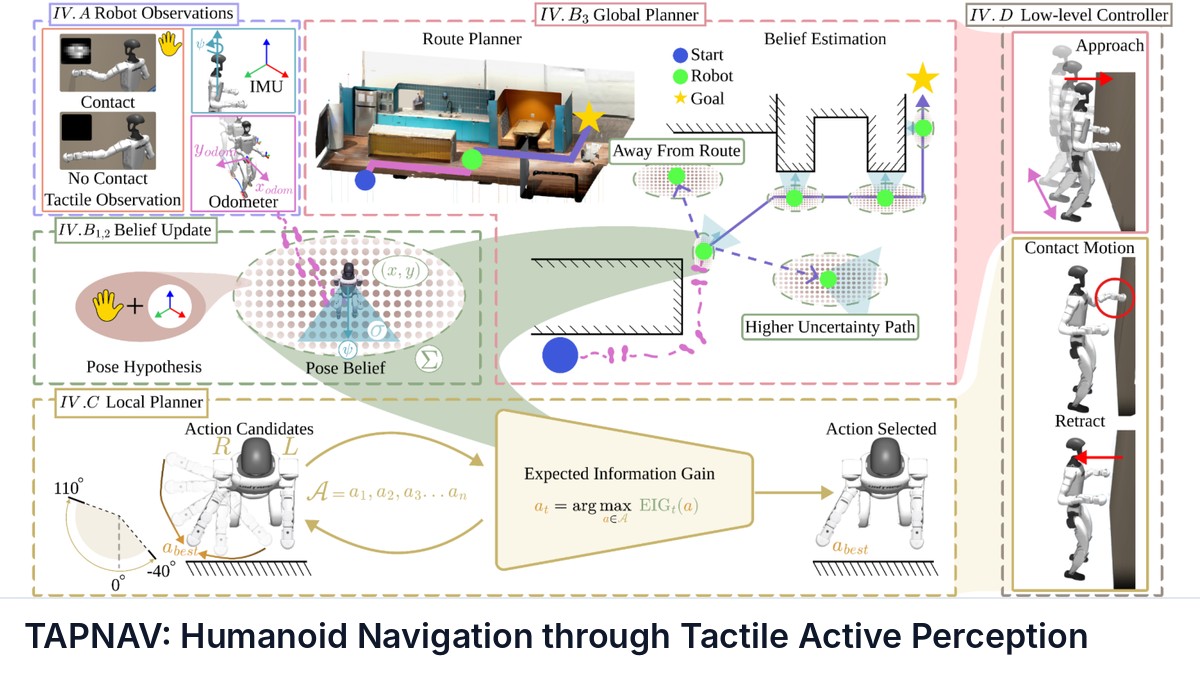
Navigation in vision-denied environments is challenging for humanoid robots because proprioceptive odometry drifts and localization uncertainty accumulates rapidly.
A Low-Cost, Open Platform for End-to-End Autonomous Driving on a Miniature Ackermann Vehicle
Gustavo Claudio Karl Couto, Eric Aislan Antonelo, Gabriel George Zipperer
This paper presents a low-cost, open experimental platform for research in end-to-end autonomous driving with miniature Ackermann vehicles.