
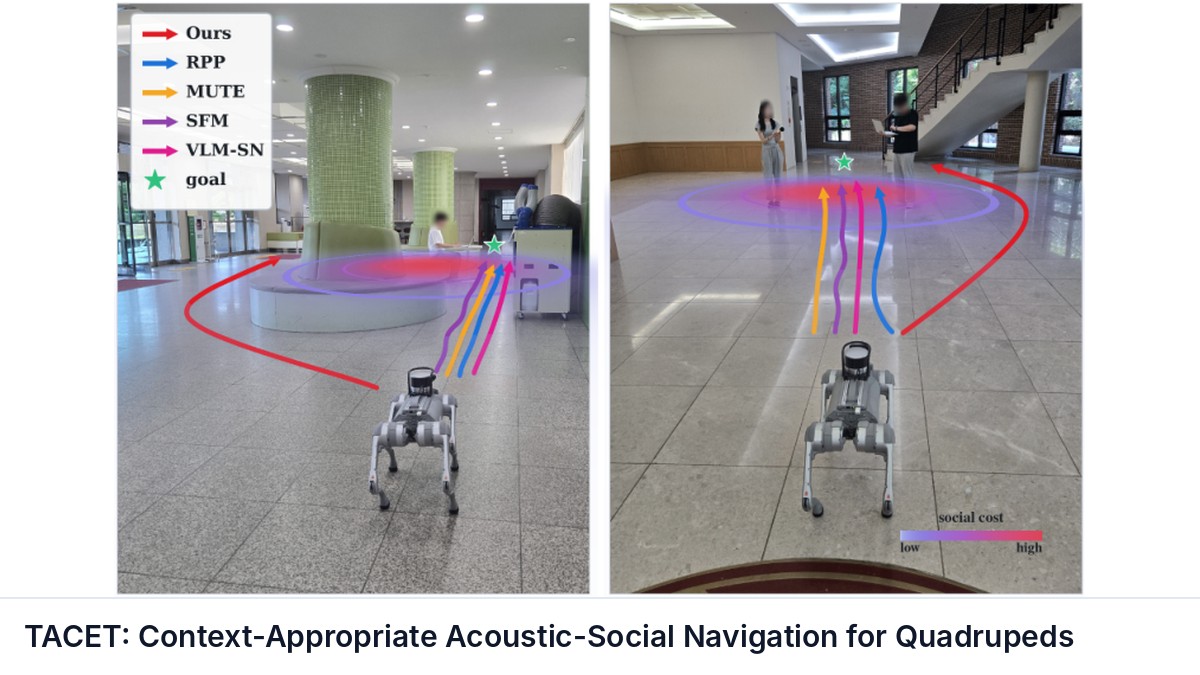
TACET: Context-Appropriate Acoustic-Social Navigation for Quadrupeds
Sungsan Park, Young-Sik Shin, Sanghyun Kim · N/A · 2026
Framework
N/A
License
N/A
Stars
N/A
Summary
Quadruped robots entering hospitals, care homes, and quiet offices must be context-appropriate not only in where they move but in how loudly they move: a legged robot's locomotion noise, dominated by foot-ground impacts, is itself a social variable.
Abstract Summary
Key Points
- Quadruped robots entering hospitals, care homes, and quiet offices must be context-appropriate not only in where they move but in how loudly they move: a legged robot's locomotion noise, dominated by foot-ground impacts, is itself a social variable.
- Prior social navigation respects human space but treats the robot as acoustically uniform, while quiet-locomotion methods reduce noise to an operator-specified, context-blind level.
- We present TACET, a context-appropriate acoustic-social navigation method that infers social context from the robot's egocentric view and decides both where it walks and how loudly, coupling a slow fine-tuned vision-language reasoner to a fast reactive controller through a single compact behavior token, <gait, speed, social_cost>.
- The same token conditions both a social costmap (where to go) and a quiet locomotion policy (how loudly to move), while a structured out-of-view memory keeps recently seen people in the reasoner's context after they leave the camera view.
- On a real quadruped, context-conditioned locomotion lowers locomotion noise by up to 9.3 dBA at matched speed, and across our scenarios the full method keeps personal-space compliance at 100% with low acoustic intrusion (<=2.9 dBA), jointly improving spatial and acoustic performance in the evaluated scenarios.
Methodology
We consider a quadruped operating in a human-shared indoor space, tasked with reaching a goal pose while behaving in a context-appropriate manner: respecting the spatial social norms of nearby people (personal space, conversations, and groups) and limiting the acoustic intrusion its locomotion imposes on them.
These two objectives are coupled, since how the robot should move depends on who is nearby and what they are doing, yet they act on different quantities, one spatial and one acoustic.
Experiments
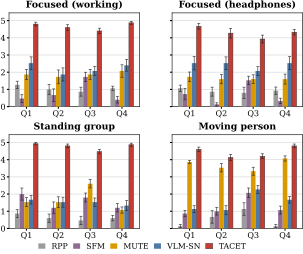
We evaluate TACET at two levels. We first characterize the locomotion policy as a noise source in isolation, on a controlled traverse with no people present, separating the gait’s acoustic contribution from that of any detour. We then evaluate the full method in social encounters, measuring whether the robot is simultaneously space-respecting and quiet toward the people it meets.
Each condition is repeated for ten trials and we report the mean, following the evaluation protocol of prior quiet-locomotion work [ 1 ] .
Sources and Demonstrations
Figures are reproduced from Park et al. See the full paper for experimental details and the project page, when the paper links one, for demonstrations and videos.
Related Papers
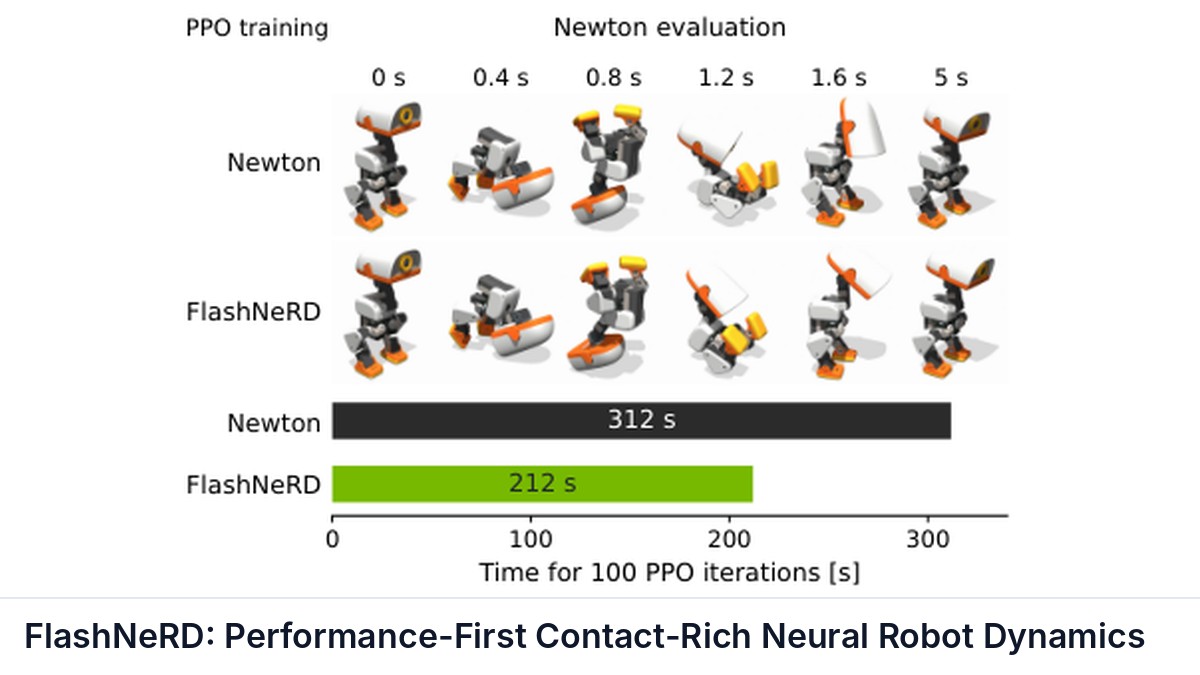
FlashNeRD: Performance-First Contact-Rich Neural Robot Dynamics
Mohammadmehdi Ataei, Mohammad Amin Nabian, Jie Xu et al.
Compared with analytical physics, learned dynamics models promise robot simulation that is faster, inherently differentiable, and easily adaptable to real data.
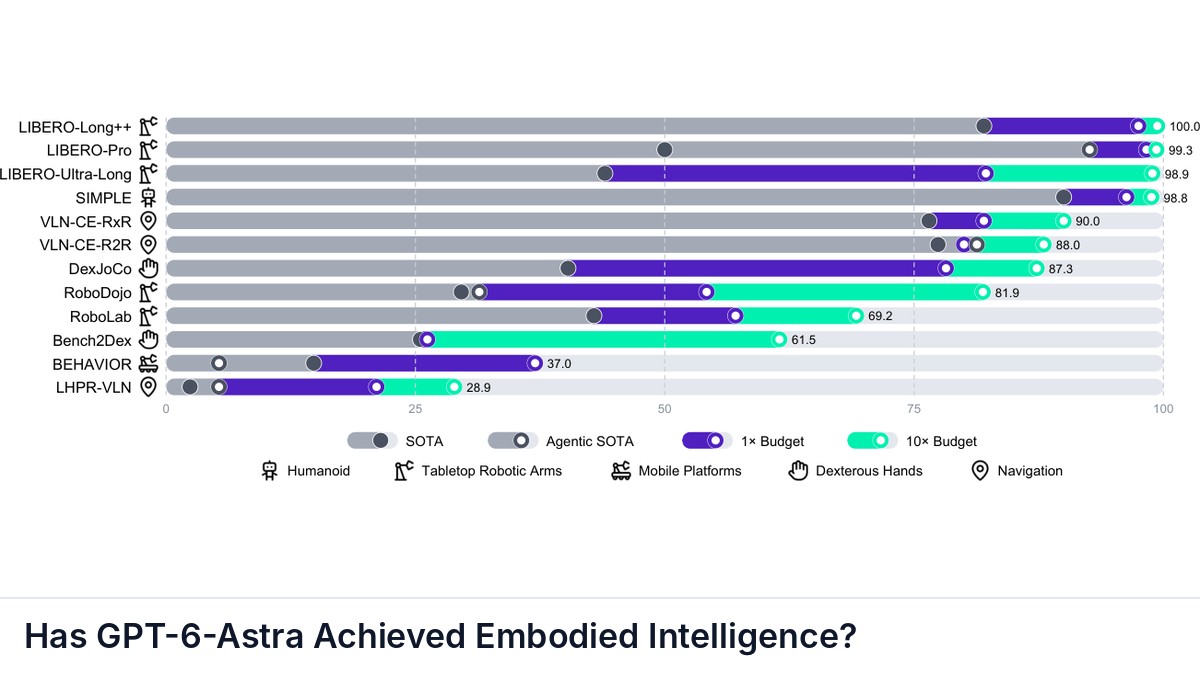
Has GPT-6-Astra Achieved Embodied Intelligence?
SenseNova, Joint Research Team, : et al.
GPT-6-Astra demonstrates a level of competence in robotic manipulation and navigation that challenges the conventional paradigm of building specialized models for individual tasks and embodiments.
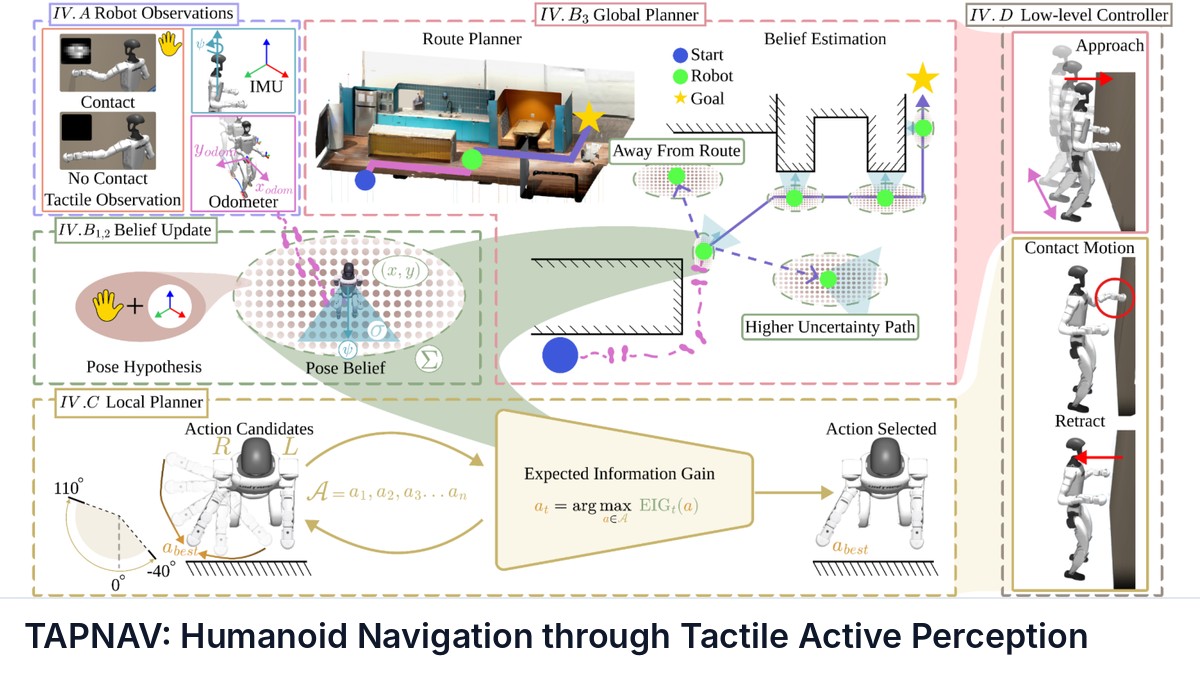
TAPNAV: Humanoid Navigation through Tactile Active Perception
Huaze Liu, Zhenyu Wu, Jaehwi Jang et al.
Navigation in vision-denied environments is challenging for humanoid robots because proprioceptive odometry drifts and localization uncertainty accumulates rapidly.
A Low-Cost, Open Platform for End-to-End Autonomous Driving on a Miniature Ackermann Vehicle
Gustavo Claudio Karl Couto, Eric Aislan Antonelo, Gabriel George Zipperer
This paper presents a low-cost, open experimental platform for research in end-to-end autonomous driving with miniature Ackermann vehicles.