
Adaptation Needs in Robotic Systems: Assessing Behavior Trees and Their Enhancement
Mehran Rostamnia, Gianluca Filippone, Ricardo Caldas, Patrizio Pelliccione · N/A · 2026
Framework
N/A
License
N/A
Stars
N/A
Summary
Robotic systems increasingly operate in dynamic, uncertain, and open-ended environments, where design-time assumptions may no longer hold, and adaptation becomes necessary to maintain effective and safe operation.
Abstract Summary
Key Points
- Robotic systems increasingly operate in dynamic, uncertain, and open-ended environments, where design-time assumptions may no longer hold, and adaptation becomes necessary to maintain effective and safe operation.
- Behavior Trees (BTs) are widely used in robotic control architectures due to their modularity, readability, and reactivity.
- This raises a central question: are BTs sufficient to meet the adaptation needs of modern robotic systems?
- This paper investigates this question through a literature-driven study complemented by empirical validation.
- First, we derive a classification of robotic adaptation needs from the literature, organizing them into six categories: Knowledge, Perception, Actuation, System, Mission, and Environment.
Methodology
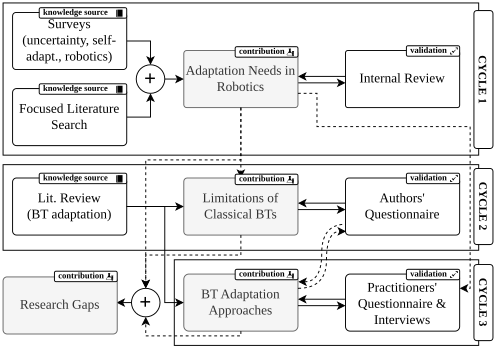
This research aimed not only to review existing literature but also to incrementally construct and validate an artifact that supports the analysis of adaptation needs in robotic systems and their relationship with BTs.
Adaptation Needs of Robotic Systems (RQ1)
Robotic systems rarely operate under fixed, fully known, and predictable conditions. Instead, they are exposed to uncertainty originating from their internal state, their sensing and actuation capabilities, their mission objectives, and the environment in which they operate.
In this context, adaptation becomes necessary when the current behavior, configuration, or knowledge of the robotic system is no longer adequate to satisfy the mission under the observed operating conditions.
Adaptive BTs: Approaches and Enhancements (RQ3)
This section answers RQ3 by characterizing the main approaches used to enhance BTs for adaptation. The goal is not only to list existing techniques, but also to understand how they compensate for the limitations of classical BTs identified in RQ2. We organize the analyzed studies into four primary families of BT enhancement: BT evolution , BT extension , BT generation , and BT refinement .
Some approaches combine these families, particularly BT generation and refinement, and we term them hybrid approaches.
Sources and Demonstrations
Figures are reproduced from Rostamnia et al. See the full paper for experimental details and the project page, when the paper links one, for demonstrations and videos.
Related Papers
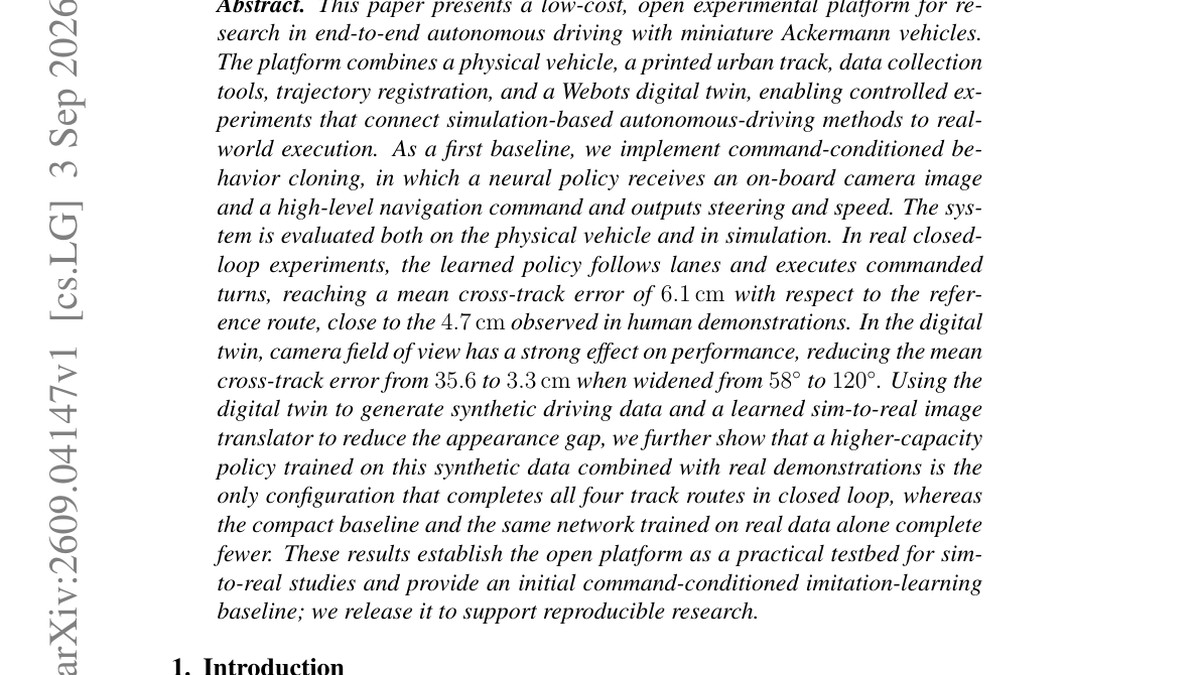
A Low-Cost, Open Platform for End-to-End Autonomous Driving on a Miniature Ackermann Vehicle
Gustavo Claudio Karl Couto, Eric Aislan Antonelo, Gabriel George Zipperer
This paper presents a low-cost, open experimental platform for research in end-to-end autonomous driving with miniature Ackermann vehicles.
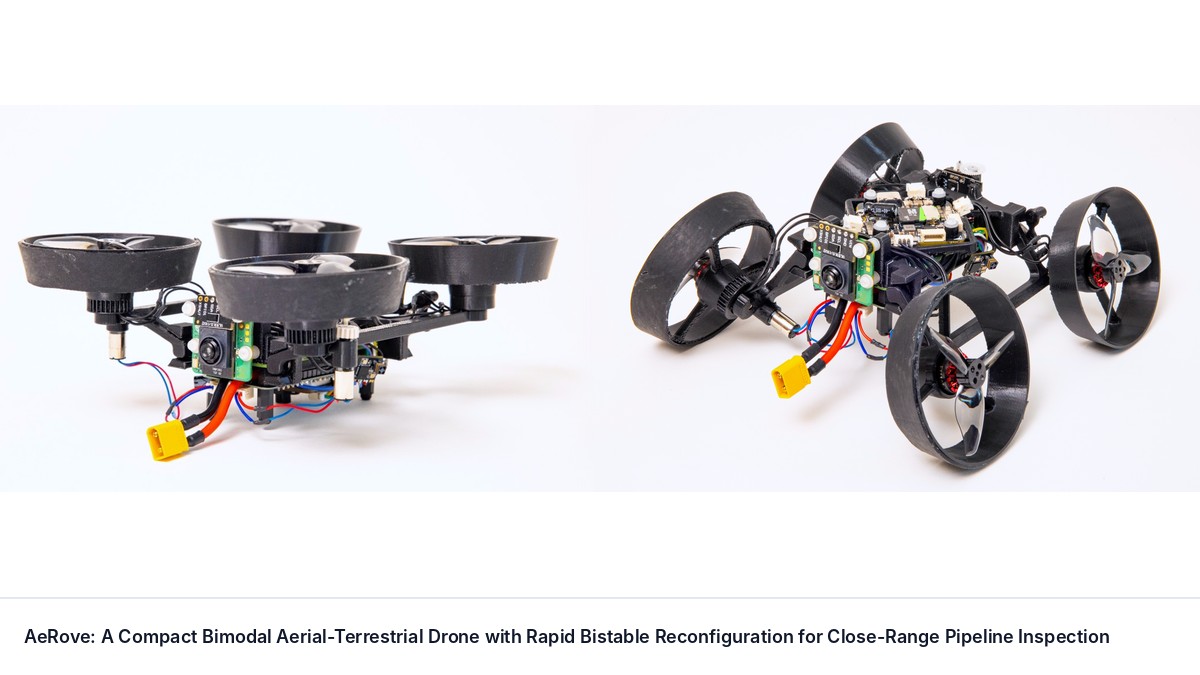
AeRove: A Compact Bimodal Aerial-Terrestrial Drone with Rapid Bistable Reconfiguration for Close-Range Pipeline Inspection
Caleb Polillio, Petras Swissler
Close-proximity pipeline inspection is challenging for standard drones due to high hovering power consumption, airflow sensitivity, and propeller wash interference with gas sensing. To address this, we present AeRove, a compact bimodal aerial-terrestrial robot.

Aim Short to Reach Far: Your Frozen World Model Can Plan Better Than You Think
Xvyuan Liu, Jianjie Fang, Chen Gao et al.
Planners built on visual world models commonly score each predicted outcome by its distance to the encoded goal image. We show that this target can limit control even with exact dynamics and globally optimal short-horizon search: reaching a goal may require actions that initially move away from it.
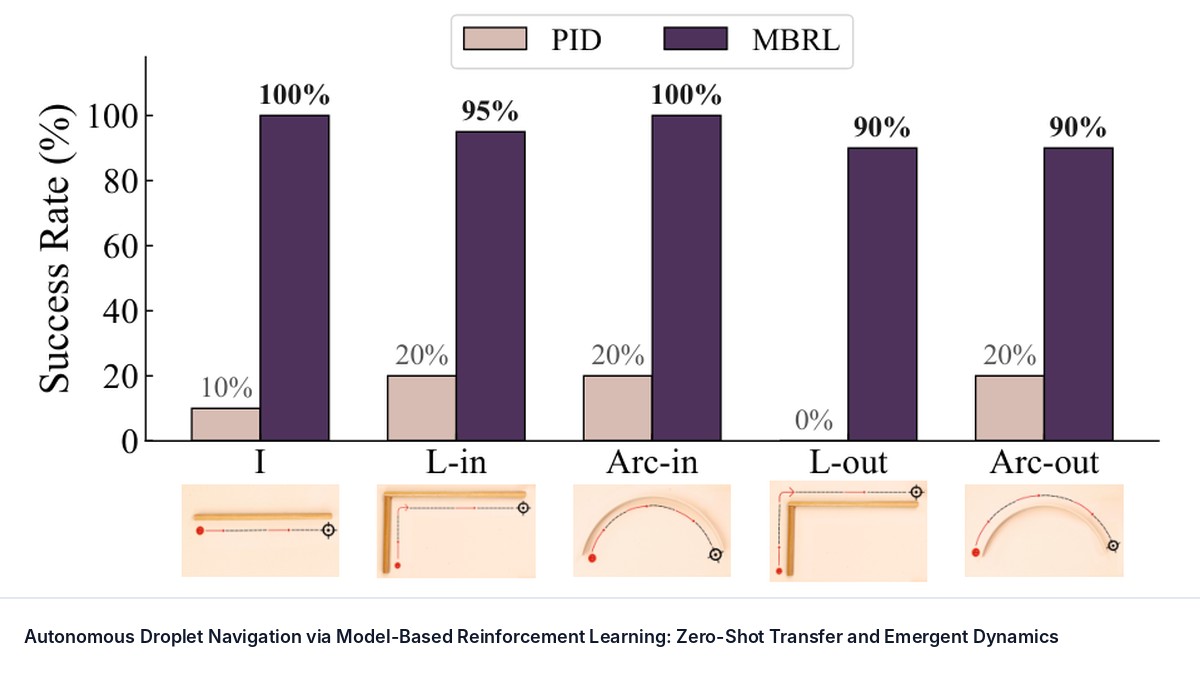
Autonomous Droplet Navigation via Model-Based Reinforcement Learning: Zero-Shot Transfer and Emergent Dynamics
Rajneesh Anand, Mayuresh V. Kothare
Self-driving laboratories (SDLs) are transforming chemical and materials discovery through closed-loop automation, yet automated infrastructure for physical manipulation of soft, deformable matter remains beyond current robotic platforms.