
LunaDrive: A Delay-Compensated High-Voltage GaN FET-Based Motor Driver for Dynamic Robots with Flat BLDC Motors
Sota Yuzaki, Temma Suzuki, Hiromi Tada, Masanori Konishi, Kento Kawaharazuka, Kei Okada · N/A · 2026
Framework
N/A
License
N/A
Stars
N/A
Summary
The performance improvement of high-power flat BLDC motors has accelerated the development of dynamic robots. However, many commercially available servo motors assume operating voltages of 48 V or lower, which limits the maximum rotational speed.
Abstract Summary
Key Points
- The performance improvement of high-power flat BLDC motors has accelerated the development of dynamic robots.
- However, many commercially available servo motors assume operating voltages of 48 V or lower, which limits the maximum rotational speed.
- Dynamic robots require rapid energy generation, so this voltage constraint restricts motion performance.
- Therefore, driving motors beyond the rated voltage is desirable to increase the instantaneous maximum speed.
- On the other hand, semiconductor devices used in motor drivers have a trade-off between voltage rating and current capacity.
Method
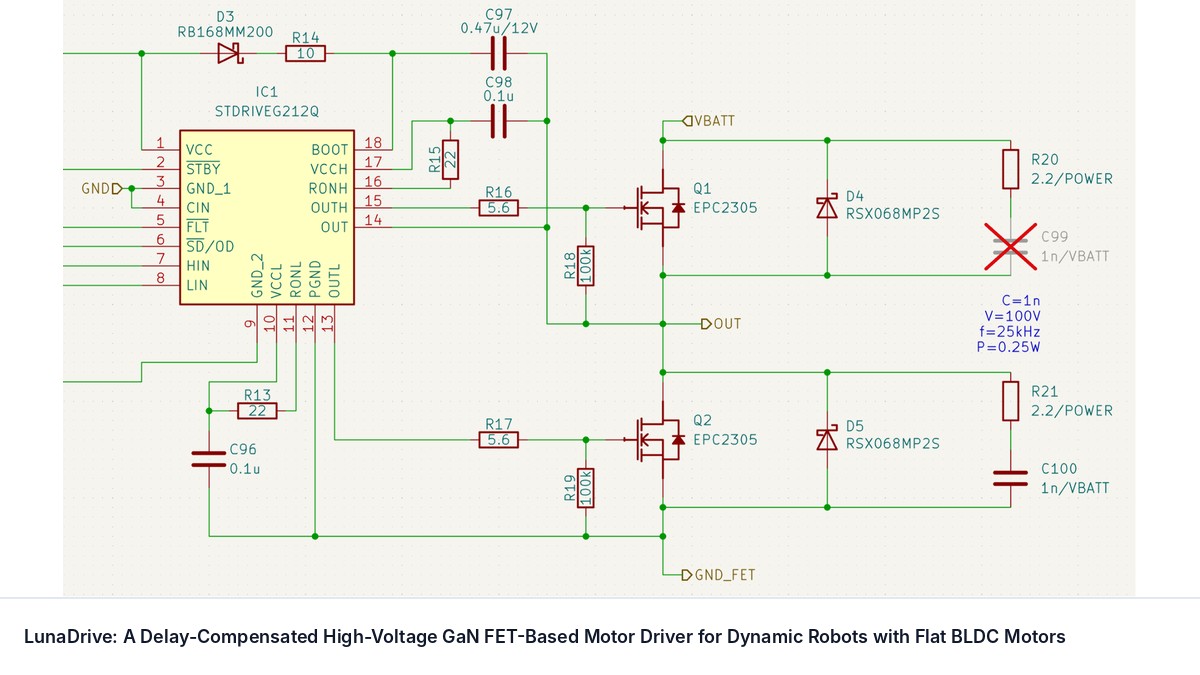
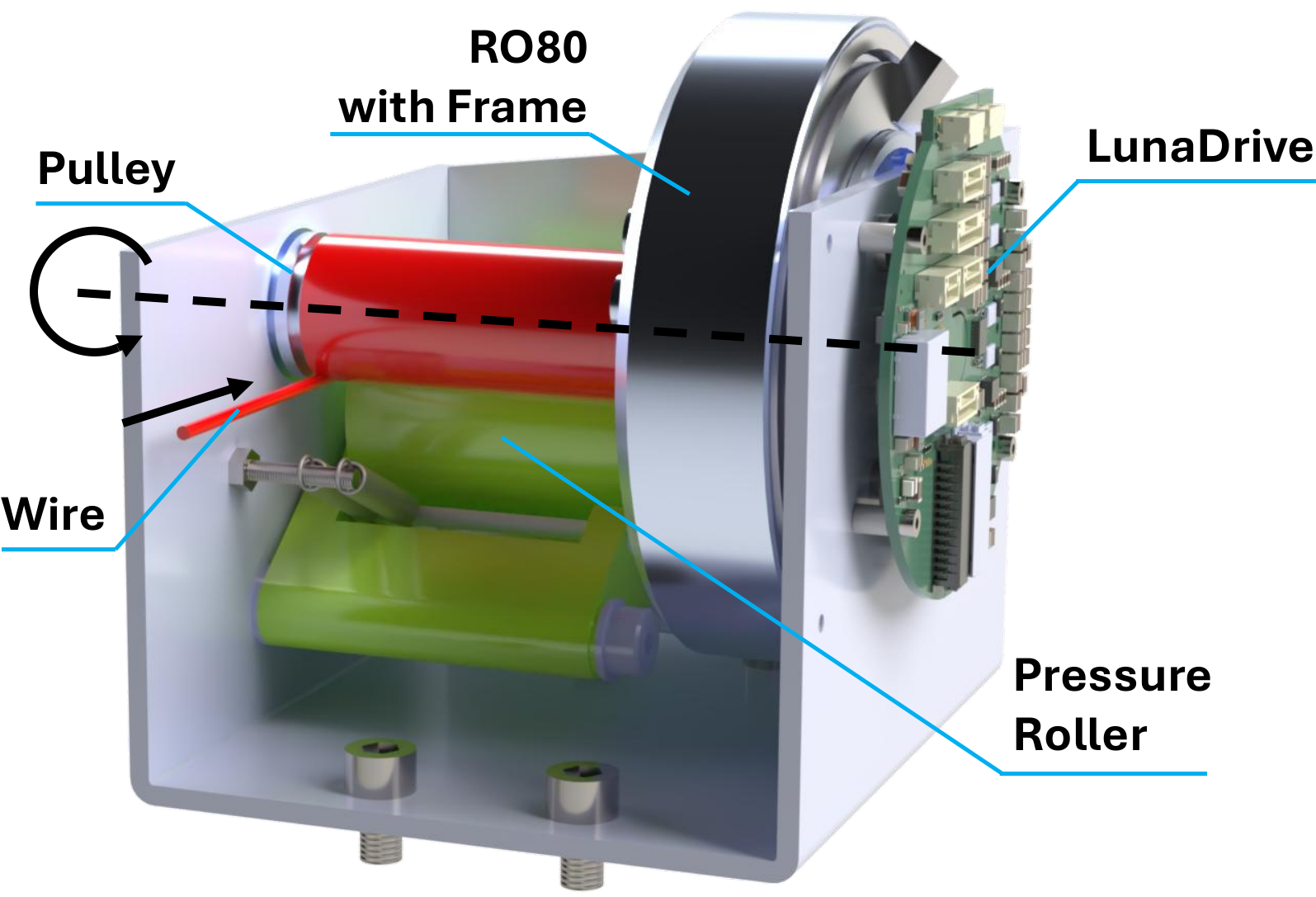
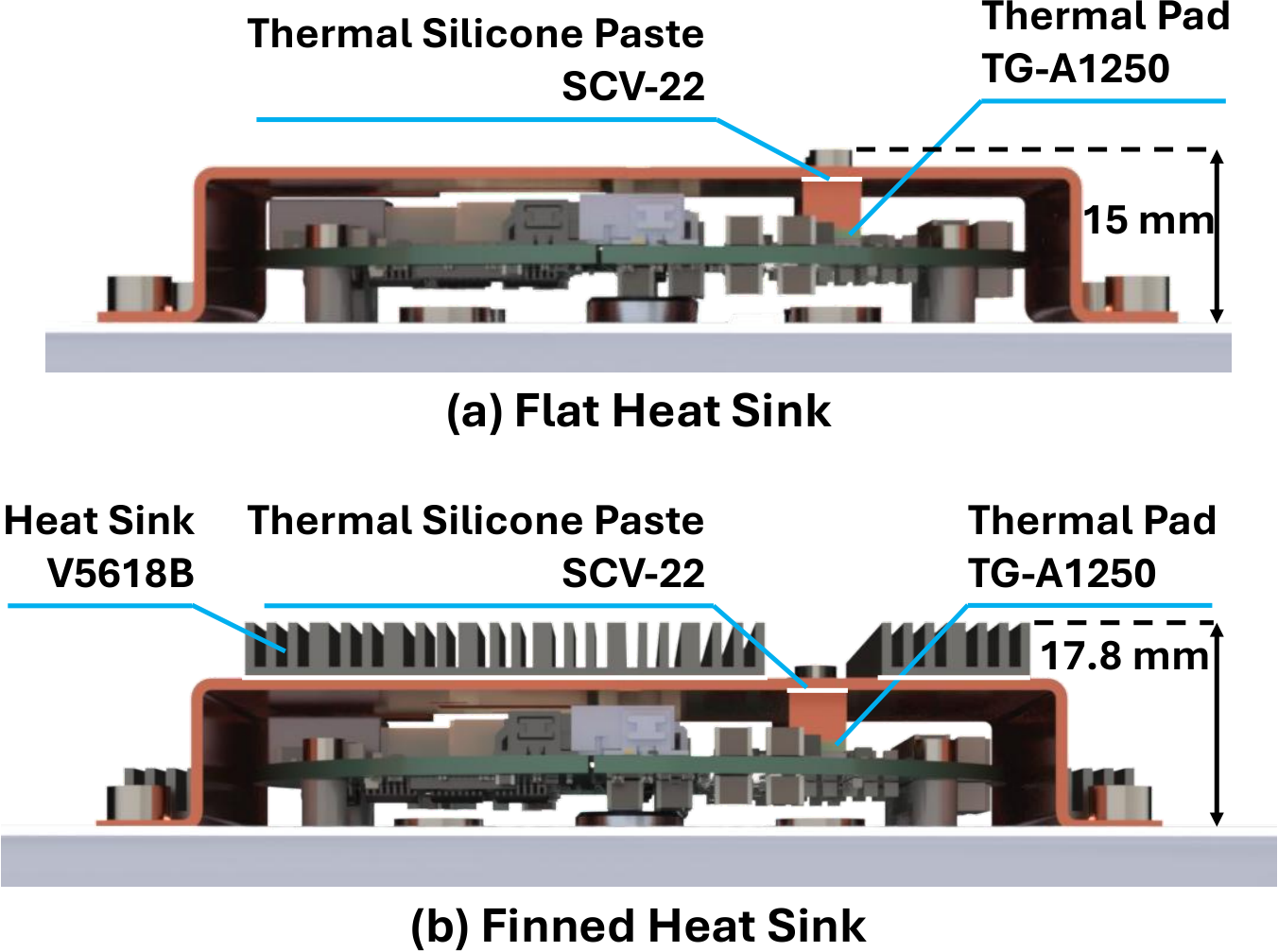
LunaDrive consists of two boards, as shown in Fig. 2 . One is a controller board for motor control and communication with the host system. The other is a driver board that drives the BLDC motor using GaN FETs. The diameter is $70\text{\,}\mathrm{m}\mathrm{m}$. Only the connector section used by the user protrudes outward. The thickness is $8.51\text{\,}\mathrm{m}\mathrm{m}$.
Experiments
In this experiment, switching waveforms were observed when $10\text{\,}\mathrm{A}$ was applied to the motor in order to verify proper switching operation. The oscilloscope used for the measurement was an MDO4054B-3 (Tektronix) with a bandwidth of $500\text{\,}\mathrm{MHz}$. The measurement results are shown in Fig. 9 .
Since the motor is a load with large current fluctuations, the slew rate was set to $4.5\text{\,}\mathrm{V}$ as a conservative design choice.
Sources and Demonstrations
Figures are reproduced from Yuzaki et al. See the full paper for experimental details and the project page, when the paper links one, for demonstrations and videos.
Related Papers

3D Euler-Angle Orientation Control for Two-Ray Fading Mitigation in Maritime Air-to-Sea Communications
Mohammed Bajja, Abdoul Karim A. H. Saliah, Hajar El Hammouti et al.
Maritime Air-to-Sea links are dominated by a line-of-sight ray and a sea-surface reflected ray whose destructive combination produces deep fades. Existing mitigation strategies optimize Unmanned Aerial Vehicle position or trajectory but leave attitude unexploited.
A Balanced Data Diet: Addressing the Exploration Bottleneck in Mega-Scale RL for Robot Control
Octi Zhang, Mateo Guaman Castro, Patrick Yin et al.
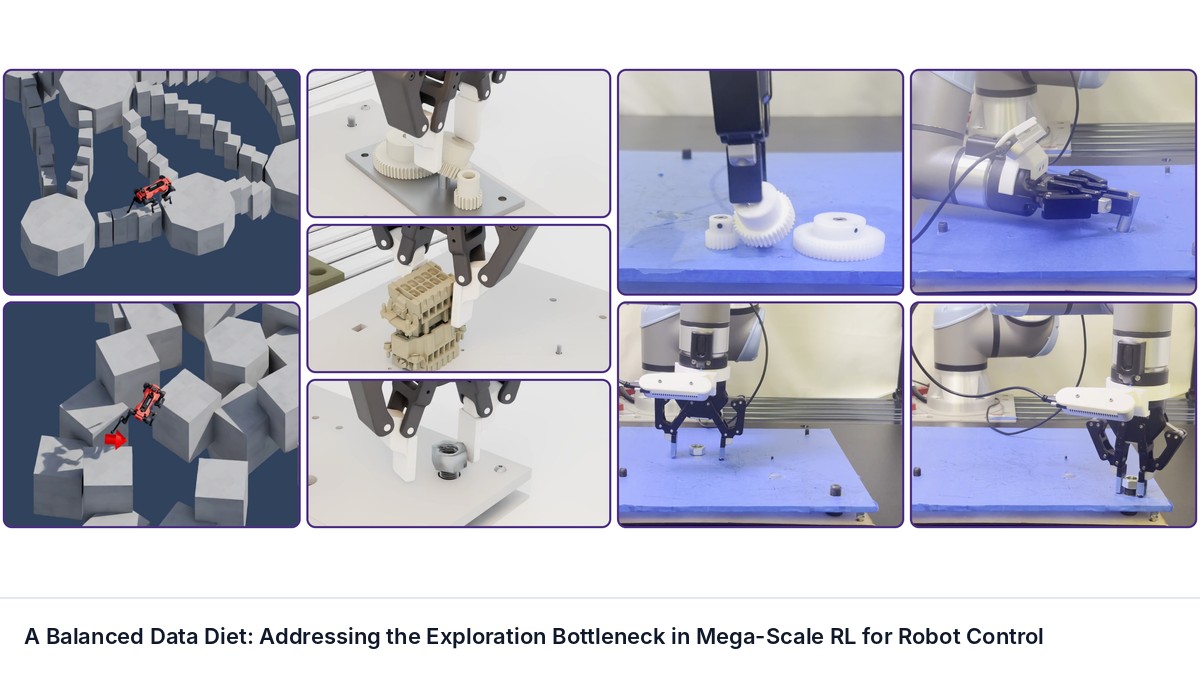
General-purpose robots must perform a wide range of tasks from agile locomotion to dexterous manipulation.
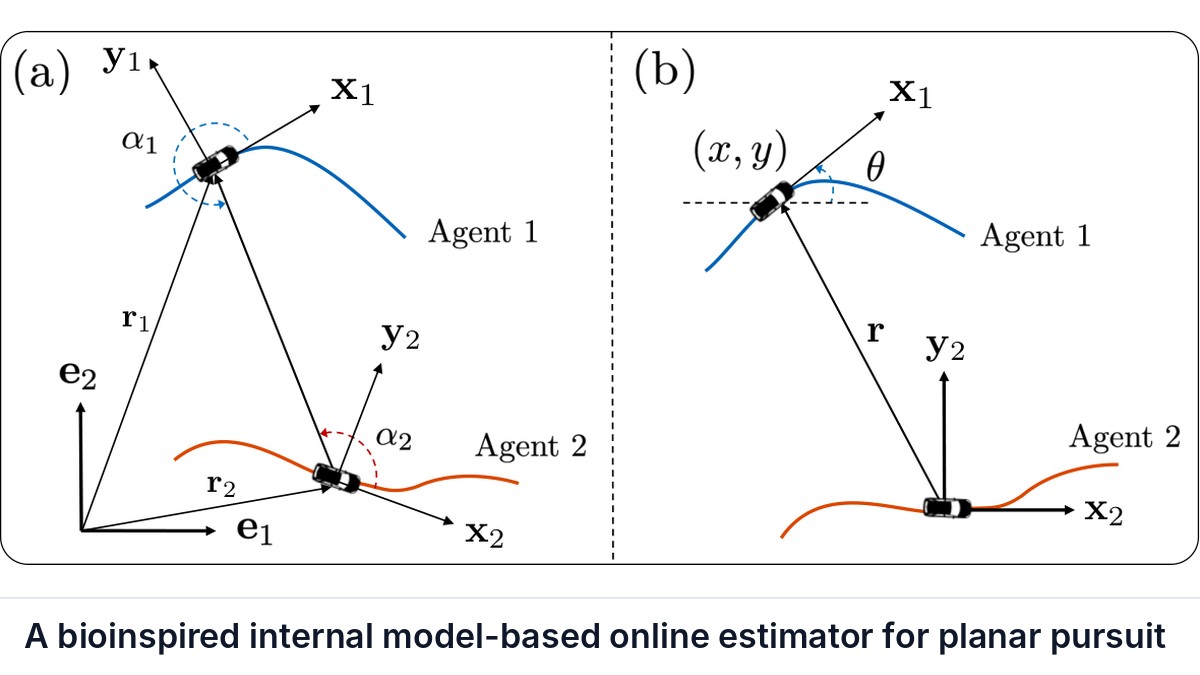
A bioinspired internal model-based online estimator for planar pursuit
Tengyue Liu, Xincheng Li, Sofia Morales Ferreira et al.
Bioinspired feedback controls for pursuit, tracking, and collective motion are often expressed in terms of the relative configuration between interacting agents.
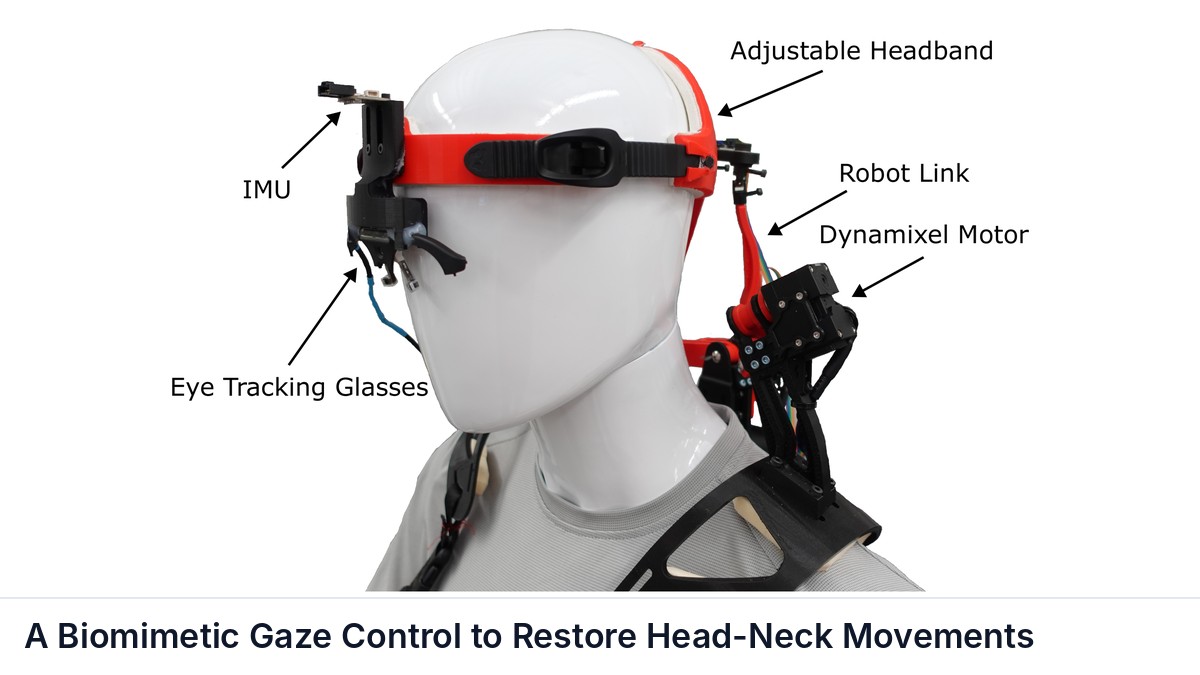
A Biomimetic Gaze Control to Restore Head-Neck Movements
Colin Rubow, Haohan Zhang
Powered neck exoskeletons are developed to restore head-neck motions for those with neck muscle weakness. Current methods using hand-held input devices to control these robotic systems are unintuitive or non-viable for these populations.