
A bioinspired internal model-based online estimator for planar pursuit
Tengyue Liu, Xincheng Li, Sofia Morales Ferreira, Kevin Galloway, Udit Halder · N/A · 2026
Framework
N/A
License
N/A
Stars
N/A
Summary
Bioinspired feedback controls for pursuit, tracking, and collective motion are often expressed in terms of the relative configuration between interacting agents.
Abstract Summary
Key Points
- Bioinspired feedback controls for pursuit, tracking, and collective motion are often expressed in terms of the relative configuration between interacting agents.
- In practice, however, onboard sensors may not directly provide all quantities required for feedback control, necessitating estimation of unobserved quantities.
- This paper develops a bioinspired internal model-based estimator for reconstructing those quantities from partial sensory observations and known self-motion.
- State reconstruction is posed as an optimization problem that treats the relative kinematics as constraints and minimizes the disagreement between the internal model outputs and measurements from onboard sensors.
- Pontryagin's Maximum Principle is used to derive the necessary optimality conditions
Preliminaries
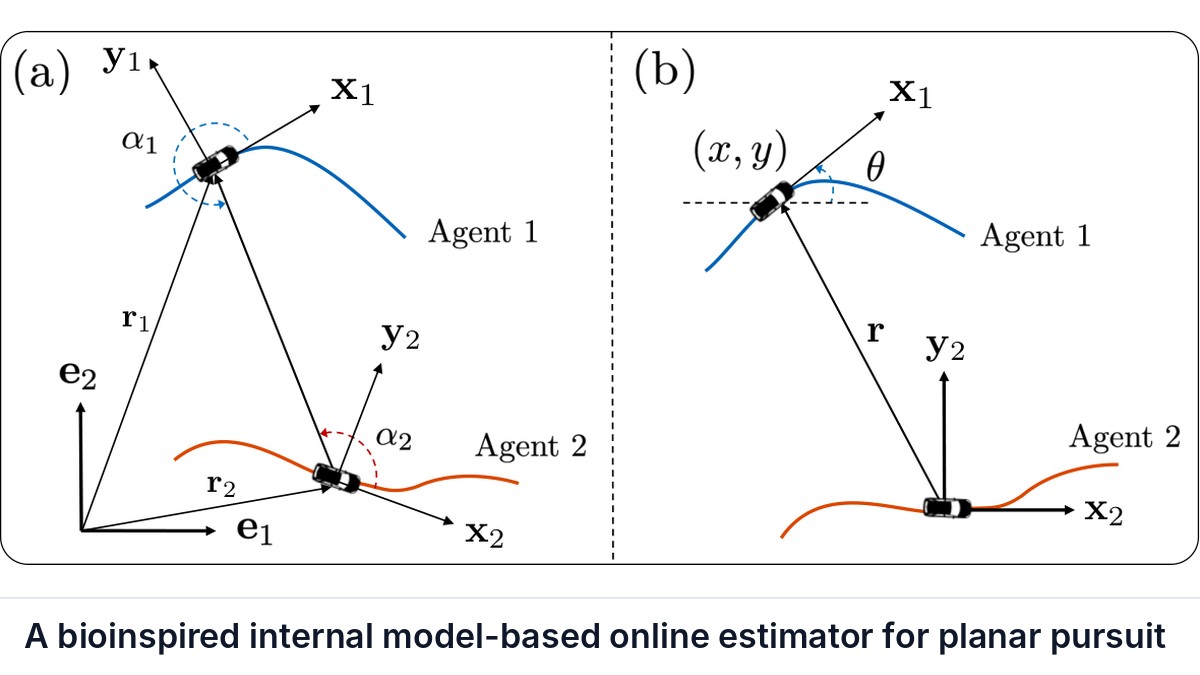
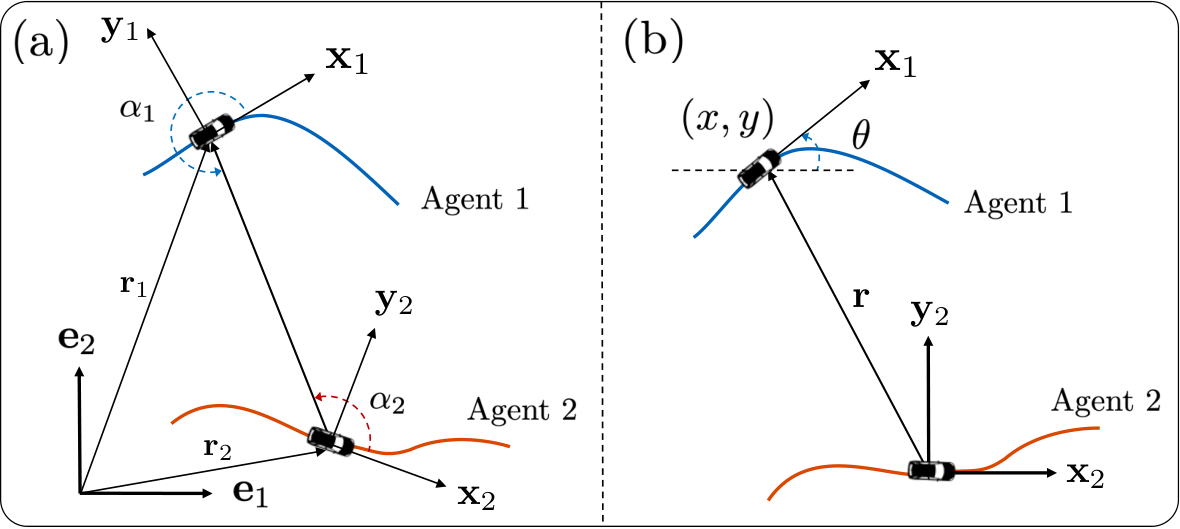
Consider two agents moving in the plane spanned by the global inertial frame $\{\mathbf{e}_{1},\mathbf{e}_{2}\}$ (see Fig. 1 (a)).
Agent $i$ has global position $\mathbf{r}_{i}=x_{i}\,\mathbf{e}_{1}+y_{i}\,\mathbf{e}_{2}$ and heading $\theta_{i}$ that describes the moving frames $\mathbf{x}_{i}=\cos\theta_{i}\,\mathbf{e}_{1}+\sin\theta_{i}\,\mathbf{e}_{2}$ and $\mathbf{y}_{i}=-\sin\theta_{i}\,\mathbf{e}_{1}+\cos\theta_{i}\,\mathbf{e}_{2}$.
Internal Model-based Estimator (IME)
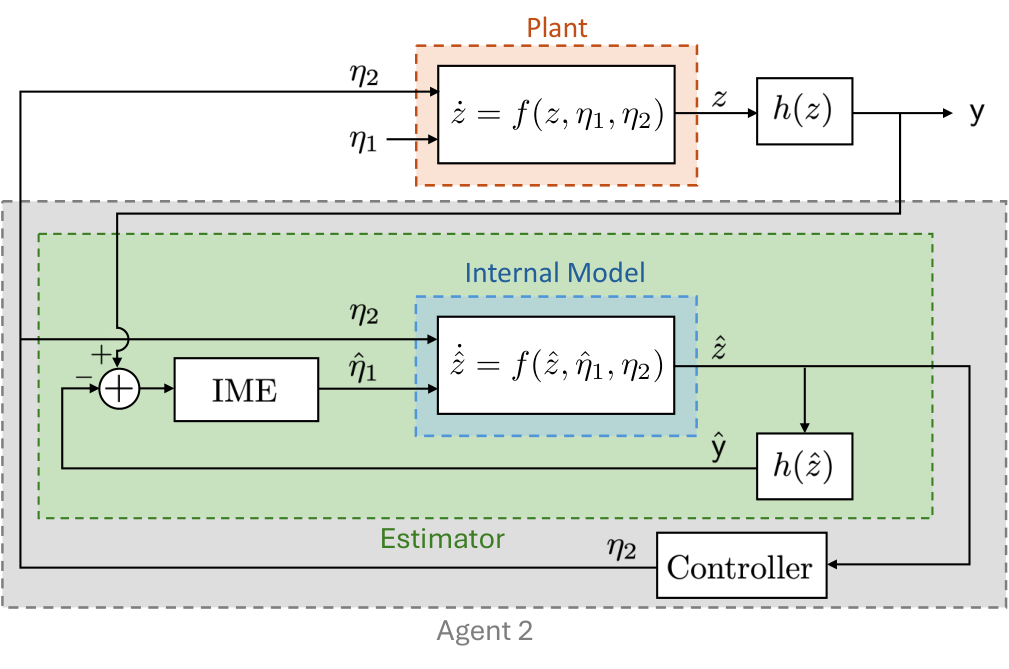
In this section, we propose an internal model-based estimator (IME) which uses partial observations to reconstruct the relative states and unknown controls of the pursuee required for feedback. We suppose that pursuer maintains an internal representation of the relative state $z$ and pursuee controls $\eta_{1}$.
Numerical and Experimental Results
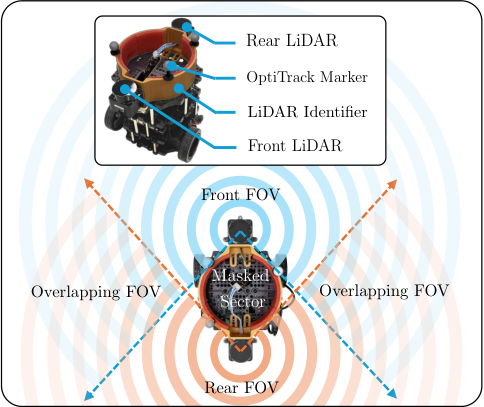
Numerical simulations and physical experiments are used to quantify both estimation accuracy and control execution of the proposed estimator. The code used for all simulations and experiments is available at [ 31 ] . While the proposed estimator is applicable to any feedback control laws of the form ( 6 ), this paper focuses on two specific bioinspired pursuit strategies for the evaluation.
A brief introduction to these pursuit strategies is provided next. Shape variables.
Sources and Demonstrations
Figures are reproduced from Liu et al. See the full paper for experimental details and the project page, when the paper links one, for demonstrations and videos.
Related Papers

3D Euler-Angle Orientation Control for Two-Ray Fading Mitigation in Maritime Air-to-Sea Communications
Mohammed Bajja, Abdoul Karim A. H. Saliah, Hajar El Hammouti et al.
Maritime Air-to-Sea links are dominated by a line-of-sight ray and a sea-surface reflected ray whose destructive combination produces deep fades. Existing mitigation strategies optimize Unmanned Aerial Vehicle position or trajectory but leave attitude unexploited.
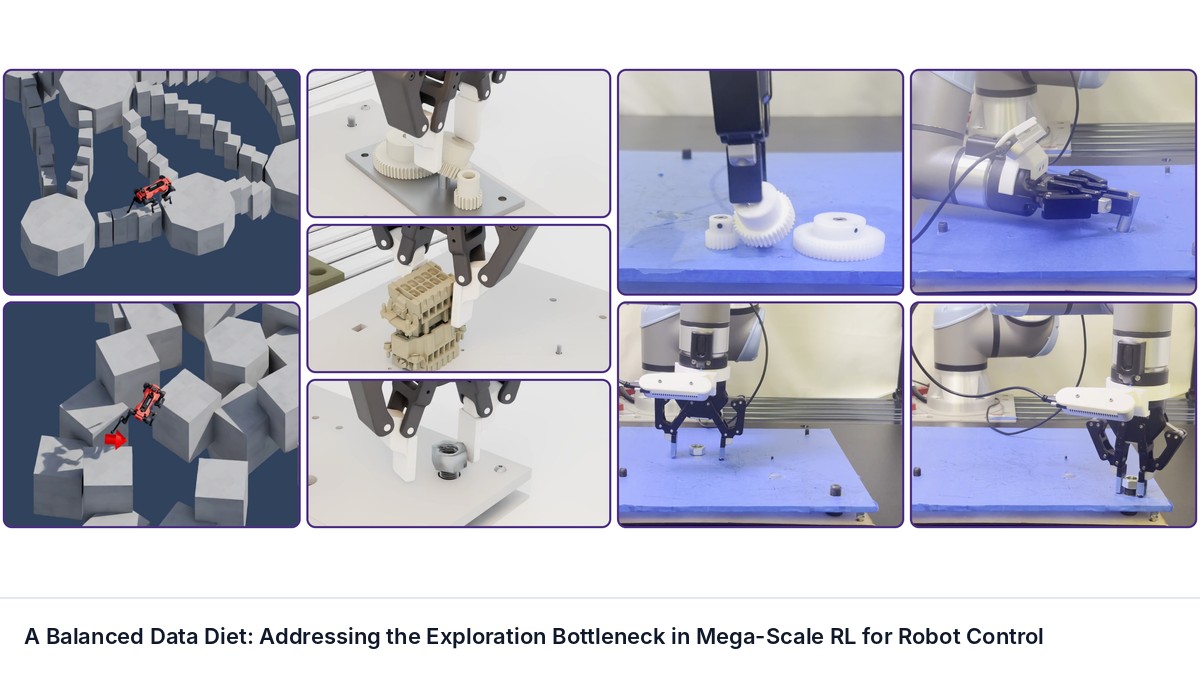
A Balanced Data Diet: Addressing the Exploration Bottleneck in Mega-Scale RL for Robot Control
Octi Zhang, Mateo Guaman Castro, Patrick Yin et al.
General-purpose robots must perform a wide range of tasks from agile locomotion to dexterous manipulation.
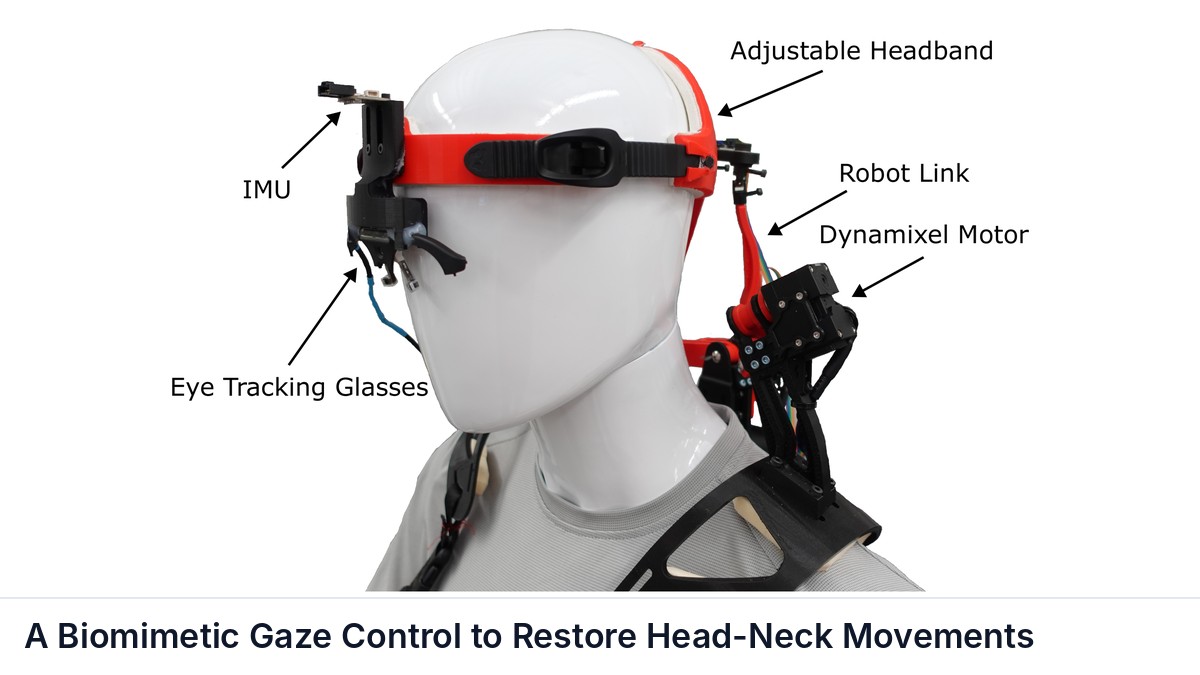
A Biomimetic Gaze Control to Restore Head-Neck Movements
Colin Rubow, Haohan Zhang
Powered neck exoskeletons are developed to restore head-neck motions for those with neck muscle weakness. Current methods using hand-held input devices to control these robotic systems are unintuitive or non-viable for these populations.
A Browser-Native Digital Test Range for Benchmarking 4D Ocean-Glider Planning Algorithms
Edward Holmberg, Elias Ioup, Mahdi Abdelguerfi
Repeated in-situ evaluation of ocean-glider planners requires scarce vehicles, operators, deployment and recovery resources, and ocean conditions that cannot be reset for competing algorithms.