
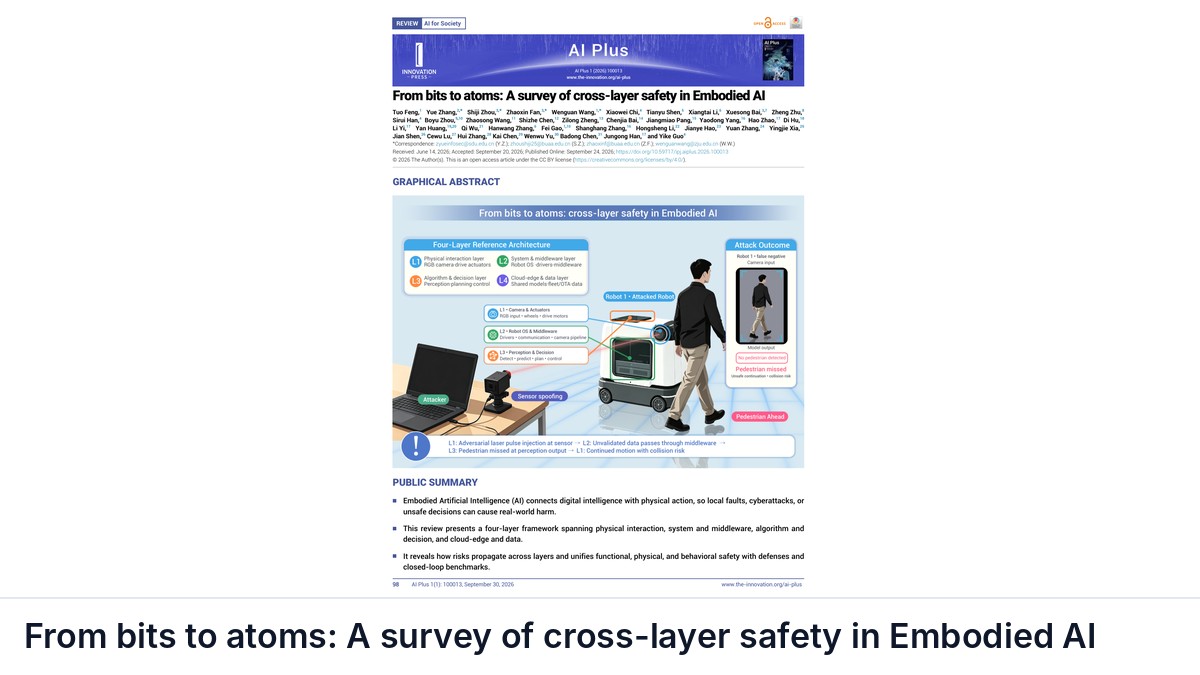
From bits to atoms: A survey of cross-layer safety in Embodied AI
Tuo Feng, Yue Zhang, Shiji Zhou, Zhaoxin Fan, Wenguan Wang, Xiaowei Chi, Tianyu Shen, Xiangtai Li, Xuesong Bai, Zheng Zhu, Sirui Han, Boyu Zhou, Zhaosong Wang, Shizhe Chen, Zilong Zheng, Chenjia Bai, Jiangmiao Pang, Yaodong Yang, Hao Zhao, Di Hu, Li Yi, Yan Huang, Qi Wu, Hanwang Zhang, Fei Gao, Shanghang Zhang, Hongsheng Li, Jianye Hao, Yuan Zhang, Yingjie Xia, Jian Shen, Cewu Lu, Hui Zhang, Kai Chen, Wenwu Yu, Badong Chen, Jungong Han, Yike Guo · N/A · 2026
Framework
N/A
License
N/A
Stars
N/A
Summary
Embodied Artificial Intelligence (AI) introduces cyber-physical risks because digital failures and attacks can cause physical harm.
Abstract Summary
Key Points
- Embodied Artificial Intelligence (AI) introduces cyber-physical risks because digital failures and attacks can cause physical harm.
- This survey organizes embodied AI safety through a four-layer reference architecture -- comprising the physical interaction, system and middleware, algorithm and decision, and cloud-edge and data layers -- and uses it to connect vulnerabilities, propagation paths, and safeguards across the system stack.
- It traces the evolution of safety paradigms and examines how faults and attacks cross architectural boundaries to produce physical consequences.
- Furthermore, the survey systematizes composite attack chains, outlines multi-layered defense strategies, and reviews representative embodied safety benchmarks.
- Ultimately, we advocate for unifying software alignment with rigorous hardware constraints to build trustworthy systems capable of operating safely within human-centric environments.
From bits to atoms: A survey of cross-layer safety in Embodied AI
|Authors: Tuo Feng, Yue Zhang, Shiji Zhou, Zhaoxin Fan, Wenguan Wang, Xiaowei Chi, Tianyu Shen, Xiangtai Li, Xuesong Bai, Zheng Zhu, Sirui Han, Boyu Zhou, Zhaosong Wang, Shizhe Chen, Zilong Zheng, Chenjia Bai, Jiangmiao Pang, Yaodong Yang, Hao Zhao, Di Hu, Li Yi, Yan Huang, Qi Wu, Hanwang Zhang, Fei Gao, Shanghang Zhang, Hongsheng Li, Jianye Hao, Yuan Zhang, Yingjie Xia, Jian Shen, Cewu Lu, Hui Zhang, Kai Chen, Wenwu Yu, Badong Chen, Jungong Han, Yike Guo
|Venue: arXiv preprint | Year: 2026
|arXiv: 2610.14038
Abstract
Embodied Artificial Intelligence (AI) introduces cyber-physical risks because digital failures and attacks can cause physical harm. This survey organizes embodied AI safety through a four-layer reference architecture — comprising the physical interaction, system and middleware, algorithm and decision, and cloud-edge and data layers — and uses it to connect vulnerabilities, propagation paths, and safeguards across the system stack. It traces the evolution of safety paradigms and examines how faults and attacks cross architectural boundaries to produce physical consequences. Furthermore, the survey systematizes composite attack chains, outlines multi-layered defense strategies, and reviews representative embodied safety benchmarks. Ultimately, we advocate for unifying software alignment with rigorous hardware constraints to build trustworthy systems capable of operating safely within human-centric environments.
Key Contributions
- Embodied Artificial Intelligence (AI) introduces cyber-physical risks because digital failures an…
- This survey organizes embodied AI safety through a four-layer reference architecture — comprisin…
- It traces the evolution of safety paradigms and examines how faults and attacks cross architectur…
- Furthermore, the survey systematizes composite attack chains, outlines multi-layered defense stra…
- Ultimately, we advocate for unifying software alignment with rigorous hardware constraints to bui…
Topics
- benchmark
Code & Data
- GitHub repository: https://github.com/tfzhou/VS-Survey
BibTeX
@article{Feng2026_261014038,
  title     = {From bits to atoms: A survey of cross-layer safety in Embodied AI},
  author    = {Tuo Feng and Yue Zhang and Shiji Zhou and Zhaoxin Fan and Wenguan Wang and Xiaowei Chi and Tianyu Shen and Xiangtai Li and Xuesong Bai and Zheng Zhu and Sirui Han and Boyu Zhou and Zhaosong Wang and Shizhe Chen and Zilong Zheng and Chenjia Bai and Jiangmiao Pang and Yaodong Yang and Hao Zhao and Di Hu and Li Yi and Yan Huang and Qi Wu and Hanwang Zhang and Fei Gao and Shanghang Zhang and Hongsheng Li and Jianye Hao and Yuan Zhang and Yingjie Xia and Jian Shen and Cewu Lu and Hui Zhang and Kai Chen and Wenwu Yu and Badong Chen and Jungong Han and Yike Guo},
  year      = {2026},
  eprint    = {2610.14038},
  archivePrefix = {arXiv},
  primaryClass  = {cs.RO},
  url       = {https://arxiv.org/abs/2610.14038}
}
Related Papers

3D Euler-Angle Orientation Control for Two-Ray Fading Mitigation in Maritime Air-to-Sea Communications
Mohammed Bajja, Abdoul Karim A. H. Saliah, Hajar El Hammouti et al.
Maritime Air-to-Sea links are dominated by a line-of-sight ray and a sea-surface reflected ray whose destructive combination produces deep fades. Existing mitigation strategies optimize Unmanned Aerial Vehicle position or trajectory but leave attitude unexploited.
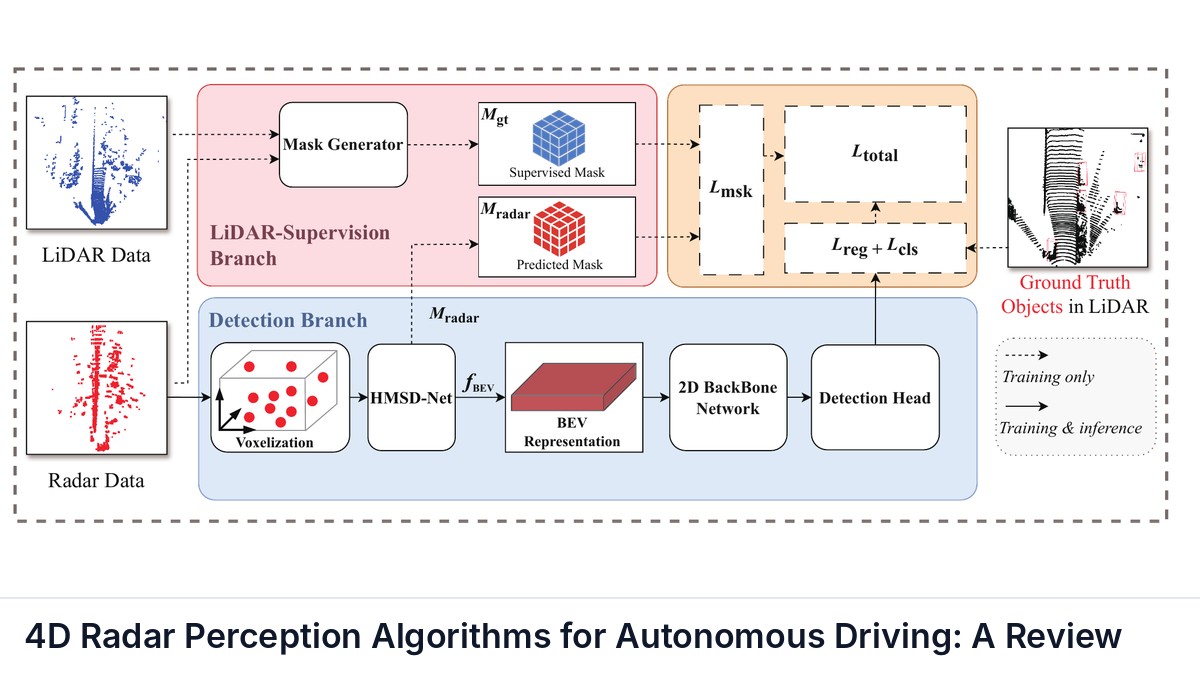
4D Radar Perception Algorithms for Autonomous Driving: A Review
Xumin Wu, Jun Zhou, Jilin Mei et al.
Research on 4D millimeter-wave radar perception algorithms has flourished in recent years, extending from signal processing and object detection to semantic segmentation, motion estimation, occupancy prediction, and dynamic scene reconstruction.
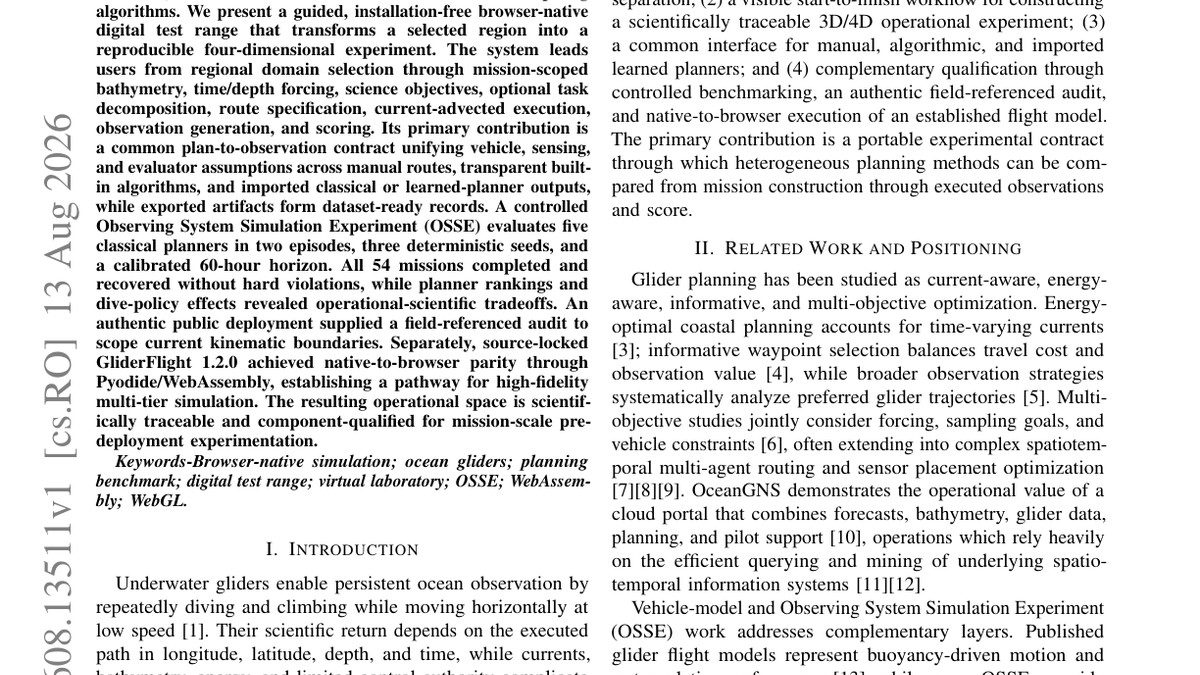
A Browser-Native Digital Test Range for Benchmarking 4D Ocean-Glider Planning Algorithms
Edward Holmberg, Elias Ioup, Mahdi Abdelguerfi
Repeated in-situ evaluation of ocean-glider planners requires scarce vehicles, operators, deployment and recovery resources, and ocean conditions that cannot be reset for competing algorithms.
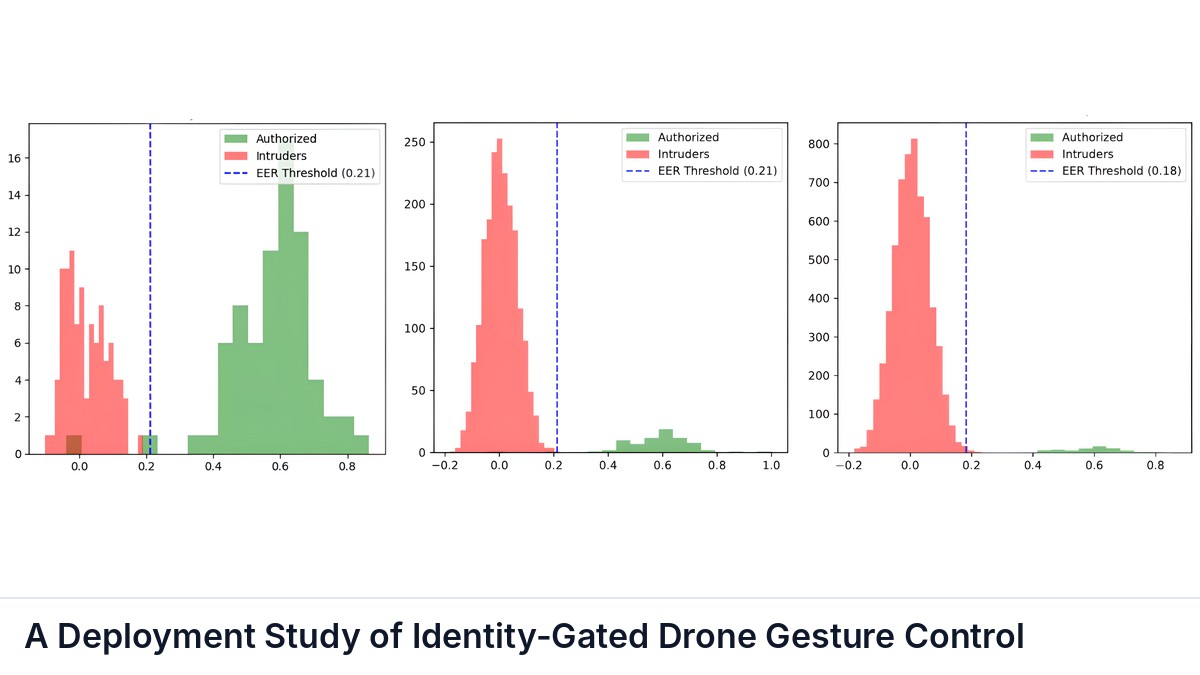
A Deployment Study of Identity-Gated Drone Gesture Control
Diyari Mohammed Salih, Ilyes Chaabeni, Naima Ait Oufroukh
Vision-based gesture control accepts commands from any hand in the camera field of view, which is unsafe in shared indoor spaces.