
A Deployment Study of Identity-Gated Drone Gesture Control
Diyari Mohammed Salih, Ilyes Chaabeni, Naima Ait Oufroukh · N/A · 2026
Framework
N/A
License
N/A
Stars
N/A
Summary
Vision-based gesture control accepts commands from any hand in the camera field of view, which is unsafe in shared indoor spaces.
Abstract Summary
Key Points
- Vision-based gesture control accepts commands from any hand in the camera field of view, which is unsafe in shared indoor spaces.
- This paper presents IGate, an identity-gated control stack that includes gesture control and face tracking, in which commands are admitted only when an enrolled operator is verified.
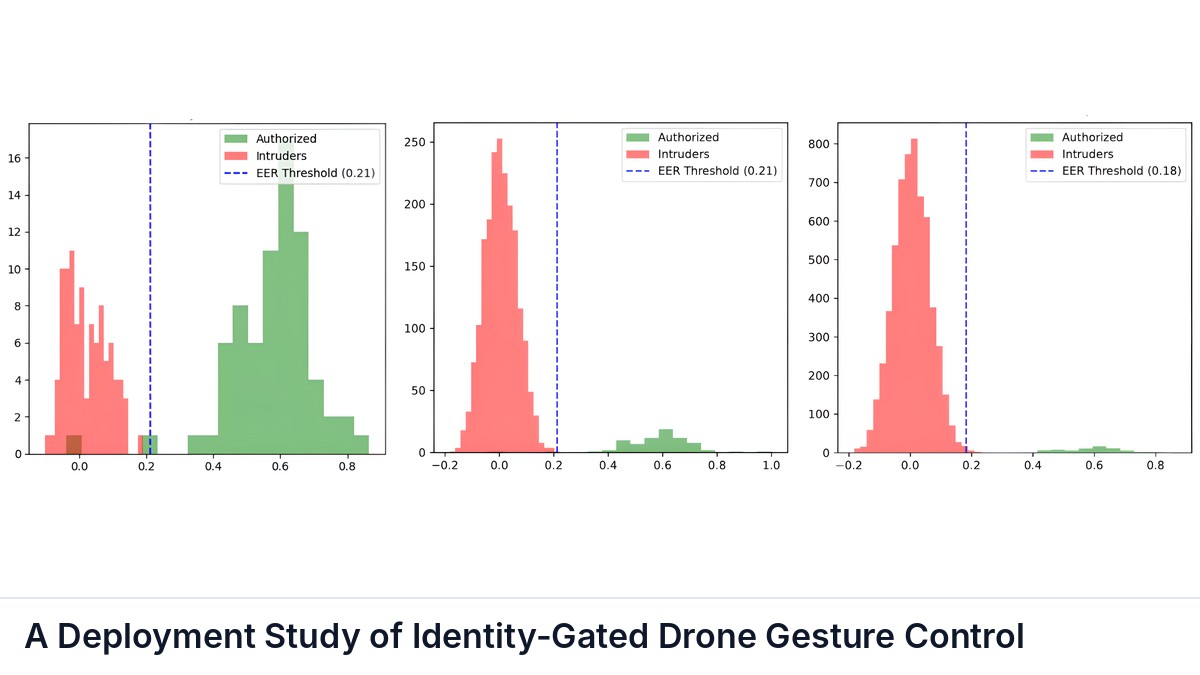
- The system performs few-shot user enrolment from 20 initial face frames, without prior user-specific training: verification compares an embedding of the current face crop against the enrolled template by cosine similarity, while face tracking uses proportional correction.
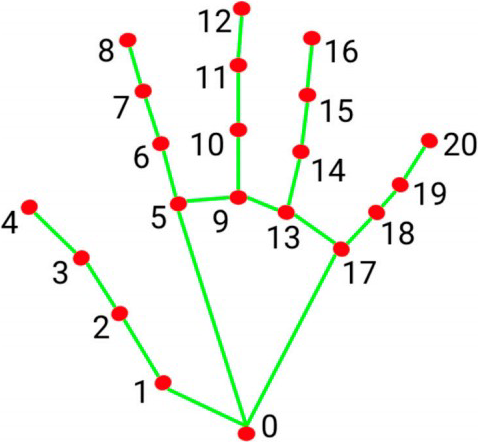
- Gesture control is achieved by classifying extracted hand landmarks using an RBF-SVM trained on a custom dataset.
- Additionally, a hierarchical finite-state machine handles mode selection, default, and fallback behaviours.
Method
DJI Tello EDU camera IMU, barometer motors aircraft host latest-frame buffer thread, depth 1 MediaPipe Hands every 2nd frame MediaPipe face every 4th frame gesture classifier rule / RBF-SVM identity gate $\tau_{\mathrm{on}}{=}0.55$ , $\Delta_{\max}{=}0.35$ s arbitration priority order RC command 10 Hz reason-only LLM local Qwen2.5-0.5B video UDP 11111 telemetry UDP 8890 command UDP 8889 Fig. 1: IGate .
The aircraft carries no computation: perception, authorization and arbitration run on the host, and every stage is logged per frame.
Experimental Setup
Each launch writes a timestamped run directory containing telemetry, decision, per-frame performance and trial logs, with a manifest recording configuration, Git commit, library versions and host. Two conventions make the latency figures meaningful: a throttled stage contributes a sample only on frames where it executed, and frames are deduplicated by sequence number before any rate is computed.
Results
The classifier is scored three ways, each stricter than the last: a within-session split; a held-out session split, trained on three sessions and tested on the fourth; and an operational measurement on frames the aircraft itself encoded. The metric is per-frame accuracy over the seven classes.
Evaluated within each session under a stratified random split, the SVM reaches an accuracy of 0.997, 0.988, 1.000 and 1.000 on sessions A, B, C and D.
Sources and Demonstrations
Figures are reproduced from Salih et al. See the full paper for experimental details and the project page, when the paper links one, for demonstrations and videos.
Related Papers

A Sim-to-Real Integration Pipeline for Training and Deployment of Chunk-Based VLA Manipulation Policies
Mathilde Kappel, Clémence Grislain, Mohamed Chetouani et al.
Vision-Language-Action (VLA) models have become a prominent paradigm for mapping multimodal inputs, including semantic instructions, visual observations of the scene, and proprioceptive observations, to robot actions.
Aim Short to Reach Far: Your Frozen World Model Can Plan Better Than You Think
Xvyuan Liu, Jianjie Fang, Chen Gao et al.
Planners built on visual world models commonly score each predicted outcome by its distance to the encoded goal image. We show that this target can limit control even with exact dynamics and globally optimal short-horizon search: reaching a goal may require actions that initially move away from it.
Beyond Reconstruction: What Matters in Action Tokenization for Robot Policies?
Haoran Chen, Jingtian Ji, Samuel Wheeler et al.
Autoregressive action-token policies such as vision-language-action models require action tokenizers to translate discrete token sequences into precise control actions in continuous space. Many action tokenizers learn the mapping between tokens and actions via a reconstruction objective.

Capability-Aware Arbitration for Semantic Intent-Based Shared Control
Zhaoda Du, Michael Bowman, Xiaoli Zhang
Shared control often allocates robot authority based on confidence in inferred human intent, assuming reliable autonomous execution. When this assumption fails, high intent confidence can cause over-helping.