
4D Radar Perception Algorithms for Autonomous Driving: A Review
Xumin Wu, Jun Zhou, Jilin Mei, Chen Min, Yu Hu · N/A · 2026
Framework
N/A
License
N/A
Stars
N/A
Summary
Research on 4D millimeter-wave radar perception algorithms has flourished in recent years, extending from signal processing and object detection to semantic segmentation, motion estimation, occupancy prediction, and dynamic scene reconstruction.
Abstract Summary
Key Points
- Research on 4D millimeter-wave radar perception algorithms has flourished in recent years, extending from signal processing and object detection to semantic segmentation, motion estimation, occupancy prediction, and dynamic scene reconstruction.
- This review organizes the field according to the evolution of perception tasks and algorithms
- It first introduces radar fundamentals, data representations, and quality-enhancement methods, and then reviews object-level perception, motion and localization, local and dense spatial perception, and dynamic scene understanding.
- Across these directions, we compare radar-only learning, multimodal fusion, and cross-modal supervision and knowledge distillation.
- Particular attention is paid to how elevation, Doppler measurements, and radar physical priors are exploited across tasks.
Radar Point-Cloud and Tensor Enhancement
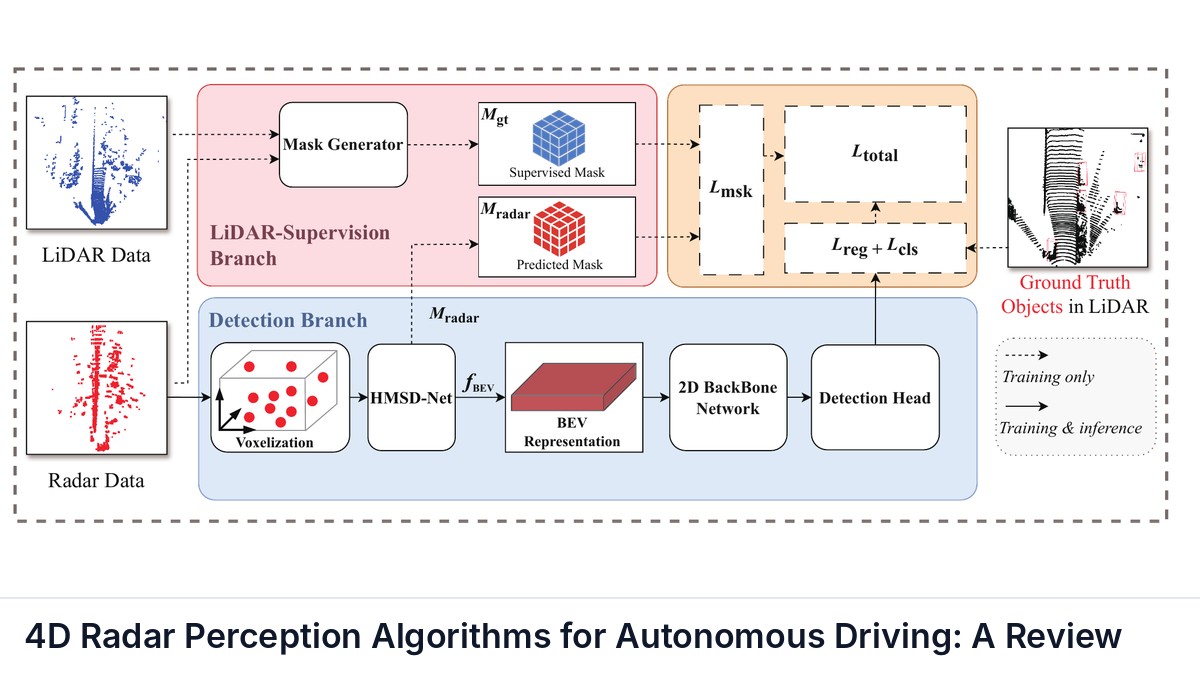
Radar point-cloud and tensor enhancement is a moderately mature direction. As summarized in Fig. 3 , 4D radar point clouds are typically sparser and less geometrically complete than LiDAR point clouds, but they offer longer detection range, direct radial-velocity and RCS measurements, and stronger adverse-weather robustness [ 1 , 51 , 55 ] .
This complementarity motivates enhancement that improves geometric usability without discarding radar-specific motion and scattering evidence.
Object-Level Perception
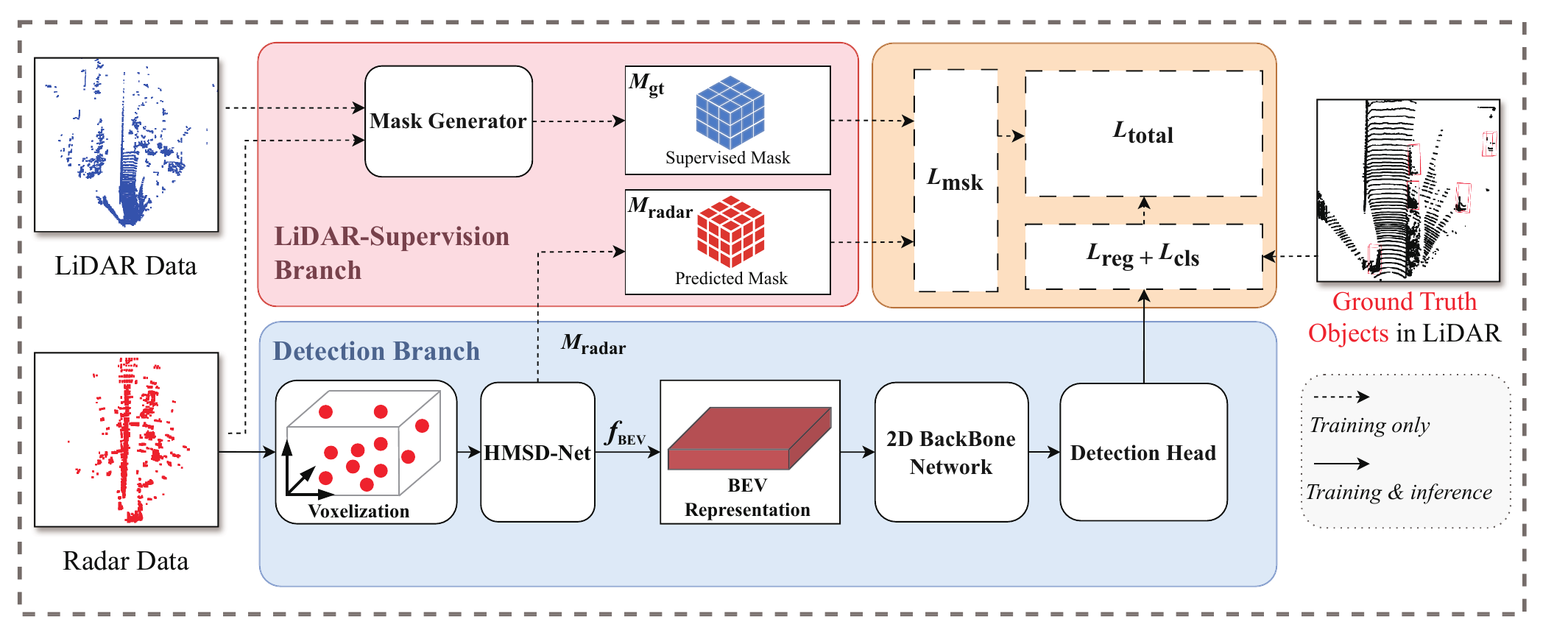
Object-level perception is one of the most mature and extensively studied 4D radar directions. Research has progressed from early radar object classification [ 83 ] to extensive 3D detection, with practical baselines established for both radar-only and fusion-based perception. Current work continues to improve recognition of vulnerable road users under sparse returns [ 86 ] .
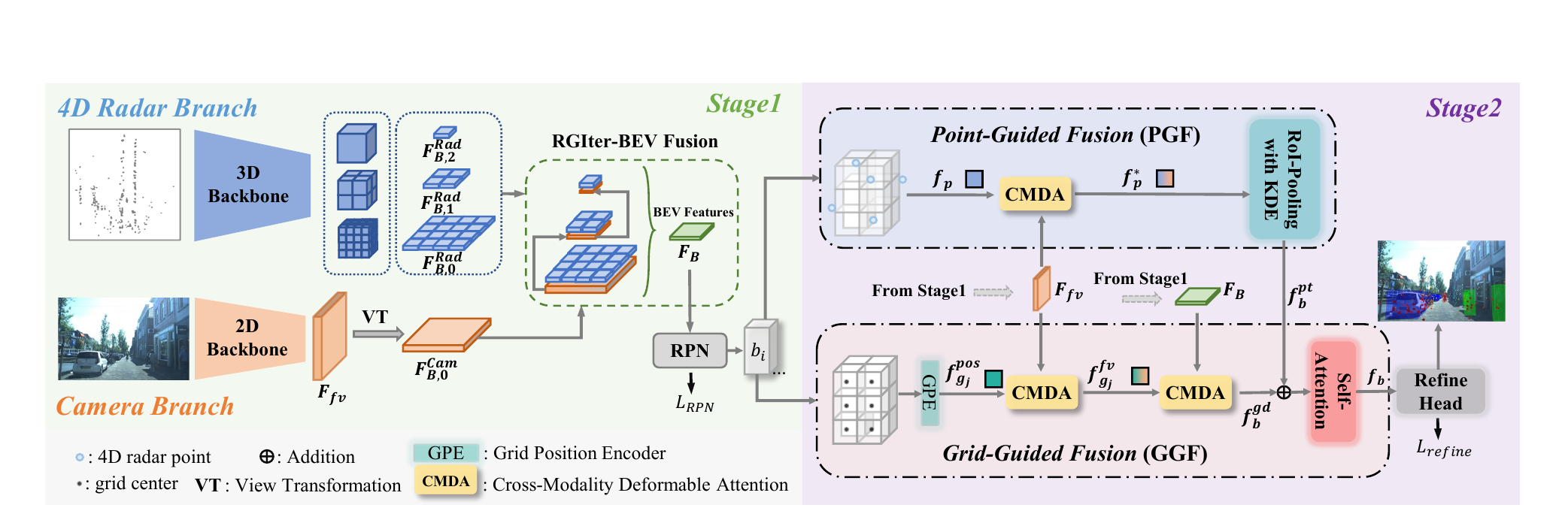
Current object-level studies follow three technical routes: radar-only learning, multimodal fusion, and cross-modal supervision.
Object Motion Perception
Motion perception comprises subdirections with unequal maturity. Multi-object and extended-target tracking form the most established branch. Moving-instance segmentation, ego-motion estimation, odometry, localization, and SLAM have reached an intermediate stage, whereas scene-flow estimation remains an early but active direction. Object tracking is studied mainly through radar-only tracking and camera–radar fusion.
Radar-only methods follow tracking-by-detection, extended-object filtering, or box-free moving-instance tracking.
Local Spatial Geometry and Depth Completion
Radar-guided depth completion and radar-based road-boundary perception remain early-stage 4D radar directions. Current work follows two main routes: camera–radar methods infer dense image-aligned metric depth from sparse radar ranges, whereas radar-only methods estimate local road-boundary geometry from temporal point clouds.
Radar already measures range at observed returns; depth completion therefore fills unobserved image regions rather than re-estimating the measured radar range.
Dense Spatial Perception
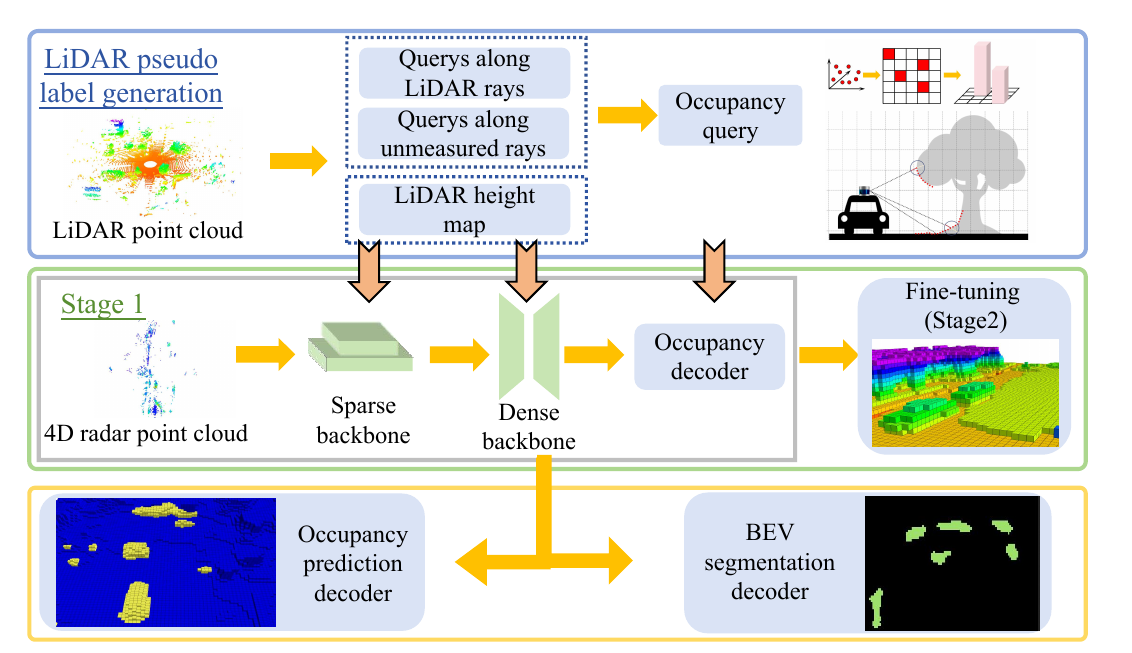
Within dense spatial perception, point-wise semantic segmentation remains an early-stage direction, whereas grid- and voxel-based occupancy prediction has developed rapidly into a major 4D radar task. Point-wise segmentation assigns semantic labels only to measured radar returns, while occupancy prediction estimates free, occupied, and semantic states on a regular 3D grid, including locations without a return.
Existing point-wise segmentation studies are dominated by cross-modal knowledge distillation.
Dynamic Dense Scene Understanding
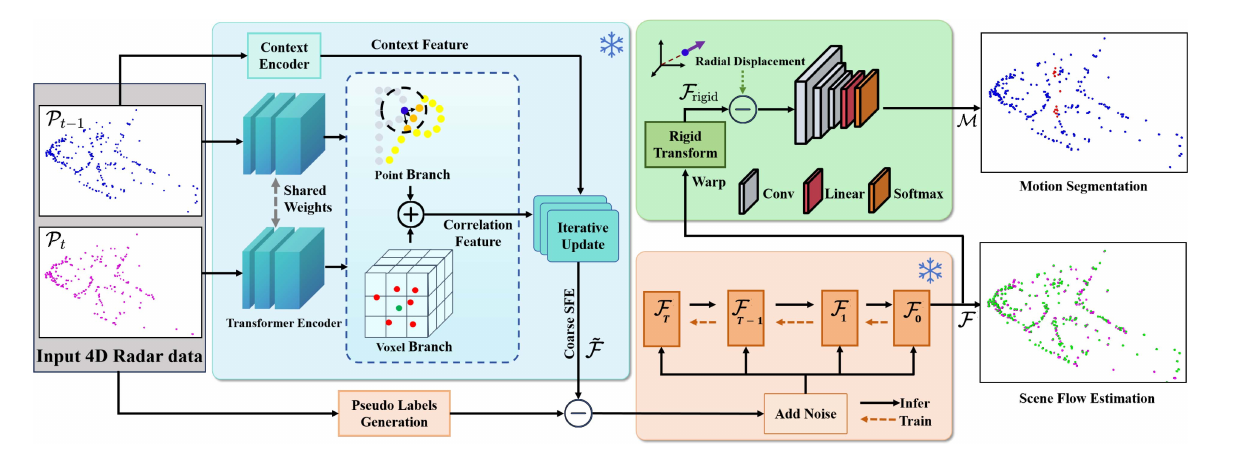
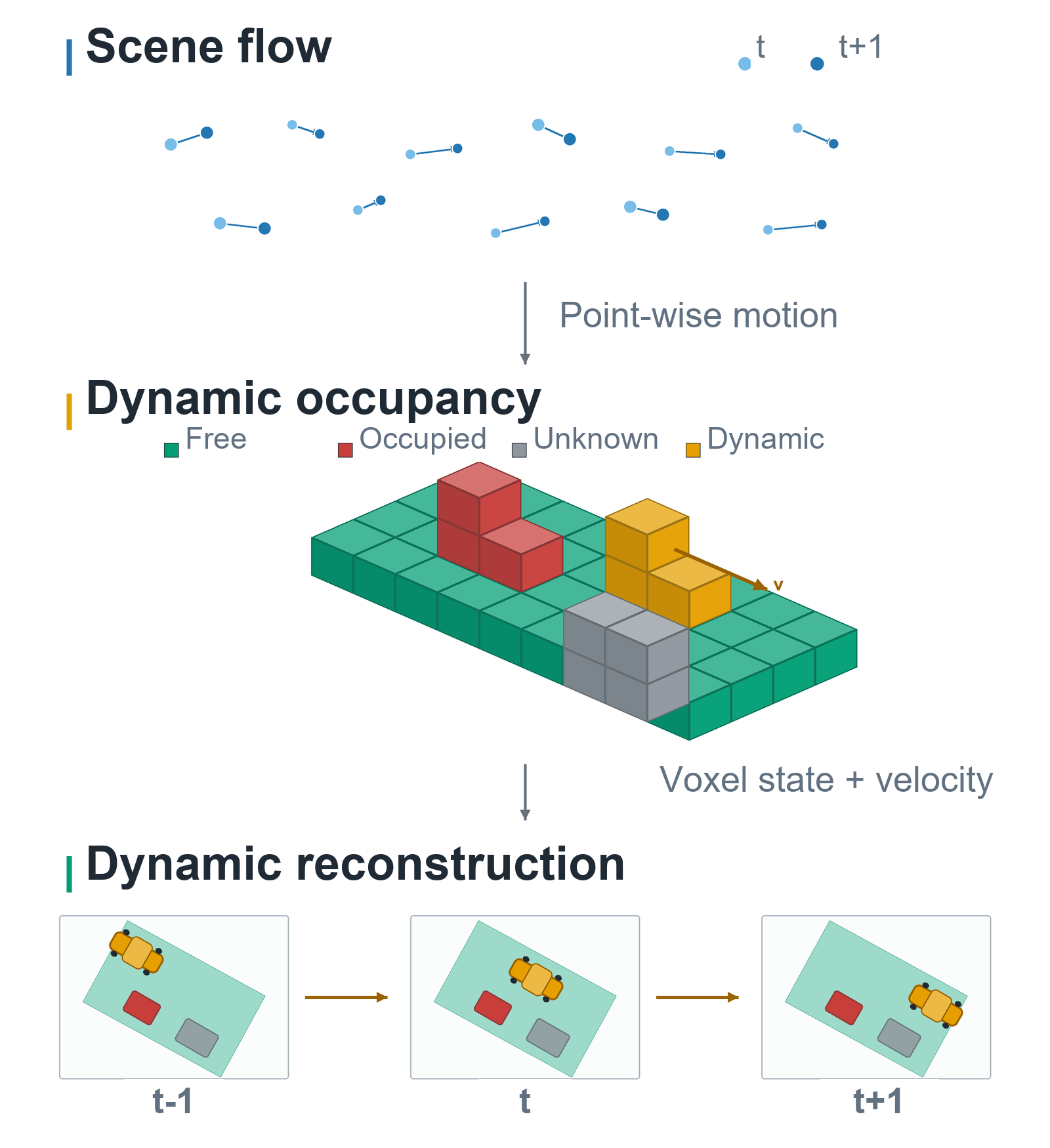
Dynamic dense scene understanding is an exploratory direction that aims to represent both spatial structure and temporal evolution. Existing studies provide partial solutions at three levels—point-wise motion, temporally updated voxel states, and cross-frame scene reconstruction. However, a unified representation connecting these outputs has not yet emerged. Figure 8 summarizes these three conceptual levels.
At the point level, scene-flow methods recover the 3D motion of sparse radar returns between adjacent frames.
Datasets and Benchmark Protocols
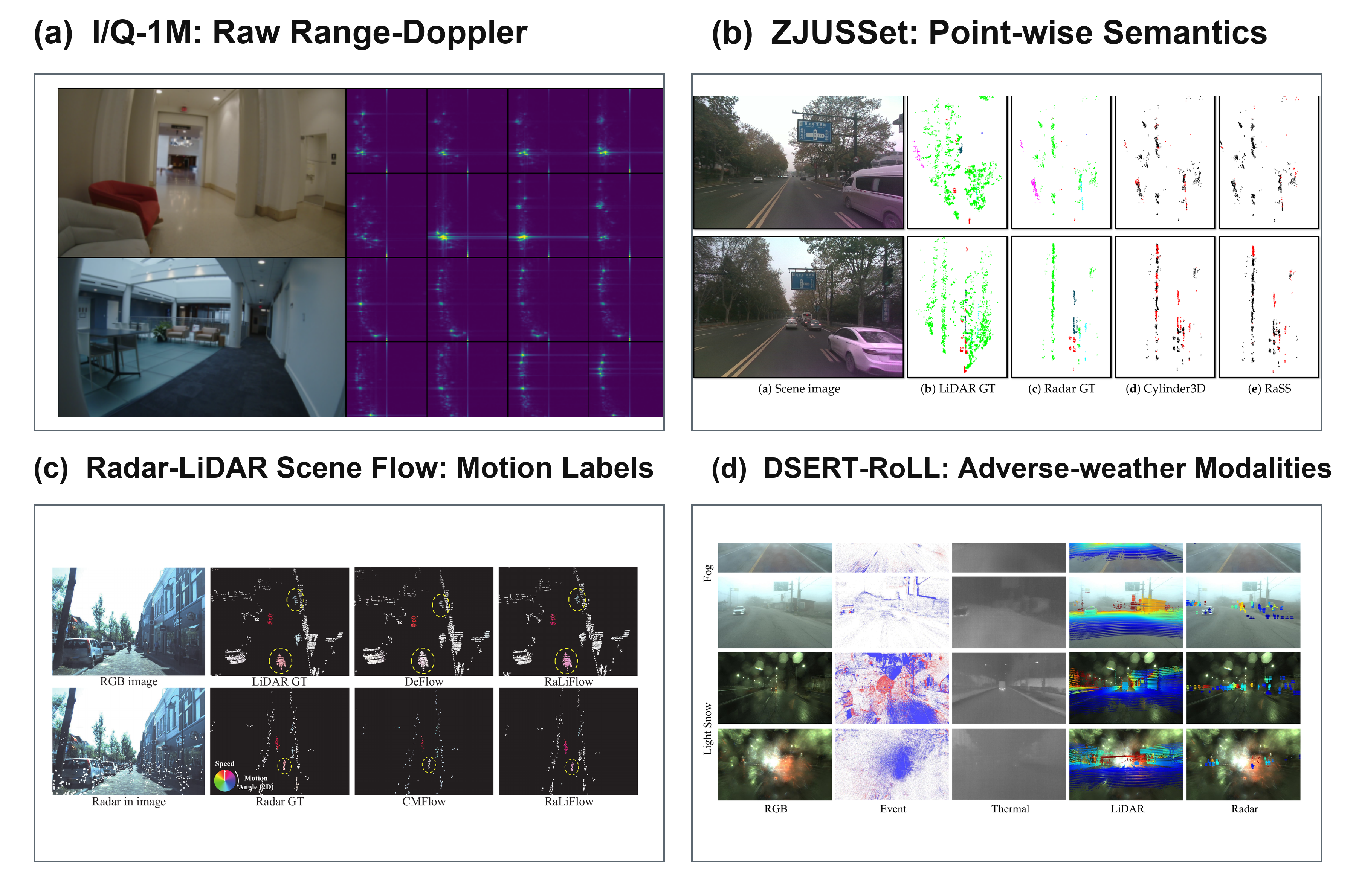
Early 4D radar datasets concentrated on object-level perception. VoD and TJ4DRadSet established point-cloud benchmarks for 3D detection, while K-Radar added radar tensors and adverse-weather sequences. RaDelft subsequently provided lower-level radar data for automotive radar detection [ 80 ] . Task coverage later expanded beyond detection.
ZJUSSet provides point-wise semantic labels, and the Radar-LiDAR Scene Flow Dataset repurposes synchronized VoD sequences with generated motion labels.
Challenges and Future Directions
First, measurement-level automotive radar data remain scarce because many road-driving datasets release processed point clouds rather than measurement-level I/Q data.
Future datasets should jointly release raw I/Q, radar tensors, point clouds, BEV products, and synchronized auxiliary sensors together with the calibration, synchronization, waveform, array, CFAR, and point-cloud-generation parameters needed to reproduce front-end processing. Second, cross-modal supervision should not be limited to LiDAR-like geometric completion.
Sources and Demonstrations
Figures are reproduced from Wu et al. See the full paper for experimental details and the project page, when the paper links one, for demonstrations and videos.
Related Papers
A Review Of Robotic World Models For Dynamic Environments Based On Factor And Scene Graphs
Marco Giberna, Miguel Fernandez-Cortizas, Jose Luis Sanchez Lopez et al.
Models based on graphs have emerged in robotics as a powerful foundation for internal world representations, where factor and scene graphs are among the most prominent model types found in the related literature and in successful robotic solutions.

A Sim-to-Real Integration Pipeline for Training and Deployment of Chunk-Based VLA Manipulation Policies
Mathilde Kappel, Clémence Grislain, Mohamed Chetouani et al.
Vision-Language-Action (VLA) models have become a prominent paradigm for mapping multimodal inputs, including semantic instructions, visual observations of the scene, and proprioceptive observations, to robot actions.
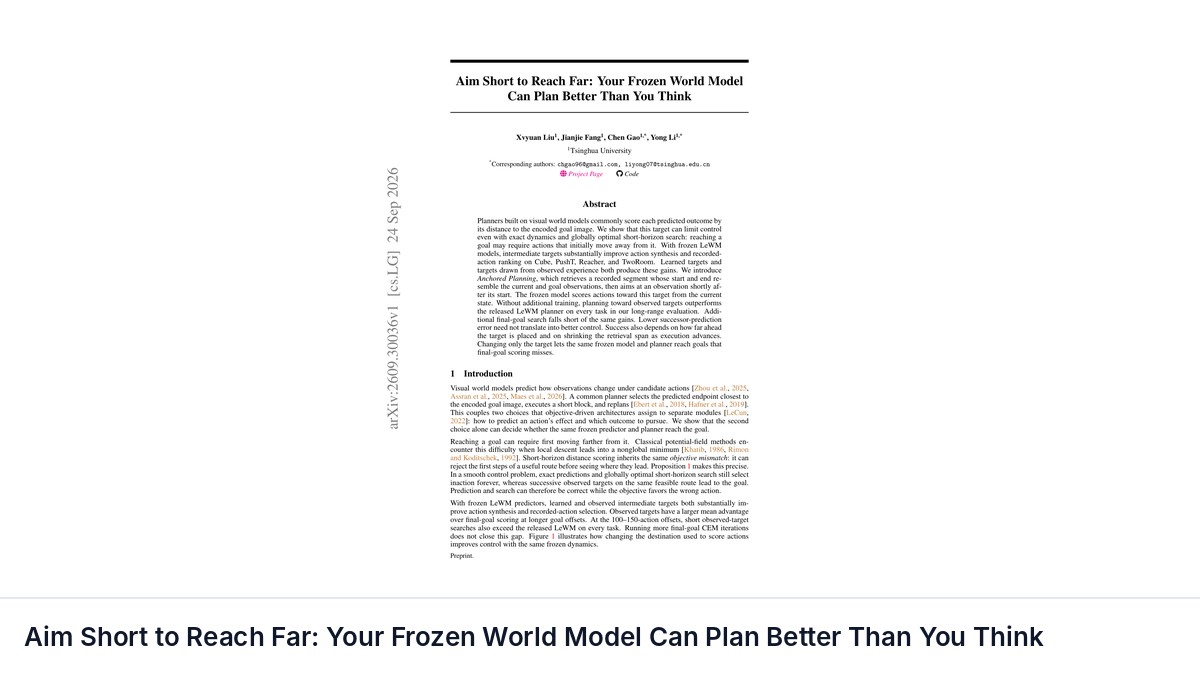
Aim Short to Reach Far: Your Frozen World Model Can Plan Better Than You Think
Xvyuan Liu, Jianjie Fang, Chen Gao et al.
Planners built on visual world models commonly score each predicted outcome by its distance to the encoded goal image. We show that this target can limit control even with exact dynamics and globally optimal short-horizon search: reaching a goal may require actions that initially move away from it.
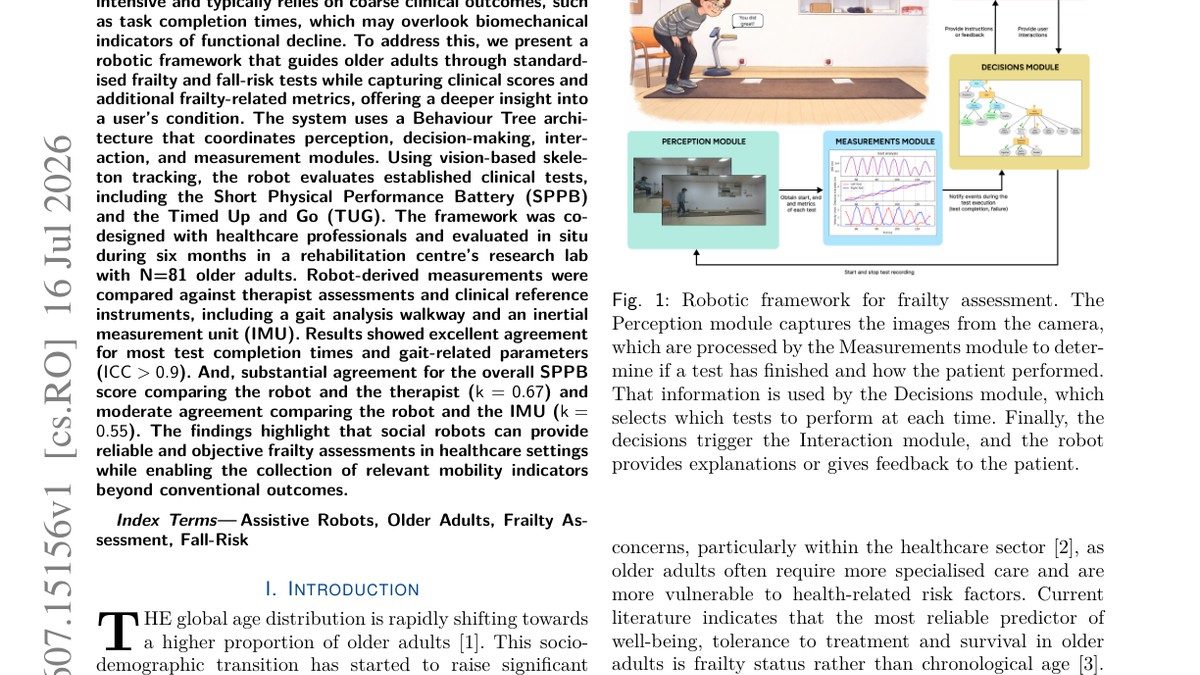
Assessing Physical Frailty and Fall-Risk Indicators with Social Robots: An in situ Evaluation with Older Adults
Aniol Civit, Antonio Andriella, Alba Martínez et al.
Frailty assessments are crucial to evaluate the risk of adverse events and the health and social care needs of older adults, yet their administration remains resource-intensive and typically relies on coarse clinical outcomes, such as task completion times, which may overlook biomechanical indicators of functional decline.