
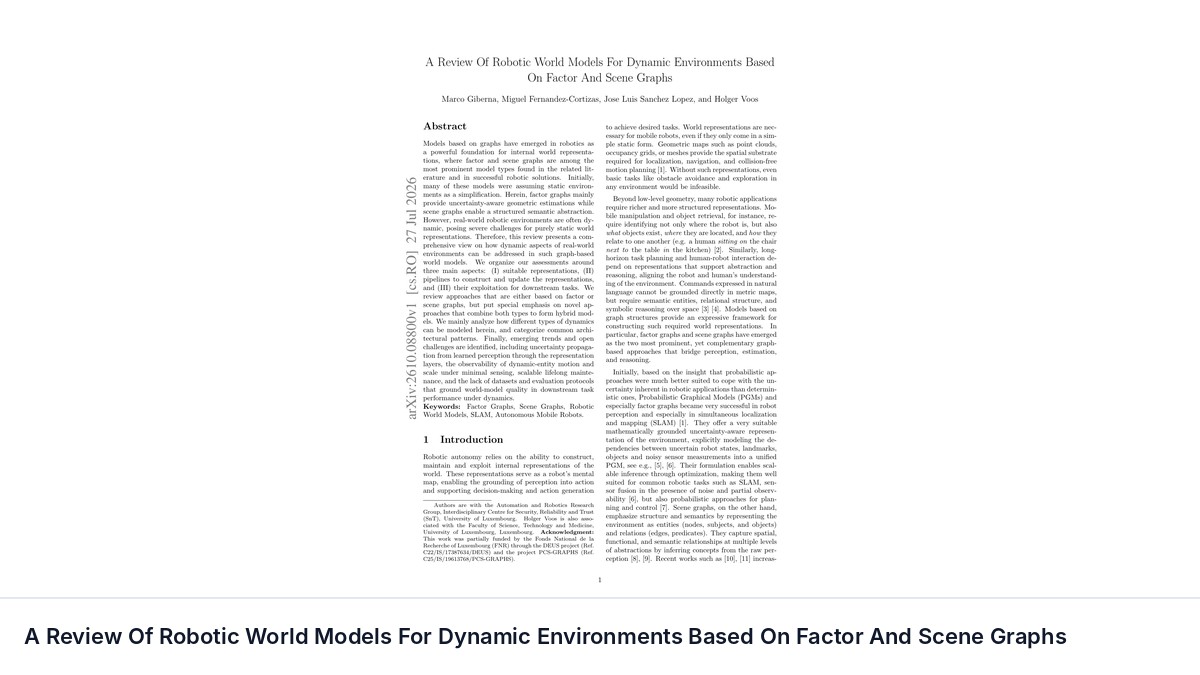
A Review Of Robotic World Models For Dynamic Environments Based On Factor And Scene Graphs
Marco Giberna, Miguel Fernandez-Cortizas, Jose Luis Sanchez Lopez, Holger Voos · N/A · 2026
Framework
N/A
License
N/A
Stars
N/A
Summary
Models based on graphs have emerged in robotics as a powerful foundation for internal world representations, where factor and scene graphs are among the most prominent model types found in the related literature and in successful robotic solutions.
Abstract Summary
Key Points
- Models based on graphs have emerged in robotics as a powerful foundation for internal world representations, where factor and scene graphs are among the most prominent model types found in the related literature and in successful robotic solutions.
- Initially, many of these models were assuming static environments as a simplification
- Herein, factor graphs mainly provide uncertainty-aware geometric estimations while scene graphs enable a structured semantic abstraction.
- However, real-world robotic environments are often dynamic, posing severe challenges for purely static world representations.
- Therefore, this review presents a comprehensive view on how dynamic aspects of real-world environments can be addressed in such graph-based world models.
A Review Of Robotic World Models For Dynamic Environments Based On Factor And Scene Graphs
|Authors: Marco Giberna, Miguel Fernandez-Cortizas, Jose Luis Sanchez Lopez, Holger Voos
|Venue: arXiv preprint | Year: 2026
|arXiv: 2610.08800
Abstract
Models based on graphs have emerged in robotics as a powerful foundation for internal world representations, where factor and scene graphs are among the most prominent model types found in the related literature and in successful robotic solutions. Initially, many of these models were assuming static environments as a simplification. Herein, factor graphs mainly provide uncertainty-aware geometric estimations while scene graphs enable a structured semantic abstraction. However, real-world robotic environments are often dynamic, posing severe challenges for purely static world representations. Therefore, this review presents a comprehensive view on how dynamic aspects of real-world environments can be addressed in such graph-based world models. We organize our assessments around three main aspects: (I) suitable representations, (II) pipelines to construct and update the representations, and (III) their exploitation for downstream tasks. We review approaches that are either based on factor or scene graphs, but put special emphasis on novel approaches that combine both types to form hybrid models. We mainly analyze how different types of dynamics can be modeled herein, and categorize common architectural patterns. Finally, emerging trends and open challenges are identified, including uncertainty propagation from learned perception through the representation layers, the observability of dynamic-entity motion and scale under minimal sensing, scalable lifelong maintenance, and the lack of datasets and evaluation protocols that ground world-model quality in downstream task performance under dynamics.
Key Contributions
- Models based on graphs have emerged in robotics as a powerful foundation for internal world repre…
- Initially, many of these models were assuming static environments as a simplification
- Herein, factor graphs mainly provide uncertainty-aware geometric estimations while scene graphs e…
- However, real-world robotic environments are often dynamic, posing severe challenges for purely s…
- Therefore, this review presents a comprehensive view on how dynamic aspects of real-world environ…
Topics
- vision
- reinforcement-learning
- benchmark
Code & Data
No code repository linked in paper metadata.
BibTeX
@article{Giberna2026_261008800,
  title     = {A Review Of Robotic World Models For Dynamic Environments Based On Factor And Scene Graphs},
  author    = {Marco Giberna and Miguel Fernandez-Cortizas and Jose Luis Sanchez Lopez and Holger Voos},
  year      = {2026},
  eprint    = {2610.08800},
  archivePrefix = {arXiv},
  primaryClass  = {cs.RO},
  url       = {https://arxiv.org/abs/2610.08800}
}
Related Papers
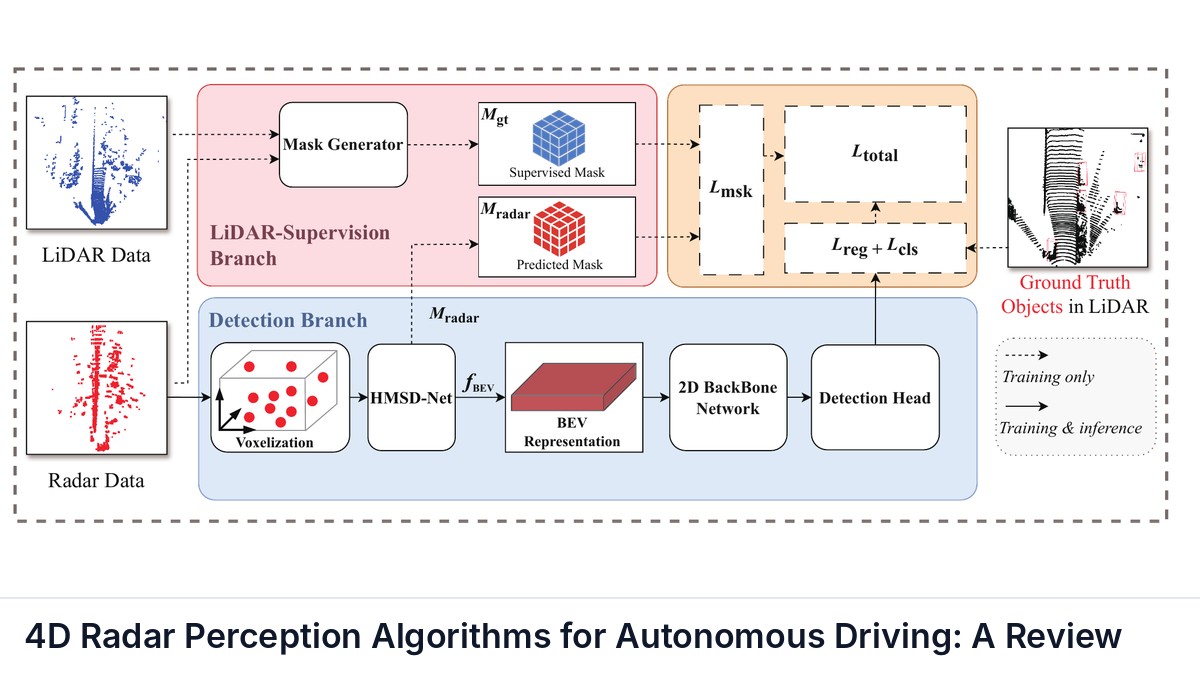
4D Radar Perception Algorithms for Autonomous Driving: A Review
Xumin Wu, Jun Zhou, Jilin Mei et al.
Research on 4D millimeter-wave radar perception algorithms has flourished in recent years, extending from signal processing and object detection to semantic segmentation, motion estimation, occupancy prediction, and dynamic scene reconstruction.

A Sim-to-Real Integration Pipeline for Training and Deployment of Chunk-Based VLA Manipulation Policies
Mathilde Kappel, Clémence Grislain, Mohamed Chetouani et al.
Vision-Language-Action (VLA) models have become a prominent paradigm for mapping multimodal inputs, including semantic instructions, visual observations of the scene, and proprioceptive observations, to robot actions.
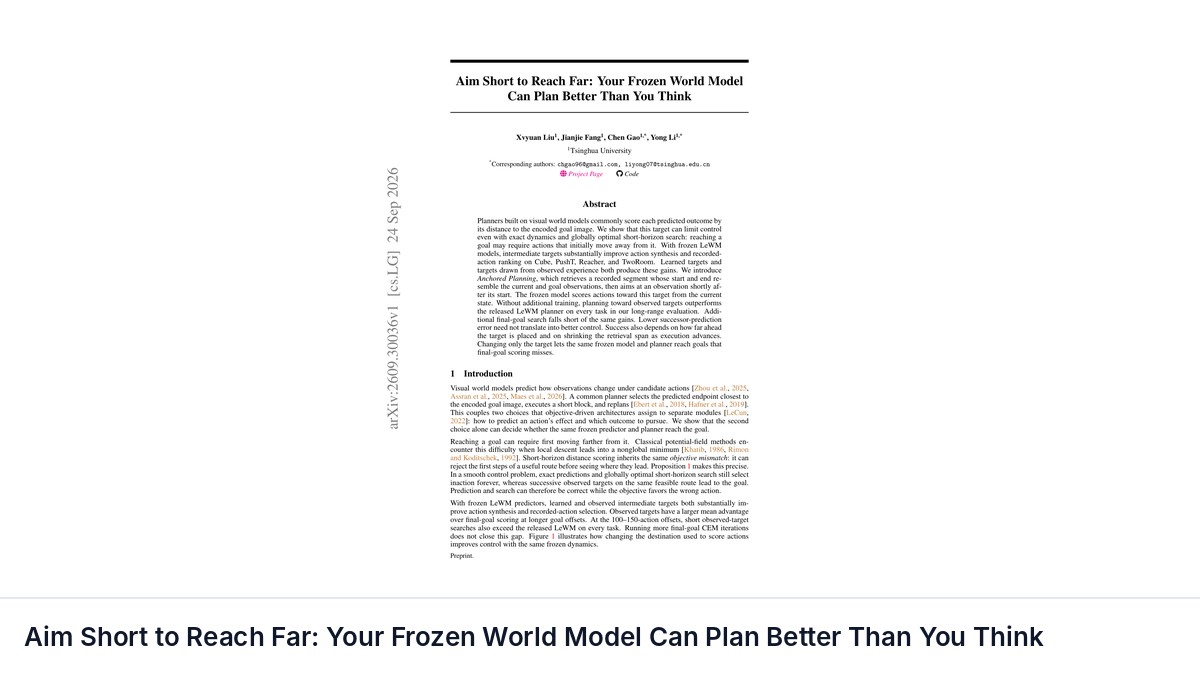
Aim Short to Reach Far: Your Frozen World Model Can Plan Better Than You Think
Xvyuan Liu, Jianjie Fang, Chen Gao et al.
Planners built on visual world models commonly score each predicted outcome by its distance to the encoded goal image. We show that this target can limit control even with exact dynamics and globally optimal short-horizon search: reaching a goal may require actions that initially move away from it.
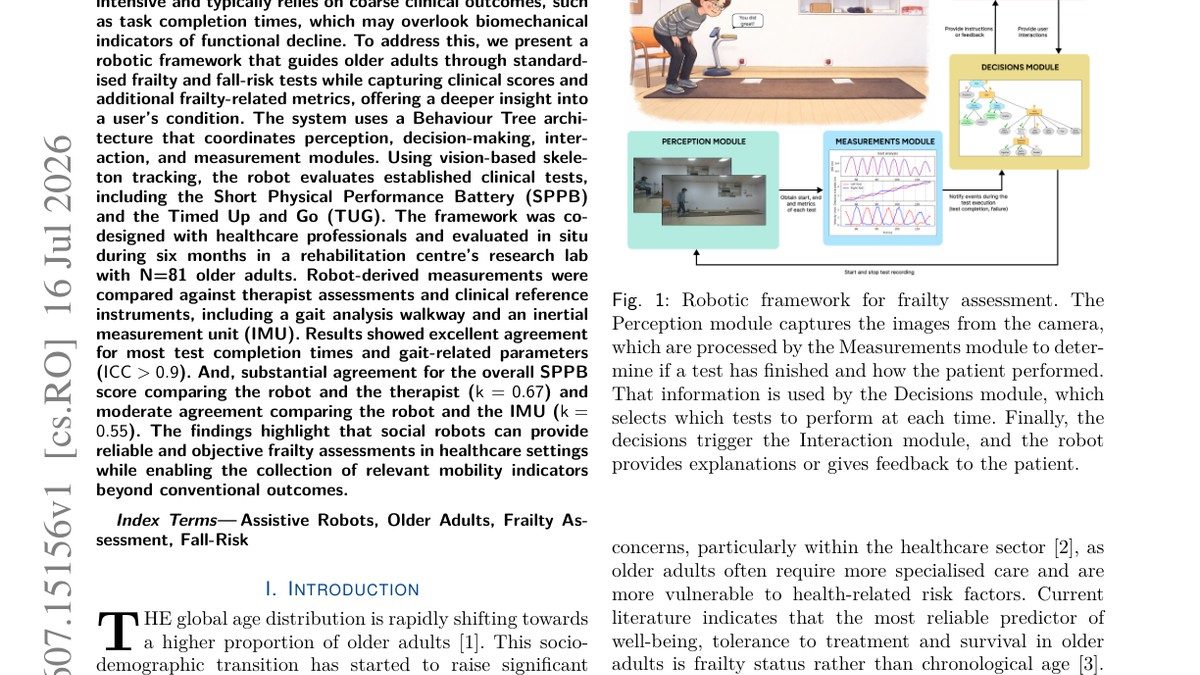
Assessing Physical Frailty and Fall-Risk Indicators with Social Robots: An in situ Evaluation with Older Adults
Aniol Civit, Antonio Andriella, Alba Martínez et al.
Frailty assessments are crucial to evaluate the risk of adverse events and the health and social care needs of older adults, yet their administration remains resource-intensive and typically relies on coarse clinical outcomes, such as task completion times, which may overlook biomechanical indicators of functional decline.