
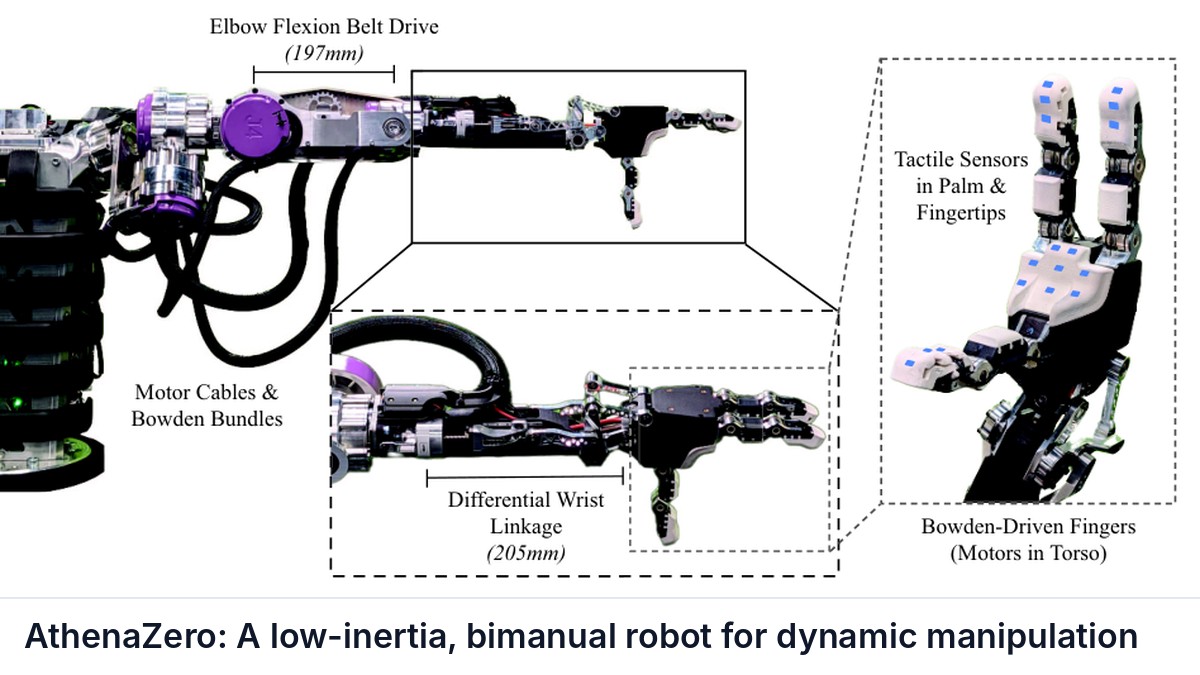
AthenaZero: A low-inertia, bimanual robot for dynamic manipulation
Andrew S. Morgan, Gregory Xie, Capprin Bass, Rachel Thomasson, Chunpeng Wang, Erfan Shahriari, Harrison Busa, Oluwaseun Araromi, Joseph Aronov, Michael Burgess, Velin D. Dimitrov, Matthew A. Estrada, Faris Hamdi, Samuel Kendig, Taeyoon Lee, Jose Oscar Mur-Miranda, Emma Sommers, Paul Titchener, Margaret Wang, Achu Wilson, Mark Yeatman, Osman Dogan Yirmibesoglu, Alfred A. Rizzi, Annan Mozeika, Nicolas Rojas, Lael Odhner · N/A · 2026
Framework
N/A
License
N/A
Stars
N/A
Summary
AthenaZero is a bimanual manipulator designed to minimize inertia without compromising control authority.
Abstract Summary
Key Points
- AthenaZero is a bimanual manipulator designed to minimize inertia without compromising control authority.
- By utilizing quasi-direct drive actuation and transmission remotization techniques, the system achieves an effective endpoint mass comparable to that of a human---about an order of magnitude less than conventional robot manipulators.
- This characteristic, combined with its inherent torque transparency, makes AthenaZero exceptionally well-suited for dynamic manipulation.
- We describe the methodology} that led to this design and demonstrate the robot's capabilities on three baseball-inspired tasks: throwing, catching, and batting, which showcase complex interactions on human-comparable timescales where milliseconds matter.
- AthenaZero was capable of throwing at speeds in excess of 30 m/s, with catching and batting at speeds in excess of 14 m/s over a short 7.3 m distance.
Results
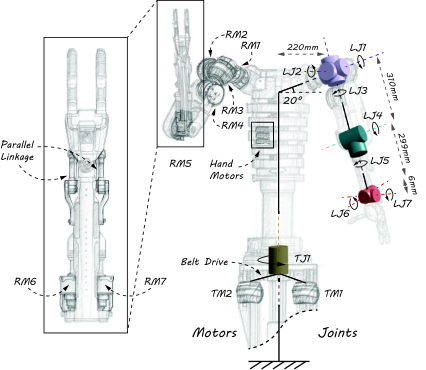
AthenaZero is a bimanual robot consisting of a 1 DoF torso, two 7 DoF arms, and two 6 DoF hands (Fig. 2 ). The entire robot is powered by a family of four custom quasi-direct drive, and highly force-transparent actuators in 95 mm, 76 mm, 38 mm, and 25 mm diameter variations. The robot stands at about 1.6 m tall with an approximate wingspan of 1.8 m.
The shoulders have a 0.44 m lateral separation, modeled after a human male.
Materials and Methods
Actuator design reigns as a central ingredient to execute our design methodology. To minimize reflected inertia and maximize transparency, we utilize quasi-direct drive motors. Since we aim for human-like mass properties, we concurrently require human-like torques, deriving our targets from the isometric torque production of equivalent human joints [ 46 , 40 , 77 ] .
Sources and Demonstrations
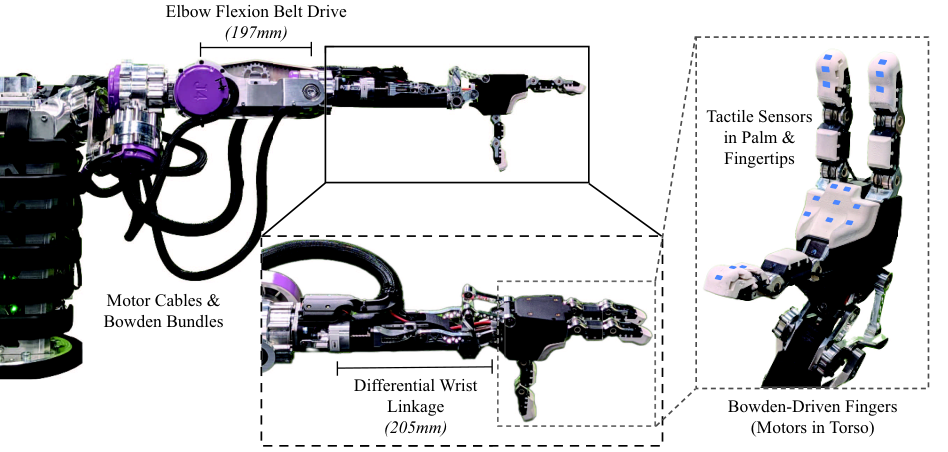
Figures are reproduced from Morgan et al. See the full paper for experimental details and the project page, when the paper links one, for demonstrations and videos.
Related Papers
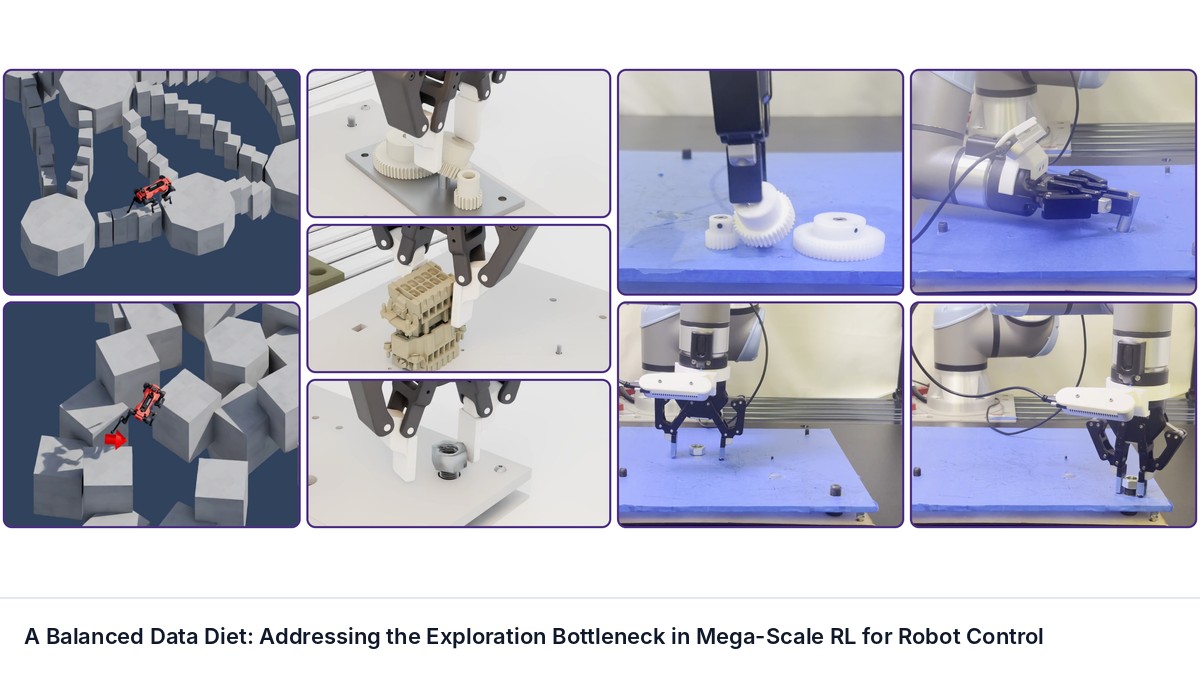
A Balanced Data Diet: Addressing the Exploration Bottleneck in Mega-Scale RL for Robot Control
Octi Zhang, Mateo Guaman Castro, Patrick Yin et al.
General-purpose robots must perform a wide range of tasks from agile locomotion to dexterous manipulation.
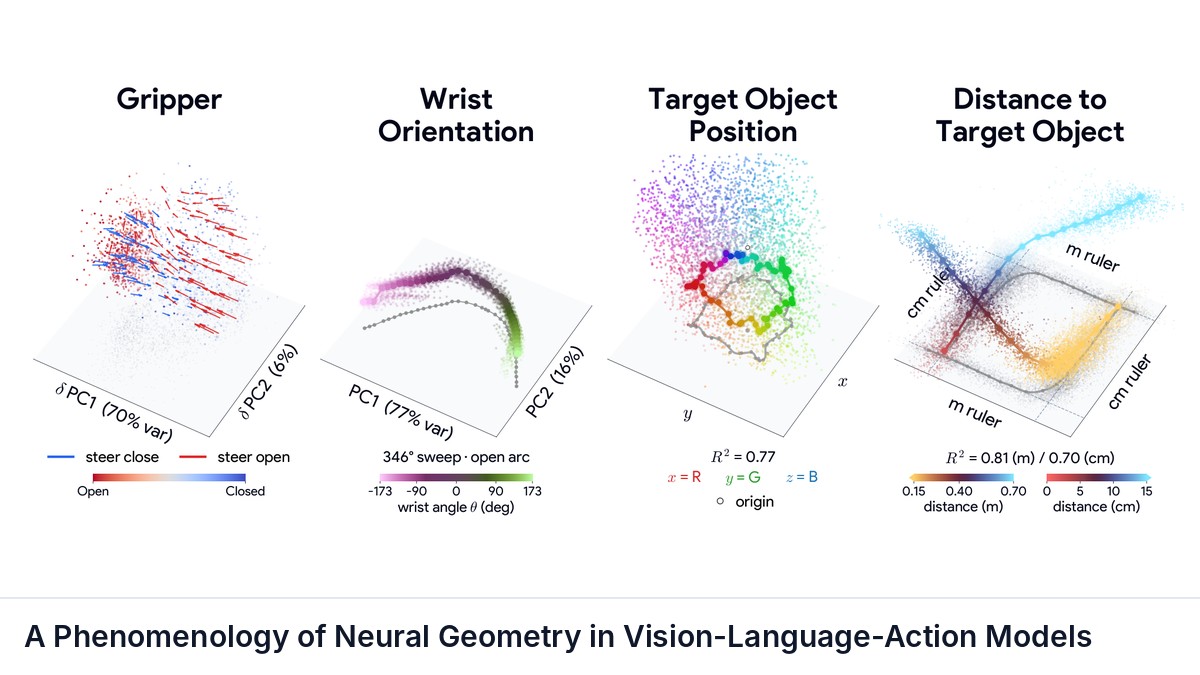
A Phenomenology of Neural Geometry in Vision-Language-Action Models
Mozes Jacobs, Aiden Swann, Mathilde Papillon et al.
Robotic manipulation is inherently geometric, but what shape does the world take inside the policy that performs it?
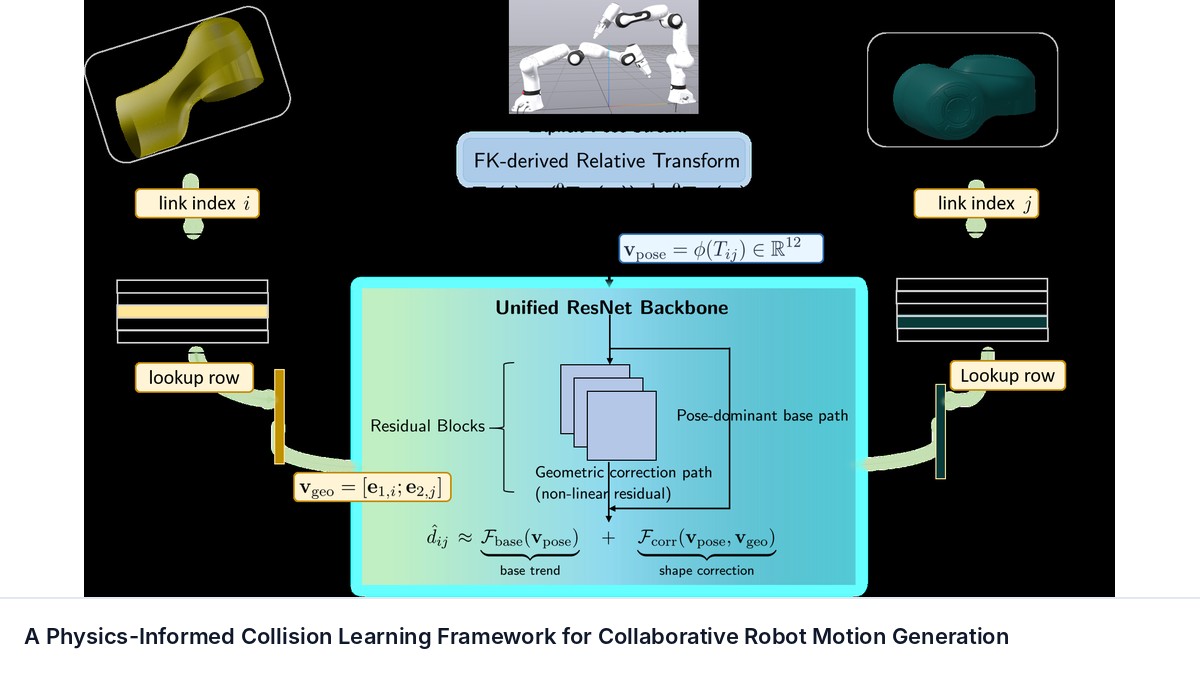
A Physics-Informed Collision Learning Framework for Collaborative Robot Motion Generation
Chen Cai, Steven Liu
Close-proximity multi-arm manipulation requires collision models that are both geometrically accurate and differentiable enough for real-time optimization.

A Sim-to-Real Integration Pipeline for Training and Deployment of Chunk-Based VLA Manipulation Policies
Mathilde Kappel, Clémence Grislain, Mohamed Chetouani et al.
Vision-Language-Action (VLA) models have become a prominent paradigm for mapping multimodal inputs, including semantic instructions, visual observations of the scene, and proprioceptive observations, to robot actions.