
A Physics-Informed Collision Learning Framework for Collaborative Robot Motion Generation
Chen Cai, Steven Liu · N/A · 2026
Framework
N/A
License
N/A
Stars
N/A
Summary
Close-proximity multi-arm manipulation requires collision models that are both geometrically accurate and differentiable enough for real-time optimization.
Abstract Summary
Key Points
- Close-proximity multi-arm manipulation requires collision models that are both geometrically accurate and differentiable enough for real-time optimization.
- Classical geometry checkers provide reliable distances but are difficult to use inside gradient-based model predictive control, while conservative proxy models can restrict tightly coupled motion.
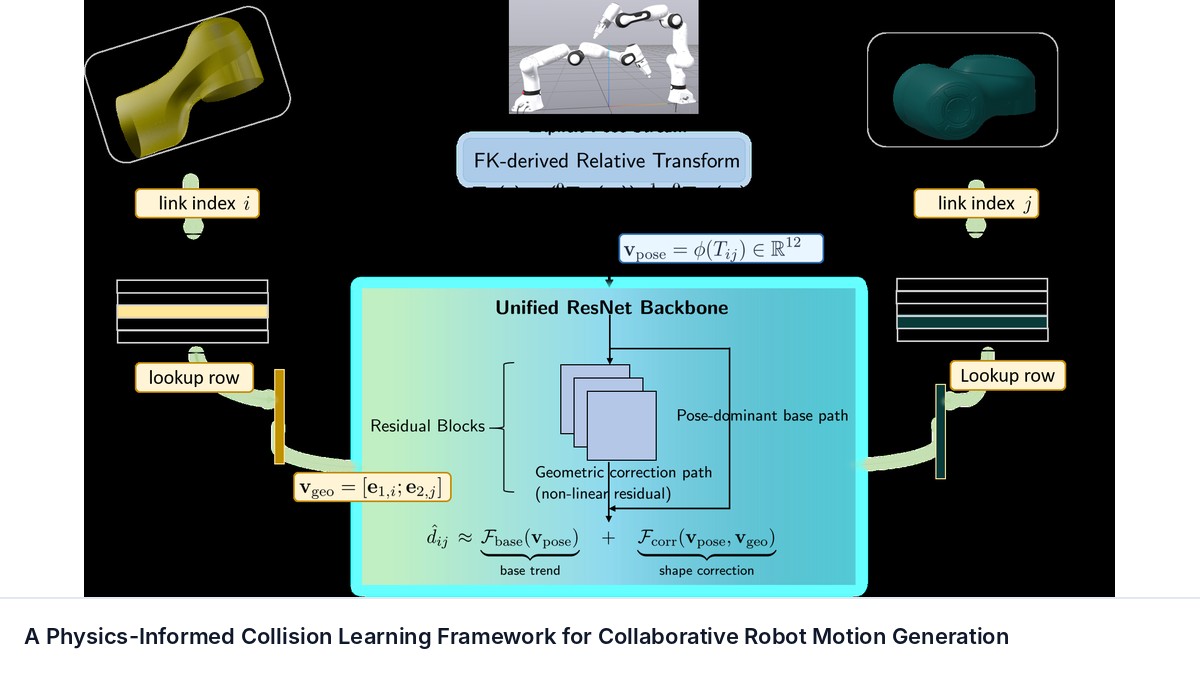
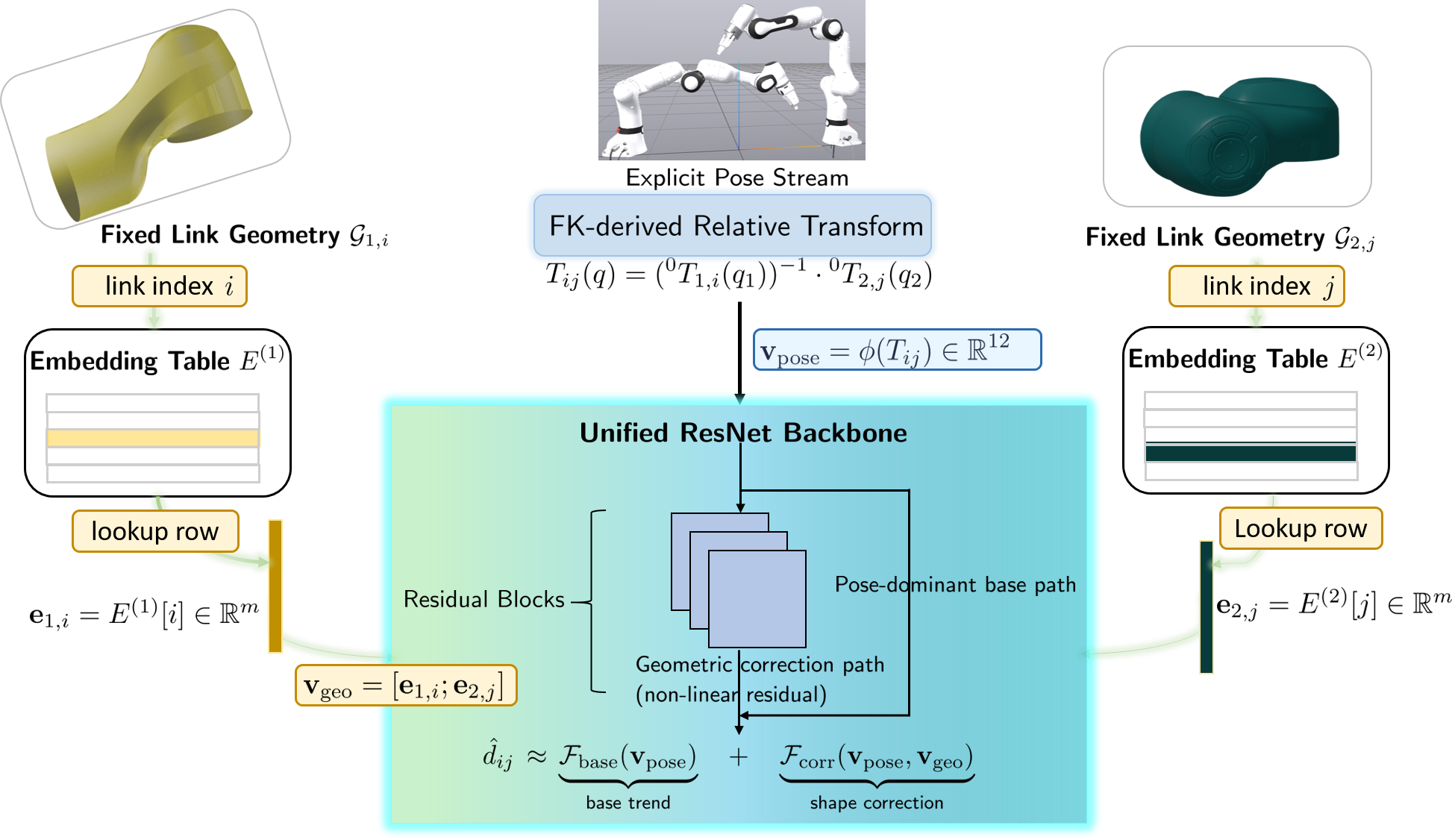
- We present PI-UDF, a physics-informed unified differentiable framework for body-to-body collision distance prediction between articulated robots.
- PI-UDF combines analytical forward kinematics with learnable link-geometry embeddings and a shared residual network to predict pairwise inter-arm distances directly from robot configurations.
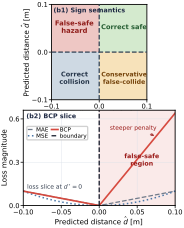
- To improve safety-critical fidelity, we combine quota-driven boundary mining with an asymmetric boundary-crossing penalty that emphasizes false-safe sign errors near the collision boundary.
Physics Informed Unified Collision Learning Framework
Consider a collaborative system comprising two manipulators with joint configurations $q_{1}\in\mathbb{R}^{n_{1}}$ and $q_{2}\in\mathbb{R}^{n_{2}}$. We denote the full dual-arm configuration by $q=[q_{1}^{\top},q_{2}^{\top}]^{\top}\in\mathbb{R}^{n_{1}+n_{2}}$. Let $\mathcal{V}_{r}(q_{r})\subset\mathbb{R}^{3}$ be the workspace volume occupied by robot $r\in\{1,2\}$ at configuration $q_{r}$.
Network Evaluation and Ablation Studies
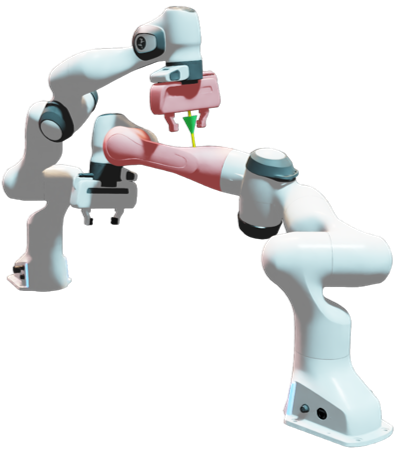
To rigorously evaluate the proposed framework, we structure our experiments to assess both system-level safety and the underlying architectural choices. As illustrated in Fig. 1 (a), we evaluate PI-UDF on a fixed-cell dual-arm system consisting of two 7-DoF Franka Emika Panda arms with a fixed relative base placement (inter-base offset $1.16\,\mathrm{m}$, opposing orientations $[0,\pi]$ rad).
OPTIMIZATION-BASED Motion PLANNING INTEGRATION
PI-UDF is actually agnostic to the downstream motion generator. In this work, we instantiate it as a differentiable inter-arm clearance term inside nonlinear model predictive control (NMPC).
Compared with reactive velocity-level collision avoidance based on simplified geometric proxies [ 13 ] , the predictive formulation optimizes tracking, regularization, hardware limits, and inter-arm clearance jointly over a finite horizon.
Real-Robot Experiments
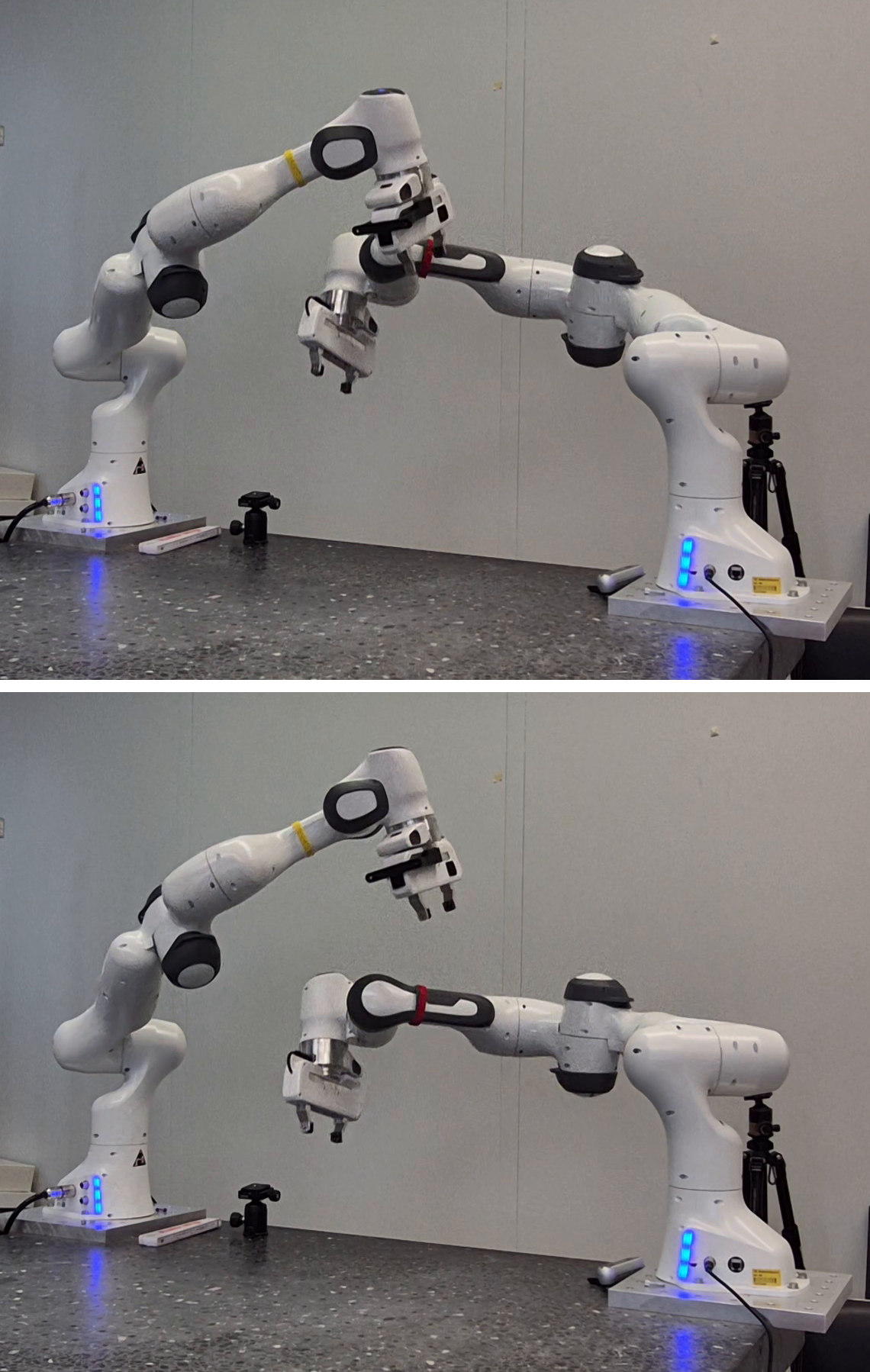
Building on the model evaluation and NMPC formulation of Secs. III–IV, we evaluate PI-UDF as a differentiable safety primitive for closed-loop dual-arm hardware control. All experiments are conducted on a dual Franka Emika Panda system with a fixed relative base placement; the two arms share a common workspace and therefore require continuous inter-arm collision reasoning during execution.
Sources and Demonstrations
Figures are reproduced from Cai et al. See the full paper for experimental details and the project page, when the paper links one, for demonstrations and videos.
Related Papers
AD-WM: Action-Discriminative World Models for Counterfactual Model Predictive Control
Jiabin Qiu, Zixuan Chen, Hongye Cao et al.
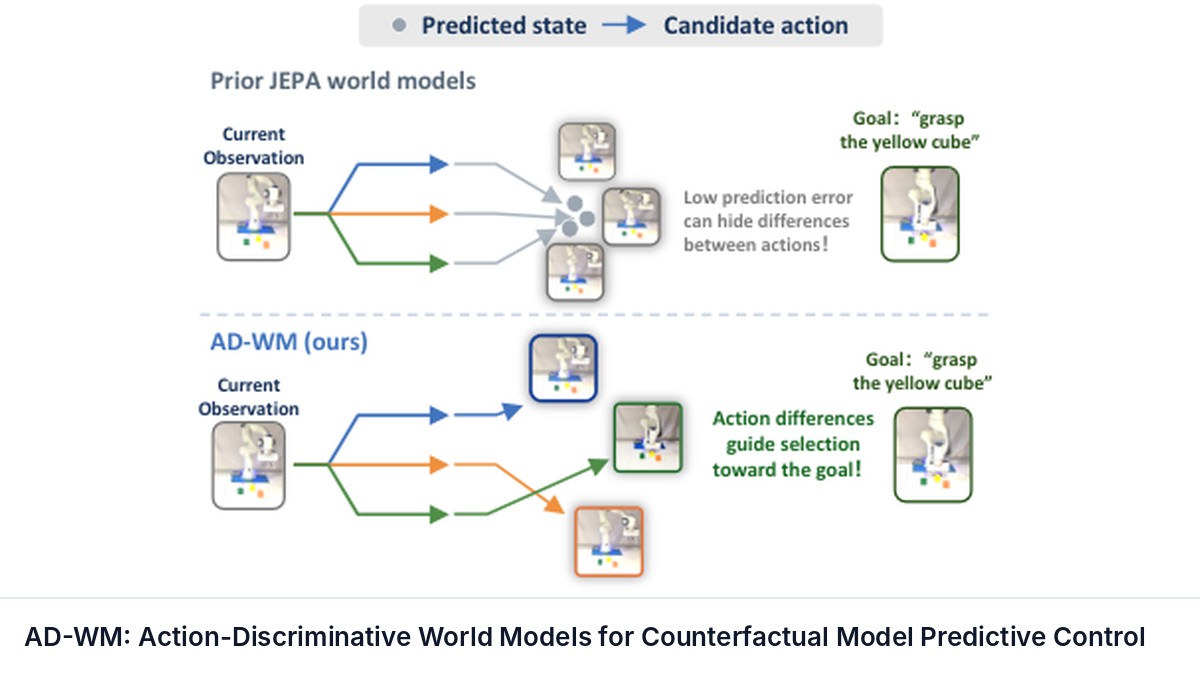
Latent world models are typically trained to predict factual transitions, whereas model predictive control (MPC) must compare alternative actions from the same state. A model can therefore achieve low factual prediction error yet poorly distinguish candidate actions.
AHEAD: Anticipatory Hand-Driven Teleoperation via Human Intent Prediction
Seok Joon Kim, Junho Lee, Federica Spinola et al.
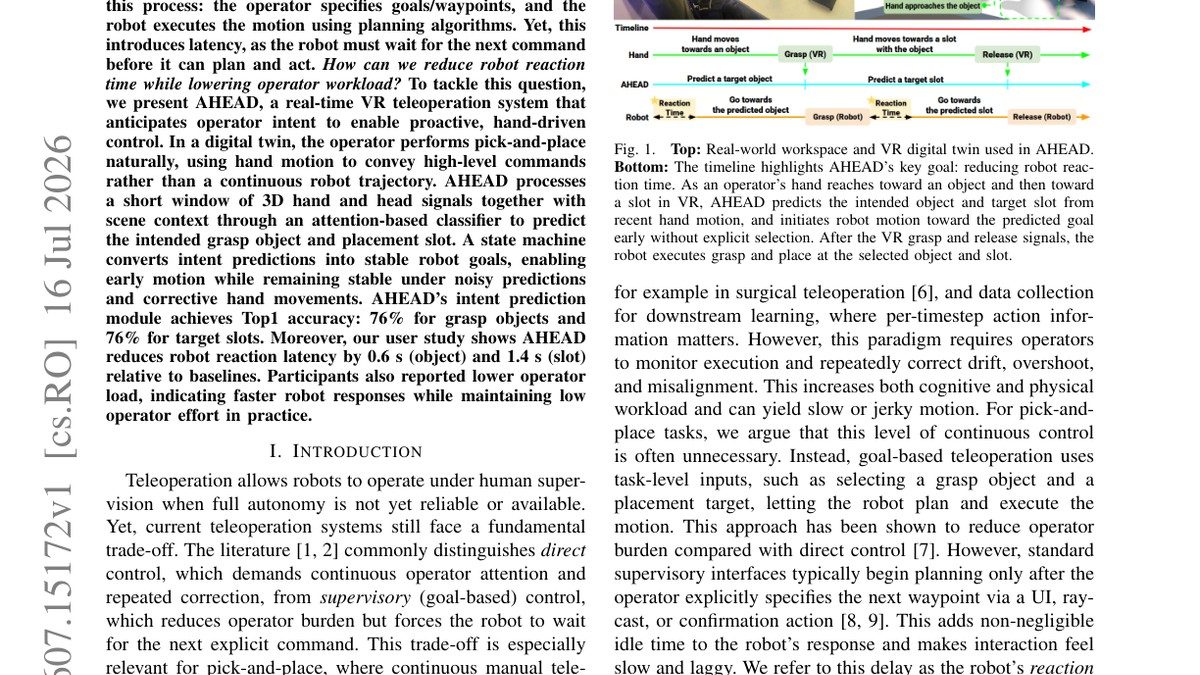
Direct hand-driven teleoperation maps an operator's hand motion to robot end-effector commands at every frame, enabling precise control, but it requires constant monitoring and correction during approach, grasp, and placement, which can be slow and fatiguing.
Aim Short to Reach Far: Your Frozen World Model Can Plan Better Than You Think
Xvyuan Liu, Jianjie Fang, Chen Gao et al.
Planners built on visual world models commonly score each predicted outcome by its distance to the encoded goal image. We show that this target can limit control even with exact dynamics and globally optimal short-horizon search: reaching a goal may require actions that initially move away from it.
Autonomous Droplet Navigation via Model-Based Reinforcement Learning: Zero-Shot Transfer and Emergent Dynamics
Rajneesh Anand, Mayuresh V. Kothare
Self-driving laboratories (SDLs) are transforming chemical and materials discovery through closed-loop automation, yet automated infrastructure for physical manipulation of soft, deformable matter remains beyond current robotic platforms.