
Training-free Behavior Cloning
Maximilian Adang, Timothy Chen, Lars Osterberg, Aiden Swann, Mac Schwager · N/A · 2026
Framework
N/A
License
N/A
Stars
N/A
Summary
Neural behavior cloning compresses demonstrations into large models, making individual actions difficult to trace and policy updates costly. Retrieval policies retain access to demonstrations but struggle with mismatch between recorded and live behavior.
Abstract Summary
Key Points
- Neural behavior cloning compresses demonstrations into large models, making individual actions difficult to trace and policy updates costly.
- Retrieval policies retain access to demonstrations but struggle with mismatch between recorded and live behavior.
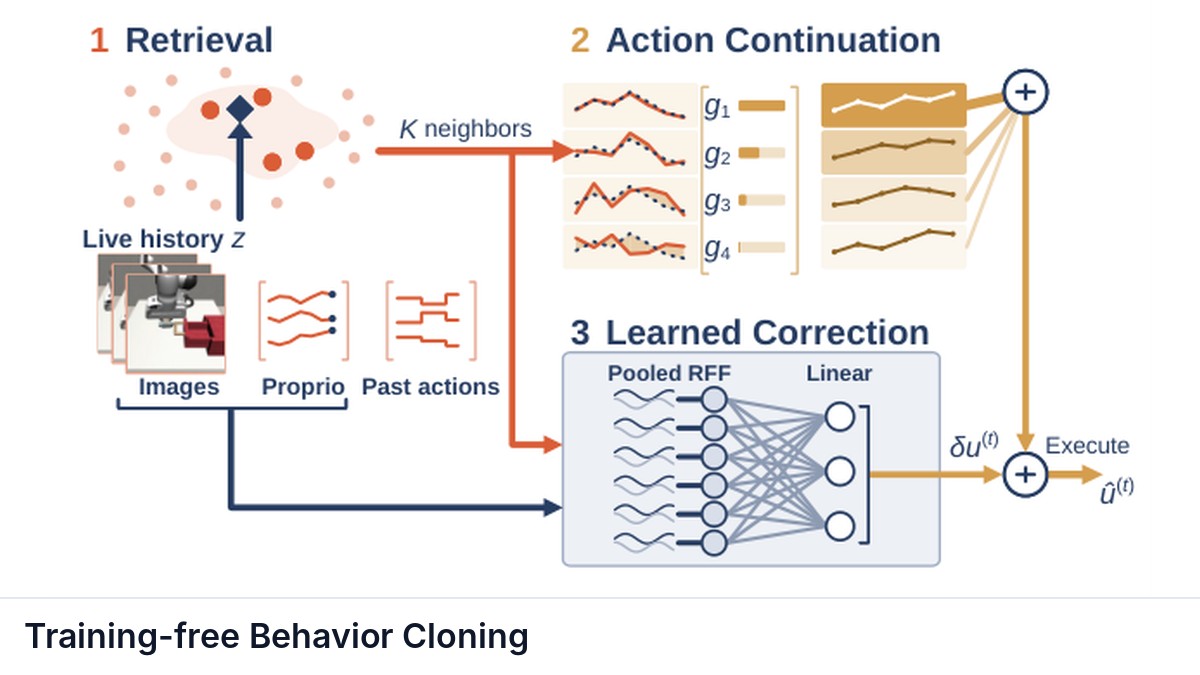
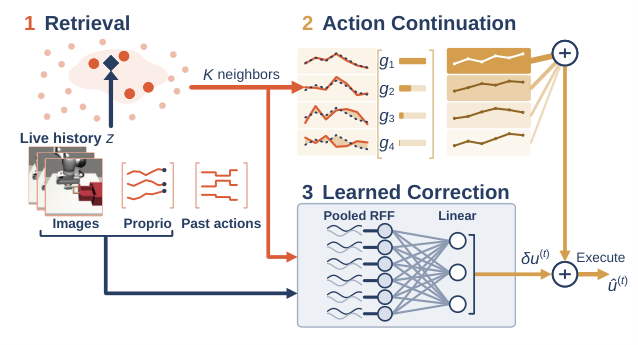
- We introduce Behavior Predictive Control (BPC), which synthesizes policies without end-to-end policy training by combining an action-aware retrieval metric, a Hankel-based action-continuation prior, and a closed-form one-step residual correction.
- Inspired by behavioral systems theory, BPC predicts future actions by blending stored observation-action data that best reconstructs the recent runtime observation--action history.
- Across simulated benchmarks and real-robot deployments, BPC is competitive with learned policies such as $π_{0.5}$ (surpassing it in some cases), while reducing policy fitting from hours to seconds on consumer GPUs and supporting closed-loop control upwards of 75 Hz on a Jetson Orin Nano.
Regularized Local Action Continuation
We adapt the trajectory-completion problem of De Persis and Tesi [ 15 , Sec. II-A, Problem 1] to behavior cloning: demonstration data constitutes a library of behaviors. Rather than predicting future observations based on a history of observations and executed actions, we seek to predict the expert action that should follow the observed history.
Time indices use parenthesized superscripts; library-column and demonstration indices use subscripts.
Extension to Nonlinear Behaviors
This perspective motivates two complementary components: future-informed retrieval to select the support for local continuation, and a shared-support nonlinear residual to correct errors that remain.
Because the action sensitivity $J_{z}$ is unknown, we use demonstrated continuations to fit a retrieval metric that favors histories predictive of valid future actions, while requiring only the observed history at deployment.
Results
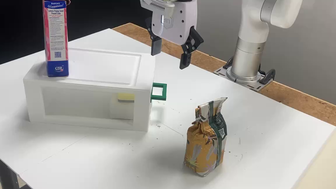
We test BPC on several hardware manipulation tasks using the UFactory xArm6. Full task descriptions are as follows: Coffee : Pick a bag of beans from a 30 cm by 30 cm area and place it on the drawer. Drawer : Open the drawer using the small handle, pick the sponge, place the sponge in the drawer, and then close the drawer.
Switch : Pick the bag of beans and place it on the opposite plate (either the left or right side).

Sources and Demonstrations
Figures are reproduced from Adang et al. See the full paper for experimental details and the project page, when the paper links one, for demonstrations and videos.
Related Papers

A Sim-to-Real Integration Pipeline for Training and Deployment of Chunk-Based VLA Manipulation Policies
Mathilde Kappel, Clémence Grislain, Mohamed Chetouani et al.
Vision-Language-Action (VLA) models have become a prominent paradigm for mapping multimodal inputs, including semantic instructions, visual observations of the scene, and proprioceptive observations, to robot actions.
Capability-Aware Arbitration for Semantic Intent-Based Shared Control
Zhaoda Du, Michael Bowman, Xiaoli Zhang
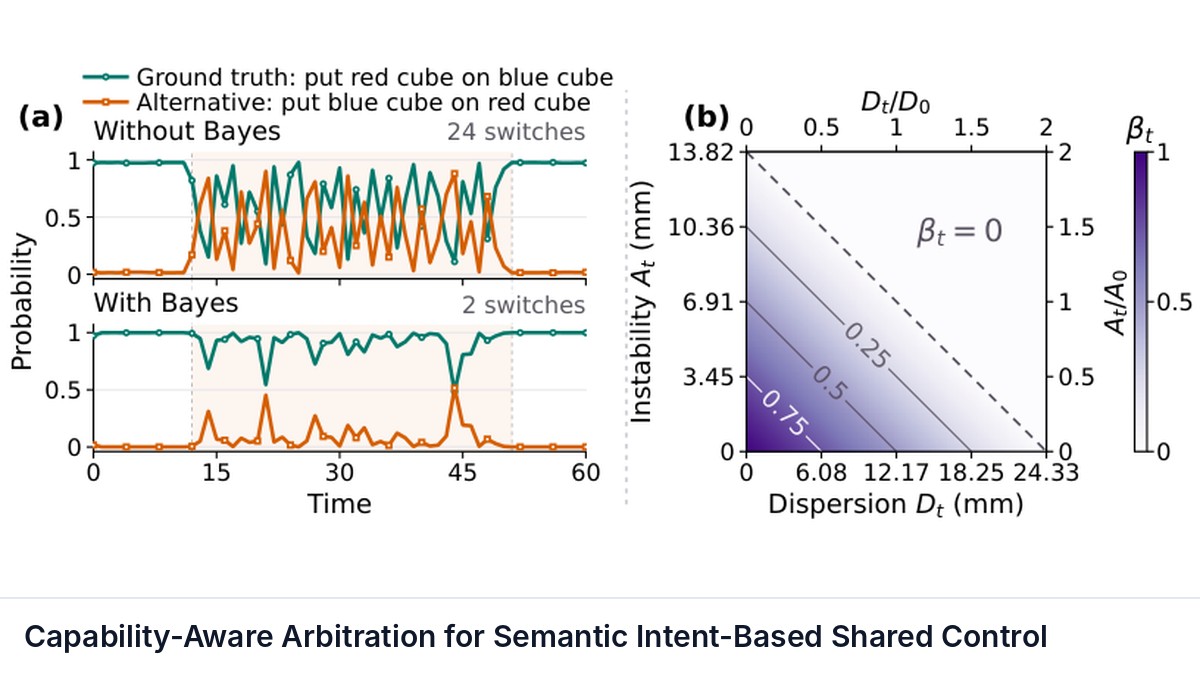
Shared control often allocates robot authority based on confidence in inferred human intent, assuming reliable autonomous execution. When this assumption fails, high intent confidence can cause over-helping.
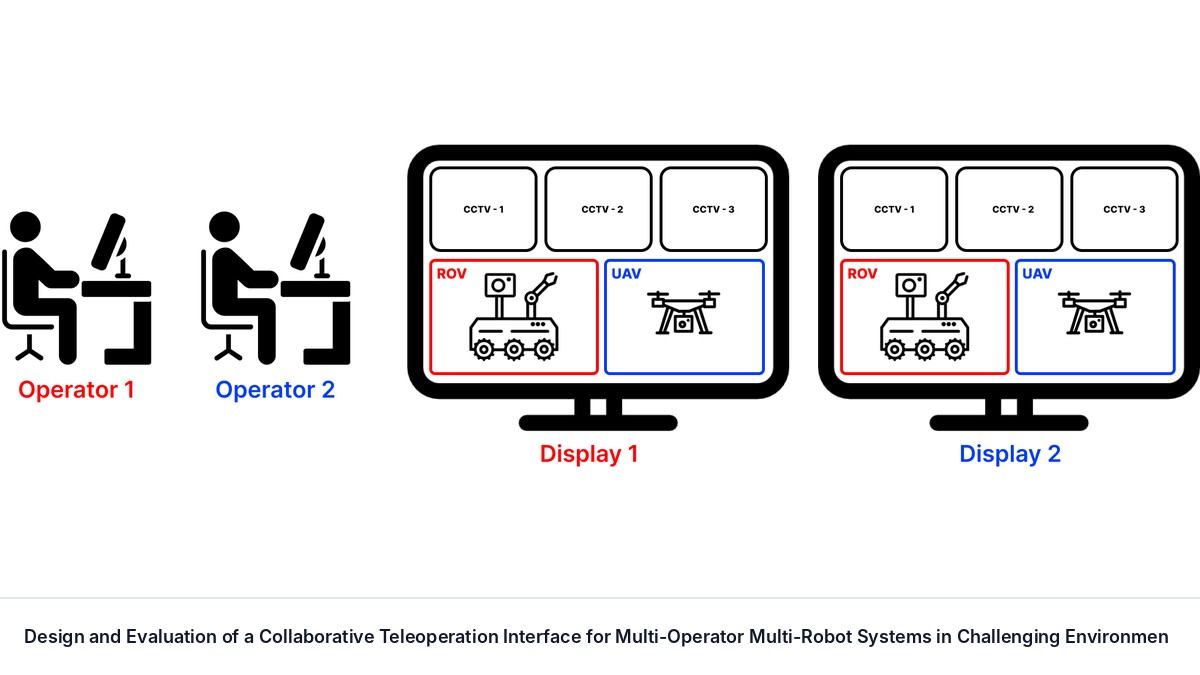
Design and Evaluation of a Collaborative Teleoperation Interface for Multi-Operator Multi-Robot Systems in Challenging Environments
Alperen Kenan, Juan José García Cárdenas, Adriana Tapus et al.
Multi-robot systems that combine the complementary capabilities of specialised platforms are critical for complex missions in challenging, inaccessible environments.
Design and Evaluation of a Touchscreen-Based Teleoperation Interface for Robotic Manipulators
Juan José García Cárdenas, Alperen Kenan, Hamidreza Raei et al.
Intuitive teleoperation interfaces are crucial for the safe and effective operation of robotic manipulators in challenging environments.