
HULK: Learning Whole-Body Forceful Loco-Manipulation for Humanoids
An Dang, Arturo Flores Alvarez, Yu-Ming Chen, Conor Mc Gartoll, Helen Sun, Aaron Ames, Nima Fazeli, Manikantan Nambi · N/A · 2026
Framework
N/A
License
N/A
Stars
N/A
Summary
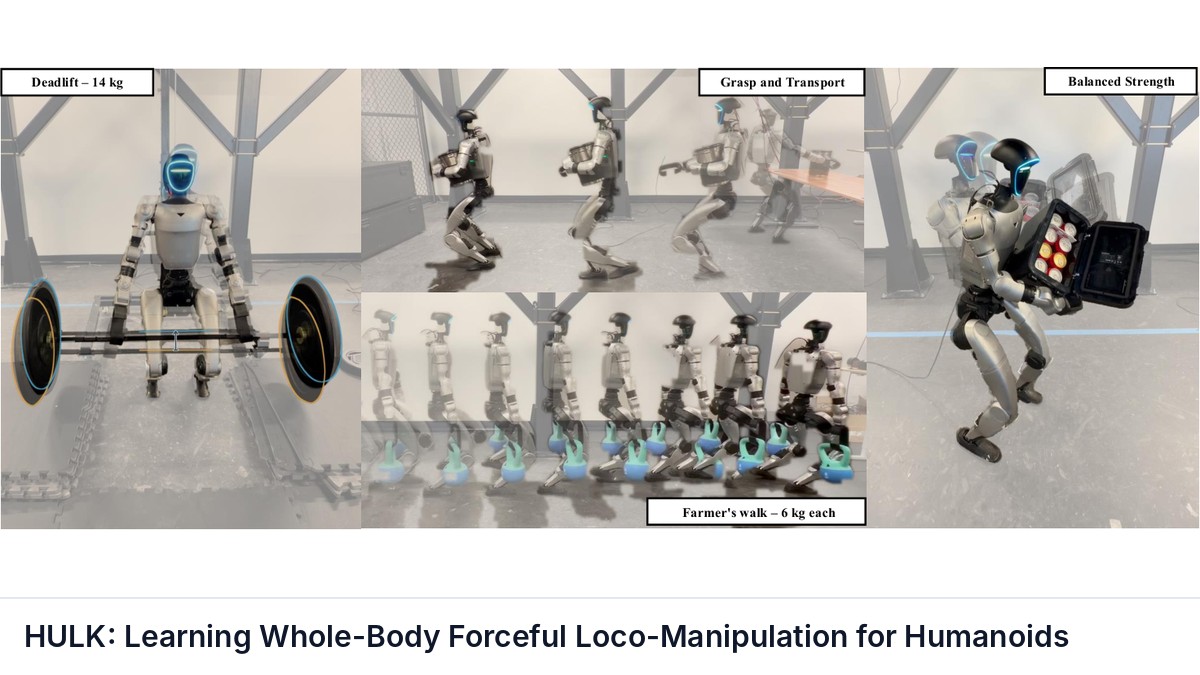
Humanoid loco-manipulation of large, heavy objects demands forceful interaction across the entire body. However, such payloads shift a humanoid's center of mass and impose sustained loads across the upper body, challenging balance and command tracking.
Abstract Summary
Key Points
- Humanoid loco-manipulation of large, heavy objects demands forceful interaction across the entire body.
- However, such payloads shift a humanoid's center of mass and impose sustained loads across the upper body, challenging balance and command tracking.
- We present HULK, a whole-body control framework for forceful loco-manipulation
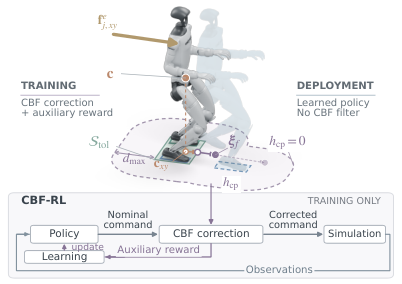
- Using model predictive control (MPC) to guide reinforcement learning with predictions of the loaded dynamics, we train two teachers: one tracks arm motions under wrist forces, and the other locomotes while holding large objects against the body.
- A capture-point control barrier function augments the wrist-force teacher during training to improve balance under load.
Methodology
Our goal is to learn a single whole-body controller for payload-driven loco-manipulation: a policy that follows planar velocity, base height, torso orientation and arm joint commands while a load acts anywhere on the upper body, and that transfers to hardware from proprioception alone.
We train two specialist teachers separately, one that tracks arm poses under forces applied at the wrists and one that locomotes while maintaining whole-body grasps across multiple objects. We distill the two into the single student we deploy ( Sec. III-G , Fig.
Experiments
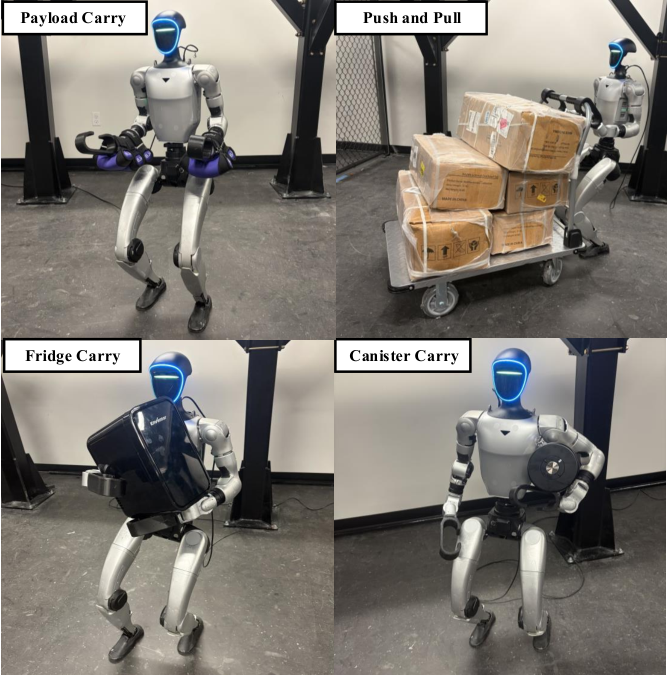
We evaluate whether HULK can maintain commanded motion under sustained load, recover from disturbances, and transfer these capabilities to forceful loco-manipulation tasks. Controllers and comparisons. We compare against FALCON, Thor, and AMO [ 15 , 16 , 28 ] .
The simulation rows Ours and Ours + CP-CBF evaluate the wrist-force teachers; hardware trials evaluate the distilled student deployed zero-shot on the Unitree G1. In simulation, all controllers receive identical commands and perturbation schedules on the same platform.
Sources and Demonstrations
Figures are reproduced from Dang et al. See the full paper for experimental details and the project page, when the paper links one, for demonstrations and videos.
Related Papers

A Sim-to-Real Integration Pipeline for Training and Deployment of Chunk-Based VLA Manipulation Policies
Mathilde Kappel, Clémence Grislain, Mohamed Chetouani et al.
Vision-Language-Action (VLA) models have become a prominent paradigm for mapping multimodal inputs, including semantic instructions, visual observations of the scene, and proprioceptive observations, to robot actions.
Behavioral Cloning Mystery
Seohong Park, Sergey Levine
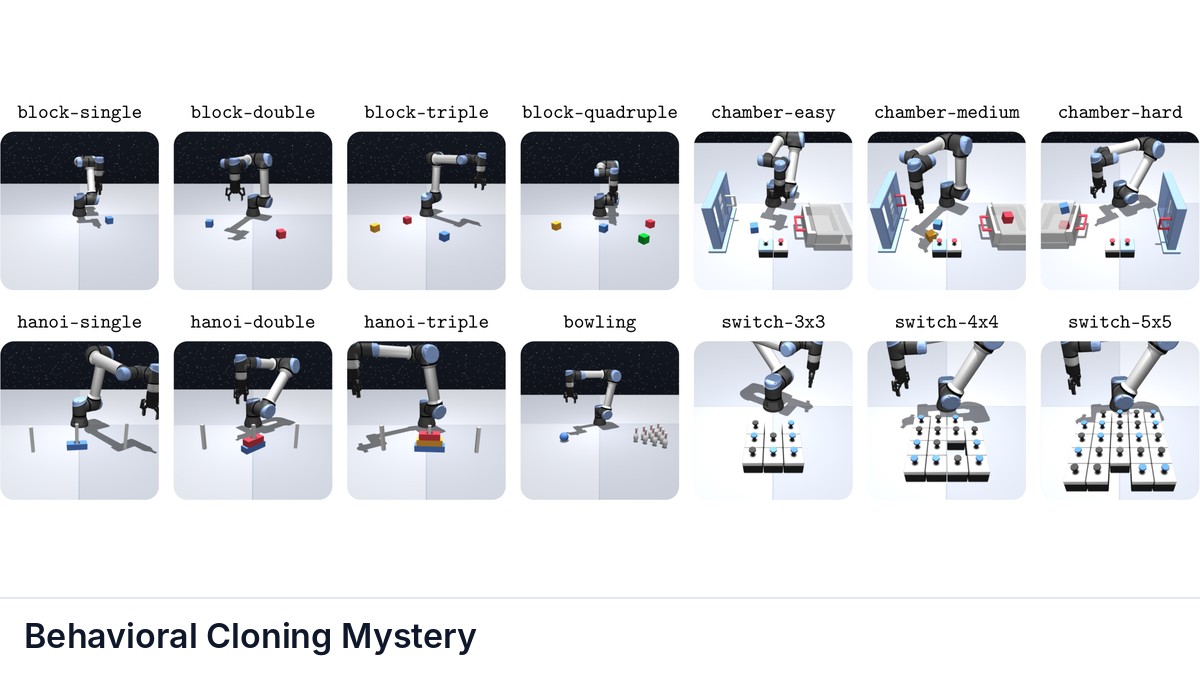
Behavioral cloning (BC), despite its simplicity, exhibits many counterintuitive phenomena in the real world. For example, the performance of BC often keeps increasing as the model overfits more to the dataset, and fully closed-loop policies often completely fail without action chunking.
Beyond Reconstruction: What Matters in Action Tokenization for Robot Policies?
Haoran Chen, Jingtian Ji, Samuel Wheeler et al.
Autoregressive action-token policies such as vision-language-action models require action tokenizers to translate discrete token sequences into precise control actions in continuous space. Many action tokenizers learn the mapping between tokens and actions via a reconstruction objective.

Capability-Aware Arbitration for Semantic Intent-Based Shared Control
Zhaoda Du, Michael Bowman, Xiaoli Zhang
Shared control often allocates robot authority based on confidence in inferred human intent, assuming reliable autonomous execution. When this assumption fails, high intent confidence can cause over-helping.