
geodex: A Library for Motion Planning on Riemannian Manifolds
Phone Thiha Kyaw, Ben Wei, Sepehr Samavi, Miguel Angel Rogel Garcia, Jonathan Kelly · N/A · 2026
Framework
N/A
License
N/A
Stars
N/A
Summary
Planning motions that respect the intrinsic geometry of a robot's configuration space, including its curvature and a configuration-dependent notion of cost, yields shorter, lower-energy, and more natural trajectories than planning under the ambient flat metric.
Abstract Summary
Key Points
- Planning motions that respect the intrinsic geometry of a robot's configuration space, including its curvature and a configuration-dependent notion of cost, yields shorter, lower-energy, and more natural trajectories than planning under the ambient flat metric.
- Existing libraries for optimization on manifolds provide rich geometric primitives but do not plan around obstacles.
- While general-purpose motion planning libraries support many state spaces and custom distance functions, they do not yet treat a configuration-dependent Riemannian metric as the geometry that drives distance, interpolation, and geodesics.
- We present geodex, an open-source C++20 library with Python bindings
- The library exposes the manifold, its Riemannian metric, the retraction, and the sampler as independent, interchangeable components through a single sampling-based motion planning interface.
Design Goals and System Overview
Motion planning algorithms typically rely on several subroutines, such as distance functions or a cost functional, local steering methods, and nearest-neighbor queries to find collision-free paths. On a Riemannian manifold, these components must all be consistent with the underlying geometry.
In most planning libraries, however, they are implemented separately and assume a fixed metric, most often the ambient Euclidean one, so adapting a planner to a new geometry means reimplementing each component by hand.
Architecture
The design goals of Section III demand a single planner that runs under any Riemannian metric at close to the speed of Euclidean planning. geodex achieves this by expressing every manifold in terms of one base topology and three interchangeable policies (metric, retraction, and sampler) that a single generic planner consumes through one compile-time interface.
Evaluation
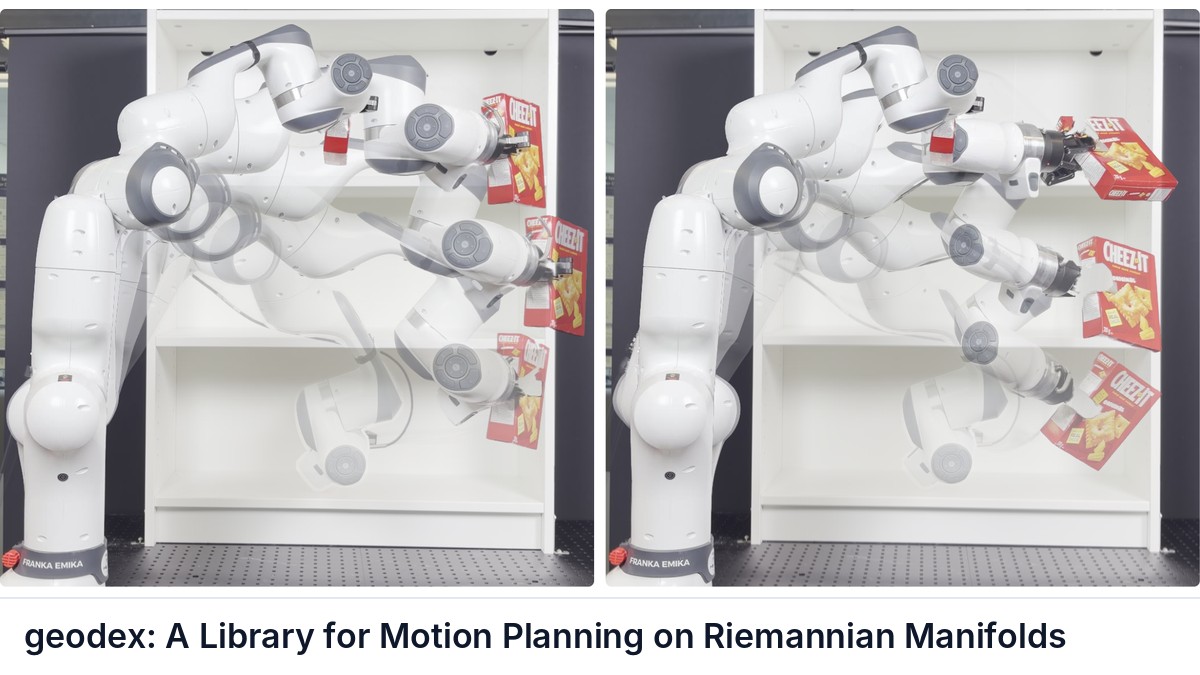
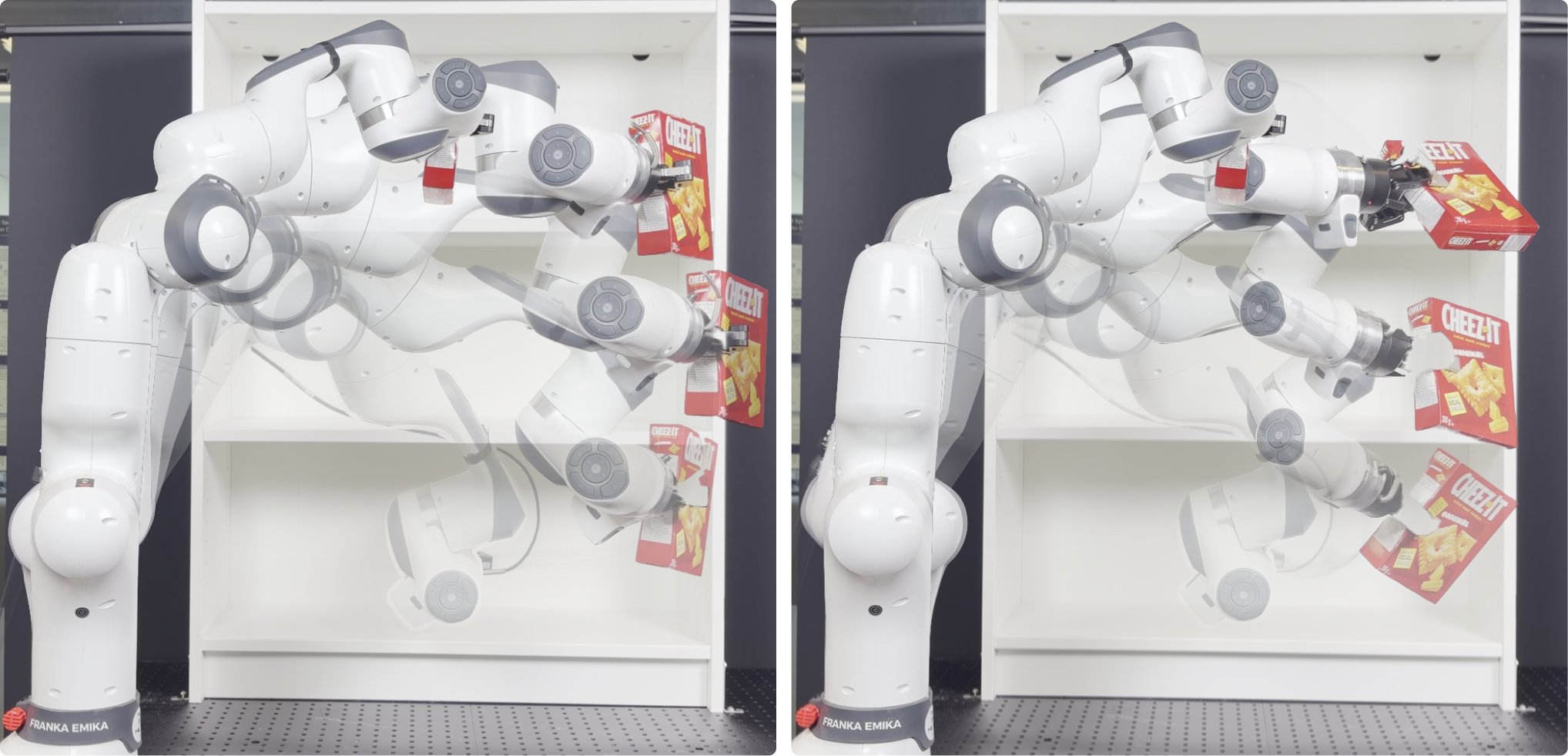
We first apply geodex to a downstream manipulation task. We perform shelving with a Franka arm using the MoveIt 2 plugin of geodex , and evaluate plans using two different metrics without touching the underlying planner or the rest of the planning stack. Under the Euclidean metric, all directions of motion have the same cost, so the planner returns the shortest motion in joint space.
Instead, we could also measure distance differently and plan the same task under a different metric.
Sources and Demonstrations
Figures are reproduced from Kyaw et al. See the full paper for experimental details and the project page, when the paper links one, for demonstrations and videos.
Related Papers
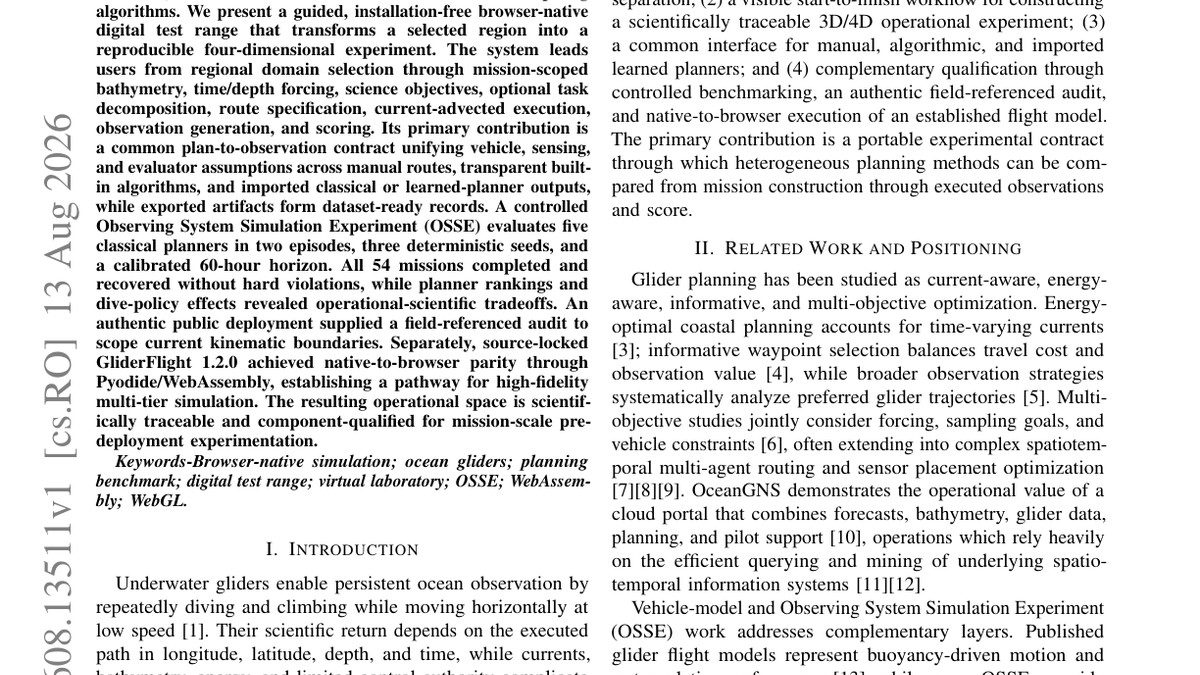
A Browser-Native Digital Test Range for Benchmarking 4D Ocean-Glider Planning Algorithms
Edward Holmberg, Elias Ioup, Mahdi Abdelguerfi
Repeated in-situ evaluation of ocean-glider planners requires scarce vehicles, operators, deployment and recovery resources, and ocean conditions that cannot be reset for competing algorithms.

Aim Short to Reach Far: Your Frozen World Model Can Plan Better Than You Think
Xvyuan Liu, Jianjie Fang, Chen Gao et al.
Planners built on visual world models commonly score each predicted outcome by its distance to the encoded goal image. We show that this target can limit control even with exact dynamics and globally optimal short-horizon search: reaching a goal may require actions that initially move away from it.
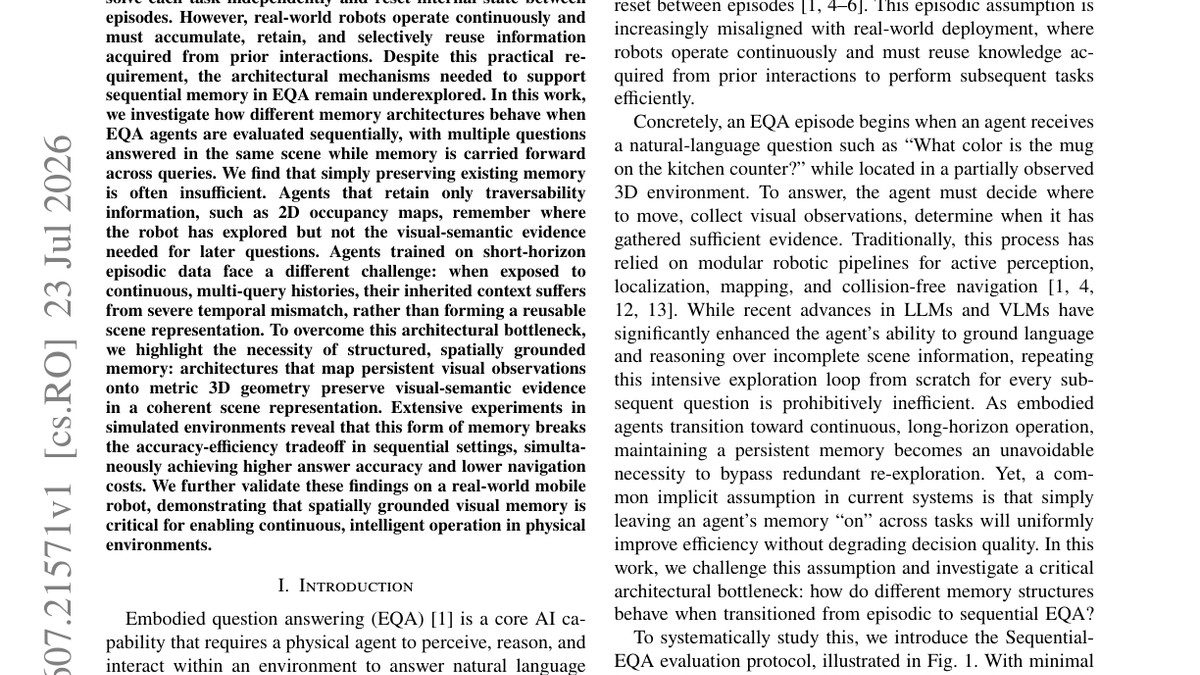
Beyond Episodic Evaluation: Memory Architectural Bottlenecks in Sequential Embodied Question Answering
Zikui Cai, Kaushal Janga, Tan Dat Dao et al.
Embodied question answering (EQA) is traditionally evaluated under an episodic formulation, where agents solve each task independently and reset internal state between episodes.
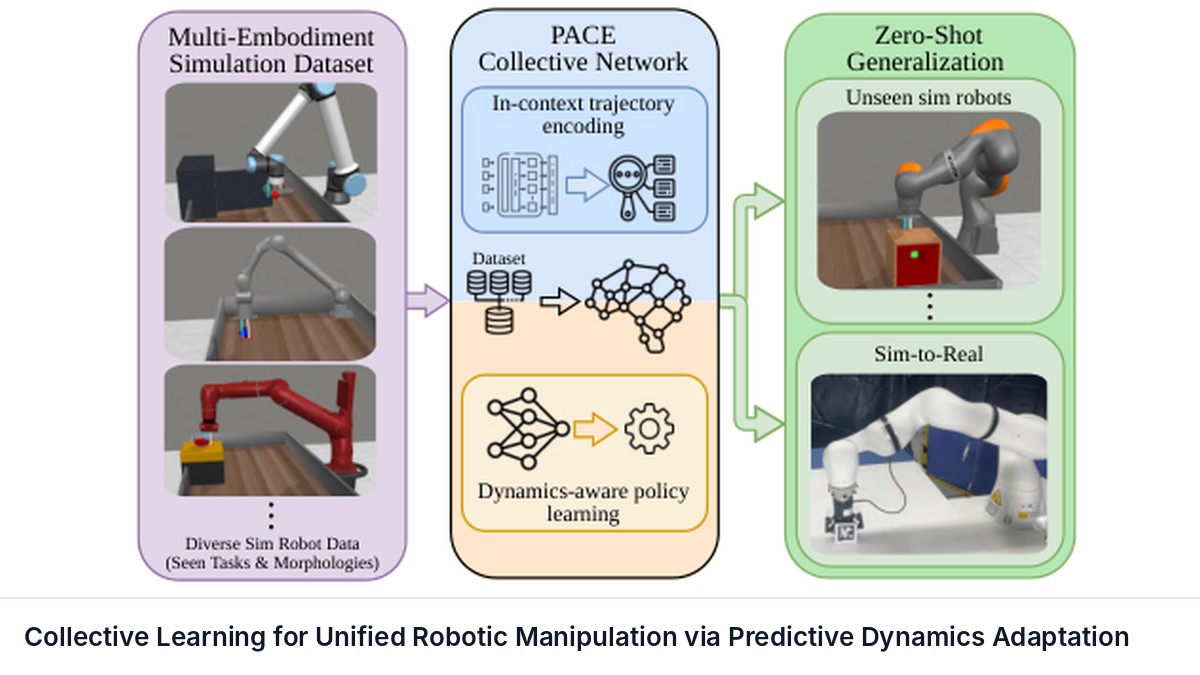
Collective Learning for Unified Robotic Manipulation via Predictive Dynamics Adaptation
Shaocheng Liu, Yuan Meng, Zhenshan Bing et al.
Learning a collective policy for state-based Cartesian manipulation across diverse robotic embodiments presents a fundamental challenge due to embodiment-dependent transition dynamics.