
iAm.md: Robot Skill Self-Assessment through Agentic Introspection for Unknown Open-Vocabulary Domains
Vincenzo Guarino, Emanuele Musumeci, Vincenzo Suriani, Daniele Nardi · N/A · 2026
Framework
N/A
License
N/A
Stars
N/A
Summary
Agentic AI based on Large Language Model generalization capabilities offers a wide range of potential applications, including planning for embodied tasks. For example, embodied agents based on Foundation models can generate plausible plans in autonomous robotics scenarios.
Abstract Summary
Key Points
- Agentic AI based on Large Language Model generalization capabilities offers a wide range of potential applications, including planning for embodied tasks.
- For example, embodied agents based on Foundation models can generate plausible plans in autonomous robotics scenarios.
- Due to limited context windows or hallucinatory phenomena in the next-token prediction formulation, behaviors may be generated without establishing whether the deployed robot and the observed environment actually support the requested operation, in what we call a "grounding failure".
- Thanks to the recent improvements in reasoning capabilities of foundation models, autonomous robot behavior generation problem can be formulated as a code generation problem.
- We present iAm.md, a Markdown standard and generation framework, that allows anchoring this process in complementary forms of deployment evidence.
Methodology
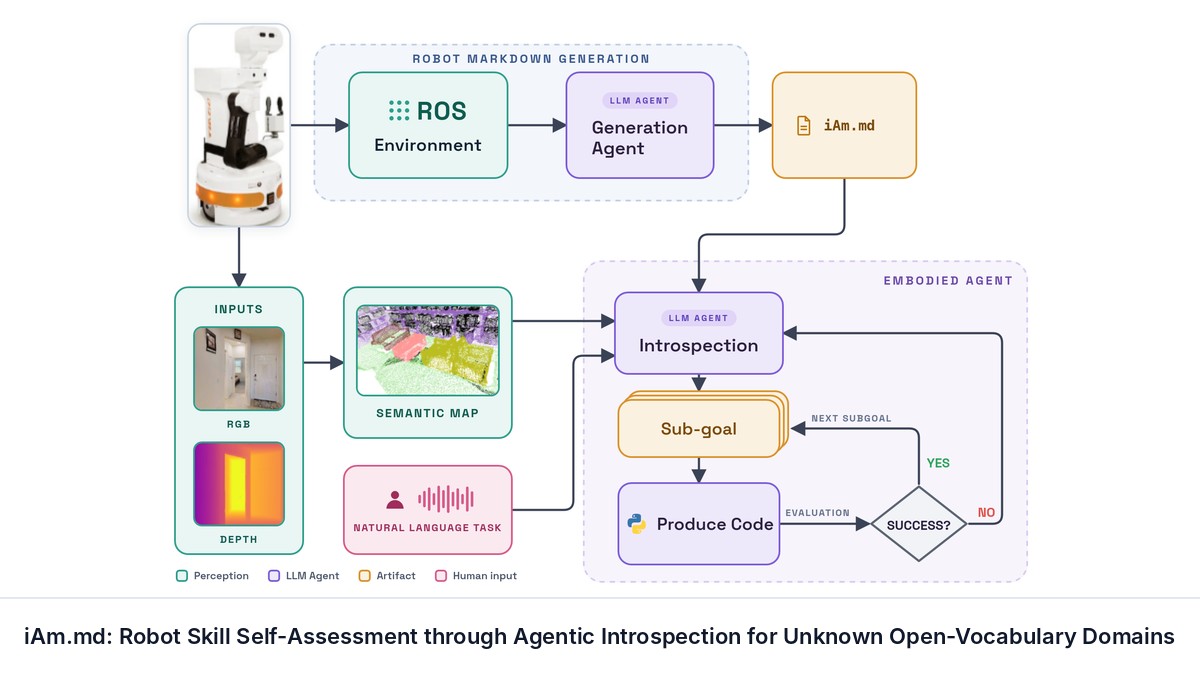
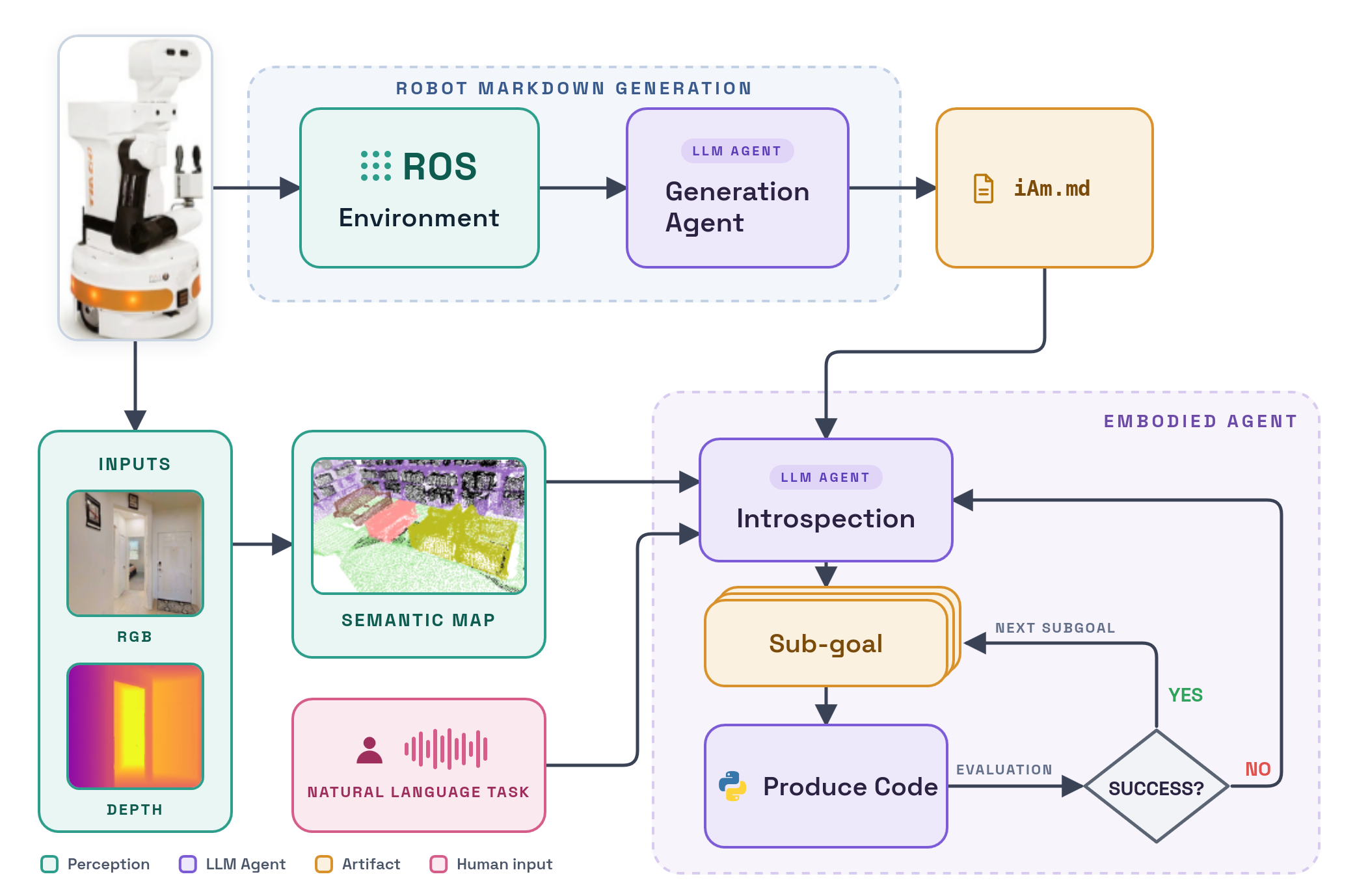
An embodied code generation system places a tool-calling foundation-model agent between a task request and the deployed robot. Persistent robot facts enter the agent context through iAm.md , whereas the current pose and camera observation describe the state in which the request must be executed. One general command tool connects this context to the live ROS 2 environment Macenski et al.
(2022) , allowing the agent to observe the execution state, write executable programs, and run them in the deployment that supplied the supporting evidence.
Experimental Results
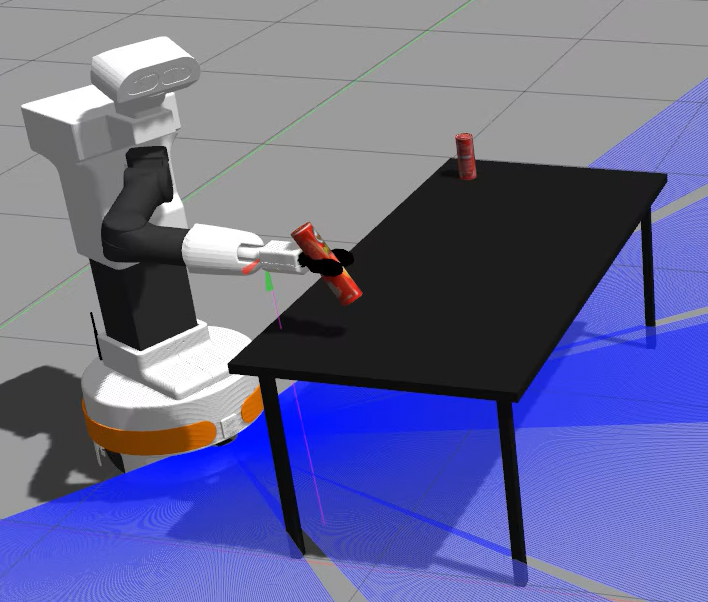
Twelve objects in a simulated scene were independently annotated as labelled spheres in the map frame through an interactive RViz interface.
An estimated record is compatible with an annotation when its centroid lies inside the sphere and its label matches; a maximum one-to-one bipartite matching over compatible pairs yields object-level Found (fraction of annotations matched) and Correct (fraction of estimates matched) scores, following Hydra Hughes et al. (2022) .
Sources and Demonstrations
Figures are reproduced from Guarino et al. See the full paper for experimental details and the project page, when the paper links one, for demonstrations and videos.
Related Papers
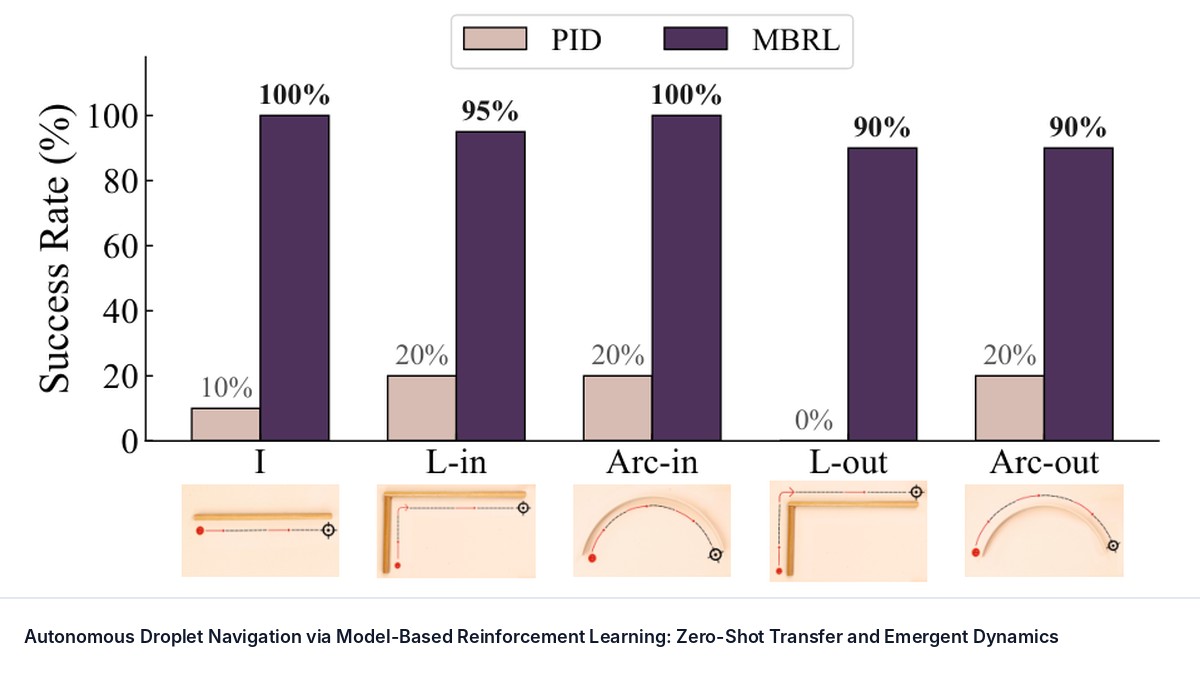
Autonomous Droplet Navigation via Model-Based Reinforcement Learning: Zero-Shot Transfer and Emergent Dynamics
Rajneesh Anand, Mayuresh V. Kothare
Self-driving laboratories (SDLs) are transforming chemical and materials discovery through closed-loop automation, yet automated infrastructure for physical manipulation of soft, deformable matter remains beyond current robotic platforms.
Evidence-Gated Task and Motion Planning with Vision-Language Models
Tsunehiko Tanaka, Matthew Stephenson, Alistair Macvicar et al.
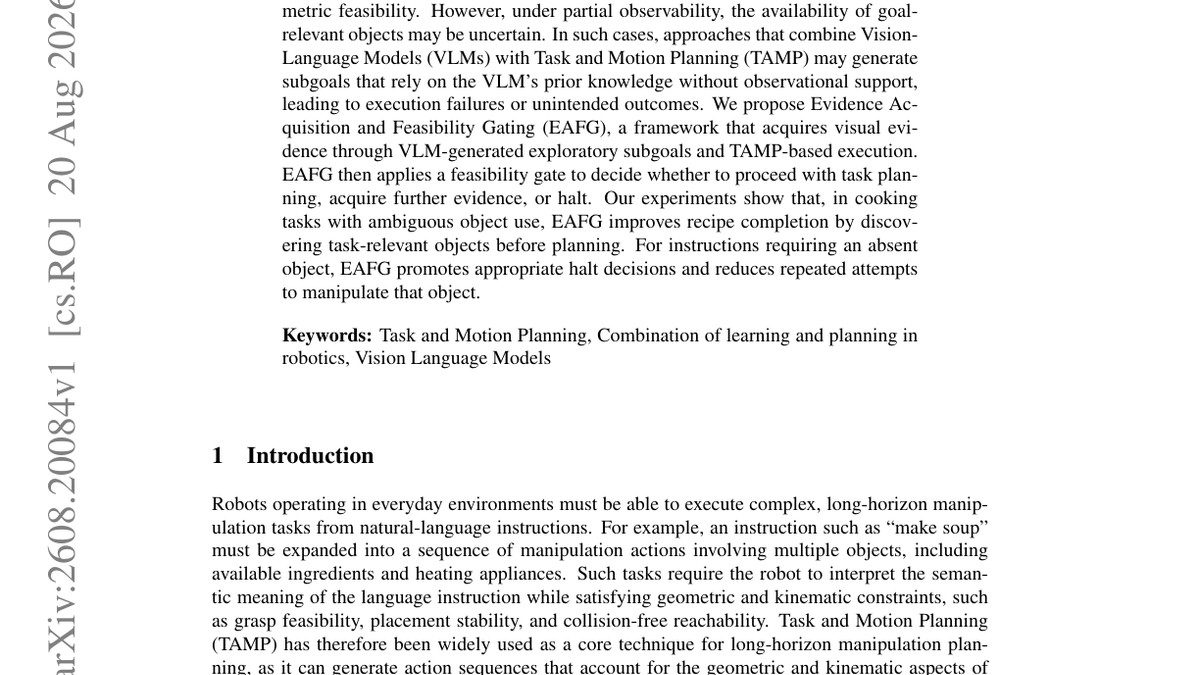
Robots executing long-horizon manipulation tasks from natural-language instructions must reason about both semantic task structure and geometric feasibility. However, under partial observability, the availability of goal-relevant objects may be uncertain.
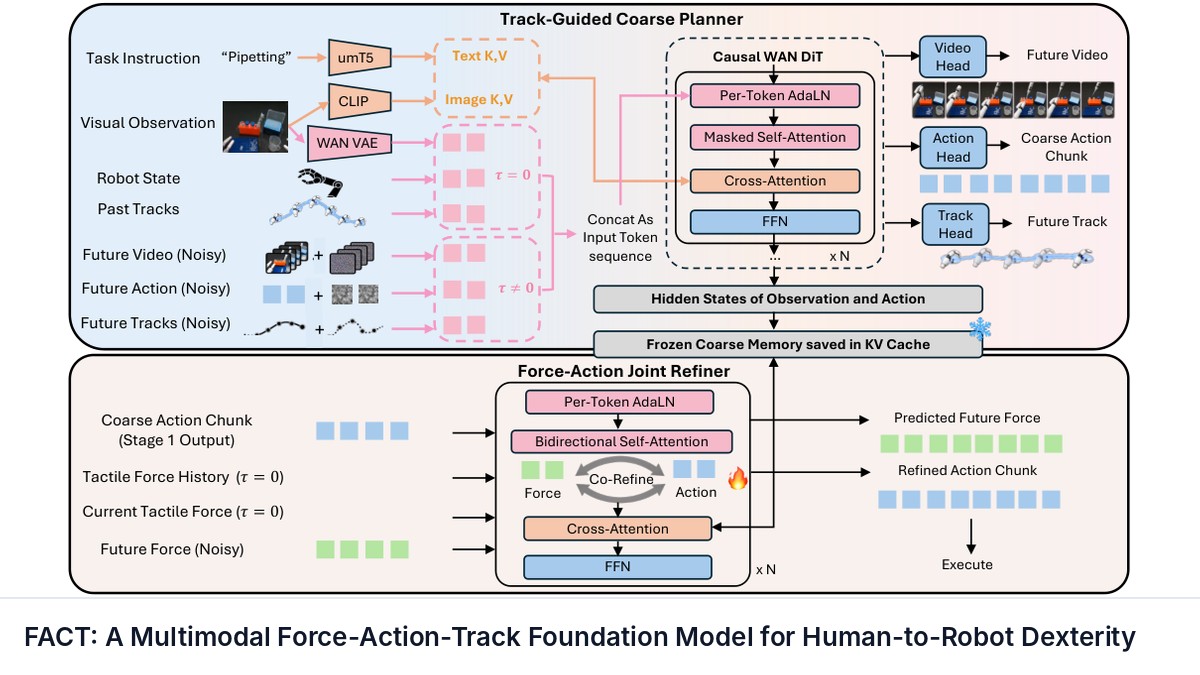
FACT: A Multimodal Force-Action-Track Foundation Model for Human-to-Robot Dexterity
Zhi Cao, Yining Hong, Jiaolong Yang et al.
Human demonstrations offer a scalable alternative to costly robot data collection for dexterous manipulation, but most human datasets lack force measurements.
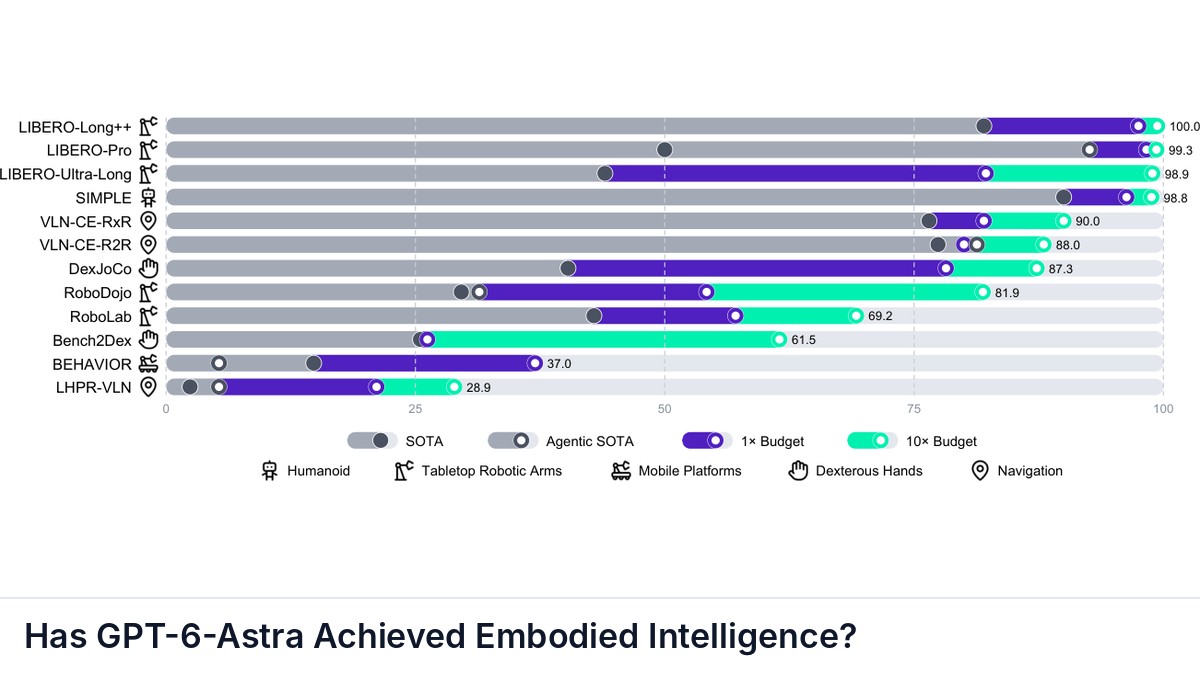
Has GPT-6-Astra Achieved Embodied Intelligence?
SenseNova, Joint Research Team, : et al.
GPT-6-Astra demonstrates a level of competence in robotic manipulation and navigation that challenges the conventional paradigm of building specialized models for individual tasks and embodiments.