
OmniHOI: Dexterous Hand-Object Interaction from Monocular Human Video
Ting Mao, Yanming Shao, Ziheng Wang, Haoyu Liu, Yiqun Wang, Xuanye Wu, Yao Mu · N/A · 2026
Framework
N/A
License
N/A
Stars
N/A
Summary
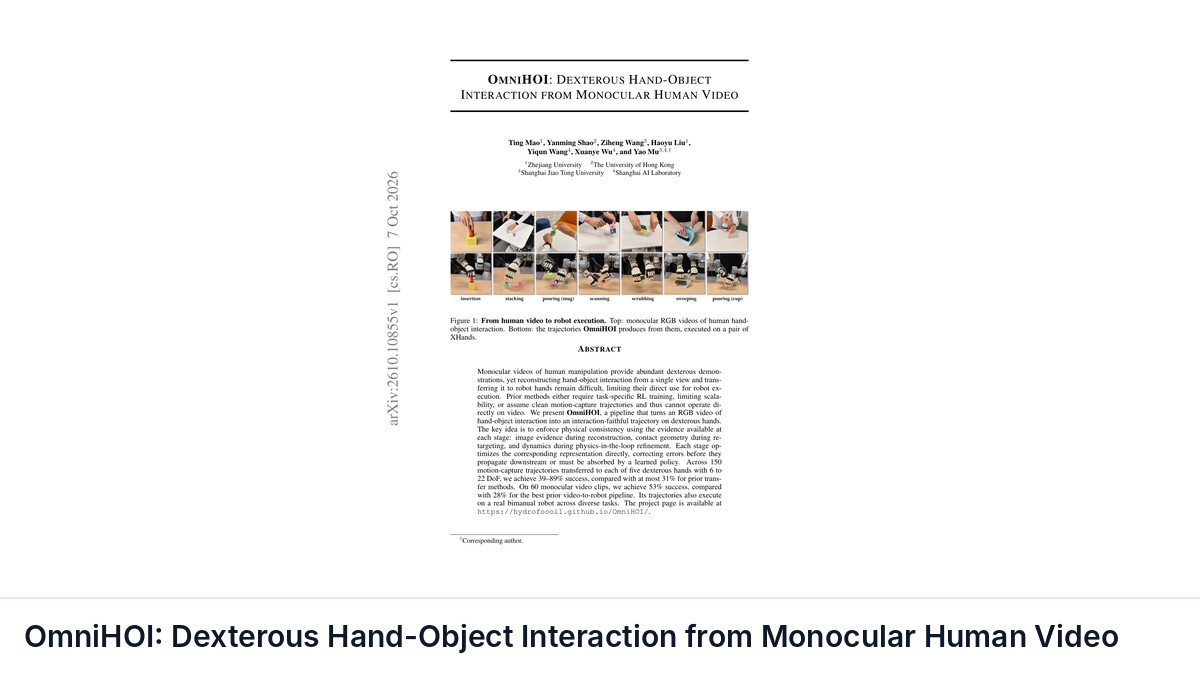
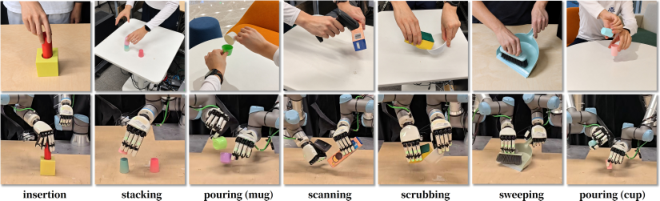
Monocular videos of human manipulation provide abundant dexterous demonstrations, yet reconstructing hand-object interaction from a single view and transferring it to robot hands remain difficult, limiting their direct use for robot execution.
Abstract Summary
Key Points
- Monocular videos of human manipulation provide abundant dexterous demonstrations, yet reconstructing hand-object interaction from a single view and transferring it to robot hands remain difficult, limiting their direct use for robot execution.
- Prior methods either require task-specific RL training, limiting scalability, or assume clean motion-capture trajectories and thus cannot operate directly on video.
- We present OmniHOI, a pipeline that turns an RGB video of hand-object interaction into an interaction-faithful trajectory on dexterous hands.
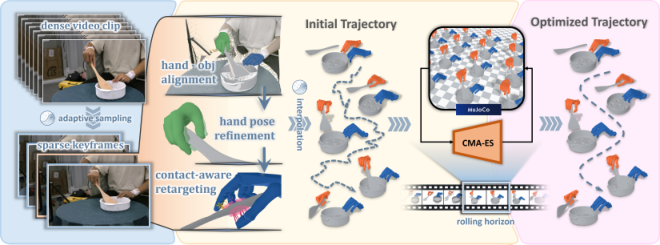
- The key idea is to enforce physical consistency using the evidence available at each stage: image evidence during reconstruction, contact geometry during retargeting, and dynamics during physics-in-the-loop refinement.
- Each stage optimizes the corresponding representation directly, correcting errors before they propagate downstream or must be absorbed by a learned policy.
Method
As shown in Figure 2 , OmniHOI samples keyframes from the video according to hand motion, reconstructs and refines the hand-object interaction in each keyframe ( Section 3.1 ), retargets the refined MANO hands ( Romero et al., 2017 ) to the robot hand under contact guidance, and turns the keyframes into a continuous, task-effective trajectory in simulation ( Section 3.2 ).
We use SAM 3 ( Carion et al., 2026 ) to segment hands, objects and table, and use MoGe-3 to estimate camera intrinsics and each frame’s depth as point map.
Experiments
We follow the setup and criteria from prior work, testing our method on three public datasets: ARCTIC ( Fan et al., 2023 ) , DexYCB ( Chao et al., 2021 ) and OakInk2 ( Zhan et al., 2024 ) , all with 3D hand-object pose and shape annotations.
ARCTIC includes humans operating 11 articulated objects, OakInk2 features manipulation tasks with 75 diverse objects, and DexYCB presents grasping of 20 distinct YCB-Video ( Xiang et al., 2018 ) objects.
Sources and Demonstrations
Figures are reproduced from Mao et al. See the full paper for experimental details and the project page, when the paper links one, for demonstrations and videos.
Related Papers

A Sim-to-Real Integration Pipeline for Training and Deployment of Chunk-Based VLA Manipulation Policies
Mathilde Kappel, Clémence Grislain, Mohamed Chetouani et al.
Vision-Language-Action (VLA) models have become a prominent paradigm for mapping multimodal inputs, including semantic instructions, visual observations of the scene, and proprioceptive observations, to robot actions.

Capability-Aware Arbitration for Semantic Intent-Based Shared Control
Zhaoda Du, Michael Bowman, Xiaoli Zhang
Shared control often allocates robot authority based on confidence in inferred human intent, assuming reliable autonomous execution. When this assumption fails, high intent confidence can cause over-helping.
Design and Evaluation of a Touchscreen-Based Teleoperation Interface for Robotic Manipulators
Juan José García Cárdenas, Alperen Kenan, Hamidreza Raei et al.
Intuitive teleoperation interfaces are crucial for the safe and effective operation of robotic manipulators in challenging environments.
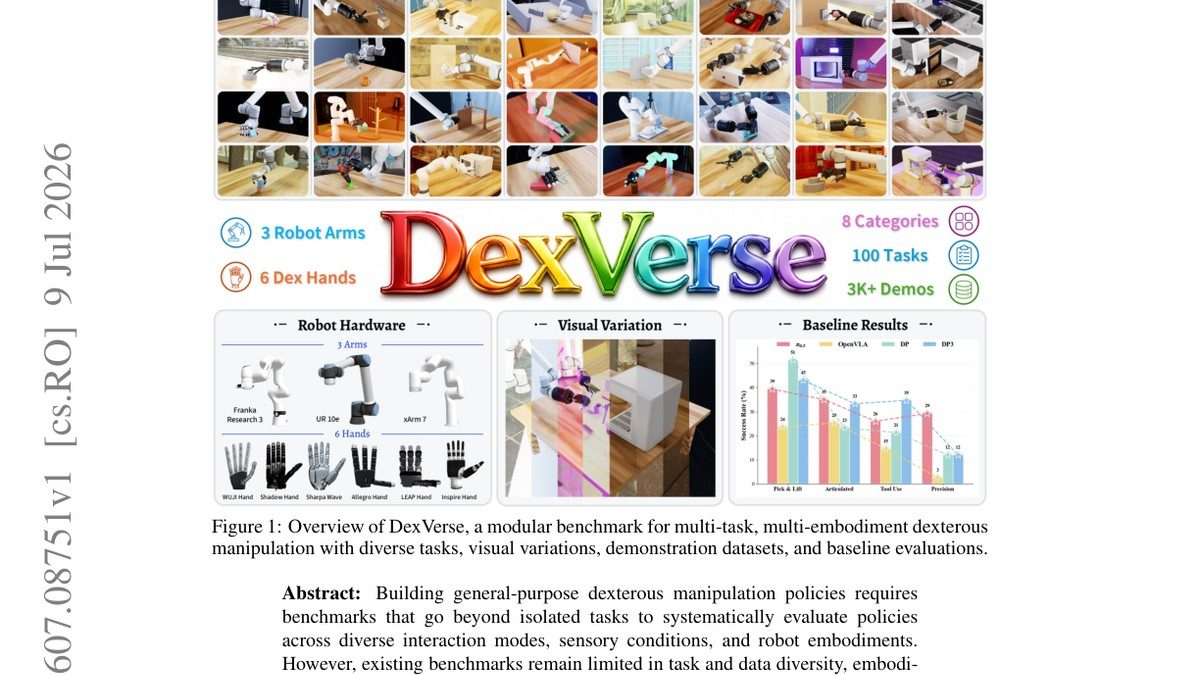
DexVerse: A Modular Benchmark for Multi-Task, Multi-Embodiment Dexterous Manipulation
Yunchao Yao, Zhuxiu Xu, Tianqi Zhang et al.
Building general-purpose dexterous manipulation policies requires benchmarks that go beyond isolated tasks to systematically evaluate policies across diverse interaction modes, sensory conditions, and robot embodiments.