
DreamTrue: Action-Faithful Robot World Model with Counterfactual Post-Training
Junyan Li, Ruizhi Li, Yu Liu, Xiangshuo Liu, Mingchao Sun, Hongyu Pan, Mu Xu, Lue Fan, Zhaoxiang Zhang · N/A · 2026
Framework
N/A
License
N/A
Stars
N/A
Summary
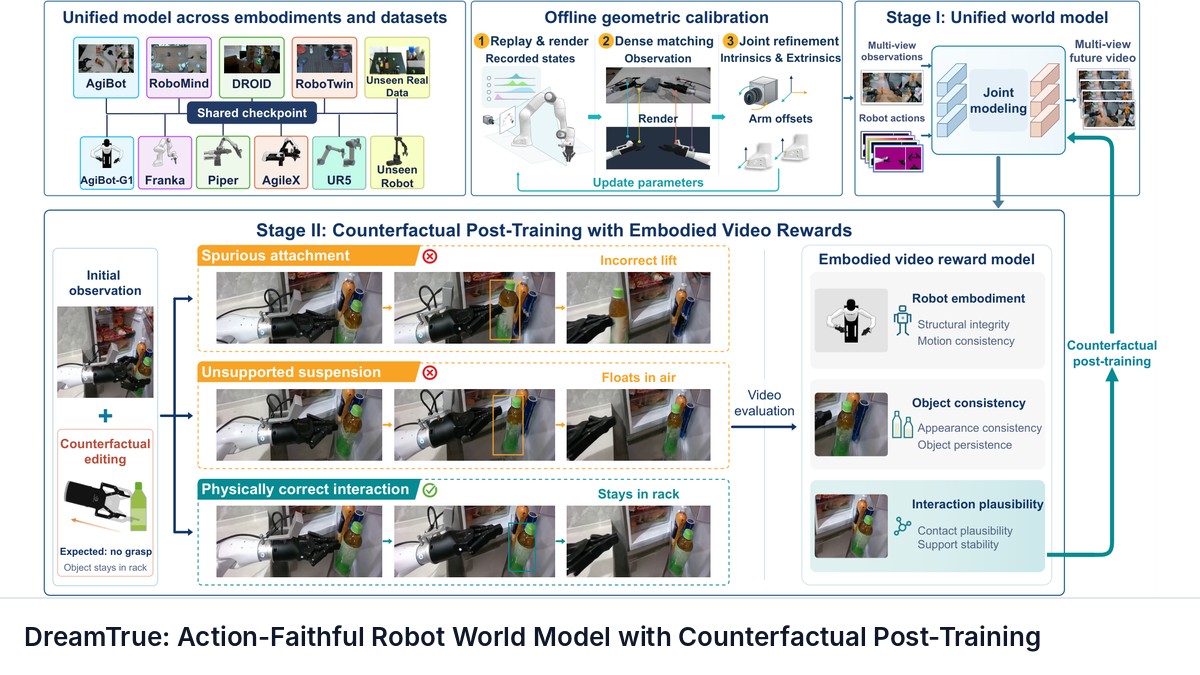
We present DreamTrue, a multi-view, cross-embodiment robot world model for action-faithful and physically plausible video prediction.
Abstract Summary
Key Points
- We present DreamTrue, a multi-view, cross-embodiment robot world model for action-faithful and physically plausible video prediction.
- Training such a model on existing robot datasets faces two obstacles: imprecise calibration can impair action following, while limited coverage of unsuccessful interactions can bias predictions toward successful outcomes.
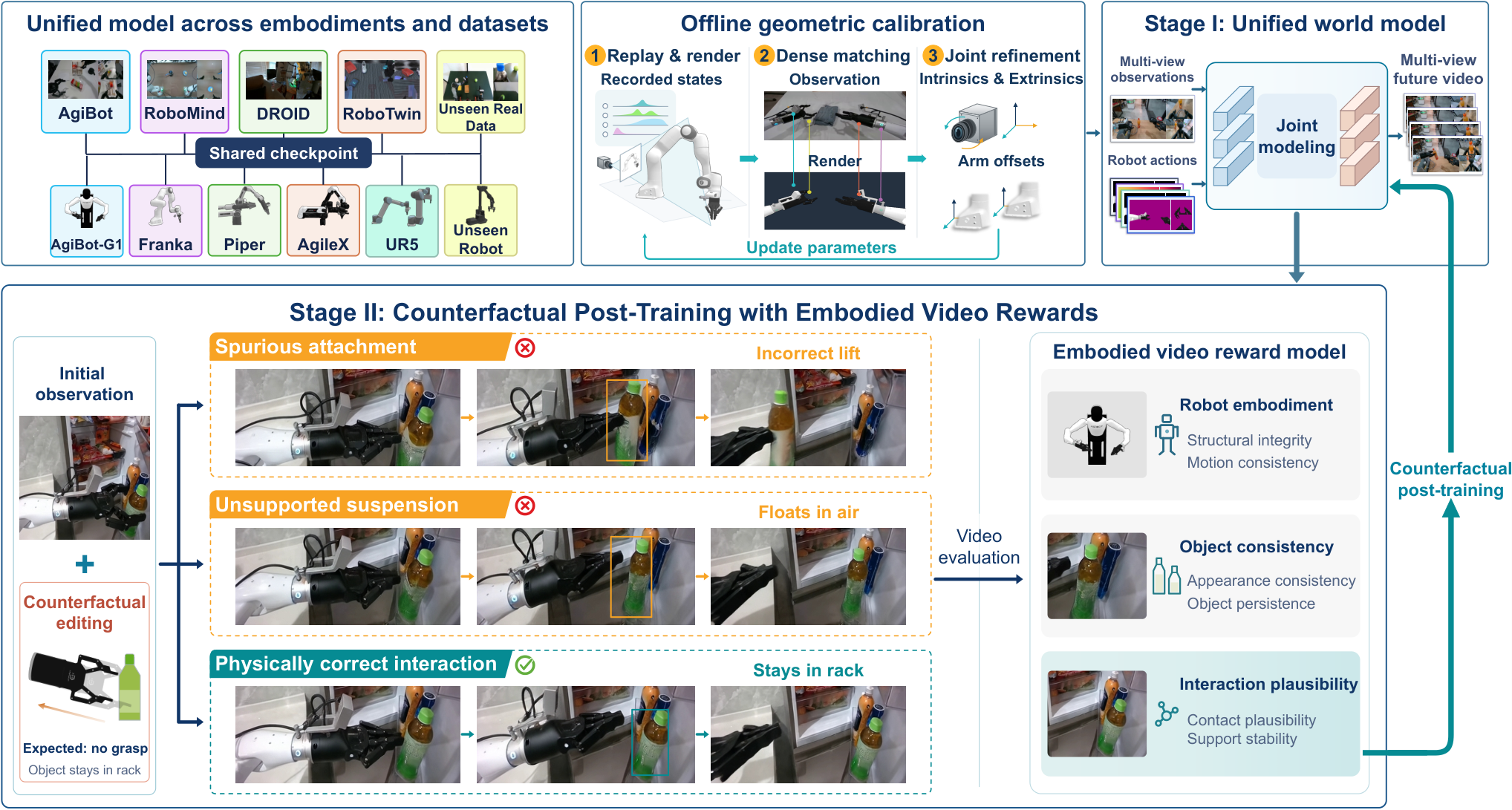
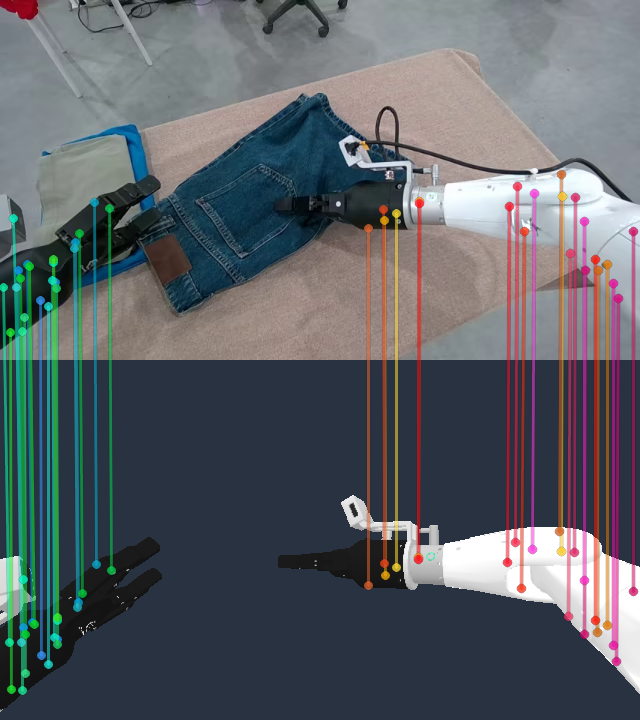
- To improve action following across embodiments, we render action trajectories into image-space conditions and introduce offline geometric calibration to align these conditions with the target videos.
- To broaden interaction coverage, we introduce counterfactual post-training, modifying recorded action trajectories and generating future videos under a wider range of actions and contact configurations.
- To provide feedback on these predictions without paired ground-truth futures, we construct a human-annotated video dataset covering robot, object, and interaction defects and use it to train an embodied video reward model.
Method
Given initial multi-view observations ${\bm{x}}_{0}^{1:V}$, a task instruction $\ell$, and an action sequence ${\bm{a}}_{1:T}$, we model the distribution of future videos as where $V$ is the number of camera views, $T$ is the prediction horizon, and $\theta$ denotes model parameters. Our framework consists of offline geometric calibration and two training stages.
We first refine camera parameters and optional robot mounting offsets to improve spatial alignment between robot renderings and recorded video frames.
Experiments
DreamTrue is jointly trained on AgiBotWorld-Beta ( Bu et al., 2025a ) , DROID ( Khazatsky et al., 2024 ) , RoboMIND 2.0 ( Hou et al., 2025 ) , and RoboTwin 2.0 ( Chen et al., 2025 ) . After filtering, the training data contain 2,232 h of multi-view trajectories across five robot arm types in real and simulated environments ( Figure 10 , in appendix).
We evaluate future prediction on held-out episodes from these datasets.
Sources and Demonstrations
Figures are reproduced from Li et al. See the full paper for experimental details and the project page, when the paper links one, for demonstrations and videos.
Related Papers
4D Radar Perception Algorithms for Autonomous Driving: A Review
Xumin Wu, Jun Zhou, Jilin Mei et al.
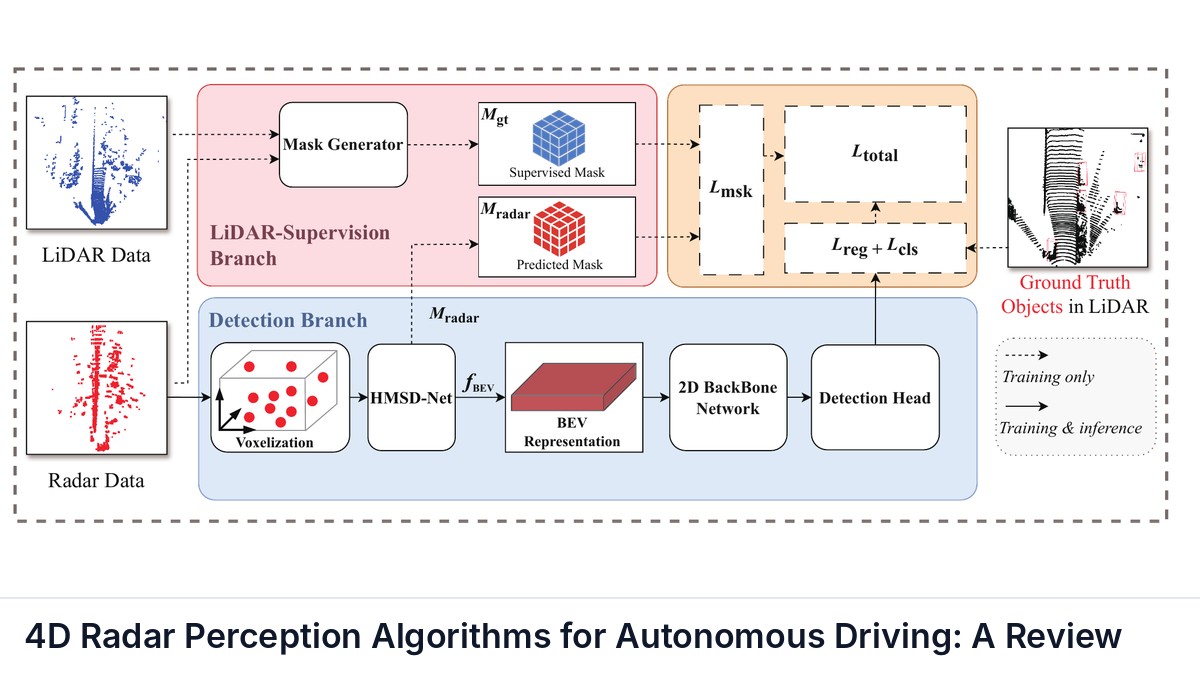
Research on 4D millimeter-wave radar perception algorithms has flourished in recent years, extending from signal processing and object detection to semantic segmentation, motion estimation, occupancy prediction, and dynamic scene reconstruction.
A Review Of Robotic World Models For Dynamic Environments Based On Factor And Scene Graphs
Marco Giberna, Miguel Fernandez-Cortizas, Jose Luis Sanchez Lopez et al.
Models based on graphs have emerged in robotics as a powerful foundation for internal world representations, where factor and scene graphs are among the most prominent model types found in the related literature and in successful robotic solutions.

A Sim-to-Real Integration Pipeline for Training and Deployment of Chunk-Based VLA Manipulation Policies
Mathilde Kappel, Clémence Grislain, Mohamed Chetouani et al.
Vision-Language-Action (VLA) models have become a prominent paradigm for mapping multimodal inputs, including semantic instructions, visual observations of the scene, and proprioceptive observations, to robot actions.
Aim Short to Reach Far: Your Frozen World Model Can Plan Better Than You Think
Xvyuan Liu, Jianjie Fang, Chen Gao et al.
Planners built on visual world models commonly score each predicted outcome by its distance to the encoded goal image. We show that this target can limit control even with exact dynamics and globally optimal short-horizon search: reaching a goal may require actions that initially move away from it.