
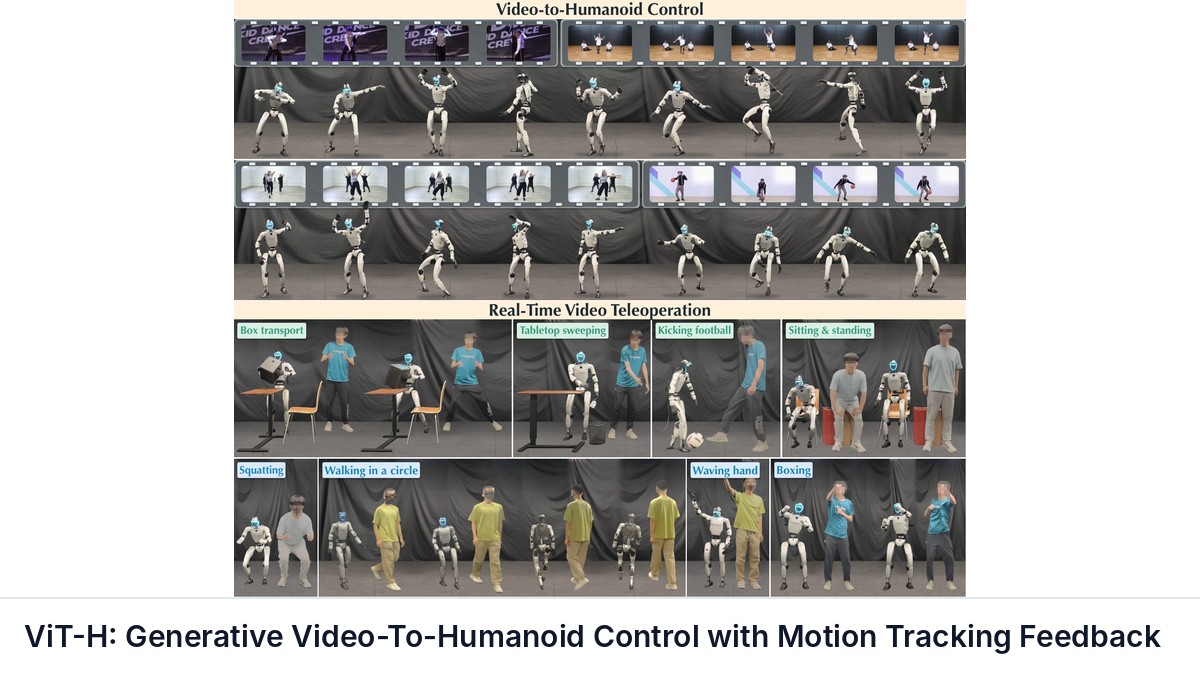
ViT-H: Generative Video-To-Humanoid Control with Motion Tracking Feedback
Zimo He, Tianyi Bian, Zizhong Yang, Hongjie Li, Nan Jiang, Jieming Cui, Baoxiong Jia, Yizhou Wang, Siyuan Huang, Yixin Zhu · N/A · 2026
Framework
N/A
License
N/A
Stars
N/A
Summary
Learning humanoid control from monocular human videos offers a scalable way to acquire diverse whole-body behaviors.
Abstract Summary
Key Points
- Learning humanoid control from monocular human videos offers a scalable way to acquire diverse whole-body behaviors.
- Yet, existing reconstruction-retargeting-tracking pipelines are limited in system-level scalability by separately optimized intermediate stages and cannot directly optimize reference motion executability using downstream tracking feedback.
- We present ViT-H, a video-to-humanoid control framework following a generation-and-tracking paradigm
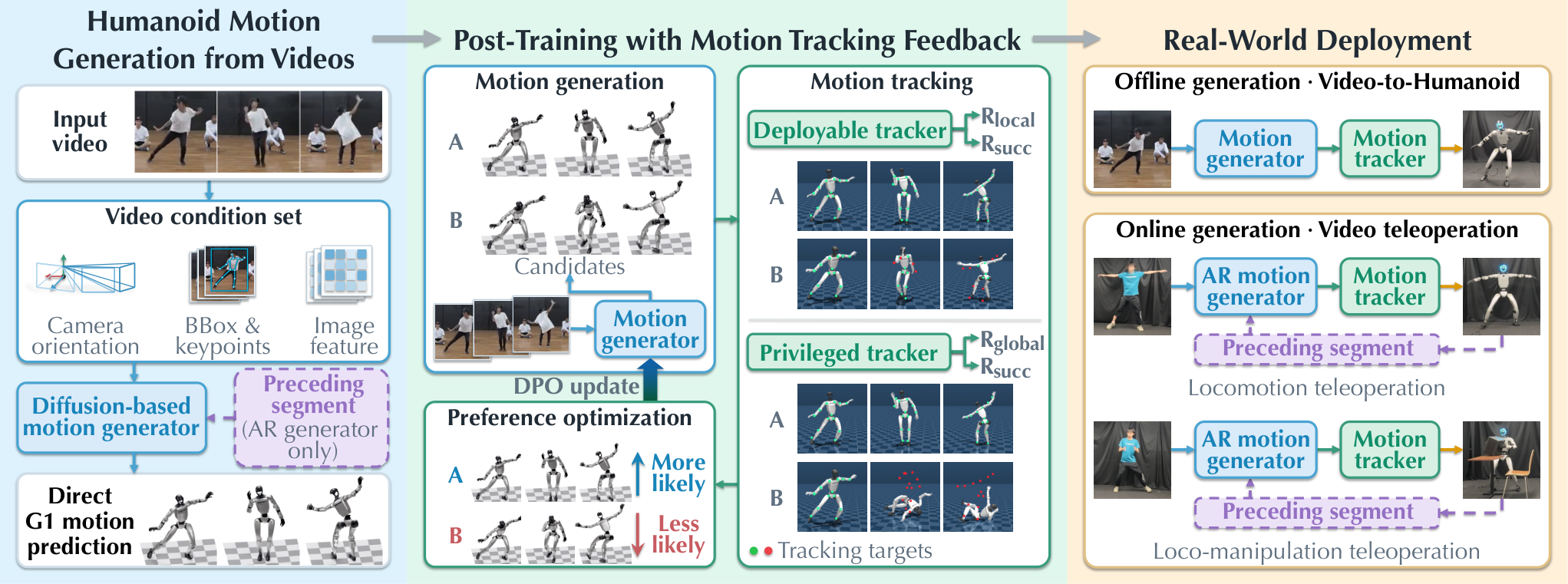
- ViT-H directly generates humanoid reference motions from videos with a diffusion model, bypassing human motion reconstruction and retargeting, and uses motion-tracking outcomes to post-train the generator with direct preference optimization.
- We further introduce an autoregressive variant that enables real-time humanoid video teleoperation with sub-400 ms latency.
ViT-H
Our goal is to convert the human motion in a monocular video $\mathbf{I}=\{\mathbf{I}_{t}\}_{t=1}^{T}$ into whole-body actions that make a Unitree G1 humanoid reproduce it. We decompose this problem into reference motion generation and whole-body tracking.
A video-conditioned generative model $\pi_{\text{gen}}$ predicts a reference humanoid motion $\mathbf{X}\sim\pi_{\text{gen}}(\cdot\mid\mathbf{I})$, and a whole-body tracking policy $\pi_{\text{track}}$ executes it.
Experiments
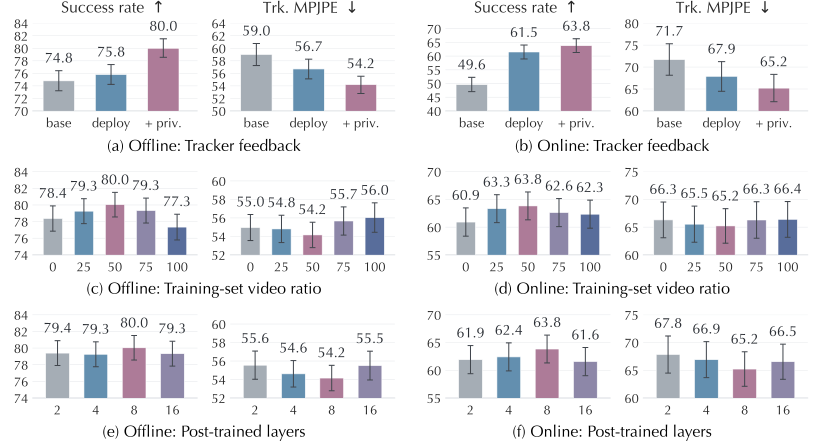
In this section, we first compare ViT-H with reconstruction-retargeting-tracking pipelines and our pre-training-only ablation variants on both datasets with 3D ground-truth annotations and video-only datasets ( Section 4.1 ). We then provide an empirical analysis of DPO post-training, investigating how preference construction and post-training design choices affect humanoid motion executability ( Section 4.2 ).
Sources and Demonstrations
Figures are reproduced from He et al. See the full paper for experimental details and the project page, when the paper links one, for demonstrations and videos.
Related Papers
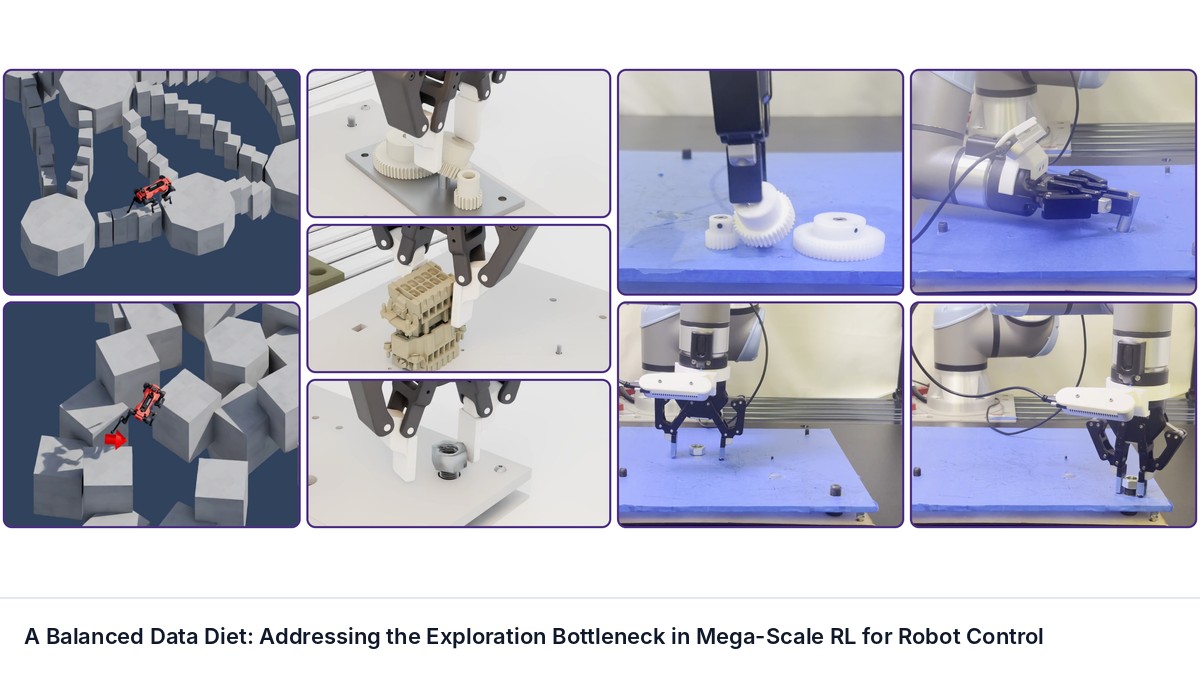
A Balanced Data Diet: Addressing the Exploration Bottleneck in Mega-Scale RL for Robot Control
Octi Zhang, Mateo Guaman Castro, Patrick Yin et al.
General-purpose robots must perform a wide range of tasks from agile locomotion to dexterous manipulation.
A Low-Cost, Open Platform for End-to-End Autonomous Driving on a Miniature Ackermann Vehicle
Gustavo Claudio Karl Couto, Eric Aislan Antonelo, Gabriel George Zipperer
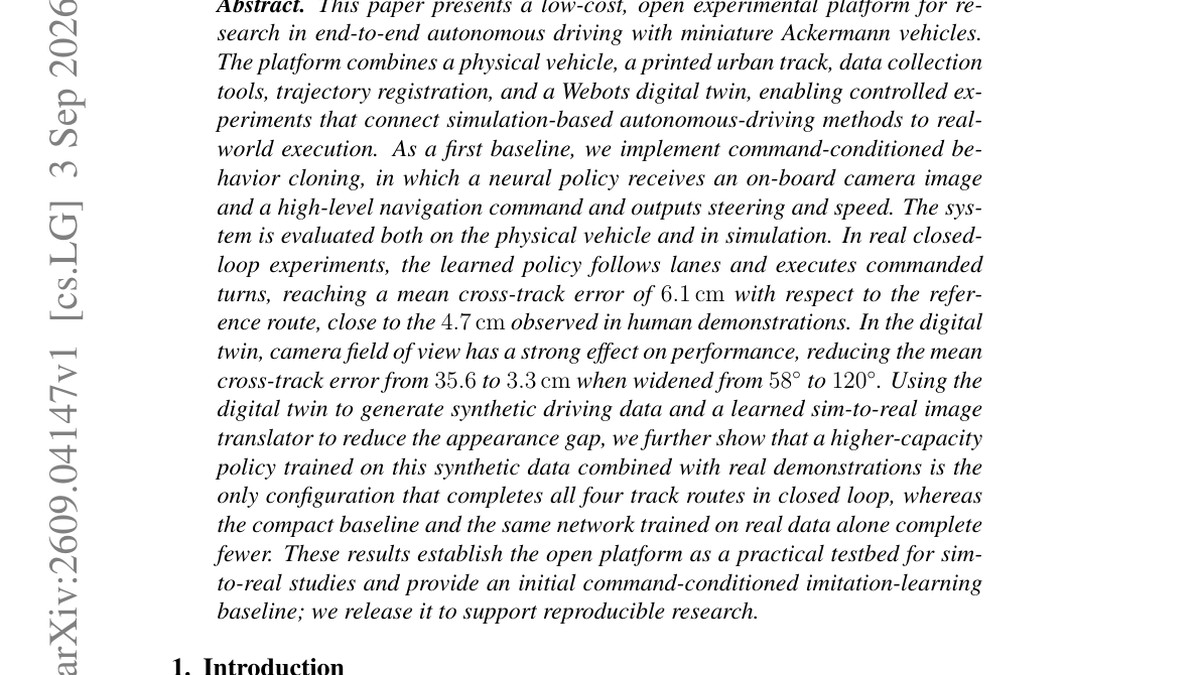
This paper presents a low-cost, open experimental platform for research in end-to-end autonomous driving with miniature Ackermann vehicles.
A Master-Salve Robot Manipulator for Needle-Based Teleoperation in MRI Chamber
Omar Curiel, Jing-Yuan Huang, Po-Chih Chen et al.
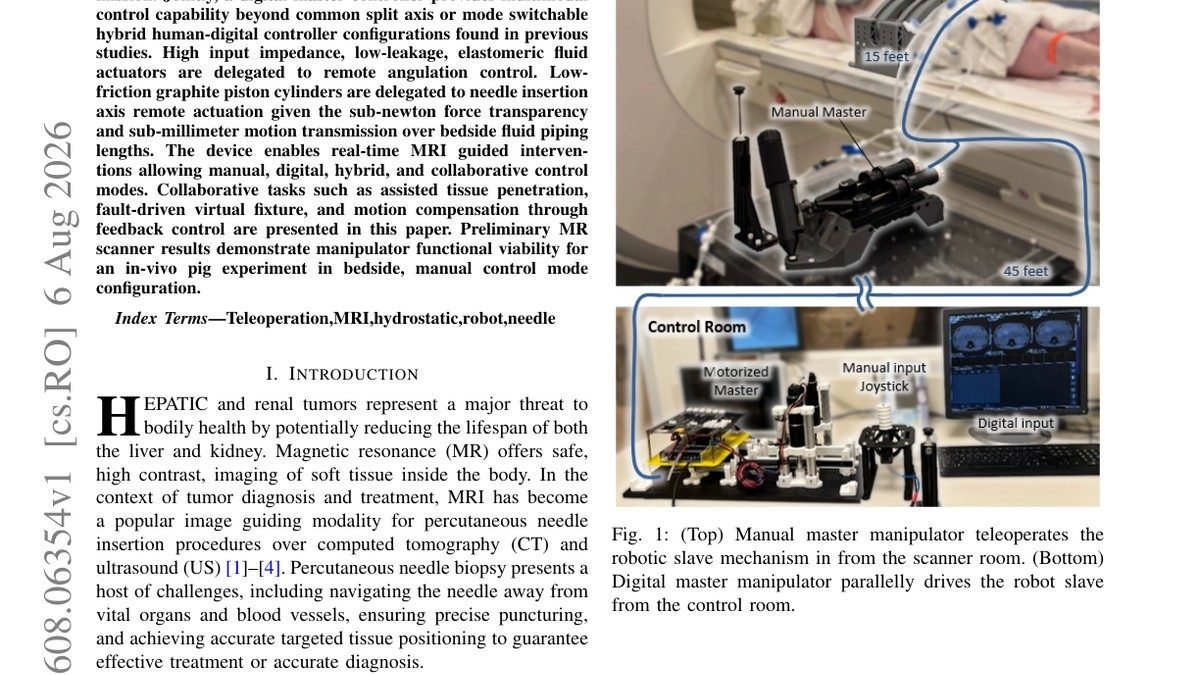
We present a MR safe, master-slave robot manipulator for abdominal interventions in the MRI chamber. A human operated 2+1-DoF master controller manipulator transmits motion and force to a 2+1-DoF slave manipulator via fluid transmission.

A Sim-to-Real Integration Pipeline for Training and Deployment of Chunk-Based VLA Manipulation Policies
Mathilde Kappel, Clémence Grislain, Mohamed Chetouani et al.
Vision-Language-Action (VLA) models have become a prominent paradigm for mapping multimodal inputs, including semantic instructions, visual observations of the scene, and proprioceptive observations, to robot actions.