
KPI: A Promptable Kernel for Physical Interaction on Humanoids
Yikai Wang, Honghao Zhu, Xiao Hu, Hao Zhang, Zelin Wang, Yip Fun Yeung, Ding Zhao, Lingfeng Sun · N/A · 2026
Framework
N/A
License
N/A
Stars
N/A
Summary
Humanoids now walk, balance and reach with remarkable generality: one whole-body tracking policy follows references from a human, or from an end-to-end policy.
Abstract Summary
Key Points
- Humanoids now walk, balance and reach with remarkable generality: one whole-body tracking policy follows references from a human, or from an end-to-end policy.
- That generality travels in the trajectory, and a trajectory alone carries limited information about the interaction it should produce: at contact, the executing controller determines how the robot behaves.
- Single-task policies usually reach hard interactions by optimising trajectory and controller together in simulation; general stacks usually assume a preset or hand-chosen controller.
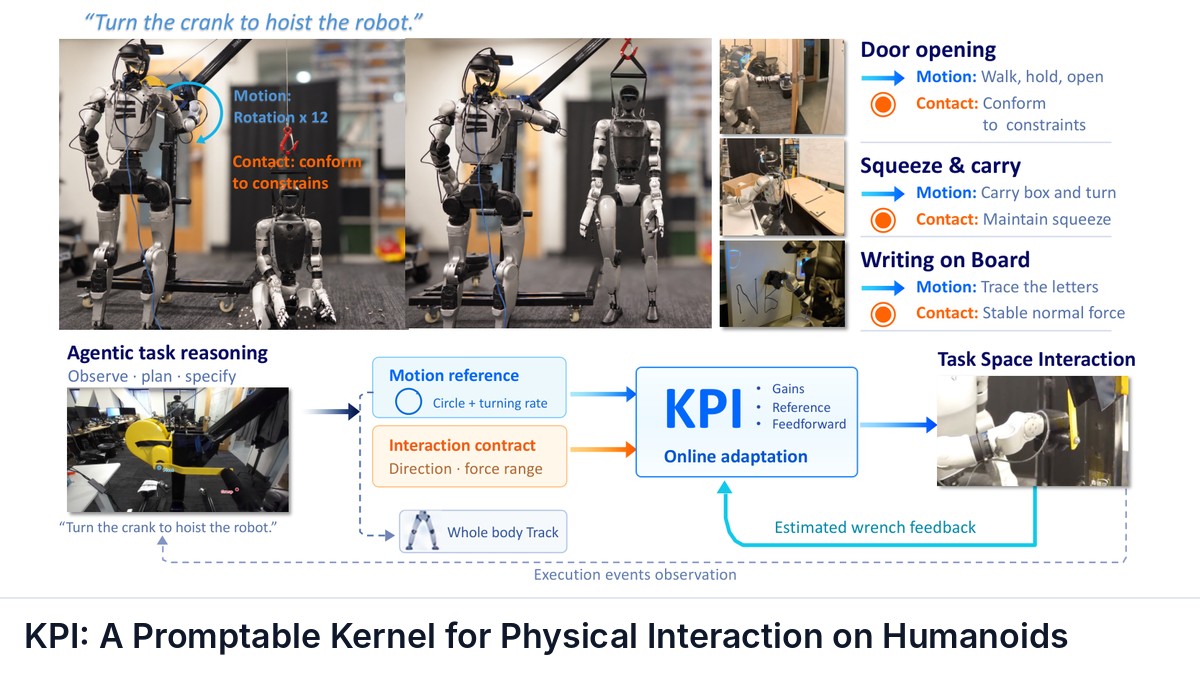
- We present KPI, a promptable kernel for physical interaction between the trajectory source and an unmodified whole-body tracker.
- Instead of a controller fixed before the task, the trajectory source sends a contract: per direction, track, comply, or hold a force range.
Method
KPI makes the controller’s interaction response an explicit part of the command interface. Alongside a nominal reference, the commander supplies a contract stating the interaction objectives. The kernel adapts the controller parameters toward it during execution and returns the interaction state.
We describe the contract-driven adaptation, its realization on a humanoid, and its use by a vision-language agent; a teleoperator or a VLA policy uses the same interface. Controller parameters and online optimization.
Experiments
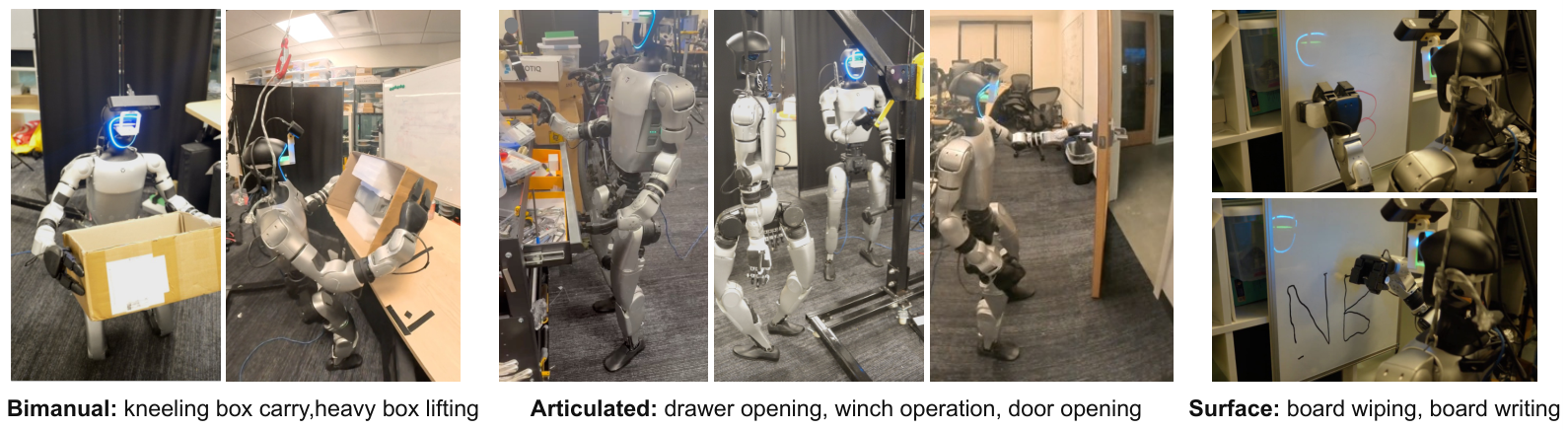
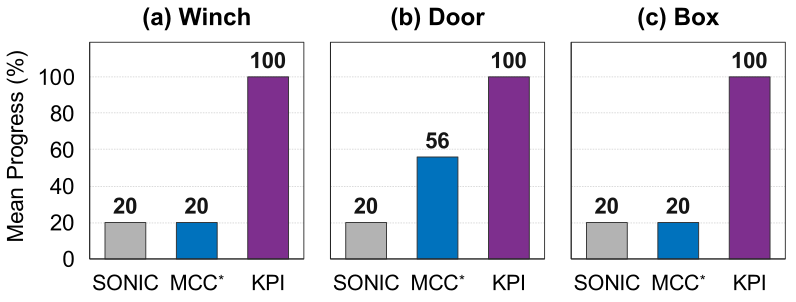
KPI supports three task categories (Fig. 3 ): bimanual transport (box placement and carrying during kneeling, standing, and running); articulated-object manipulation (drawer and door opening, and winch operation); and surface interaction (board wiping and writing). We evaluate zero-shot agentic execution on winch operation, door passage, and box transport and placement.
Sources and Demonstrations
Figures are reproduced from Wang et al. See the full paper for experimental details and the project page, when the paper links one, for demonstrations and videos.
Related Papers
A Low-Cost, Open Platform for End-to-End Autonomous Driving on a Miniature Ackermann Vehicle
Gustavo Claudio Karl Couto, Eric Aislan Antonelo, Gabriel George Zipperer
This paper presents a low-cost, open experimental platform for research in end-to-end autonomous driving with miniature Ackermann vehicles.

A Sim-to-Real Integration Pipeline for Training and Deployment of Chunk-Based VLA Manipulation Policies
Mathilde Kappel, Clémence Grislain, Mohamed Chetouani et al.
Vision-Language-Action (VLA) models have become a prominent paradigm for mapping multimodal inputs, including semantic instructions, visual observations of the scene, and proprioceptive observations, to robot actions.
Can People Distinguish Human and AI Agency in Humanoid Teleoperation? A Preliminary Study of Agency Perception
Xiang Li, Koya Dendo, Keigo Minamida et al.
Can people distinguish between human and AI agency in humanoid teleoperation?

Capability-Aware Arbitration for Semantic Intent-Based Shared Control
Zhaoda Du, Michael Bowman, Xiaoli Zhang
Shared control often allocates robot authority based on confidence in inferred human intent, assuming reliable autonomous execution. When this assumption fails, high intent confidence can cause over-helping.