
Shake to Learn: Dynamic Interrogation of Hidden Object Physics for Robotic Manipulation with Physical Reservoir Computing
Wen Sin Lor, Jun Wang, Suyi Li · N/A · 2026
Framework
N/A
License
N/A
Stars
N/A
Summary
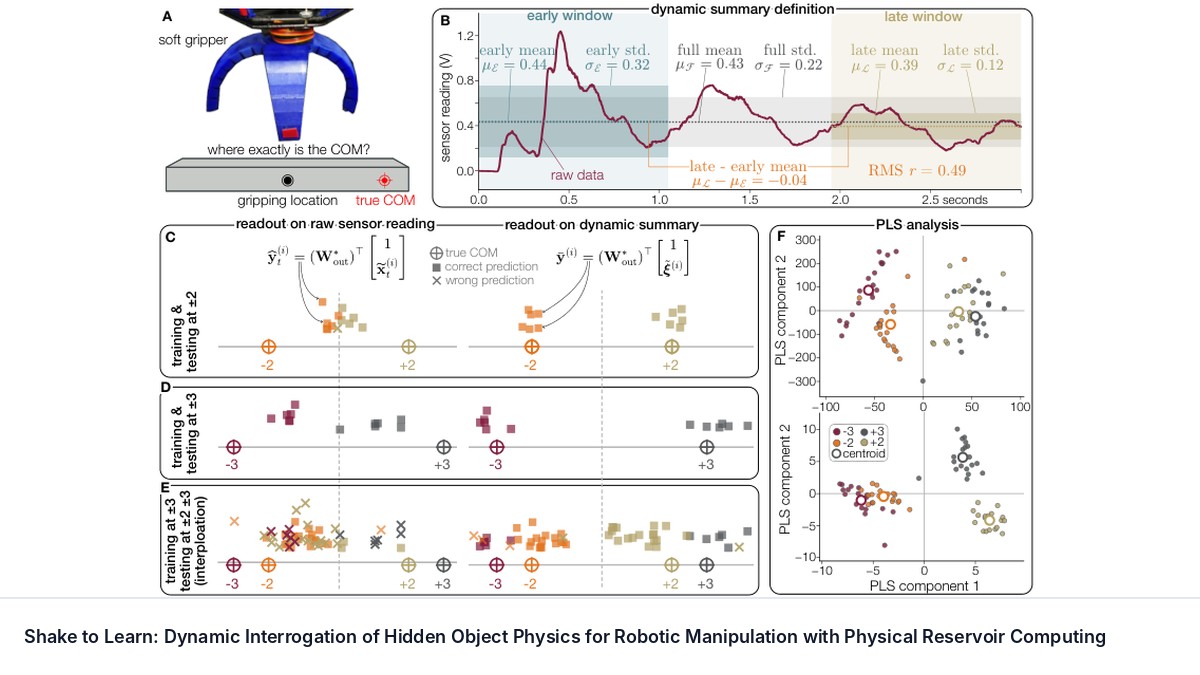
Many physical properties relevant to robotic manipulation are hidden from vision. A sealed object, for example, may reveal little about its center of mass (COM) or internal contents until it is lifted, shaken, or otherwise dynamically perturbed.
Abstract Summary
Key Points
- Many physical properties relevant to robotic manipulation are hidden from vision
- A sealed object, for example, may reveal little about its center of mass (COM) or internal contents until it is lifted, shaken, or otherwise dynamically perturbed.
- This study shows that such interactions can enable a new modality of robotic perception and learning, in which interaction-induced dynamic responses are used to infer object physics that is inaccessible to conventional sensing.
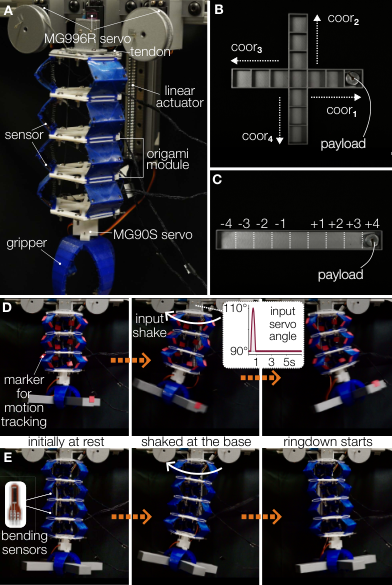
- We implement this idea using an origami-inspired soft robotic arm that functions as a physical reservoir computer.
- After grasping an object, the arm is excited by a fixed shaking input at its base, and the resulting ringdown response is recorded through either camera tracking or embedded sensors.
Dynamic Interrogation: Task Setup and Theoretical Framework
Dynamic interrogation aims to project hidden object properties into measurable dynamical responses in the coupled robot-object system. In this study, we choose the object’s COM as the targeted latent property. To this end, we 3D-print a cross-shaped and a bar-shaped container with internal dividers, and then place a payload mass $m$ inside at a selected location $\ell$ (Figure 2 ).
Therefore, adjusting the payload’s location inside the container effectively changes the object’s COM.
Dynamic Interrogation: Results and Insights
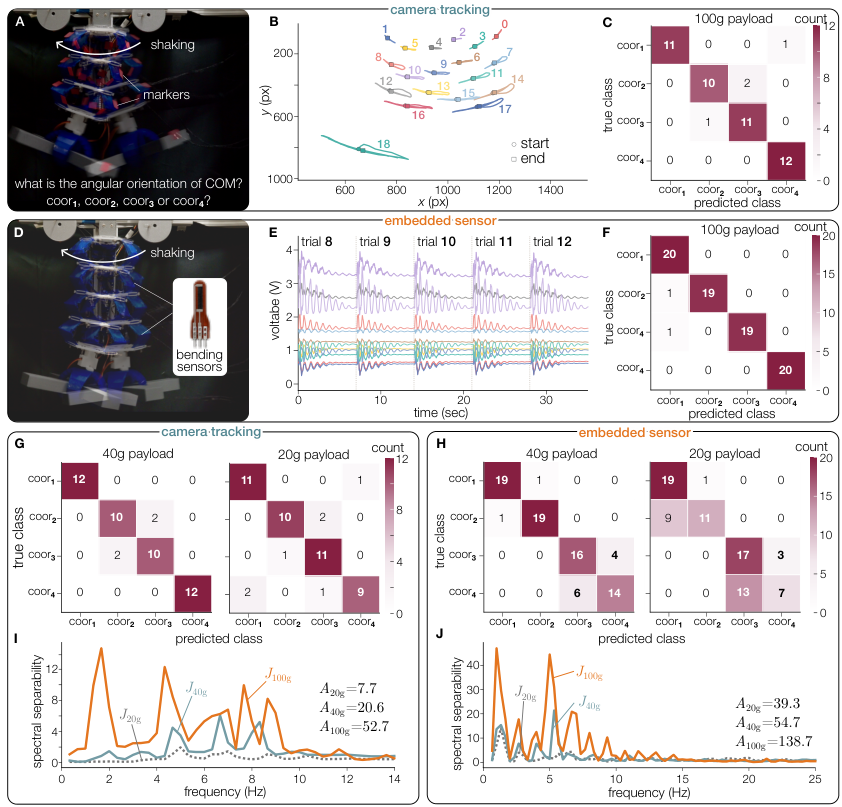
In this study, we task the soft robotic arm with inferring the hidden COM position through three challenges of increasing complexity. Task I asks whether shake-induced ringdown dynamics carry enough information to decode the angular position of a hidden payload mass within a cross-shaped container.
This establishes the fundamental principles of robotic learning via dynamic interaction, and confirms that this learning modality is accessible through both external camera tracking and embedded sensing alone.
Sources and Demonstrations
Figures are reproduced from Lor et al. See the full paper for experimental details and the project page, when the paper links one, for demonstrations and videos.
Related Papers
3DThinkVLA: Endowing Vision-Language-Action Models with Latent 3D Priors via 3D-Thinking-Guided Co-training
Jiaxin Shi, Xidong Zhang, Fucai Zhu et al.
We propose a 3D-thinking-guided co-training framework that enables vision-language-action (VLA) models to perform 3D spatial reasoning implicitly during action prediction.
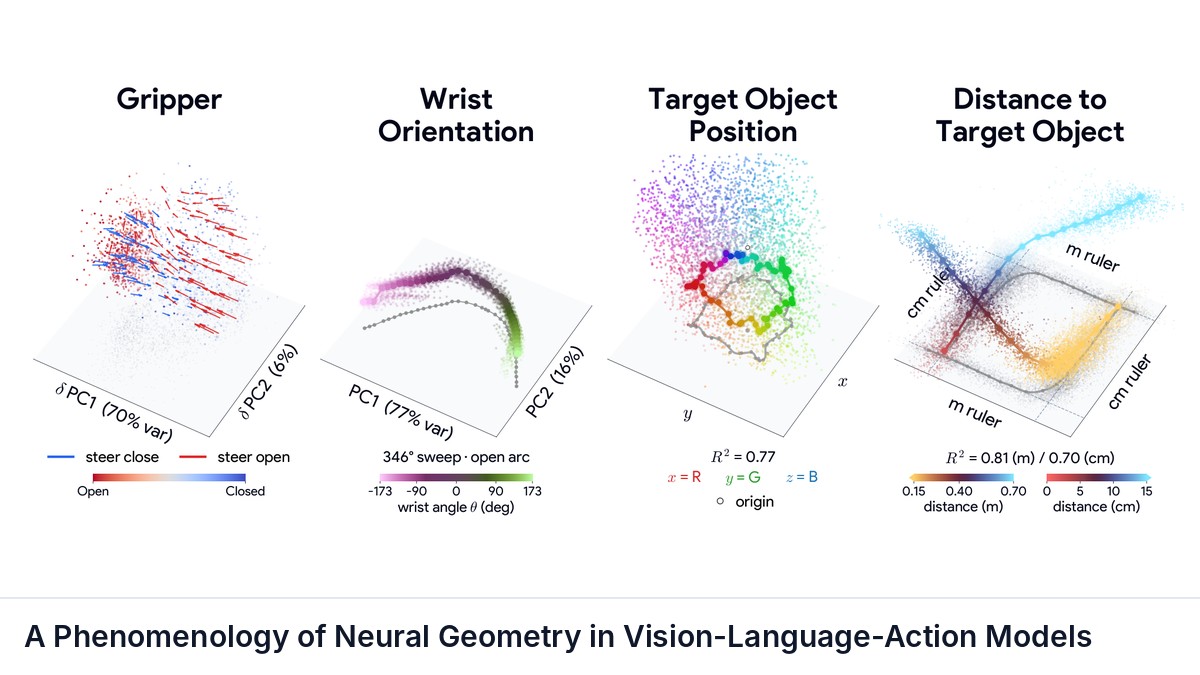
A Phenomenology of Neural Geometry in Vision-Language-Action Models
Mozes Jacobs, Aiden Swann, Mathilde Papillon et al.
Robotic manipulation is inherently geometric, but what shape does the world take inside the policy that performs it?

A Sim-to-Real Integration Pipeline for Training and Deployment of Chunk-Based VLA Manipulation Policies
Mathilde Kappel, Clémence Grislain, Mohamed Chetouani et al.
Vision-Language-Action (VLA) models have become a prominent paradigm for mapping multimodal inputs, including semantic instructions, visual observations of the scene, and proprioceptive observations, to robot actions.
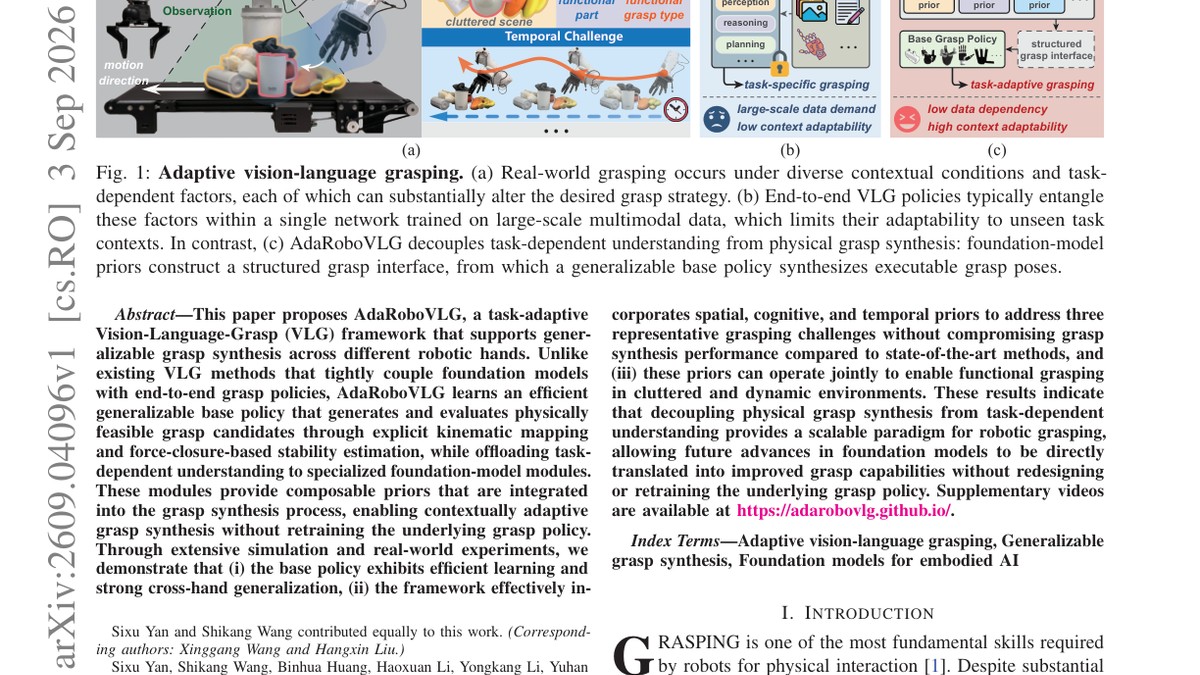
Adaptive Vision-Language Grasping via Composable Foundation Priors and Generalizable Grasp Synthesis
Sixu Yan, Shikang Wang, Binhua Huang et al.
This paper proposes AdaRoboVLG, a task-adaptive Vision-Language-Grasp (VLG) framework that supports generalizable grasp synthesis across different robotic hands.