
Dex-One2Many: Learning Dexterous Manipulation from a Single Human Demonstration
Jusuk Lee, Sungha Kim, Yeonsoo Park, Jonguk Cheon, Yoonkyo Jung, Yongjun You, H. Jin Kim, Jia-Bin Huang, Furong Huang, Youngseok Jang, Seungjae Lee · N/A · 2026
Framework
N/A
License
N/A
Stars
N/A
Summary
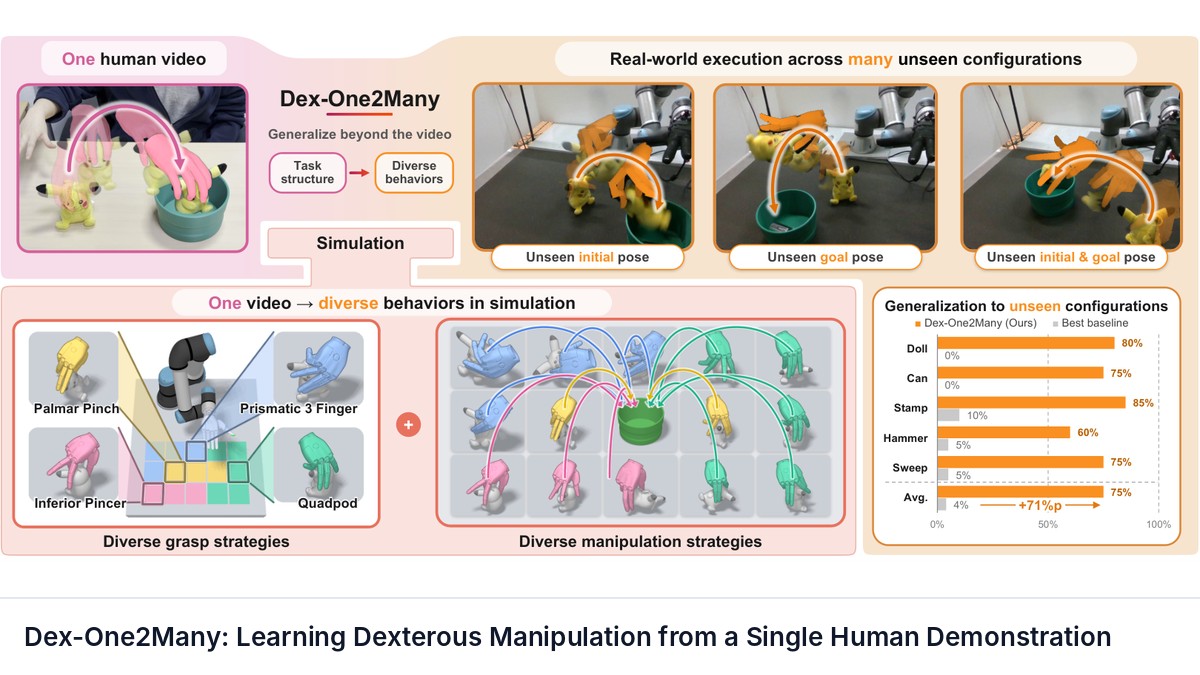
While learning dexterous manipulation from a single human video offers a promising alternative to costly robot demonstrations, many recent methods predominantly imitate demonstrated motions.
Abstract Summary
Key Points
- While learning dexterous manipulation from a single human video offers a promising alternative to costly robot demonstrations, many recent methods predominantly imitate demonstrated motions.
- Such strict motion matching often limits generalization to initial object poses, goal poses, and grasps not shown in the video.
- Alternatively, discovering a policy via reinforcement learning (RL) allows for broad generalization, but without prior guidance, it struggles with high-dimensional exploration in complex, multi-stage tasks.
- To address these coupled generalization and exploration challenges, we present Dex-One2Many, a real-to-sim-to-real framework that learns a generalizable dexterous manipulation policy from a single human video.
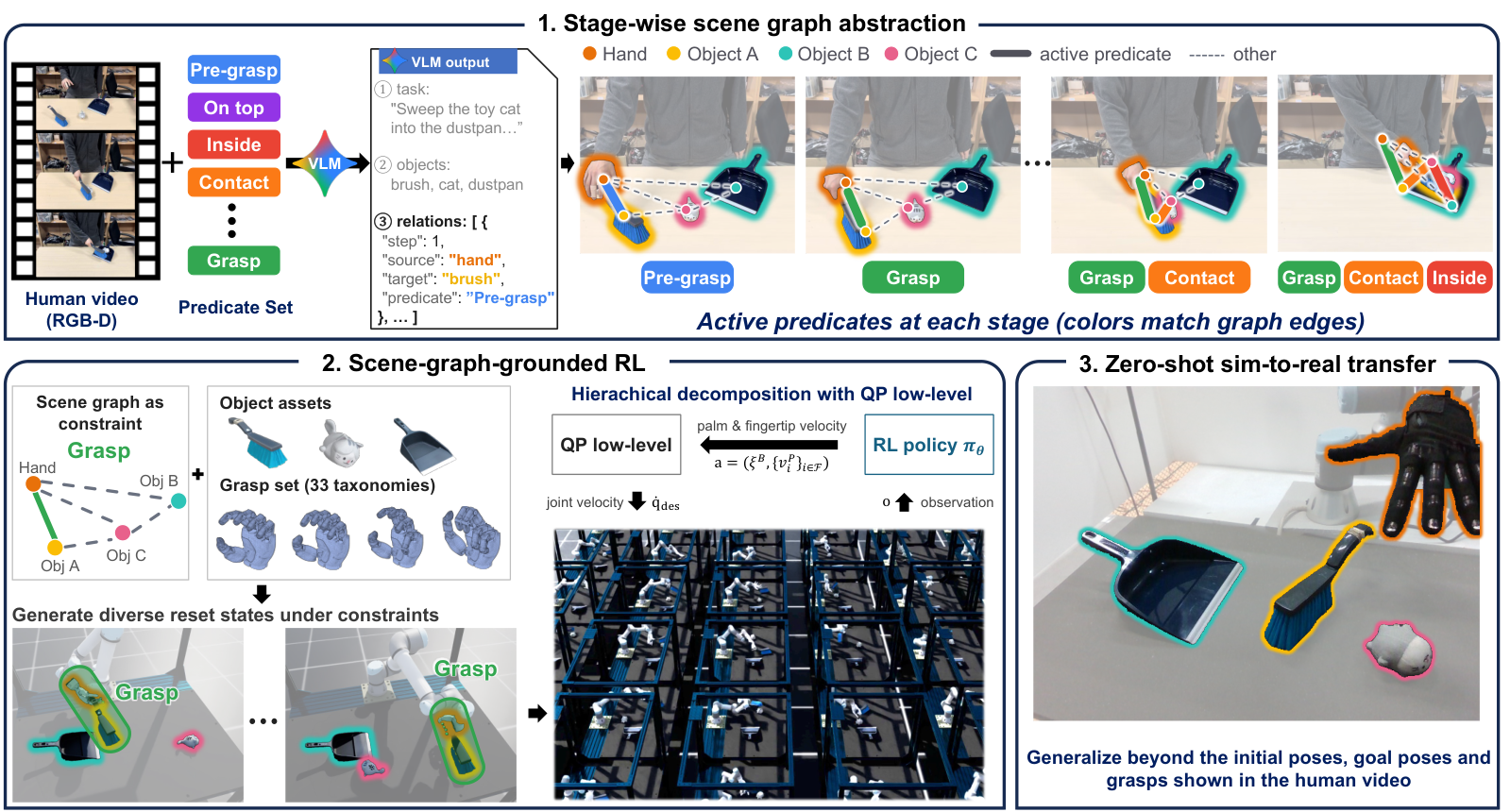
- Our key insight is to abstract the video into sequential scene graphs that guide RL, enabling efficient exploration while preserving broad generalizability.
Method
Given a single demonstration of a manipulation task, our goal is to learn a dexterous policy that generalizes to diverse spatial configurations, including randomized object poses and novel grasps, beyond the original video. To achieve this, we first abstract the demonstration into a stage-wise scene graph (Sec. 3.1 ).
We then formulate policy learning as a Markov decision process (MDP) grounded in this graph, with observations, rewards, and an initial-state distribution constructed from it without task-specific design (Sec. 3.2 ).
Experiments
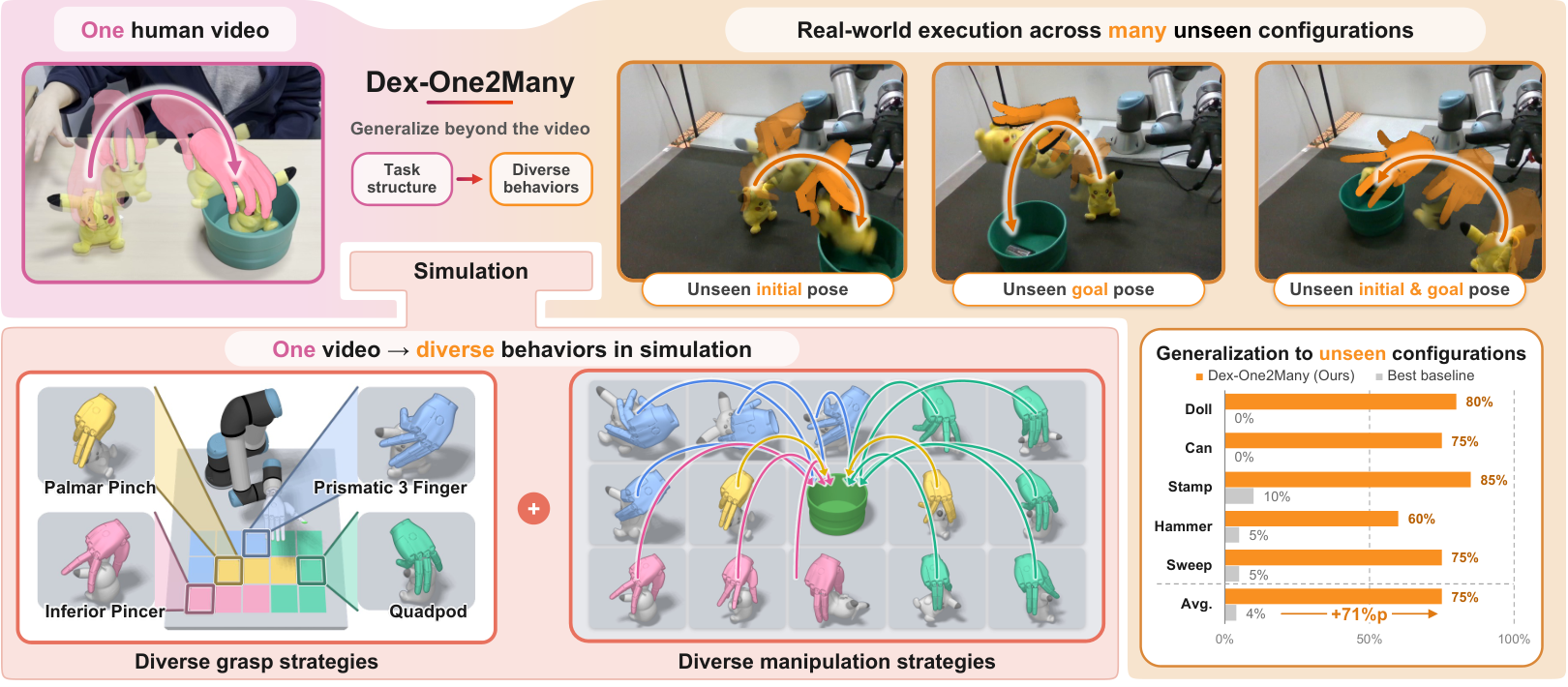
In this section, we evaluate Dex-One2Many in simulation and on real hardware. Our experiments address three questions: Does Dex-One2Many generalize to initial and goal configurations not shown in the single human video? Does Dex-One2Many apply across diverse dexterous embodiments with different kinematics? Which design choices of Dex-One2Many are critical to its performance? Tasks.
We evaluate Dex-One2Many on five manipulation tasks that span direct object manipulation and tool use (Fig. 4 ).
Sources and Demonstrations
Figures are reproduced from Lee et al. See the full paper for experimental details and the project page, when the paper links one, for demonstrations and videos.
Related Papers
A Balanced Data Diet: Addressing the Exploration Bottleneck in Mega-Scale RL for Robot Control
Octi Zhang, Mateo Guaman Castro, Patrick Yin et al.
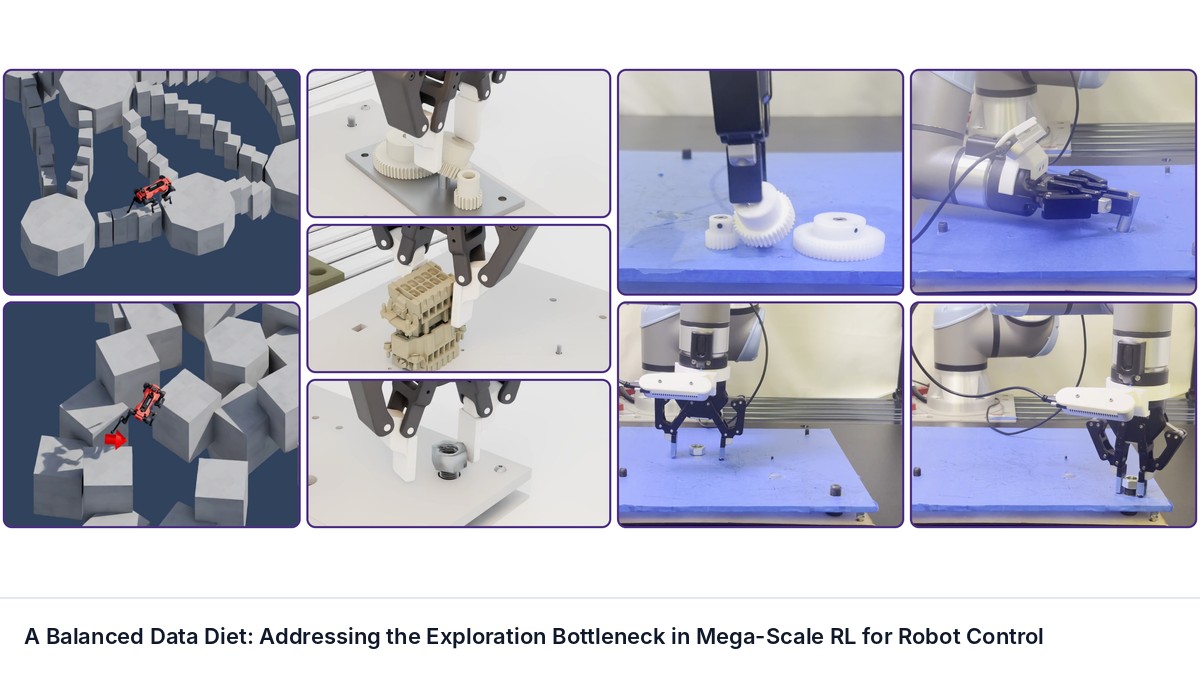
General-purpose robots must perform a wide range of tasks from agile locomotion to dexterous manipulation.

A Sim-to-Real Integration Pipeline for Training and Deployment of Chunk-Based VLA Manipulation Policies
Mathilde Kappel, Clémence Grislain, Mohamed Chetouani et al.
Vision-Language-Action (VLA) models have become a prominent paradigm for mapping multimodal inputs, including semantic instructions, visual observations of the scene, and proprioceptive observations, to robot actions.
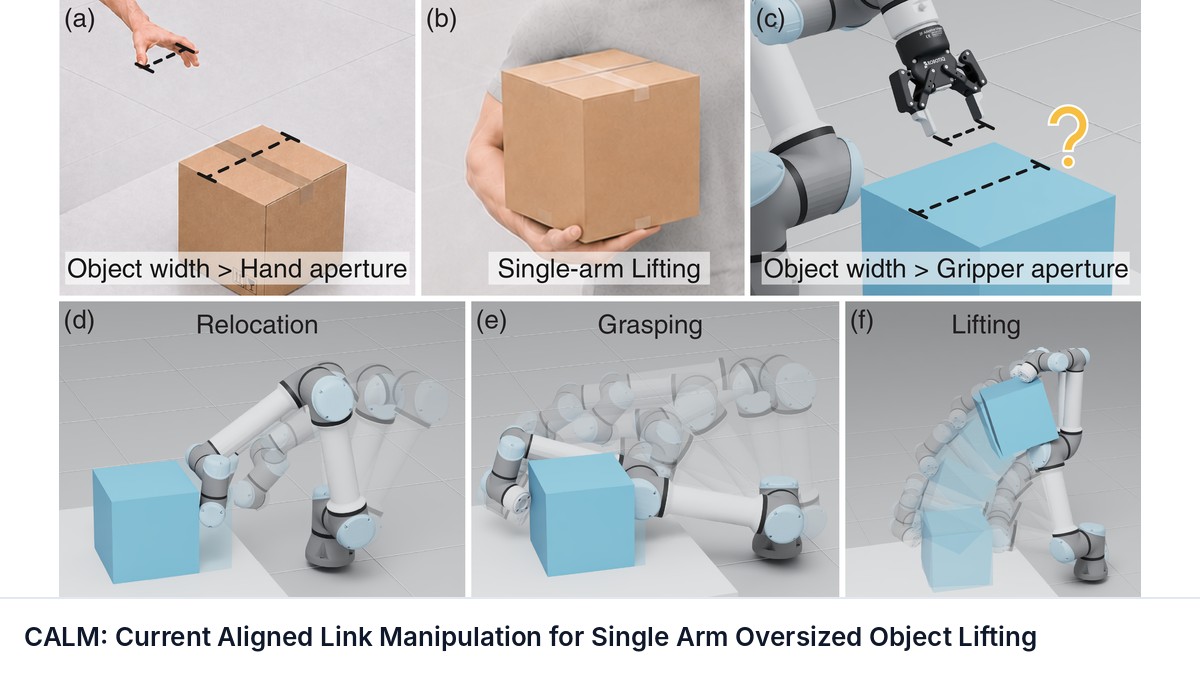
CALM: Current Aligned Link Manipulation for Single Arm Oversized Object Lifting
Hu, Jun, Chen, Sihan, Jovanovic, Kosta et al.
Most robots manipulate objects solely with their end effectors, whereas humans flexibly leverage different body parts, such as the forearm and elbow, especially when handling oversized objects.
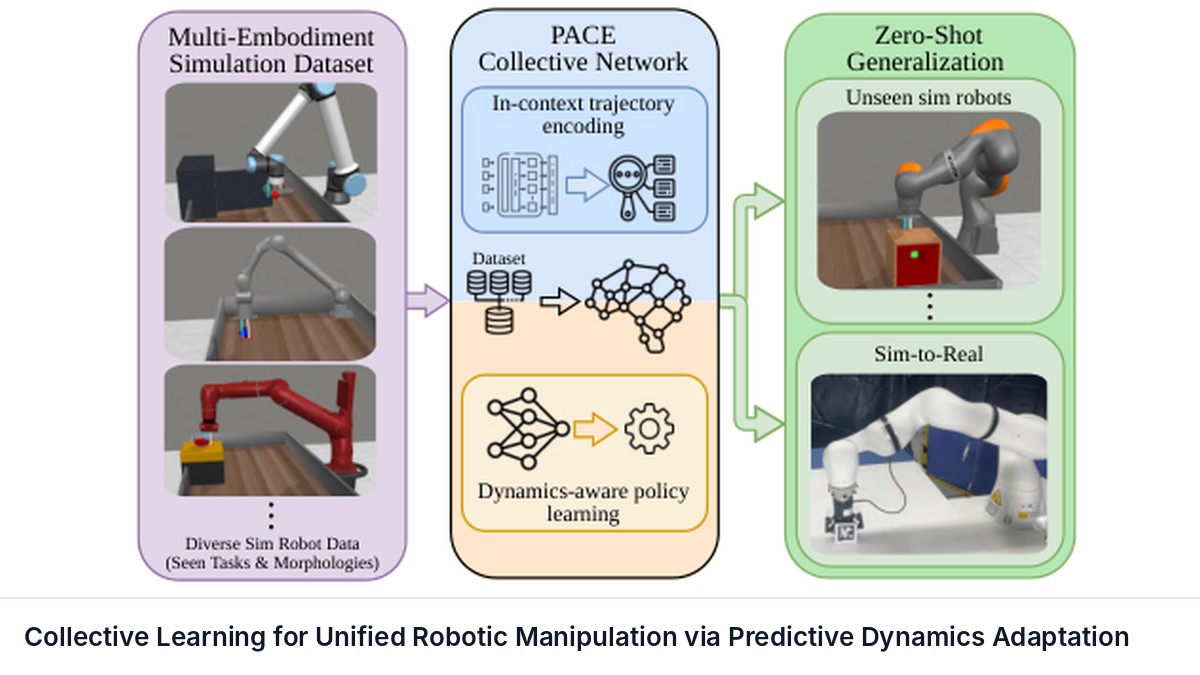
Collective Learning for Unified Robotic Manipulation via Predictive Dynamics Adaptation
Shaocheng Liu, Yuan Meng, Zhenshan Bing et al.
Learning a collective policy for state-based Cartesian manipulation across diverse robotic embodiments presents a fundamental challenge due to embodiment-dependent transition dynamics.