
Context-Aware RGB-Thermal-Radar Obstacle Perception for Resource-Constrained ASVs
Pranav Kedia, Edwin Redhead, Heiko Hamann · N/A · 2026
Framework
N/A
License
N/A
Stars
N/A
Summary
Reliable obstacle perception is challenging for small autonomous surface vessels (ASVs): reflections and glare confound visible-light cameras, vessel motion shifts the apparent waterline, and darkness removes the dominant sensing modality altogether.
Abstract Summary
Key Points
- Reliable obstacle perception is challenging for small autonomous surface vessels (ASVs): reflections and glare confound visible-light cameras, vessel motion shifts the apparent waterline, and darkness removes the dominant sensing modality altogether.
- Rather than treating multimodal fusion as a static accuracy gain, we propose a context-aware architecture that combines RGB and long-wave infrared (LWIR) imagery, frequency-modulated continuous-wave (FMCW) mmWave radar, and inertial context.
- A bearing-sector interface provides the navigation controller with calibrated obstacle probabilities, radar ranges, and sensor status.
- It also distinguishes sensor dropout from a valid observation with no detected obstacle
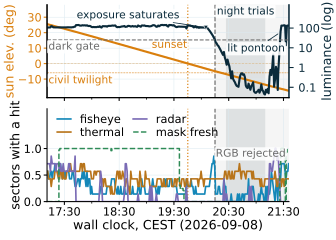
- Using new multimodal lake recordings, we deployed the pipeline in a 24-leg closed-loop pilot under uncontrolled lake conditions (16 day, 4 dusk, and 4 night; 351 m), including night legs in which RGB was unusable and the vessel drove on LWIR and radar evidence alone.
System and Operational Overview
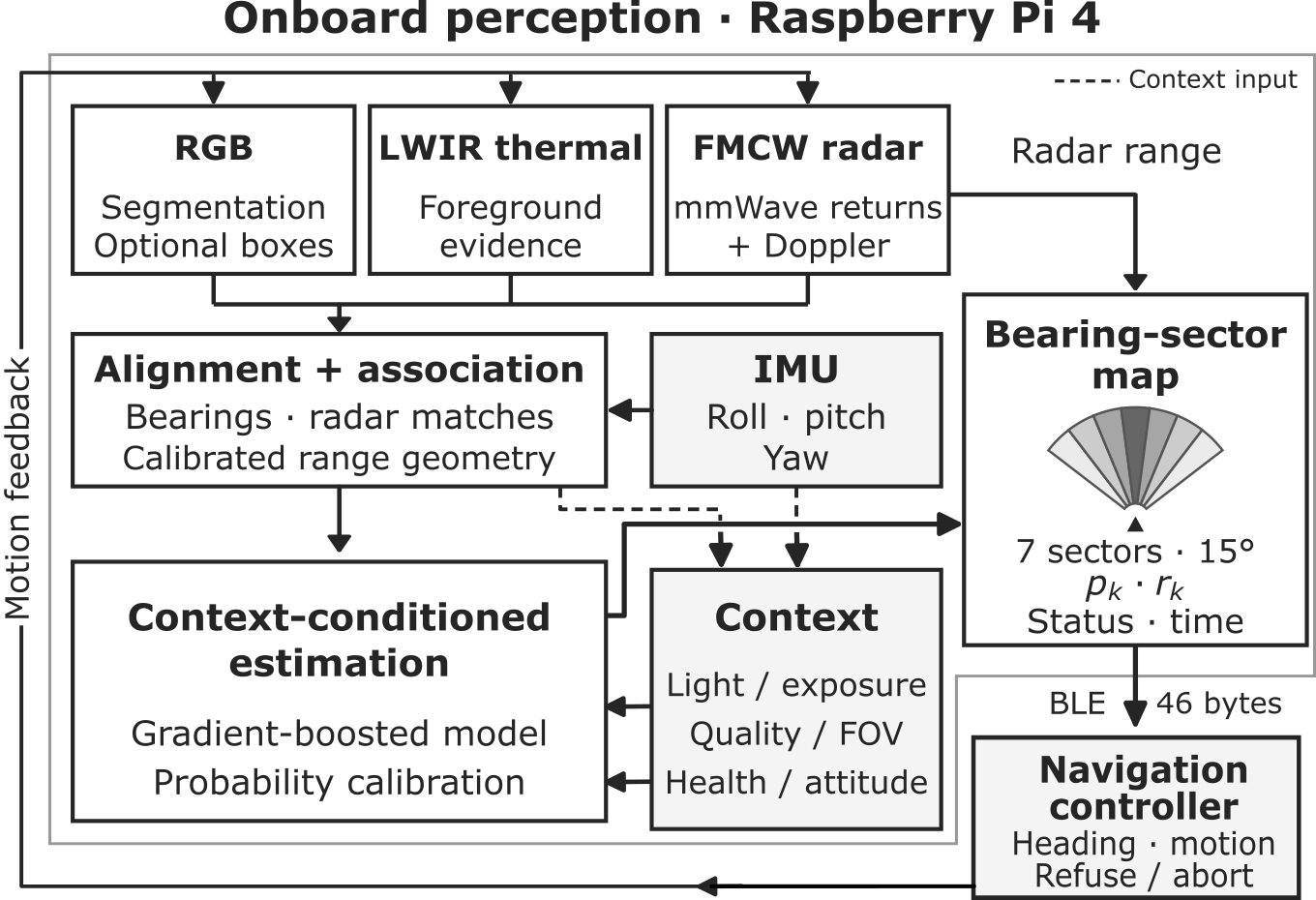
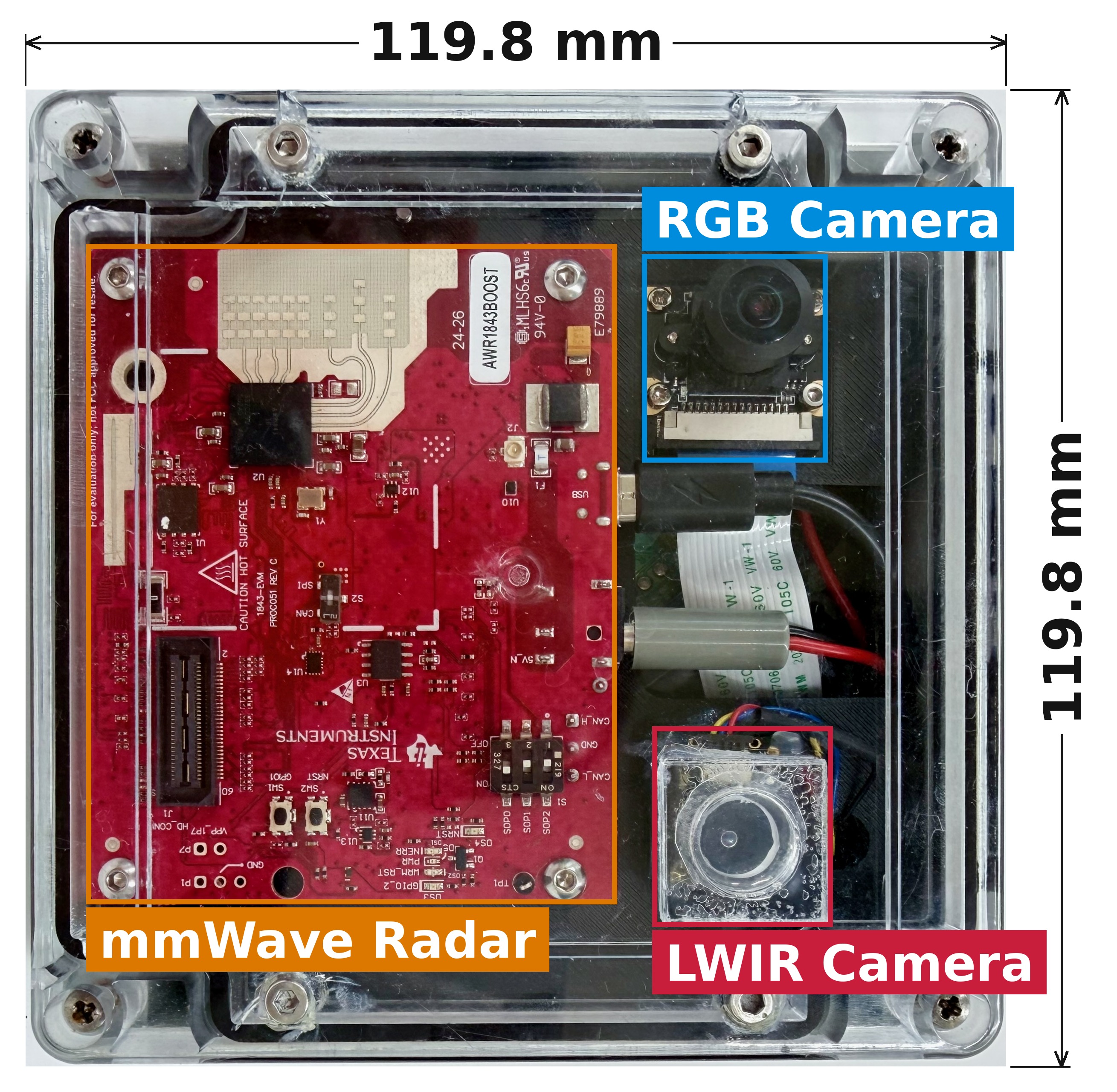
Our perception module combines RGB, LWIR thermal, and FMCW mmWave radar measurements with inertial context on an embedded computer. Its output provides the navigation controller with bearing-resolved representation of detected obstacles. Next, we describe the method’s operating constraints, sensor configuration, and timing/geometric references.
The perception subsystem consumes energy through sensing, computation, interfaces, and power conversion.
Multimodal Perception and Sector Fusion
We first undistort each RGB frame and use an embedded segmentation network to classify pixels as obstacle, water, or sky. We trained an LR-ASPP/MobileNetV3 student network through knowledge distillation [ 14 ] from eWaSR [ 4 ] , using LaRS [ 1 ] and 10,731 frames from our own recordings labeled by the teacher.
Data, Labels and Experimental Design
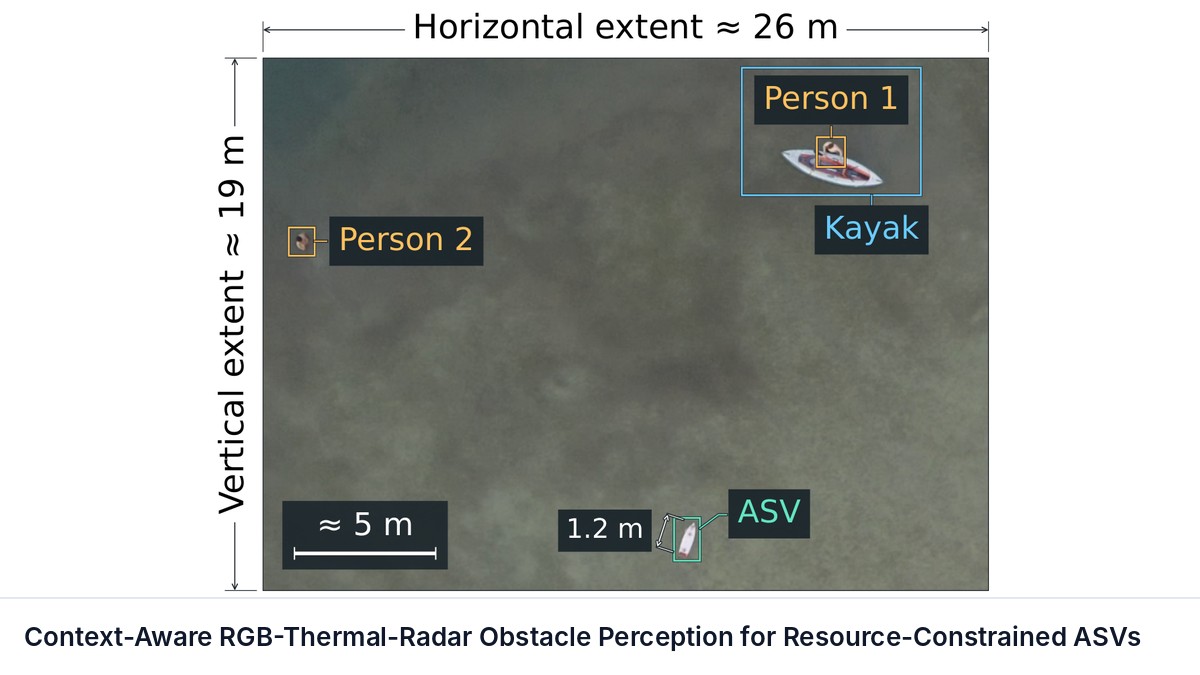
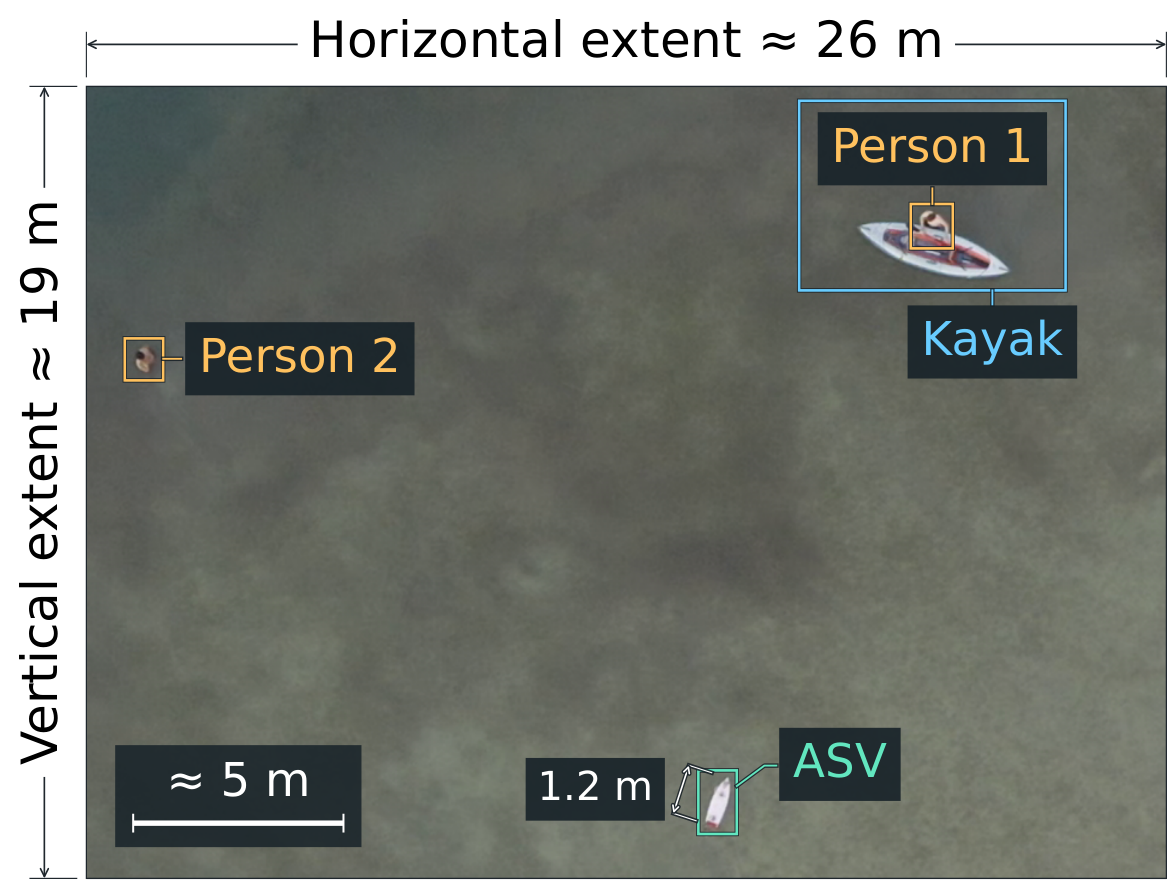
Recordings were made on a lake (Fig. 1 ) from our ASV, a pontoon, and a moored vessel, between June and September 2026: six daylight, two twilight, and one night session ($13.0\text{\,}\mathrm{h}$, 121,313 synchronized frames in the curated corpus), with buoys, moored and moving boats, wading and swimming people, water birds, and shoreline structures at ranges from $1\text{\,}\mathrm{m}$ to the shore.
Illumination is measured: exposure time, gain, and luminance are logged per frame, and sun elevation is computed from RTC time and GPS position.
Results
After the afloat calibration (camera height re-measured under load, IMU attitude, water-line contact point), monocular range on an isolated wading target at 6.9 to $8.9\text{\,}\mathrm{m}$ has a median absolute error of $3.5\text{\,}\mathrm{\%}$ (mean $+1.3\%$, 100% within $\pm 20\%$, $n=11$), against 8.3%/73% at the out-of-water height (Fig. 3 ). The height correction accounted for most of the gain.
Over whole dockside clips, the error stays large because the camera sees the shore beyond the radar’s $9\text{\,}\mathrm{m}$ range.
Sources and Demonstrations
Figures are reproduced from Kedia et al. See the full paper for experimental details and the project page, when the paper links one, for demonstrations and videos.
Related Papers
A Low-Cost, Open Platform for End-to-End Autonomous Driving on a Miniature Ackermann Vehicle
Gustavo Claudio Karl Couto, Eric Aislan Antonelo, Gabriel George Zipperer
This paper presents a low-cost, open experimental platform for research in end-to-end autonomous driving with miniature Ackermann vehicles.
Aim Short to Reach Far: Your Frozen World Model Can Plan Better Than You Think
Xvyuan Liu, Jianjie Fang, Chen Gao et al.
Planners built on visual world models commonly score each predicted outcome by its distance to the encoded goal image. We show that this target can limit control even with exact dynamics and globally optimal short-horizon search: reaching a goal may require actions that initially move away from it.
Autonomous Droplet Navigation via Model-Based Reinforcement Learning: Zero-Shot Transfer and Emergent Dynamics
Rajneesh Anand, Mayuresh V. Kothare
Self-driving laboratories (SDLs) are transforming chemical and materials discovery through closed-loop automation, yet automated infrastructure for physical manipulation of soft, deformable matter remains beyond current robotic platforms.
Autoware in Construction: Gap Analysis and LiDAR Perception Toward Off-Road Autonomous Driving
Yu Otsuki, Teja Emmey, Sena Matsushita et al.
Autoware is an open-source autonomous driving software platform widely adopted by researchers and industry developers.