
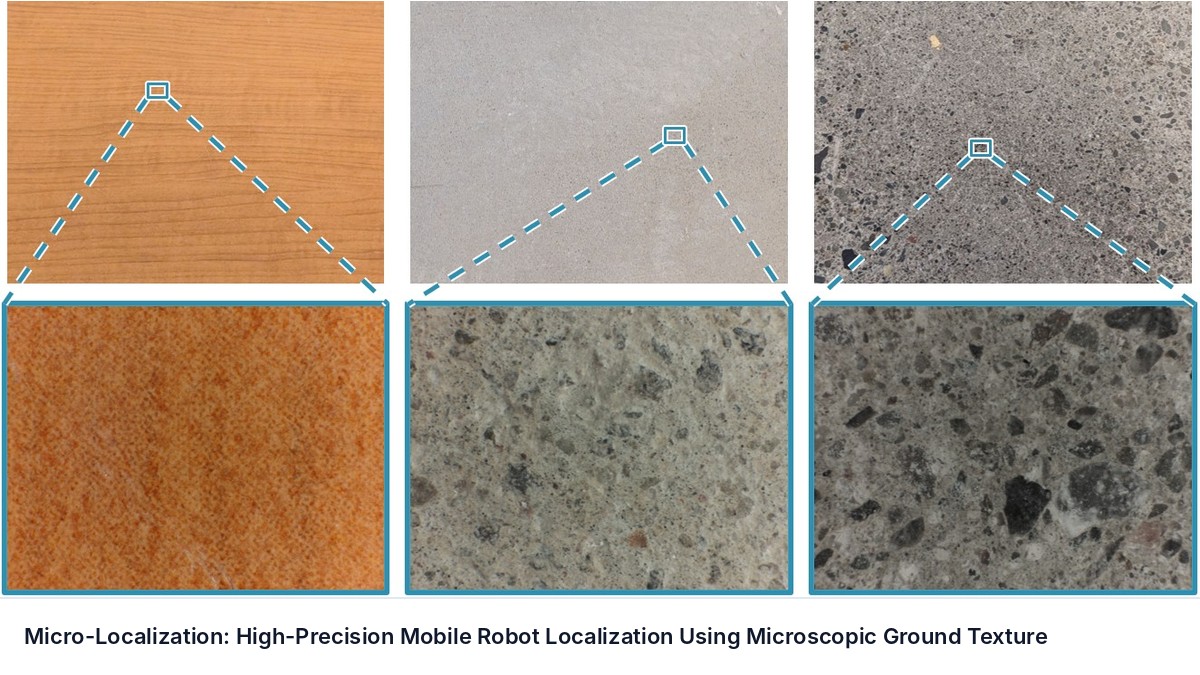
Micro-Localization: High-Precision Mobile Robot Localization Using Microscopic Ground Texture
Aaron Wilhelm, Marina de Albuquerque Marcon, Emith Uyanwatte, Nils Napp · N/A · 2026
Framework
N/A
License
N/A
Stars
N/A
Summary
We demonstrate high-precision global localization using natural ground texture viewed through microscope optics, achieving localization in the tens-of-micrometers regime.
Abstract Summary
Key Points
- We demonstrate high-precision global localization using natural ground texture viewed through microscope optics, achieving localization in the tens-of-micrometers regime.
- For the planar ground texture localization problem considered here, we relate optical magnification and image-space localization uncertainty to physical localization precision.
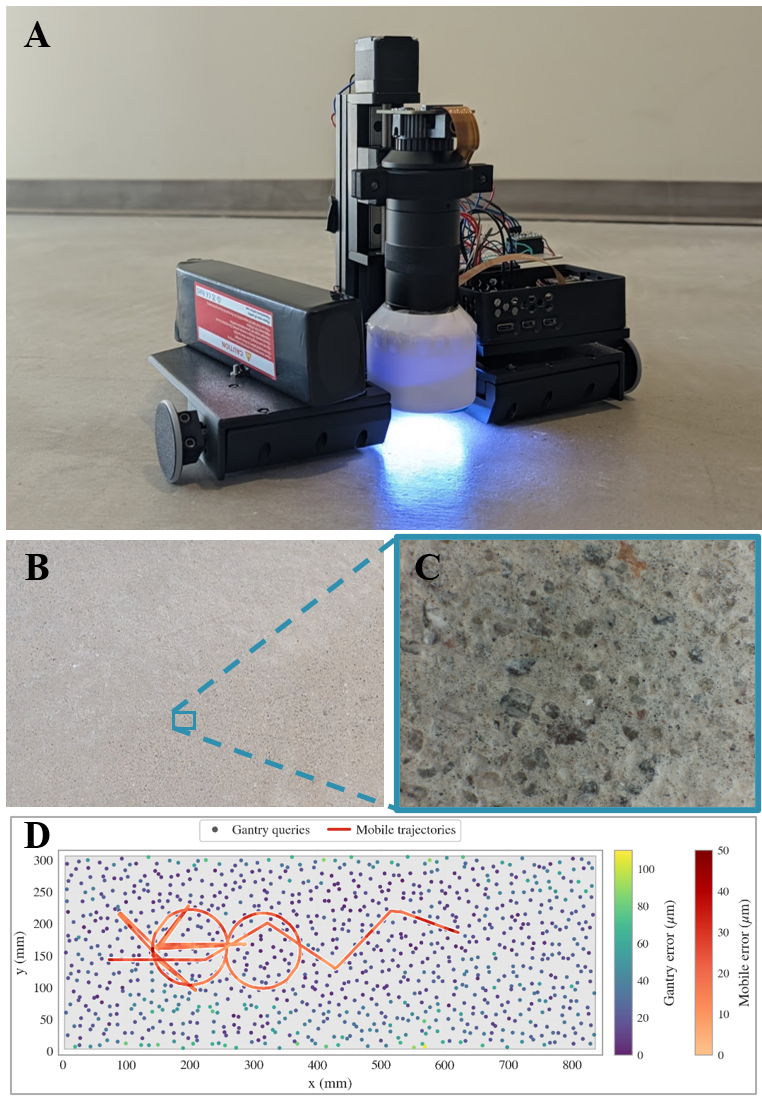
- Leveraging this relationship, we then develop a microscope-based localization system that addresses the calibration, camera-modeling, and focus challenges introduced by high-magnification imaging.
- We evaluate this system across several surface textures using a calibrated precision gantry
- Across 1,007 held-out queries per surface, the system localizes every query and achieves translation RMSEs of 28$-$73 $\mu$m.
System Design and Methodology
Ground texture localization is typically formulated using a downward-facing camera that observes a locally planar surface from an approximately fixed height. With the imaging geometry calibrated, the image pose within the surface map can be represented in SE(2) by planar translation and rotation.
Experiments and Results
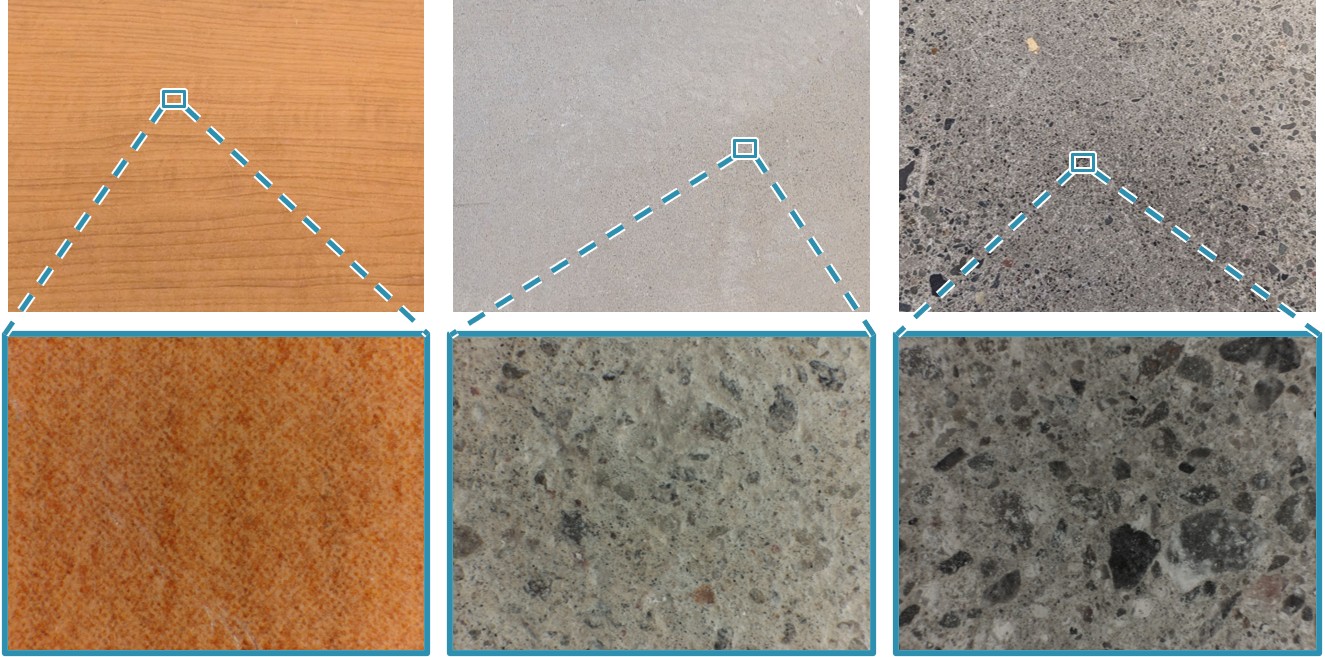
We evaluate the proposed system on three surface textures: a printed wood-grain desk surface, terrazzo, and concrete. For each surface, we independently calibrate the gantry reference system and collect a localization database followed by a separate query set. The resulting mapped region spans approximately $83.5\times 30.4~\mathrm{cm}$, corresponding to roughly 3,700 non-overlapping native camera footprints.
Each surface is evaluated using the same set of 1,007 query poses spatially distributed throughout the mapped region.
Sources and Demonstrations
Figures are reproduced from Wilhelm et al. See the full paper for experimental details and the project page, when the paper links one, for demonstrations and videos.
Related Papers
3DThinkVLA: Endowing Vision-Language-Action Models with Latent 3D Priors via 3D-Thinking-Guided Co-training
Jiaxin Shi, Xidong Zhang, Fucai Zhu et al.
We propose a 3D-thinking-guided co-training framework that enables vision-language-action (VLA) models to perform 3D spatial reasoning implicitly during action prediction.
4D Radar Perception Algorithms for Autonomous Driving: A Review
Xumin Wu, Jun Zhou, Jilin Mei et al.
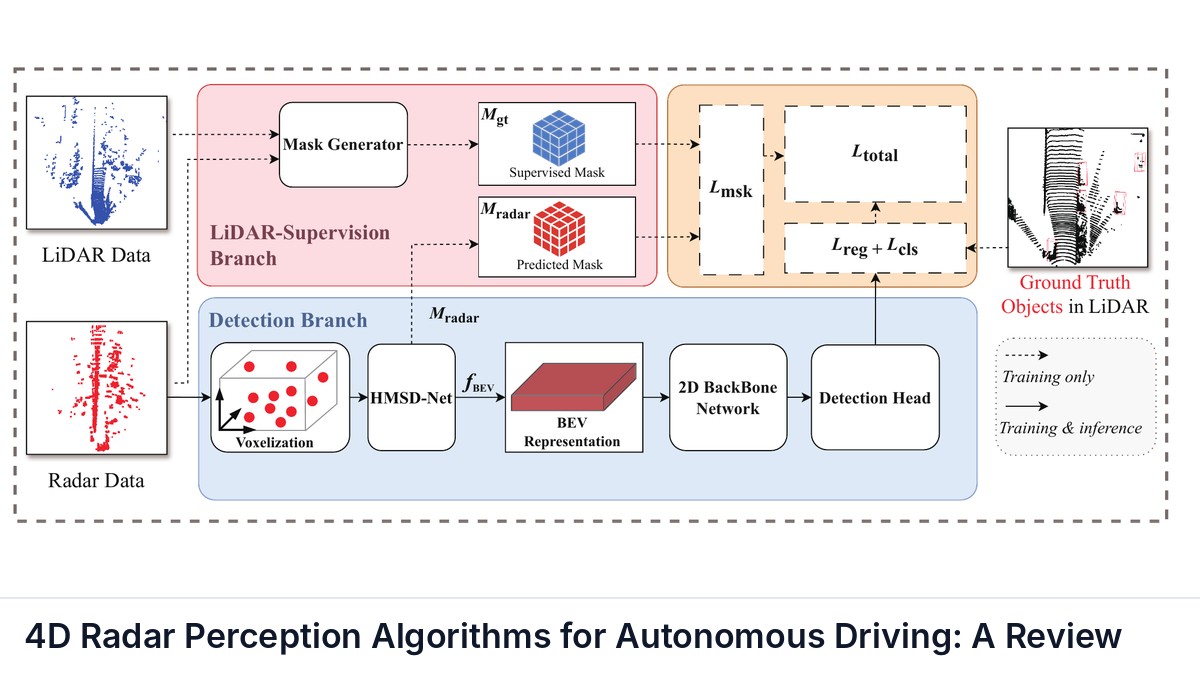
Research on 4D millimeter-wave radar perception algorithms has flourished in recent years, extending from signal processing and object detection to semantic segmentation, motion estimation, occupancy prediction, and dynamic scene reconstruction.
A Biomimetic Gaze Control to Restore Head-Neck Movements
Colin Rubow, Haohan Zhang
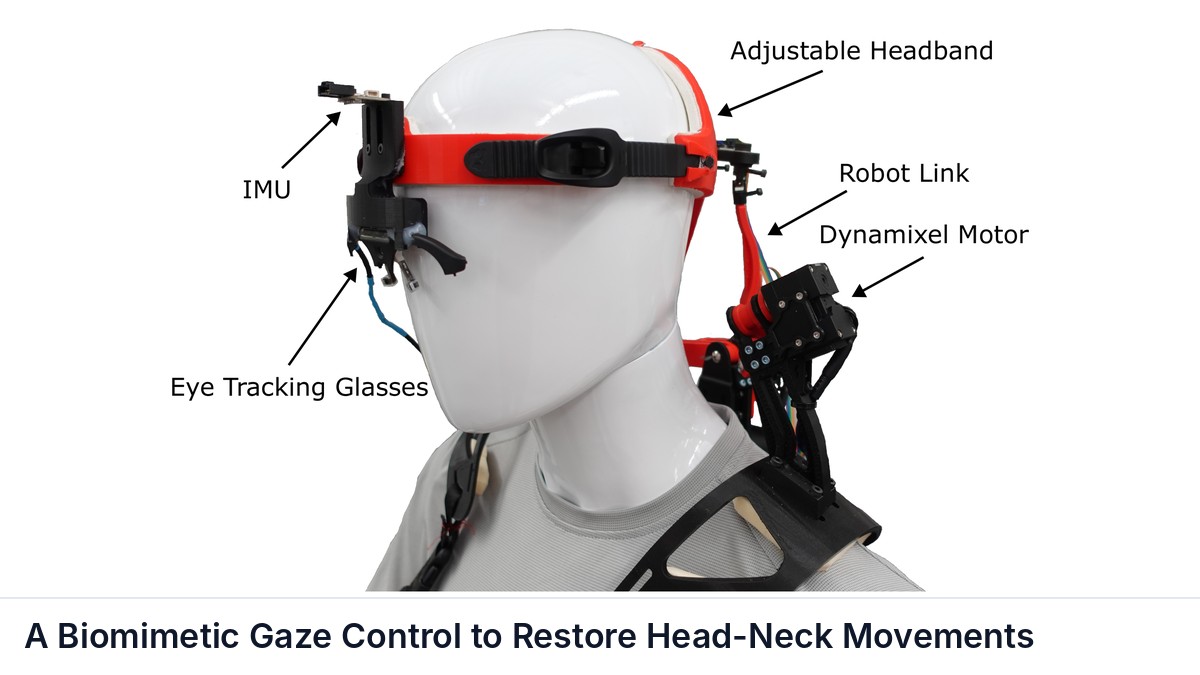
Powered neck exoskeletons are developed to restore head-neck motions for those with neck muscle weakness. Current methods using hand-held input devices to control these robotic systems are unintuitive or non-viable for these populations.
A Deployment Study of Identity-Gated Drone Gesture Control
Diyari Mohammed Salih, Ilyes Chaabeni, Naima Ait Oufroukh
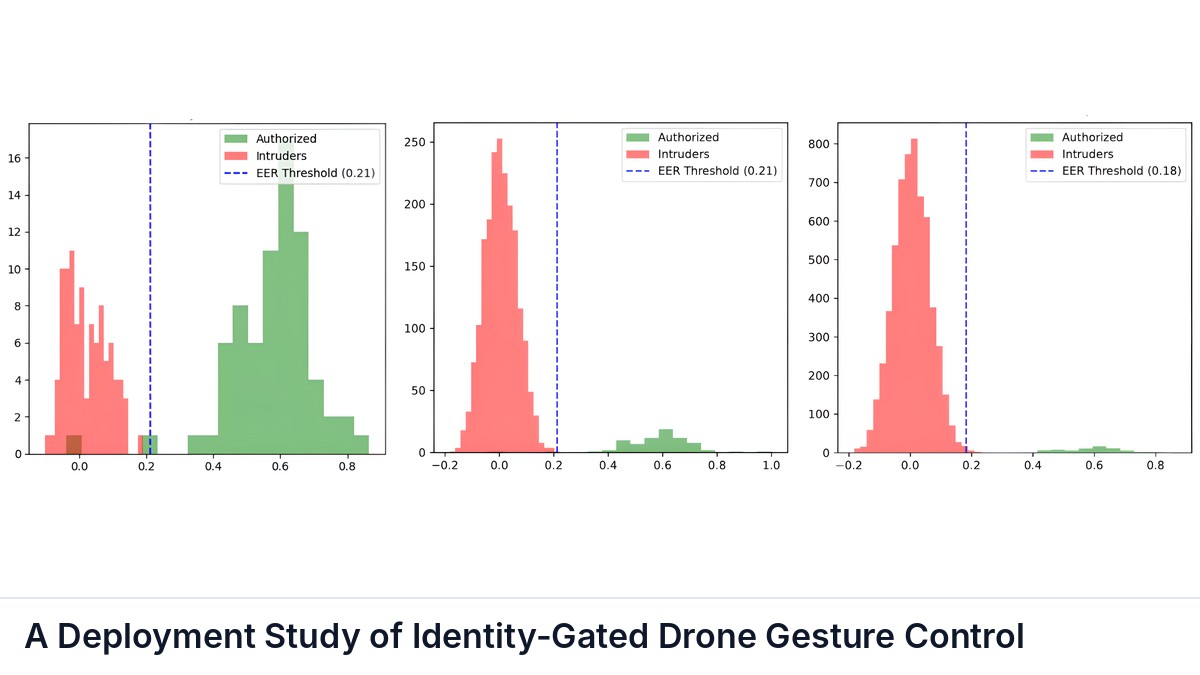
Vision-based gesture control accepts commands from any hand in the camera field of view, which is unsafe in shared indoor spaces.