

CoDA: Co-Evolution of Data Engines and Action Policies
Tianjiao Yu, Zhilin Ou, Yifan Shen, Xinzhuo Li, Yuanzhe Liu, Onkar Kishor Susladkar, Fan Wang, Ismini Lourentzou · N/A · 2026
Framework
N/A
License
N/A
Stars
N/A
Summary
Generative simulation can automate robot environment construction, but physically valid environments are not necessarily useful for training. The challenge is to identify environments that address a policy's failures and supervision that helps it overcome them.
Abstract Summary
Key Points
- Generative simulation can automate robot environment construction, but physically valid environments are not necessarily useful for training.
- The challenge is to identify environments that address a policy's failures and supervision that helps it overcome them.
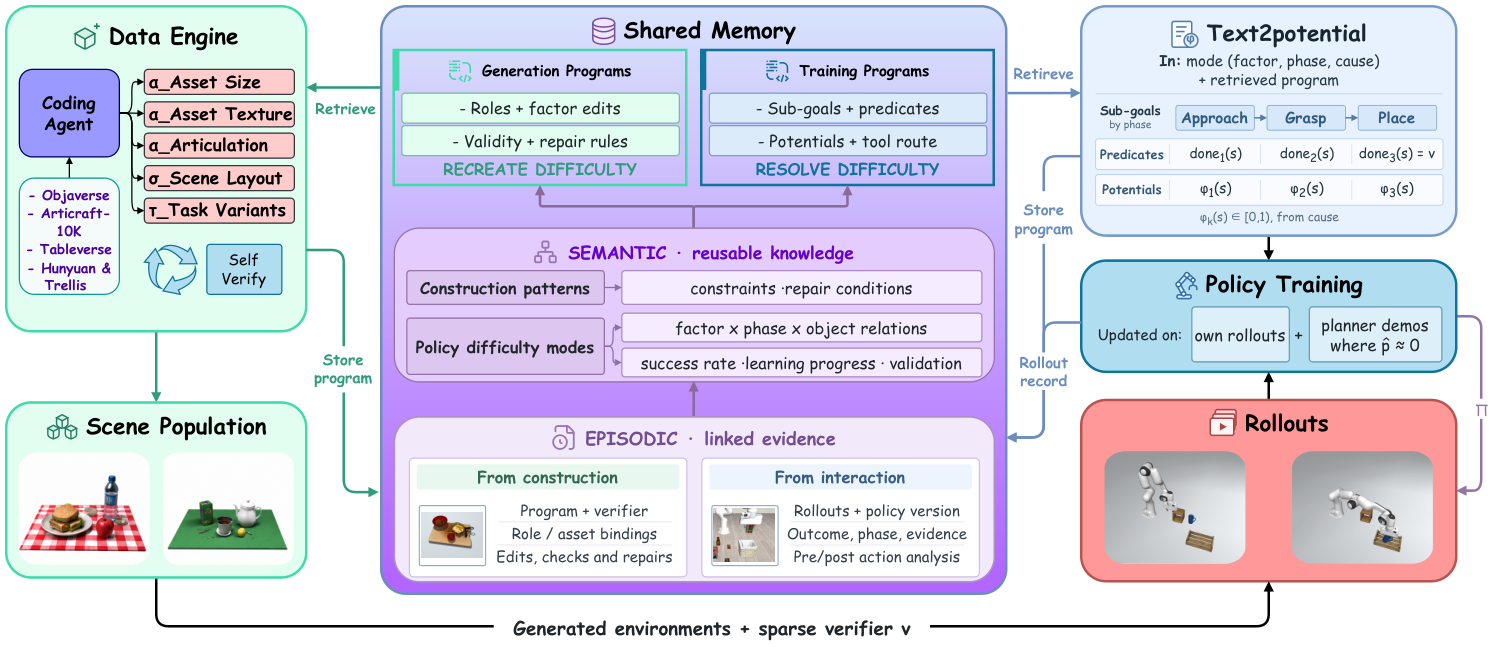
- We introduce CoDA, a framework in which a simulation data engine and an action policy co-evolve through a shared heterogeneous memory of environment construction, policy failures, and learning progress.
- The memory compiles validated diagnoses from a vision-language critic into generation programs that recreate difficulties and training programs that help the policy overcome them.
- We further propose Text2potential to convert these diagnoses into staged potentials for action-chunk value learning, providing dense supervision for policy updates while preserving the task's optimal policy under standard shaping assumptions.
Method
0.64314 0.68627 0.84706C0.34902 0.7451 0.88235o \__color_backend_reset: \__color_backend_reset: 0.44706 0.78039 0.59608D0.5451 0.81176 0.3098A \__color_backend_reset: \__color_backend_reset: couples scene generation and policy learning through a shared memory that guides both. A data engine $\mathcal{G}$, implemented as a tool-augmented coding agent, writes executable scene programs against a simulator SDK.
Each program defines an environment and a machine-checkable success predicate $\nu$.
Experiments
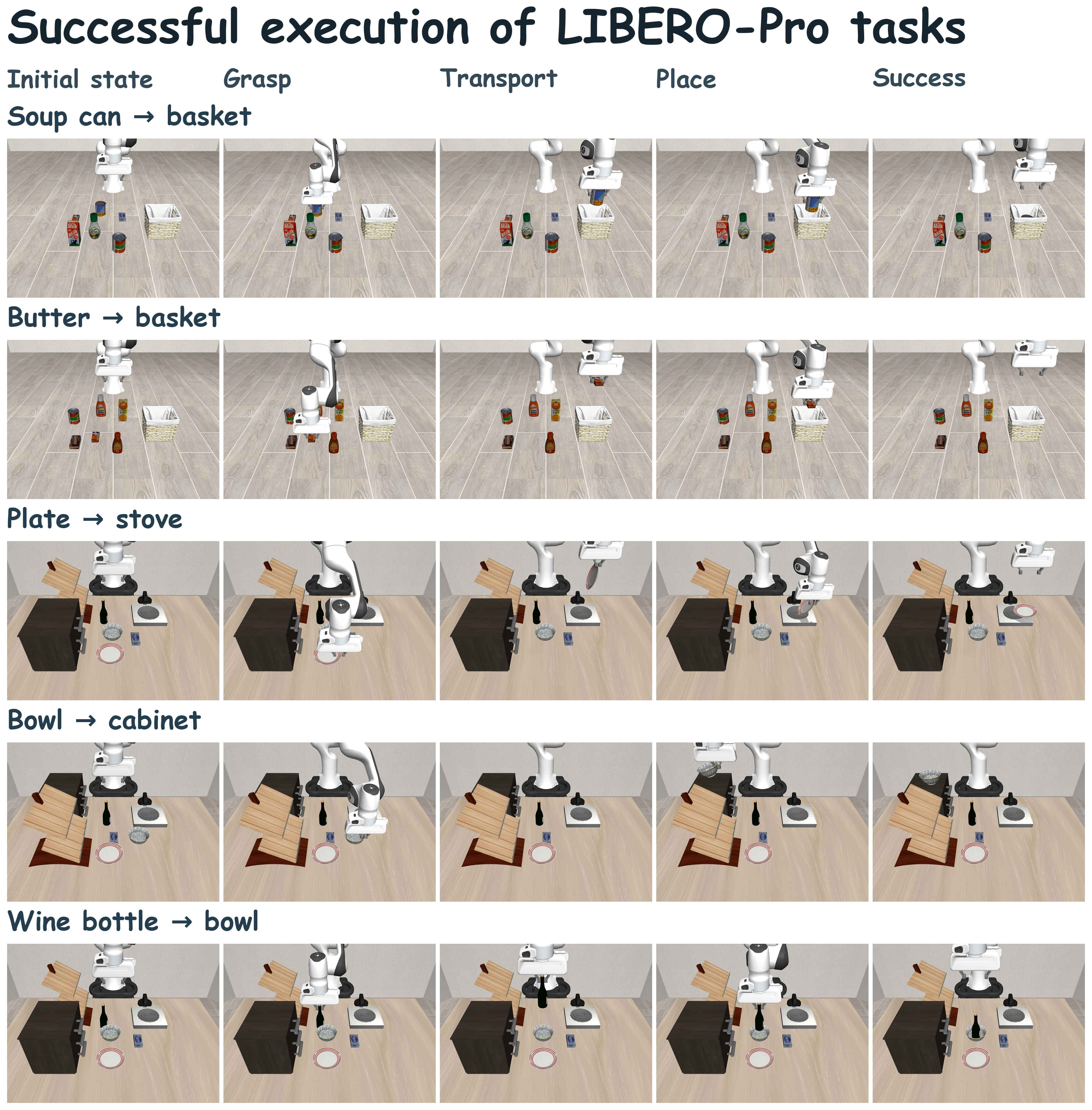
Experimental Setup. We evaluate CoDA on four manipulation task families and LIBERO-Pro [ 52 ] using $\pi_{0.5}$ [ 8 ] as the primary policy backbone. Our main comparison includes the released $\pi_{0.5}$ checkpoint, supervised fine-tuning on seed demonstrations, and policies trained with domain randomization, uniform environment variants [ 29 ] , or success-rate-guided generation [ 10 ] .
Sources and Demonstrations
Figures are reproduced from Yu et al. See the full paper for experimental details and the project page, when the paper links one, for demonstrations and videos.
Related Papers
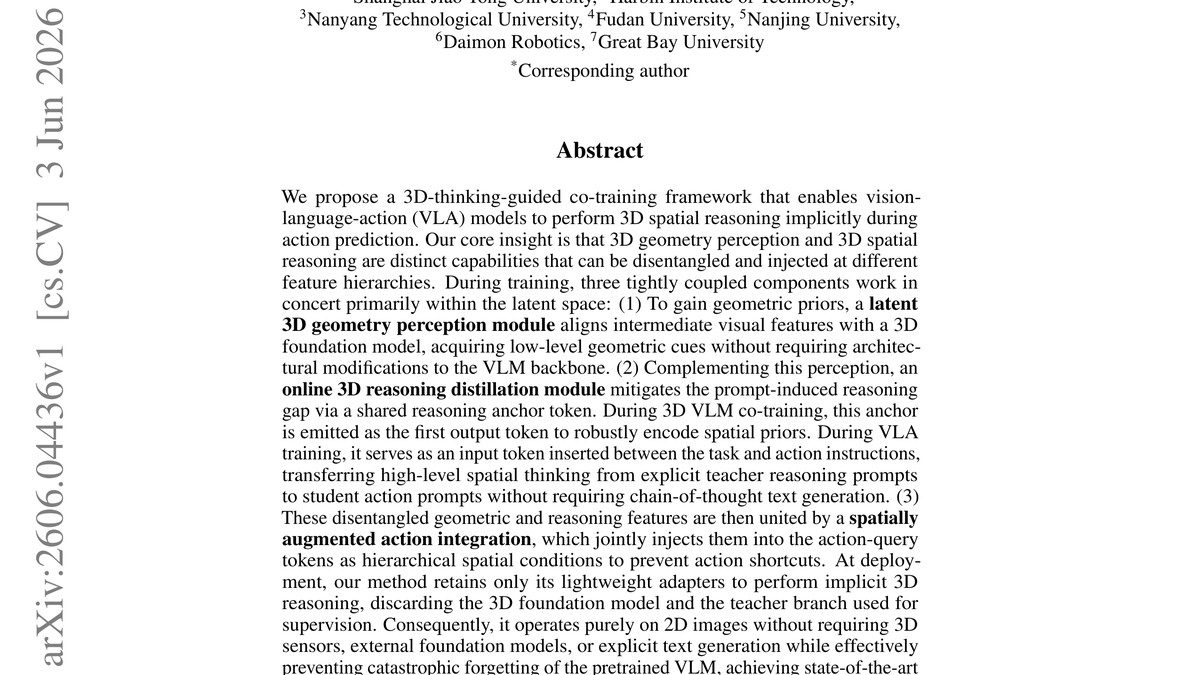
3DThinkVLA: Endowing Vision-Language-Action Models with Latent 3D Priors via 3D-Thinking-Guided Co-training
Jiaxin Shi, Xidong Zhang, Fucai Zhu et al.
We propose a 3D-thinking-guided co-training framework that enables vision-language-action (VLA) models to perform 3D spatial reasoning implicitly during action prediction.
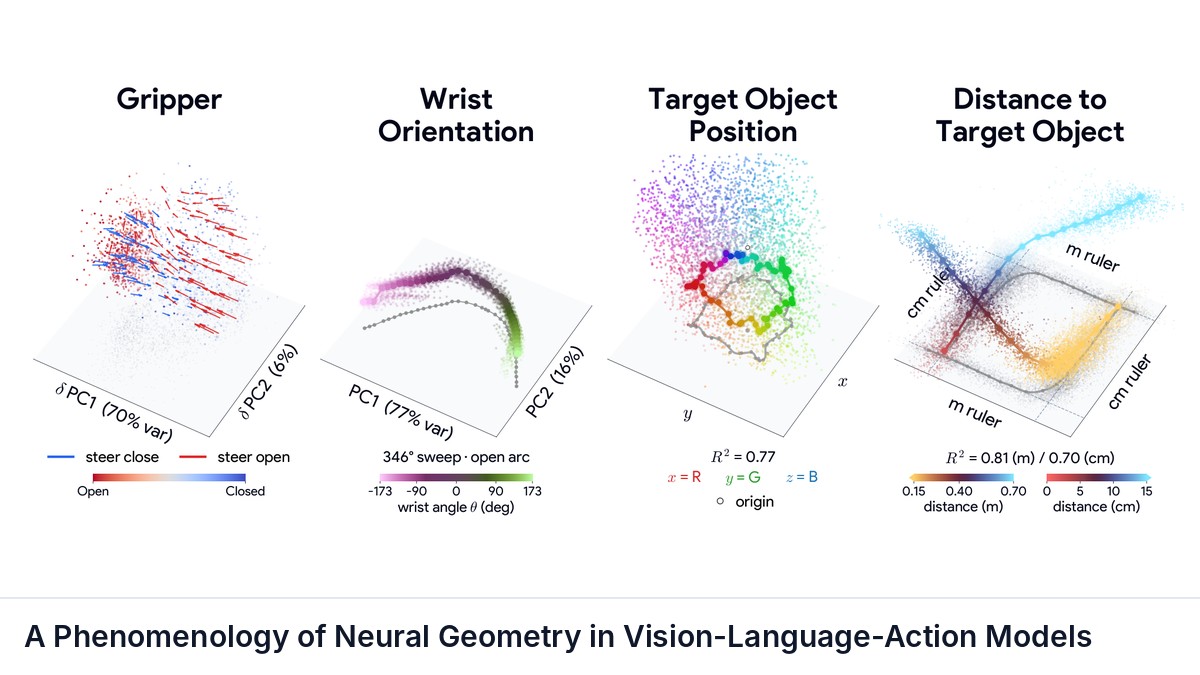
A Phenomenology of Neural Geometry in Vision-Language-Action Models
Mozes Jacobs, Aiden Swann, Mathilde Papillon et al.
Robotic manipulation is inherently geometric, but what shape does the world take inside the policy that performs it?

A Sim-to-Real Integration Pipeline for Training and Deployment of Chunk-Based VLA Manipulation Policies
Mathilde Kappel, Clémence Grislain, Mohamed Chetouani et al.
Vision-Language-Action (VLA) models have become a prominent paradigm for mapping multimodal inputs, including semantic instructions, visual observations of the scene, and proprioceptive observations, to robot actions.
Adaptive Vision-Language Grasping via Composable Foundation Priors and Generalizable Grasp Synthesis
Sixu Yan, Shikang Wang, Binhua Huang et al.
This paper proposes AdaRoboVLG, a task-adaptive Vision-Language-Grasp (VLG) framework that supports generalizable grasp synthesis across different robotic hands.