
PhysEvo: Astra Can Act, Let It
Wenqing Tian, Zeyu Zhang, Zhaocheng Liu, Fengwei Liu, Qiang Liu, Liang Wang · N/A · 2026
Framework
N/A
License
N/A
Stars
N/A
Summary
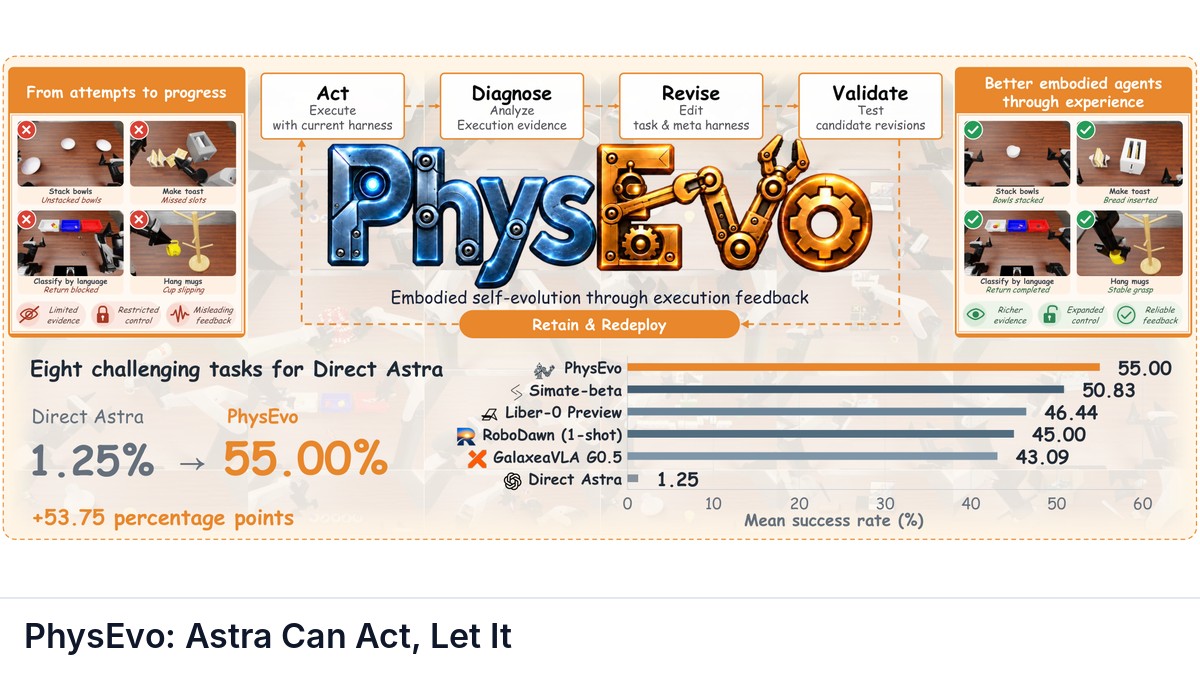
Astra can act, yet reliable manipulation depends on the system through which it observes and controls the world. We introduce PhysEvo, a framework for physical recursive self-improvement (RSI) around a single frozen model.
Abstract Summary
Key Points
- Astra can act, yet reliable manipulation depends on the system through which it observes and controls the world.
- We introduce PhysEvo, a framework for physical recursive self-improvement (RSI) around a single frozen model.
- A task agent executes robot tasks; a meta-agent uses the resulting trajectories to diagnose failures, revise tools and skills, and test corrections.
- The meta-agent can also improve its own diagnostic tools, so retained revisions support both later action and later self-improvement.
- This process develops joint-level control, evidence-seeking observation, and reusable manipulation skills without model-weight updates or a separately trained action policy.
PhysEvo: Physical Recursive Self-Improvement
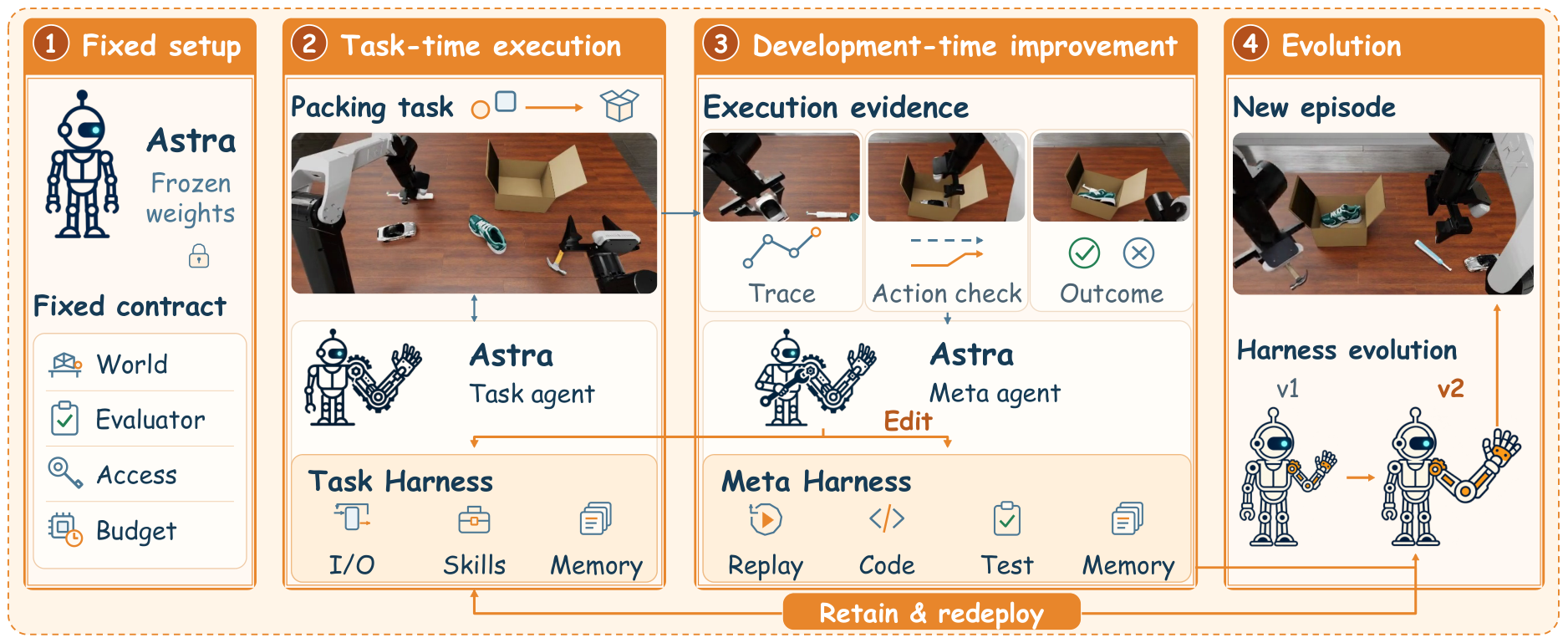
PhysEvo alternates between acting in the environment and revising the system used to act. A single frozen model performs both roles. Physical outcomes provide evidence; tested changes to the harness preserve what is learned from that evidence ( figure 2 ). Let $M_{\theta}$ denote Astra with fixed parameters.
At iteration $r$, the persistent system consists of a task harness $H^{\mathrm{task}}_{r}$ and a meta harness $H^{\mathrm{meta}}_{r}$: The task harness supplies observations, action tools, execution feedback, and skills.
The Evolved Embodied Framework
Physical RSI reshapes what Astra can control, what evidence it can obtain, and what guidance persists. We describe the resulting architecture below; tasks retain their own deployment versions ( section 5.1 ). The default control_arms interface accepts twelve absolute arm-joint targets and two continuous gripper commands. It supports both arms and remains available while an object is held.
The executor enforces native actuator limits and checks measured motion; Astra chooses the approach, arm configuration, and reconfiguration.

Experiments
We first evaluate retained deployment versions on held-out simulation layouts, then examine the revisions behind the resulting framework. On real hardware, we continue skill adaptation after deployment. We evaluate all 42 base RoboDojo simulation tasks across generalization, precision, long-horizon execution, memory, and open-ended instruction following.
Native score ranges from 0 to 100; success rate (SR) counts scores of 100. Each task averages one attempt on each of five held-out layouts.

Sources and Demonstrations
Figures are reproduced from Tian et al. See the full paper for experimental details and the project page, when the paper links one, for demonstrations and videos.
Related Papers

A Sim-to-Real Integration Pipeline for Training and Deployment of Chunk-Based VLA Manipulation Policies
Mathilde Kappel, Clémence Grislain, Mohamed Chetouani et al.
Vision-Language-Action (VLA) models have become a prominent paradigm for mapping multimodal inputs, including semantic instructions, visual observations of the scene, and proprioceptive observations, to robot actions.
Beyond Reconstruction: What Matters in Action Tokenization for Robot Policies?
Haoran Chen, Jingtian Ji, Samuel Wheeler et al.
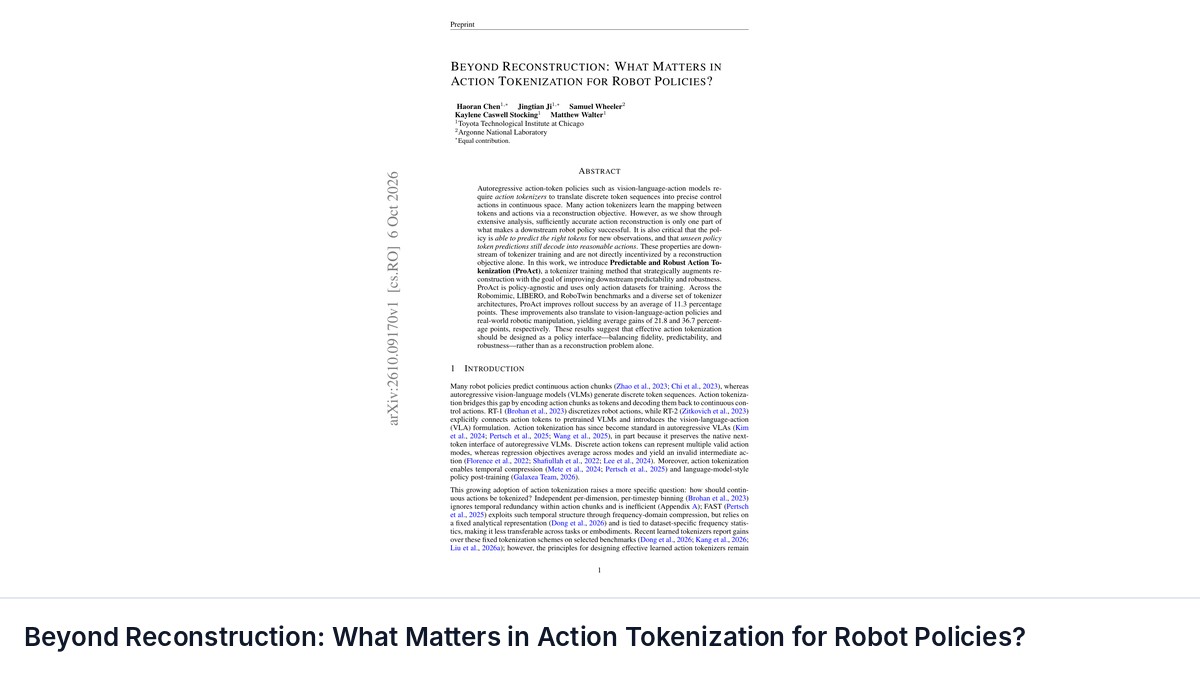
Autoregressive action-token policies such as vision-language-action models require action tokenizers to translate discrete token sequences into precise control actions in continuous space. Many action tokenizers learn the mapping between tokens and actions via a reconstruction objective.

Capability-Aware Arbitration for Semantic Intent-Based Shared Control
Zhaoda Du, Michael Bowman, Xiaoli Zhang
Shared control often allocates robot authority based on confidence in inferred human intent, assuming reliable autonomous execution. When this assumption fails, high intent confidence can cause over-helping.
DECOWAM: Decoupled Whole-Body World-Action Model for Legged Mobile Manipulation
Siyuan Ma, Boshi Zhang, Yutian Zhang et al.
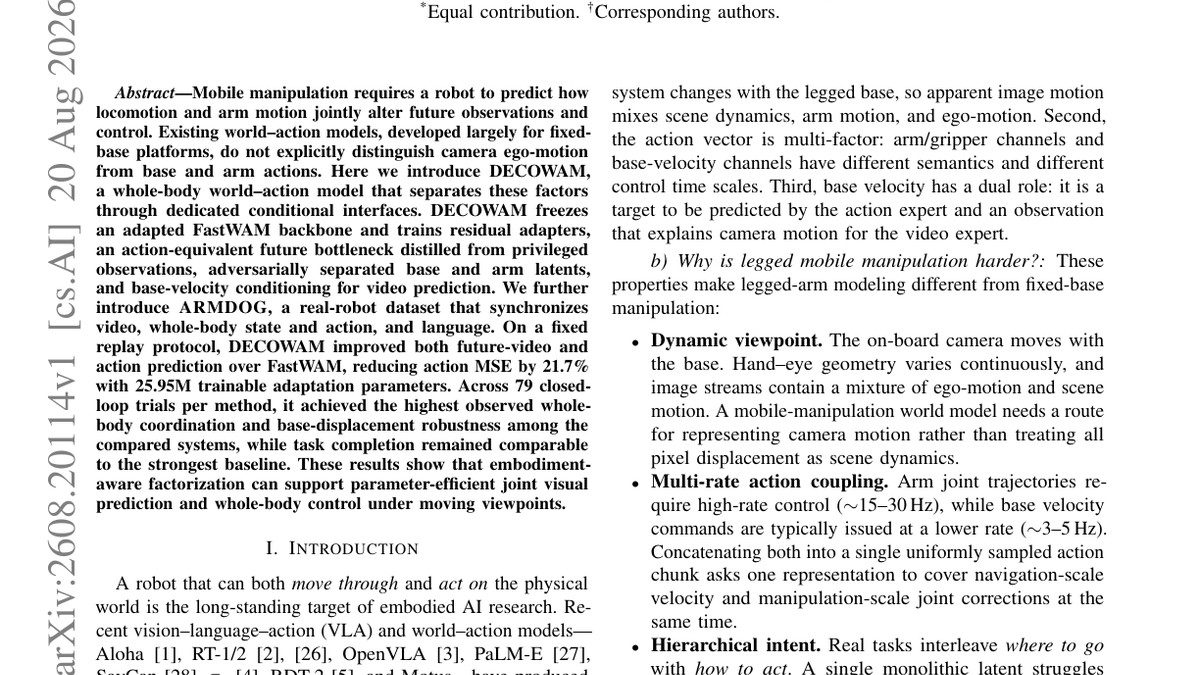
Mobile manipulation requires a robot to predict how locomotion and arm motion jointly alter future observations and control. Existing world-action models, developed largely for fixed-base platforms, do not explicitly distinguish camera ego-motion from base and arm actions.