
Norm2Tex: Augmenting Visuo-Tactile Simulations with Texture
Seongjin Bien, D\'ebora Oliveira Makowski, Roberto Calandra, Florian Walter, Wolfram Burgard · N/A · 2026
Framework
N/A
License
N/A
Stars
N/A
Summary
Large-scale datasets are essential for training generalist robot control policies. Collecting real-world tactile data is costly and time-consuming, motivating the use of tactile simulations. However, current tactile simulators capture only overall contact geometry and miss fine details like texture.
Abstract Summary
Key Points
- Large-scale datasets are essential for training generalist robot control policies
- Collecting real-world tactile data is costly and time-consuming, motivating the use of tactile simulations.
- However, current tactile simulators capture only overall contact geometry and miss fine details like texture.
- This results in a significant domain shift between simulated and real tactile data
- To address this gap, we introduce Norm2Tex, a plug-in method that augments simulations of vision-based tactile sensors with high-frequency surface details from normal map textures.
Method
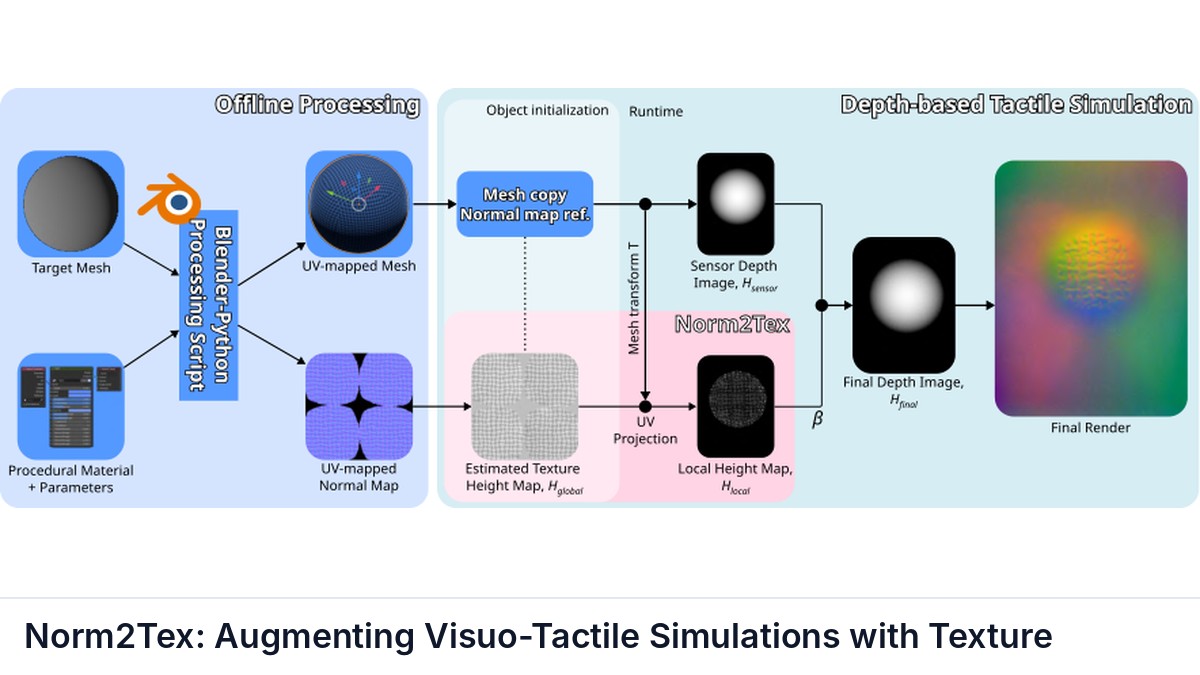
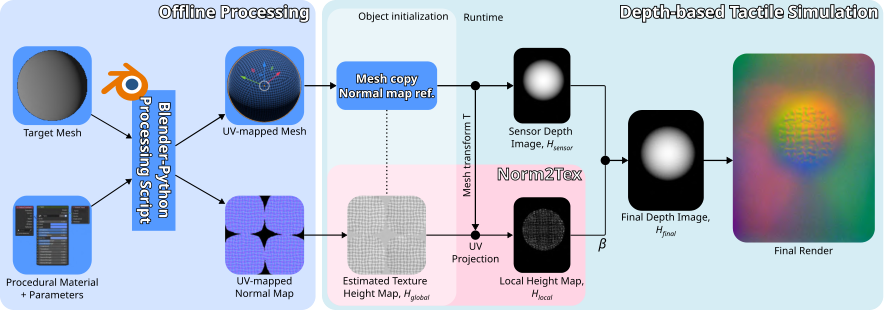
A normal map is first calculated using a mesh’s original, high-resolution vertices. This map is then applied to a simplified, lower-resolution version of the mesh [ 26 ] . This makes the simpler mesh look more detailed by mimicking how a detailed mesh reflects light. This process saves computational resources during runtime. A UV normal map represents the tangent-space unit normals of the corresponding mesh.
Experiments
We perform three separate experiments to validate the usefulness of Norm2Tex. The first experiment assesses its applicability to two existing tactile simulators, TACTO and Taxim, and how it impacts their performance. The second experiment measures sim-to-real capability through a zero-shot classification task.
The final experiment similarly assesses the sim-to-real capability of a tactile policy trained on Norm2Tex data. To assess the performance of Norm2Tex, we implemented our method for two popular tactile simulations, Taxim and TACTO.
Sources and Demonstrations
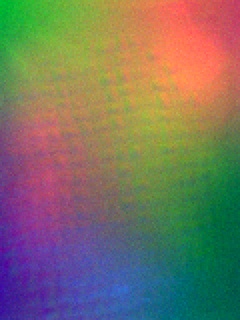
Figures are reproduced from Bien et al. See the full paper for experimental details and the project page, when the paper links one, for demonstrations and videos.
Related Papers

A Sim-to-Real Integration Pipeline for Training and Deployment of Chunk-Based VLA Manipulation Policies
Mathilde Kappel, Clémence Grislain, Mohamed Chetouani et al.
Vision-Language-Action (VLA) models have become a prominent paradigm for mapping multimodal inputs, including semantic instructions, visual observations of the scene, and proprioceptive observations, to robot actions.
Design and Evaluation of a Touchscreen-Based Teleoperation Interface for Robotic Manipulators
Juan José García Cárdenas, Alperen Kenan, Hamidreza Raei et al.
Intuitive teleoperation interfaces are crucial for the safe and effective operation of robotic manipulators in challenging environments.
DUET: Decoupled Upper- and Lower-Body Execution for Task-Agnostic Humanoid Loco-Manipulation
Kapalik Khanal, Biswash Khatiwada, Stephen Afrifa et al.
Changing a humanoid robot's manipulation policy should not require retraining the controller that maintains the robot's balance.
Generalizable Robustness Testing of DNN-Based Robotic Navigation Systems via XAI-Guided Search
Khizra Sohail, Miren Illarramendi, Aitor Arrieta
**Context:** Deep Neural Networks (DNNs) increasingly control Cyber-Physical Systems (CPSs), yet small input perturbations can cause unsafe system-level behavior.