
Generalizable Robustness Testing of DNN-Based Robotic Navigation Systems via XAI-Guided Search
Khizra Sohail, Miren Illarramendi, Aitor Arrieta · N/A · 2026
Framework
N/A
License
N/A
Stars
N/A
Summary
**Context:** Deep Neural Networks (DNNs) increasingly control Cyber-Physical Systems (CPSs), yet small input perturbations can cause unsafe system-level behavior.
Abstract Summary
Key Points
- **Context:** Deep Neural Networks (DNNs) increasingly control Cyber-Physical Systems (CPSs), yet small input perturbations can cause unsafe system-level behavior.
- Existing approaches often optimize perturbations for individual images and evaluate them only in simulation, limiting their generalizability and practical validity.
- **Objectives:** This work aims to generate robustness tests that remain effective across operational observations and to evaluate whether the resulting failures transfer from simulation to a physical robot.
- **Methods:** We propose an explainability-guided multi-objective evolutionary approach that generates sparse perturbations over representative images selected through visual and behavioral clustering.
- Aggregated Integrated Gradients guide mutations toward influential image regions
XAI-guided search-based robustness testing
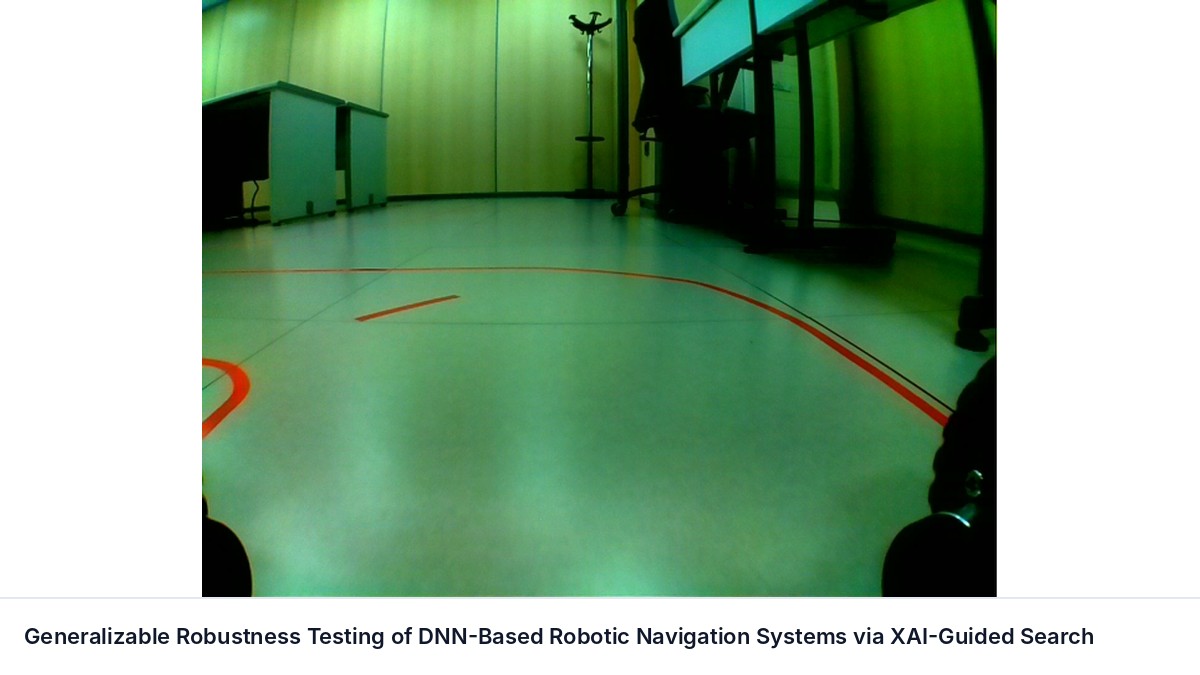
Our approach consists of three sequential phases. First, instead of generating perturbations from a single input image (as conducted in the literature [ 33 , 27 ] ), we extract a compact set of representative images from the operational dataset, since single-image perturbation-based tests may overfit to one specific scene and may not reflect the diversity of situations encountered by the robot.
Experimental Setup
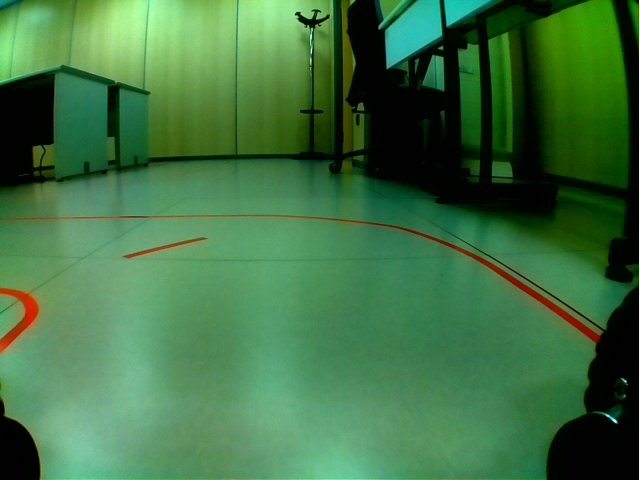
This section explains the experimental setup of our approach when applying it into an autonomous robotic platform. Specifically, we aim to answer the following three research questions (RQs): RQ1 – Sanity Check: Does XAI-guided evolutionary search outperform unguided search in generating high-impact perturbations? This RQ serves as a sanity check for the overall search strategy.
Threats to Validity
We now discuss the threats of our study and the actions we took to try to mitigate them. External validity: Our evaluation considers one DNN controller, one robotic platform, and one navigation task, which limits the generalization of the results to other models, robots, and operational environments. We partially mitigate this threat by evaluating the perturbations in both simulation and the physical system.
Internal validity: The selected clustering, attribution, perturbation, and search parameters may influence the results.

Sources and Demonstrations
Figures are reproduced from Sohail et al. See the full paper for experimental details and the project page, when the paper links one, for demonstrations and videos.
Related Papers
A Low-Cost, Open Platform for End-to-End Autonomous Driving on a Miniature Ackermann Vehicle
Gustavo Claudio Karl Couto, Eric Aislan Antonelo, Gabriel George Zipperer
This paper presents a low-cost, open experimental platform for research in end-to-end autonomous driving with miniature Ackermann vehicles.

A Sim-to-Real Integration Pipeline for Training and Deployment of Chunk-Based VLA Manipulation Policies
Mathilde Kappel, Clémence Grislain, Mohamed Chetouani et al.
Vision-Language-Action (VLA) models have become a prominent paradigm for mapping multimodal inputs, including semantic instructions, visual observations of the scene, and proprioceptive observations, to robot actions.
Aim Short to Reach Far: Your Frozen World Model Can Plan Better Than You Think
Xvyuan Liu, Jianjie Fang, Chen Gao et al.
Planners built on visual world models commonly score each predicted outcome by its distance to the encoded goal image. We show that this target can limit control even with exact dynamics and globally optimal short-horizon search: reaching a goal may require actions that initially move away from it.
Dexterity from Supervised Play
Botao He, Yiming Dou, Yiannis Aloimonos et al.
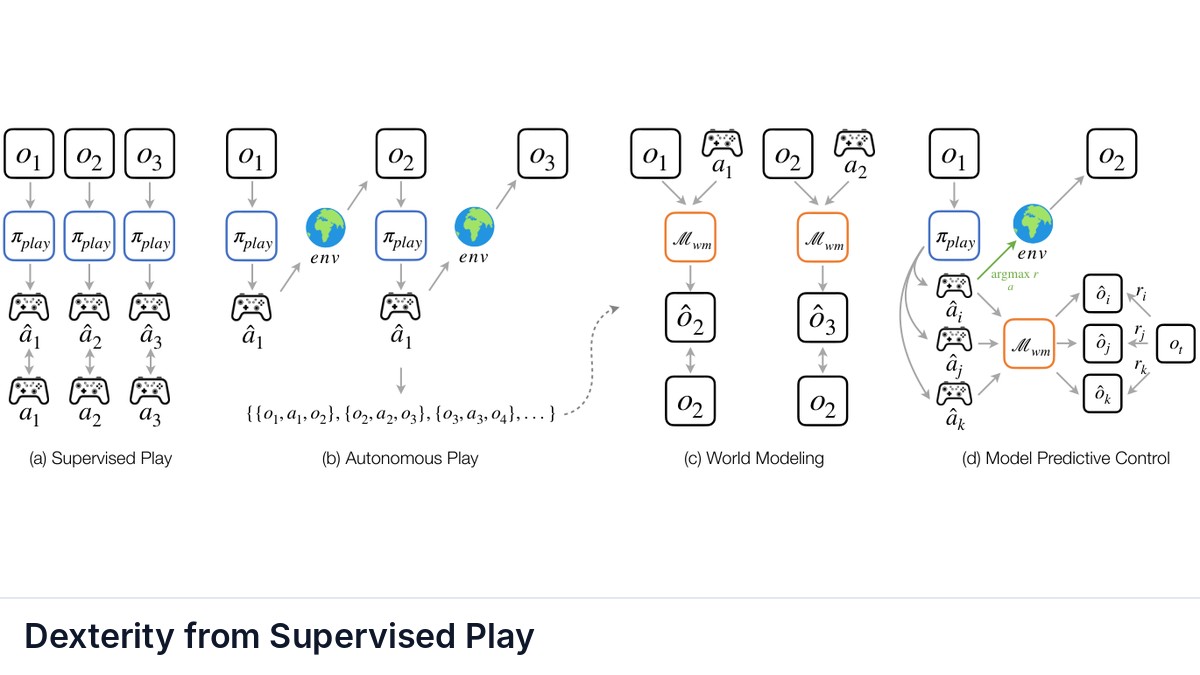
How can robots autonomously collect the contact-rich experience needed to learn dexterous manipulation?