
MoSA: Motion-constrained Stress Adaptation for Mitigating Real-to-Sim Gap in Continuum Dynamics
Jiaxu Wang, Junhao He, Jingkai Sun, Yi Gu, Yunyang Mo, Jiahang Cao, Qiang Zhang, Renjing Xu · Chinese University of Hong Kong (Shenzhen) · 2026
Summary
MoSA closes the real-to-sim gap for continuum robots by learning a residual stress field that captures anisotropic material behavior missed by standard simulators.
Abstract Summary
Key Points
- Targets the real-to-sim gap in continuum and soft robots.
- Learns residual anisotropy from visual deformation observations.
- Corrects simulator dynamics without explicit material parameter calibration.
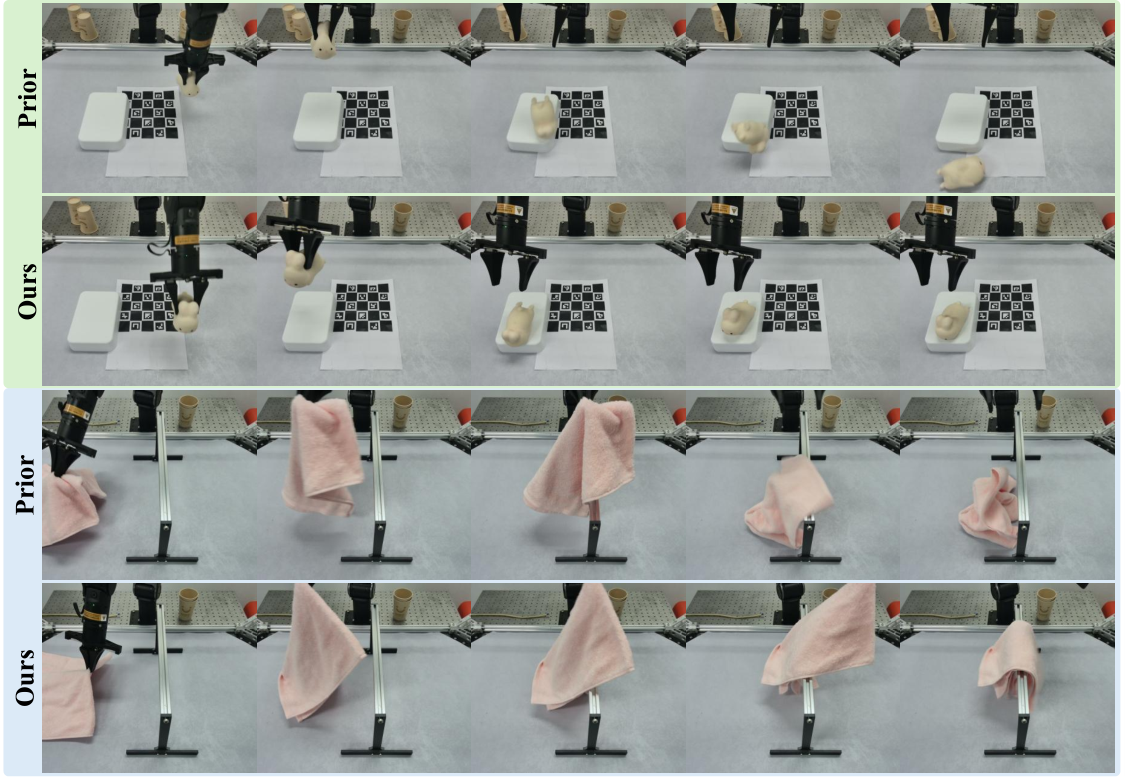
- Enables model-predictive control on real continuum robot hardware.
- Reduces trajectory tracking error by over 60% compared to standard simulators.
Methodology
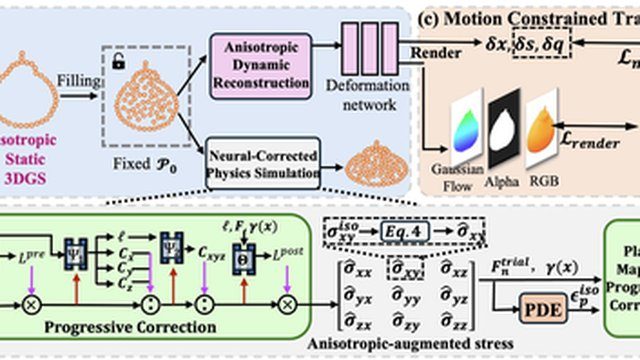
Problem Definition . This work aims to learn real-to-sim dynamics from multi-view videos by preserving an isotropic constitutive prior as the backbone and modeling the residual effects induced by mild anisotropy and heterogeneity.
Experiments
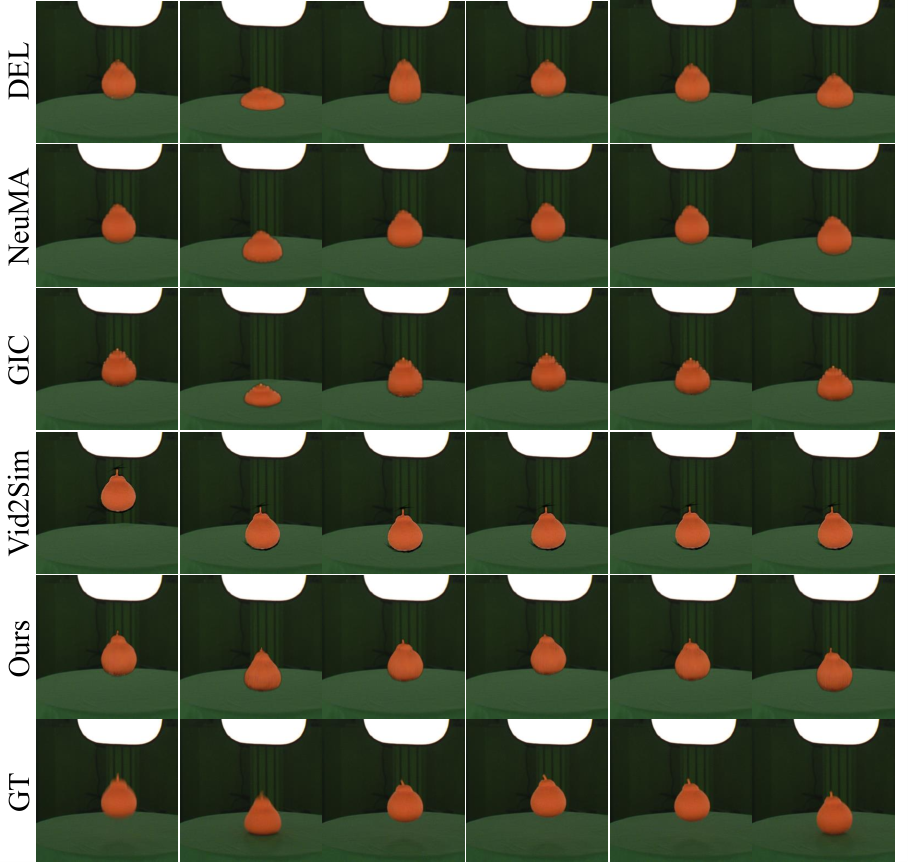
Dataset. We thoroughly evaluate our method on both synthetic and real-world datasets. For synthetic evaluation, we use the dataset released by PAC-NeRF ( Li et al., 2023 ) , which provides multi-view RGB sequences together with 3D ground-truth geometry trajectories across diverse materials.
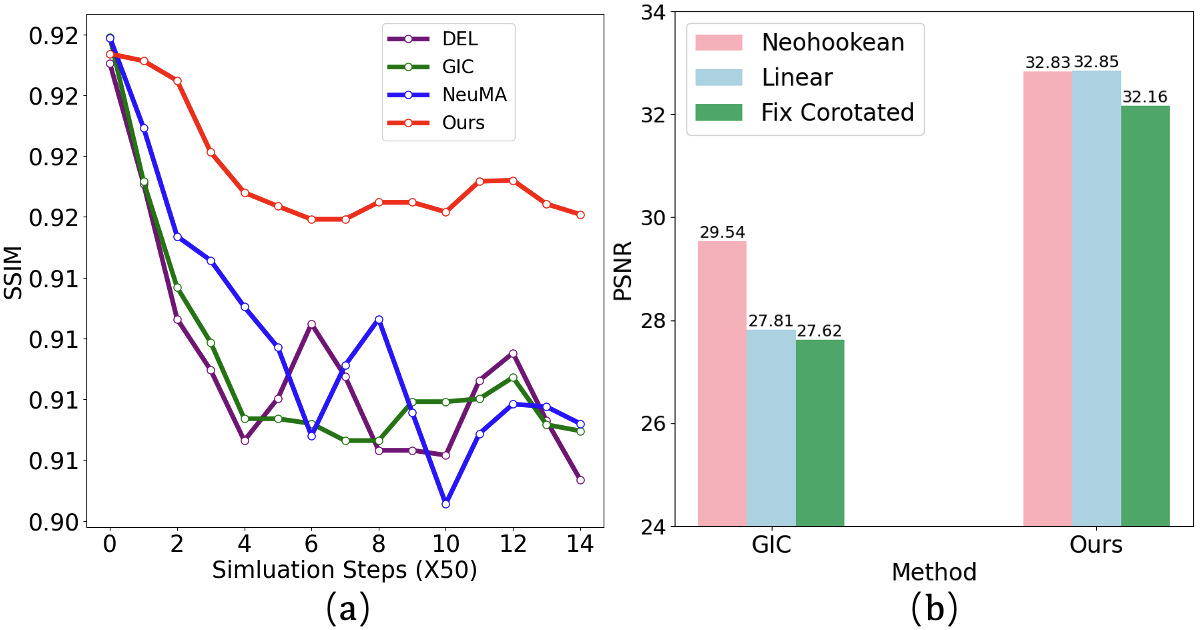
This synthetic benchmark allows us to quantitatively evaluate 3D trajectory accuracy, prove the dynamics grounding, and to verify that our residual stress corrections do not introduce spurious anisotropy when an isotropic backbone is sufficient.
mpact Statement
MoSA improves the fidelity of real-to-sim continuum dynamics by modeling mild residual anisotropy and heterogeneity beyond standard isotropic assumptions. This can benefit a broad range of applications that rely on reliable physical simulation, including graphics, embodied interaction, and robotics, by enabling more accurate and data-efficient dynamics identification and reducing failures caused by model mismatch.
Sources and Demonstrations
Figures are reproduced from Wang et al. See the full paper for experimental details and the project page, when the paper links one, for demonstrations and videos.
Related Papers
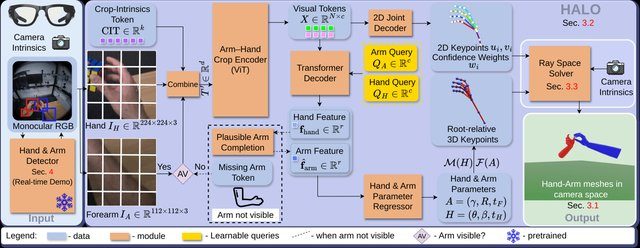
EgoForce: Forearm-Guided Camera-Space 3D Hand Pose from a Monocular Egocentric Camera
Christen Millerdurai, Shaoxiang Wang, Yaxu Xie et al.
Reconstructing the absolute 3D pose and shape of the hands from the user's viewpoint using a single head-mounted camera is crucial for practical egocentric interaction in AR/VR, telepresence, and hand-centric manipulation tasks, where sensing must remain compact and unobtrusive.
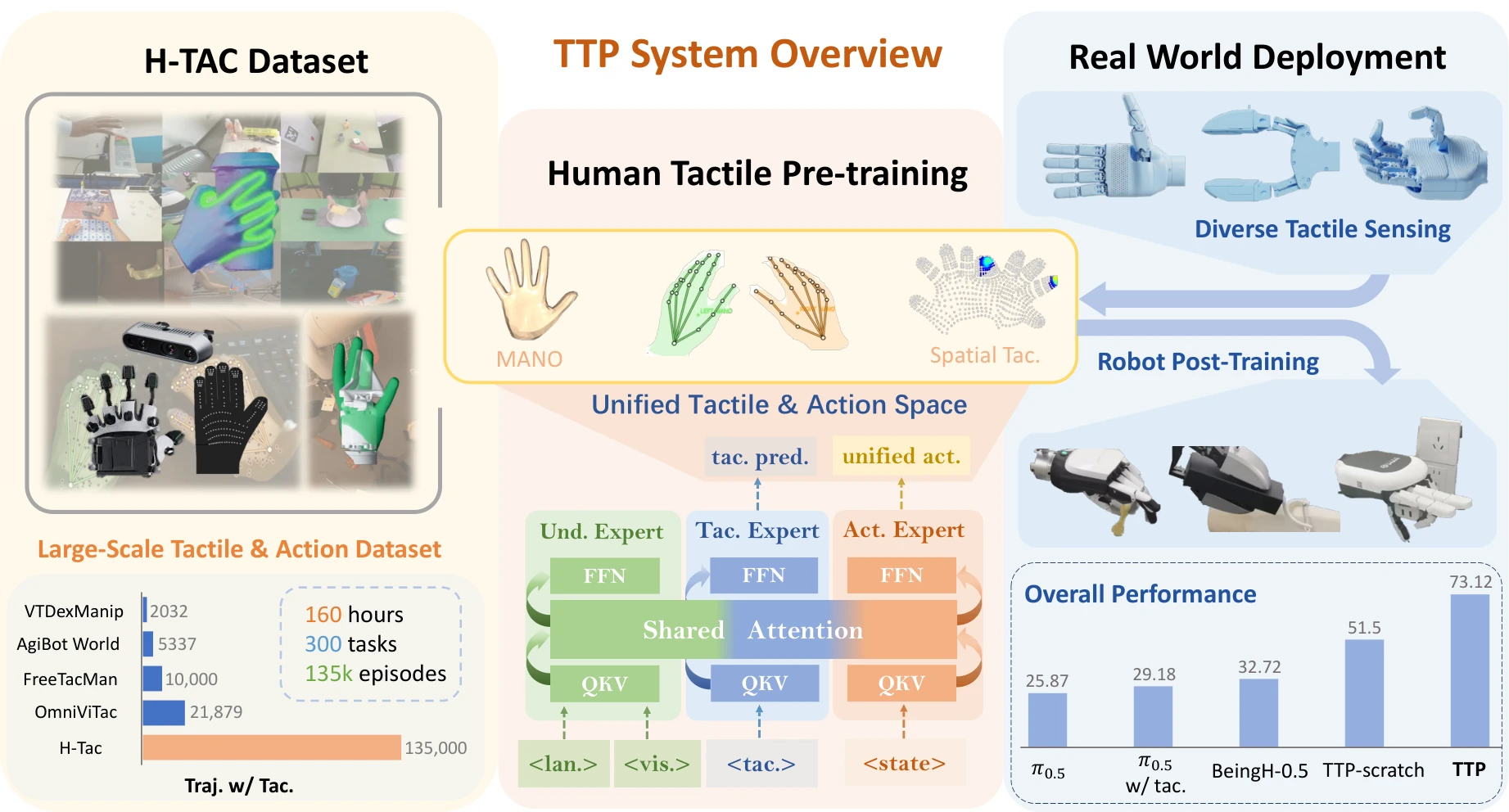
Human-Centric Transferable Tactile Pre-Training for Dexterous Robotic Manipulation
Chi Zhang, Penglin Cai, Ziheng Xi et al.
TTP transfers tactile experience from human demonstrations into robot policies for contact-sensitive manipulation.
 Video
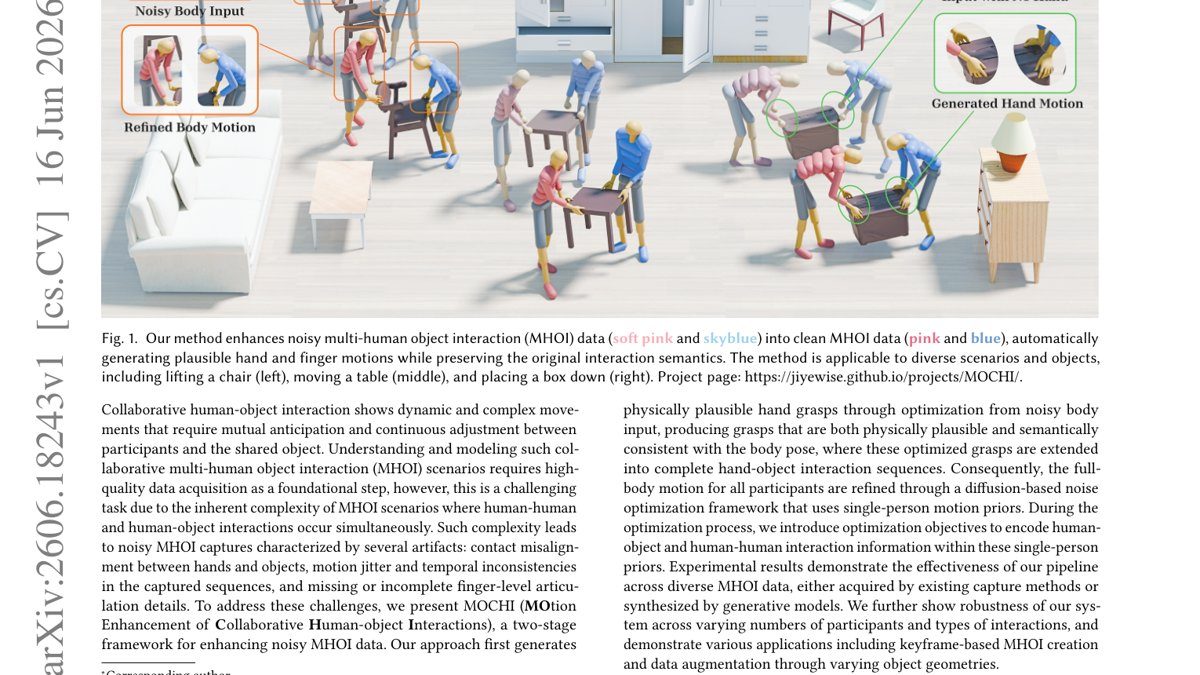
MOCHI: Motion Enhancement of Collaborative Human-object Interactions
Jiye Lee, Yonghun Choi, Jungdam Won
Two-stage framework that enhances noisy multi-human object interaction (MHOI) data by generating plausible hand grasps and refining full-body motion via diffusion-based optimization.

SafeManip: A Property-Driven Benchmark for Temporal Safety Evaluation in Robotic Manipulation
Chengyue Huang, Khang Vo Huynh, Sebastian Elbaum et al.
Robotic manipulation is typically evaluated by task success, but successful completion does not guarantee safe execution. Many rl failures are temporal: a robot may touch a clean surface after contamination or release an object before it is fully inside an enclosure.