
At a glance
- Problem: vision alone misses contact information needed for delicate manipulation. Source
- Idea: share action and tactile representations across human pre-training and robot adaptation. Source
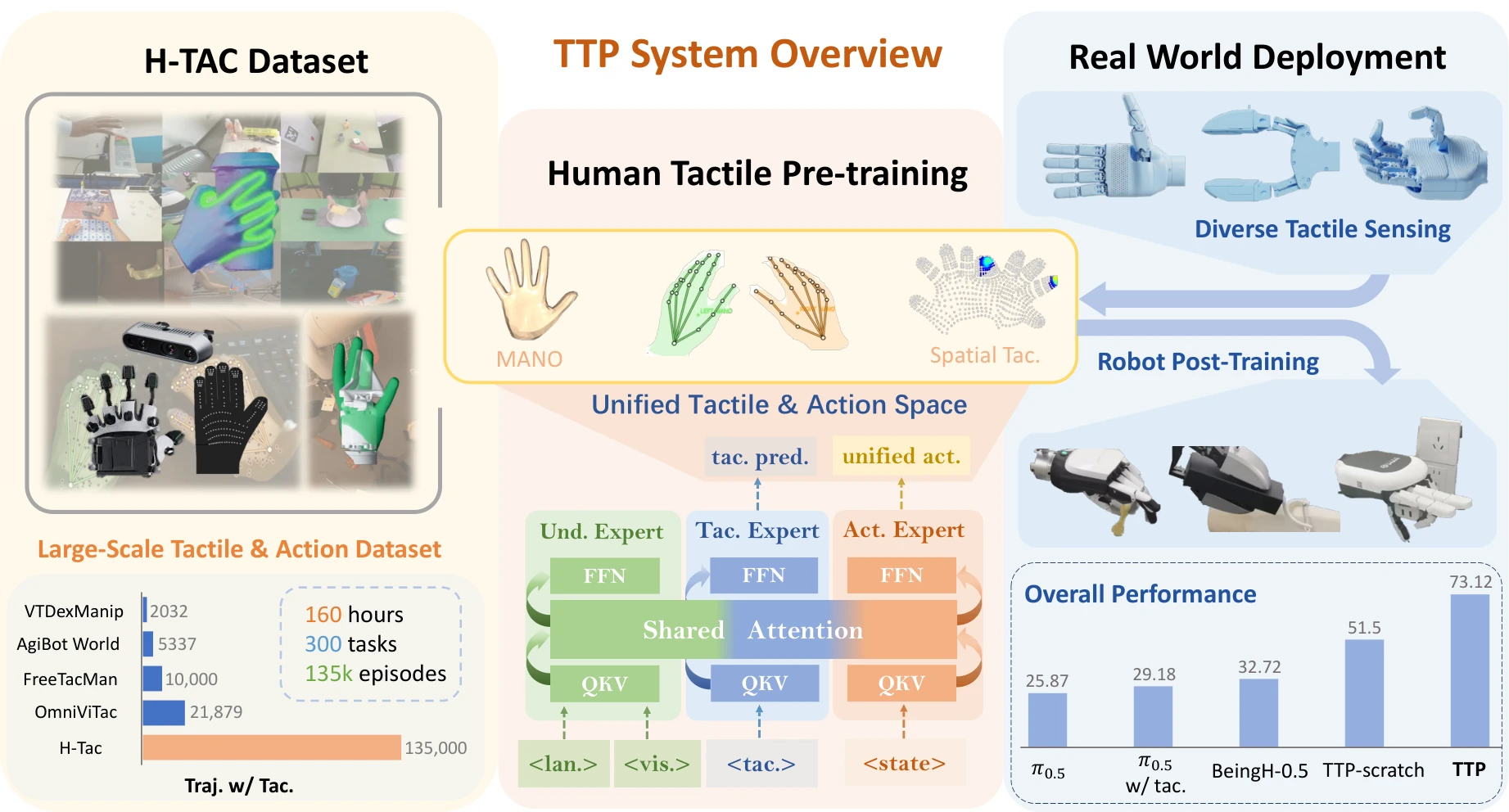
- Data: H-Tac contains 160 hours spanning more than 300 tasks and 135,000 episodes. Source
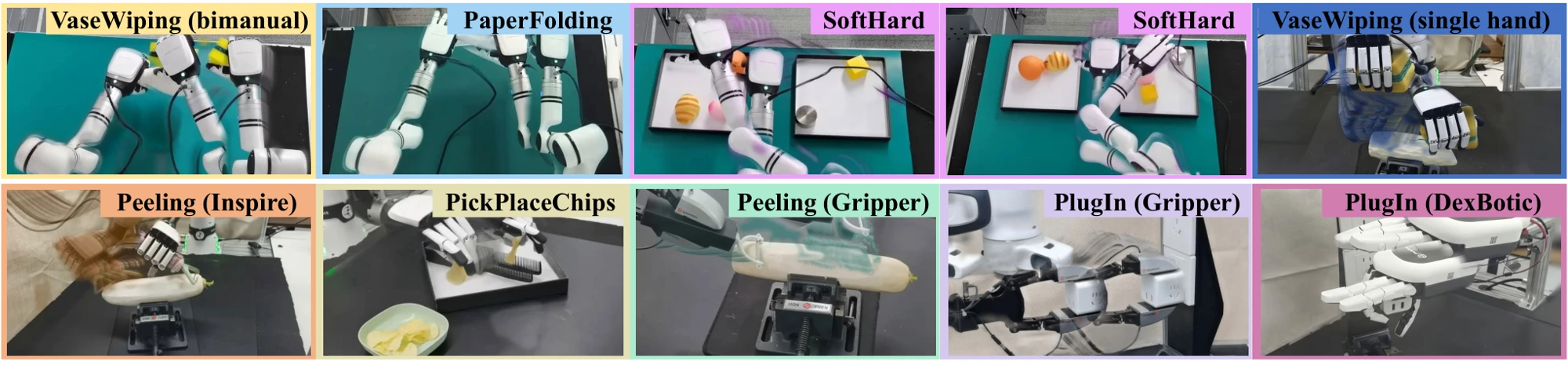
Evaluation scope The real-robot evaluation separates ten in-distribution trials from five out-of-distribution trials per method and task. Source
How it works
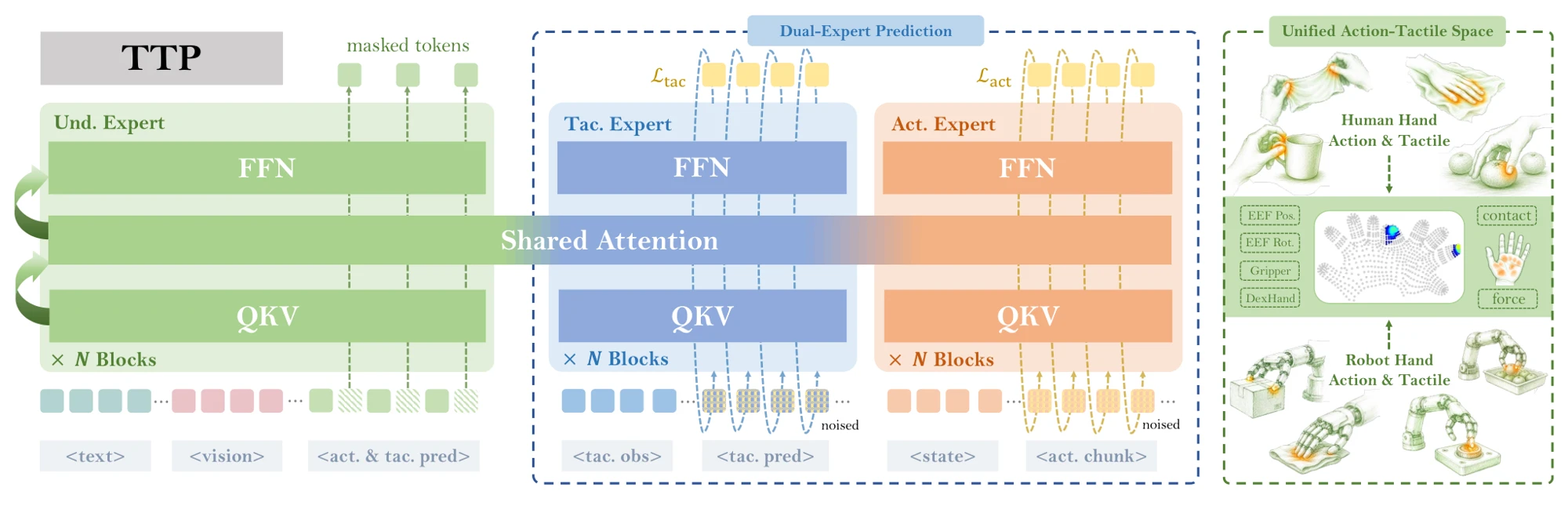
- Map tactile readings onto a common hand representation to preserve spatial meaning across embodiments. Source
- Train action and tactile experts together so the model predicts future contact as well as motion. Source
Evidence & results
- On in-distribution fragile-chip placement, TTP succeeds in 80% of trials versus 60% without pre-training and 10% for BeingH-0.5. Evidence
- In-distribution peeling with the Inspire hand reaches 23.33 cm on average, versus 14.65 cm without pre-training; this metric is length, not success rate. Evidence
Limitations & boundaries
Takeaway
Tactile pre-training helps delicate tasks, but gains depend on the task and do not eliminate difficult contact failures. Source
Resources
Figures: the paper's authors. Editorial source and image review: 2026-10-21. Findings are author-reported, not independently reproduced by Robotics Research Hub.
Original abstract
As an essential modality for dexterous and contact-rich tasks, tactile sensing provides precise force feedback that cannot be reliably inferred from vision. However, limited by hardware and data collection systems, existing datasets with tactility remain small in scale and narrow in contact coverage. Meanwhile, Vision-Language-Action (VLA) models with tactile modality are constrained on dynamics-agnostic post-training, which limits the performance ceiling on downstream tasks. In this paper, we present H-Tac, a large-scale tactile-action dataset with 160-hour egocentric human videos containing more than 300 tasks and 135k episodes. Building upon this, we propose Transferable Tactile Pre-Training (TTP), a system of tactile-based pre-training on human data for fine-grained robotic tasks. To bridge the gap between humans and robots, we use unified tactile and action spaces throughout the pre-training and post-training phases, preserving prior knowledge during human-to-robot transfer. By leveraging a tactile expert for future tactile prediction, our framework explicitly models the contact dynamics and precise physical interactions. Extensive experiments in simulation and on real robots demonstrate that our model achieves superior performance, exhibiting robust generalization and fine-grained manipulation capabilities. TTP paves the way for scalable tactile pre-training via human-to-robot transfer.