
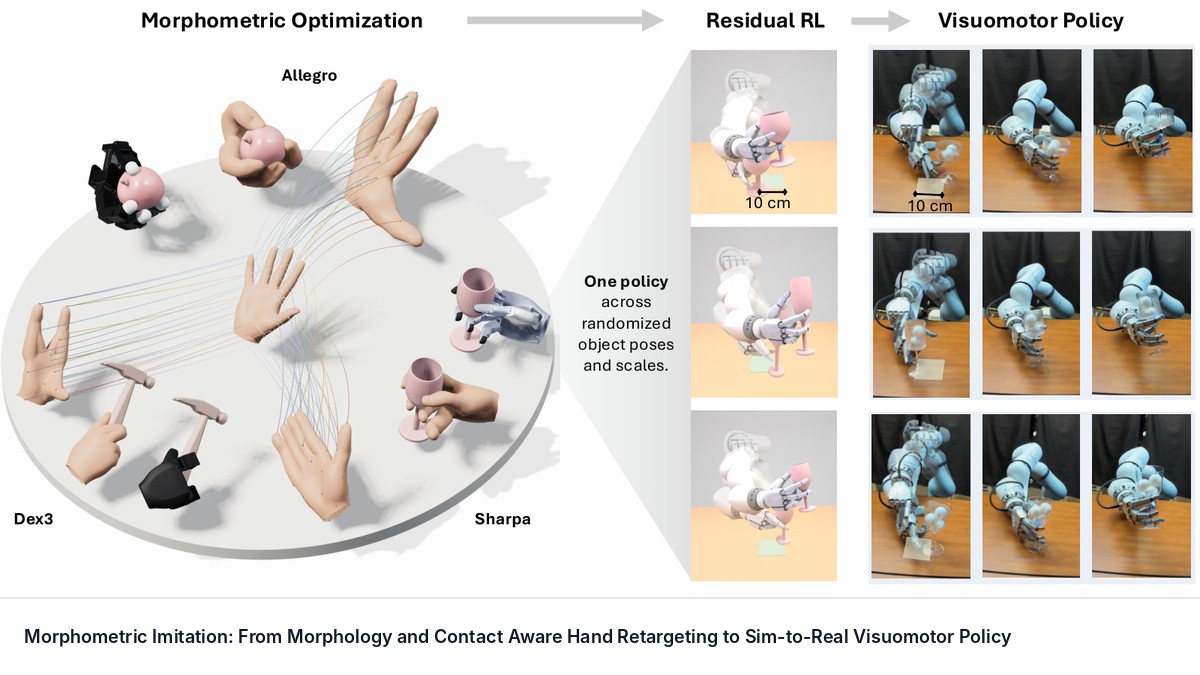
Morphometric Imitation: From Morphology and Contact Aware Hand Retargeting to Sim-to-Real Visuomotor Policy
Tara Sadjadpour, Siming He, C. K. Wolfe, Haozhi Qi, Lea Wilken, S. Shankar Sastry, Claire Tomlin, Jitendra Malik · N/A · 2026
Framework
N/A
License
N/A
Stars
N/A
Summary
Human hand-object interactions (HOIs) provide a rich source of demonstrations for dexterous manipulation, but learning directly from them presents challenges in bridging morphology gaps, ensuring dynamical feasibility, and sim-to-real deployment.
Abstract Summary
Key Points
- Human hand-object interactions (HOIs) provide a rich source of demonstrations for dexterous manipulation, but learning directly from them presents challenges in bridging morphology gaps, ensuring dynamical feasibility, and sim-to-real deployment.
- We present Morphometric Imitation, a three-stage framework that transforms reconstructed HOIs into zero-shot sim-to-real visuomotor policies.
- First, morphometric optimization (MMO) kinematically retargets human motion across hand morphologies while preserving demonstrated contacts.
- Second, residual reinforcement learning (RL) refines the kinematic reference using object pose and contact information from the human motion to produce dynamically feasible robot demonstrations.
- Third, these demonstrations are distilled into visuomotor policies
Modeling Human Hands with MANO
Our method builds on the MANO hand model [ 35 ] , where the skinning function $W$ poses a rest-pose mesh $T_{P}\in\mathbb{R}^{V\times 3}$ about the rest-pose joint locations $J\in\mathbb{R}^{(K+1)\times 3}$ according to the pose $\overset{\rightarrow}{\theta}$ and the per-vertex blend weights $\mathcal{W}\in\mathbb{R}^{V\times(K+1)}$.
The rest-pose mesh and joints are obtained from a template hand mesh $\overline{\mathbf{T}}\in\mathbb{R}^{V\times 3}$ as where $\mathcal{J}\in\mathbb{R}^{(K+1)\times V}$ is a joint regressor.
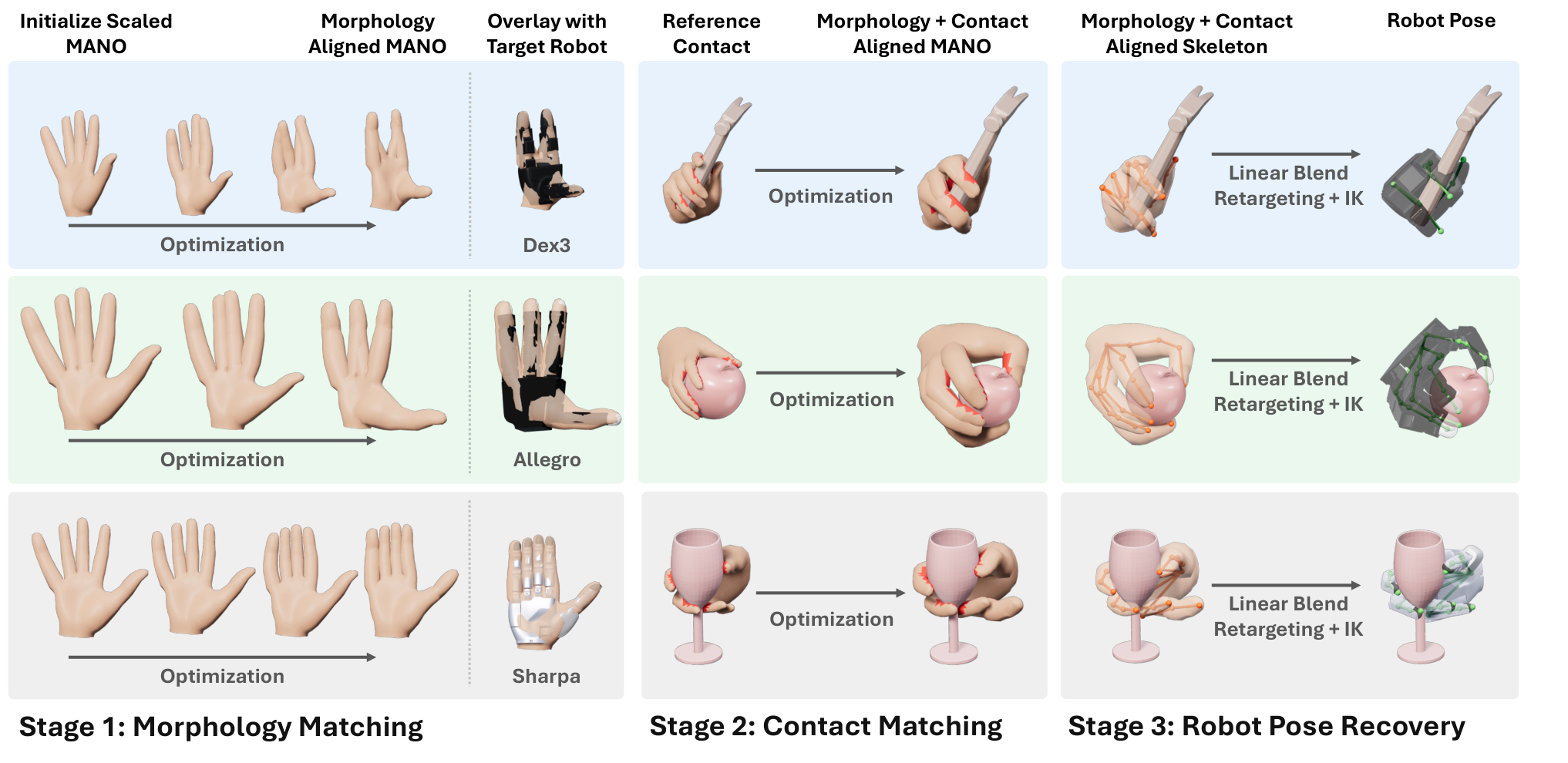
Kinematic Retargeting: Morphometric Optimization
The first stage of our pipeline converts human hand motion into robot hand motion with Morphometric Optimization (MMO) , which consists of three steps (Figure 3 ). (1) Morphology matching optimizes the MANO model to match the morphology of the robot hand.
(2) Because this morphological change can alter the hand-object contacts, contact matching re-optimizes the morphology-aligned MANO hand at each frame to recover the contacts of the original MANO hand.
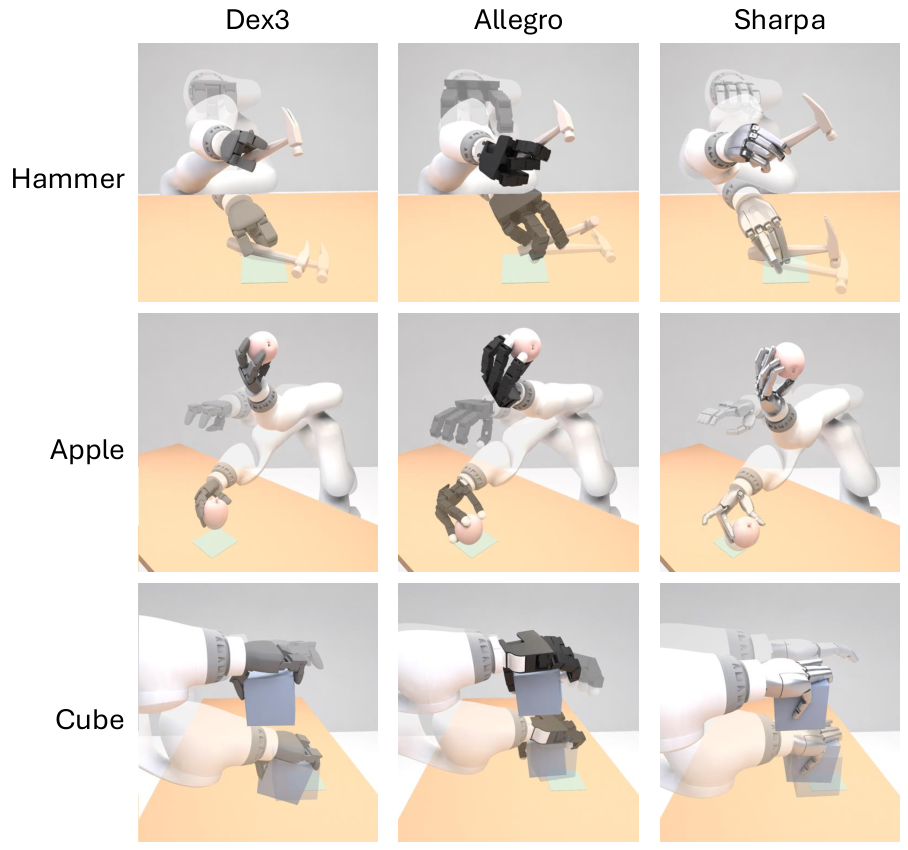
Dynamic Retargeting: Residual Reinforcement Learning
Kinematic retargeting provides a reference robot trajectory $\mathbf{q}_{\text{ref}}$ that captures the desired hand motion and contact behavior but does not account for the dynamics of the robot-object interaction.
Zero-Shot Sim-to-Real Visuomotor Policy
We distill each privileged residual RL teacher into a visuomotor student policy for zero-shot sim-to-real deployment. We collect demonstrations by rolling out the teacher under the domain randomizations above, except random timestep initialization, since demonstrations begin at the start of the reference trajectory.
Experiments
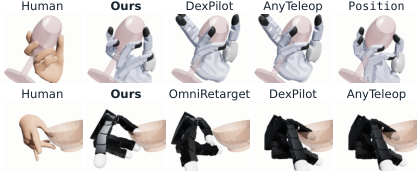
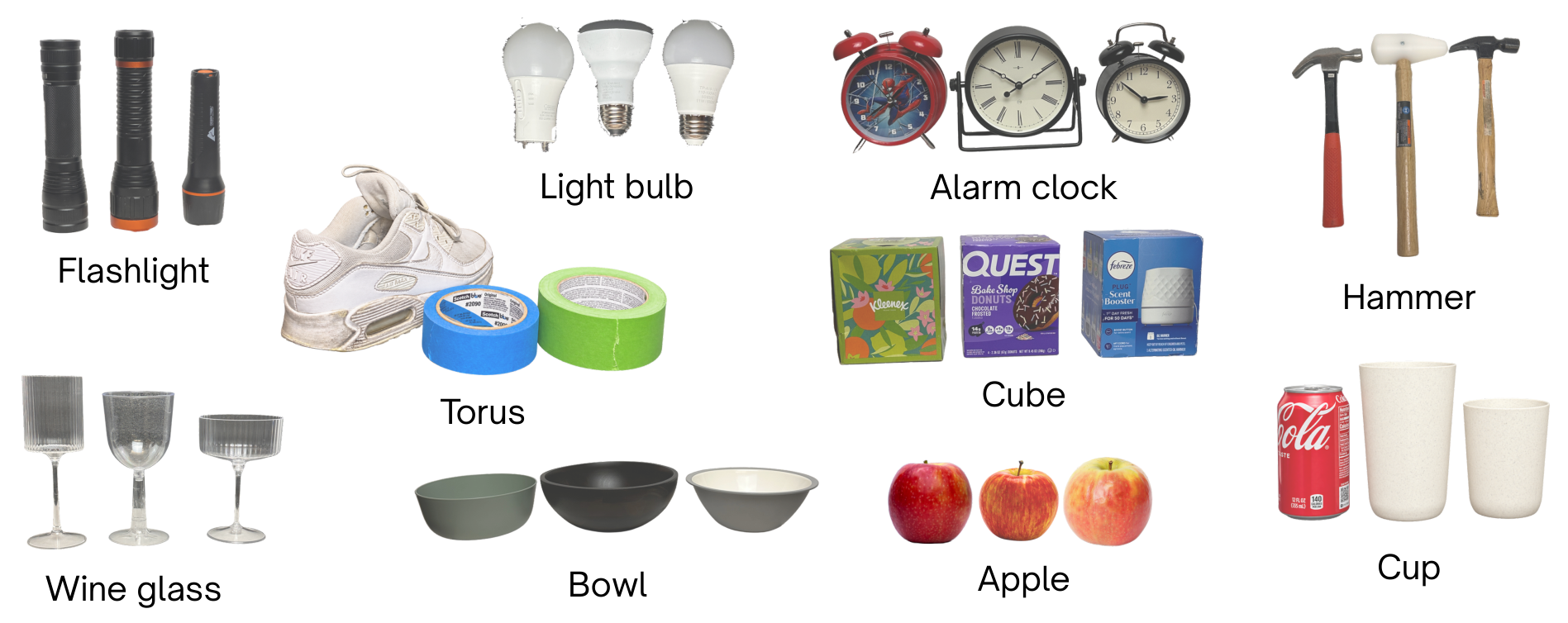
Does MMO better preserve demonstrated hand-object contacts than prior kinematic retargeting methods across robot hand embodiments? Do the kinematic references from MMO lead to better downstream dynamic retargeting? Are both object pose and contact information important for successful dynamic retargeting?
How robustly do the resulting visuomotor policies transfer zero-shot to real-world objects with diverse geometries and physical properties across randomized poses within a $10\,\text{cm}\times 10$ cm region? We first describe the setup (Section...
Sources and Demonstrations
Figures are reproduced from Sadjadpour et al. See the full paper for experimental details and the project page, when the paper links one, for demonstrations and videos.
Related Papers
A Balanced Data Diet: Addressing the Exploration Bottleneck in Mega-Scale RL for Robot Control
Octi Zhang, Mateo Guaman Castro, Patrick Yin et al.
General-purpose robots must perform a wide range of tasks from agile locomotion to dexterous manipulation.

A Sim-to-Real Integration Pipeline for Training and Deployment of Chunk-Based VLA Manipulation Policies
Mathilde Kappel, Clémence Grislain, Mohamed Chetouani et al.
Vision-Language-Action (VLA) models have become a prominent paradigm for mapping multimodal inputs, including semantic instructions, visual observations of the scene, and proprioceptive observations, to robot actions.
CALM: Current Aligned Link Manipulation for Single Arm Oversized Object Lifting
Hu, Jun, Chen, Sihan, Jovanovic, Kosta et al.
Most robots manipulate objects solely with their end effectors, whereas humans flexibly leverage different body parts, such as the forearm and elbow, especially when handling oversized objects.
Collective Learning for Unified Robotic Manipulation via Predictive Dynamics Adaptation
Shaocheng Liu, Yuan Meng, Zhenshan Bing et al.
Learning a collective policy for state-based Cartesian manipulation across diverse robotic embodiments presents a fundamental challenge due to embodiment-dependent transition dynamics.