
Cosserat Modeling of Trimmed Helicoid Soft Arms with a Separated-Section Constitutive Law
Zhihang Qin, Linxin Hou, Zeyu Zhong, Yuchen Sun, Wenci Xin, Yueheng Zhang, Ji Qi, Jie Wang, Muhammad Sunny Nazeer, Yu Jun Tan, Federico Renda, Cecilia Laschi · N/A · 2026
Framework
N/A
License
N/A
Stars
N/A
Summary
Cosserat rod models for soft robots usually construct sectional stiffness by summing material properties over a common cross-section. This assumption becomes inaccurate for trimmed helicoid arms, where load-bearing helix domains are separated and connected only through sparse fused crossings.
Abstract Summary
Key Points
- Cosserat rod models for soft robots usually construct sectional stiffness by summing material properties over a common cross-section.
- This assumption becomes inaccurate for trimmed helicoid arms, where load-bearing helix domains are separated and connected only through sparse fused crossings.
- This paper formulates a separated-section constitutive law that evaluates each helix domain in its local frame and pulls its constitutive response back to the backbone, yielding an effective backbone stiffness.
- Sparse-fusion mechanics captures the additional compliance caused by relative motion between neighboring domains and determines channel-wise reduction profiles $\eta_c(s/L)$ for bending, torsion, and extension.
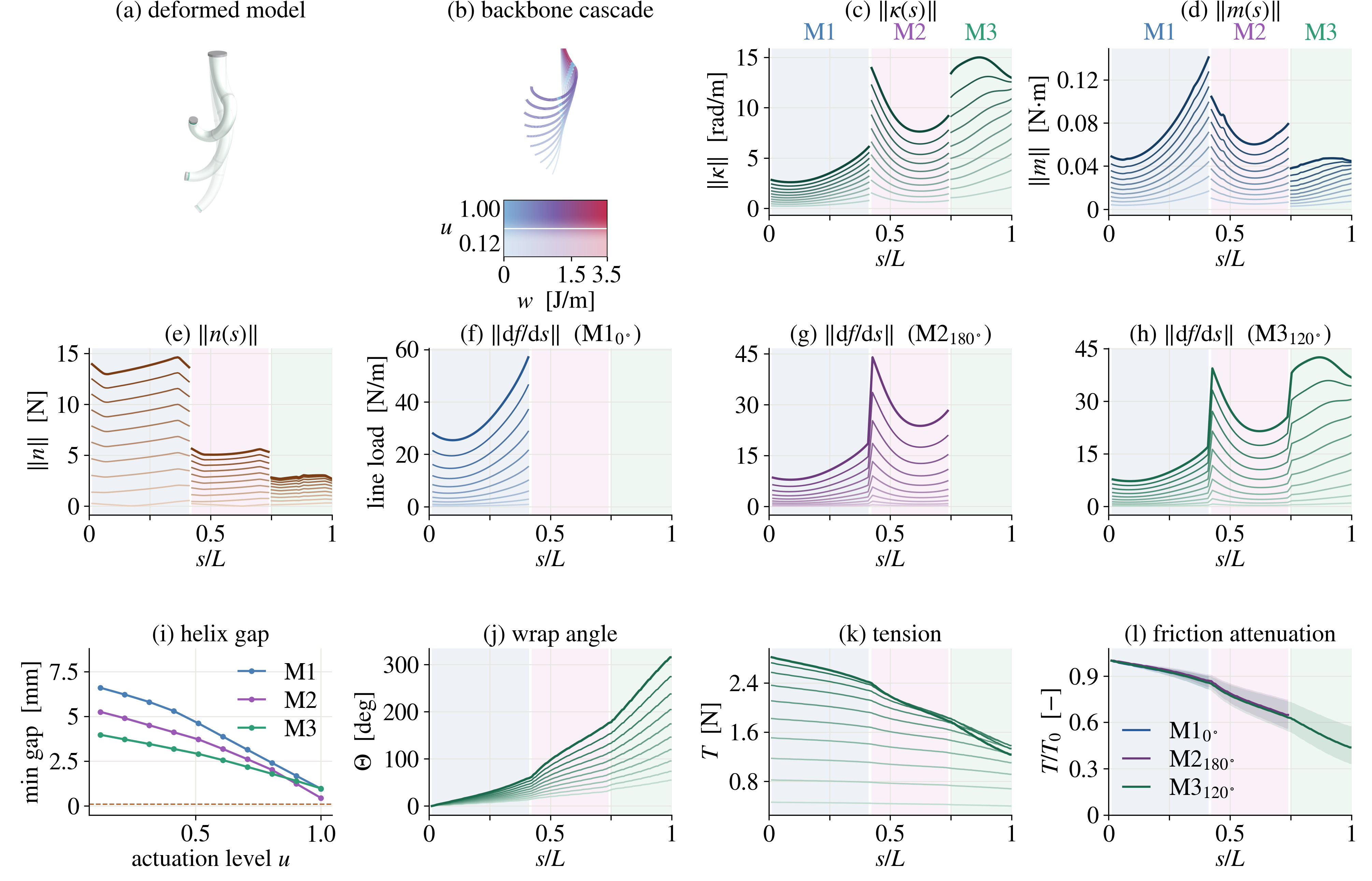
- The resulting effective sectional stiffness is strongly anisotropic: bending and extension are reduced by about one order of magnitude, whereas torsion remains close to the effective backbone stiffness.
Modeling Framework
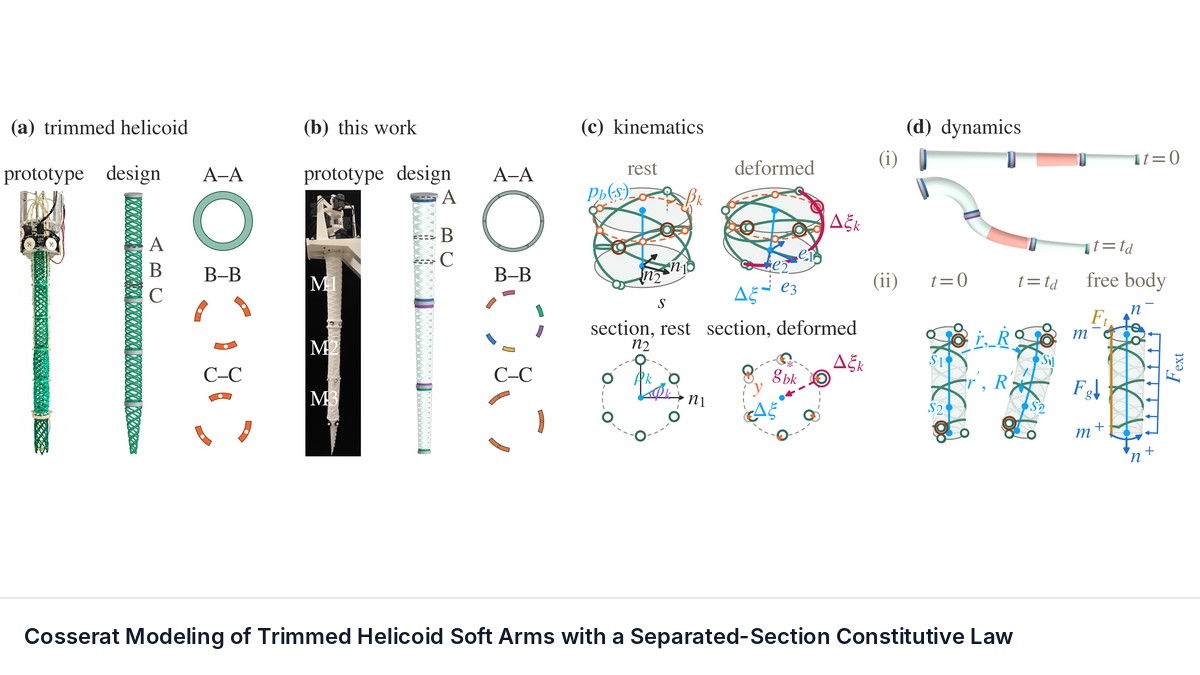
Figure 1 (b–d) summarizes the prototype and the kinematic and dynamic descriptions used in the model. The arm is represented as a serial assembly of three tapered arm sections, denoted M1, M2, and M3, separated by rigid platforms. Each arm section is actuated by three tendons, while the distal tendons are routed through guide bores in the proximal sections.
The backbone geometry, helix layout, tendon routes, mass distribution, and material properties are obtained from the CAD model and the fabricated structure.
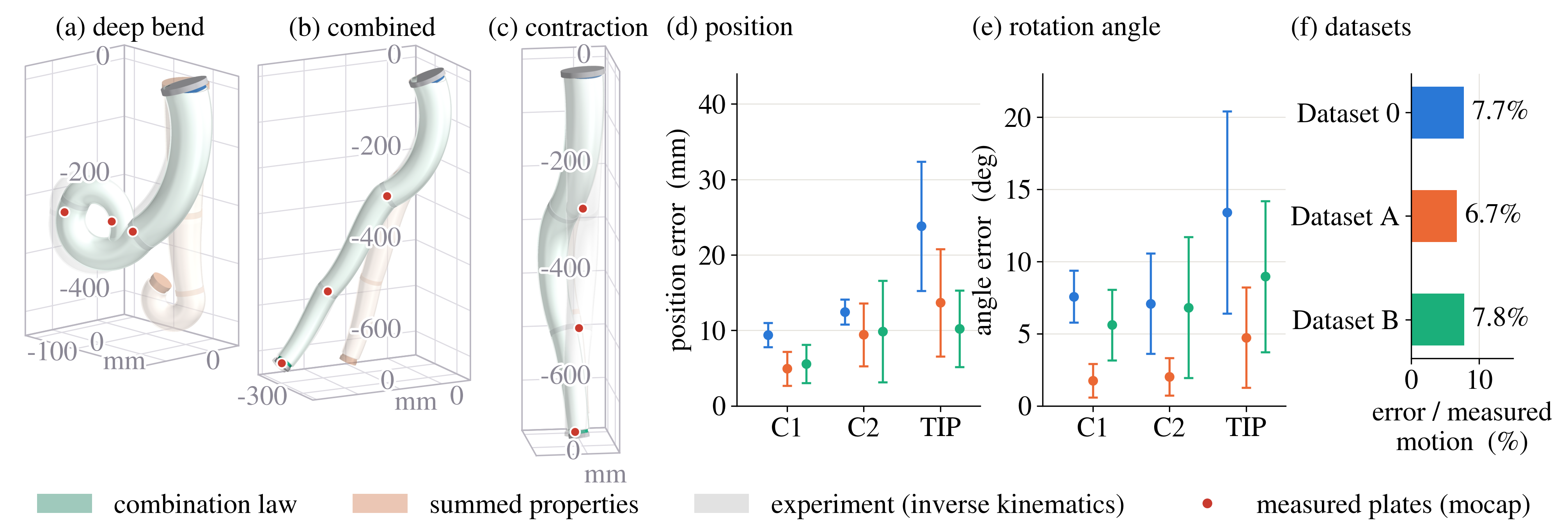
Model Analysis and Experimental Validation
The experimental platform consists of three tapered trimmed helicoid modules printed from TPU 95A using a Bambu Lab H2D printer, with rigid PLA connectors and mounting components. The arm is mounted vertically on a stainless-steel frame through a rigid bolted support.
Each module is actuated by three tendons driven by ROBOTIS DYNAMIXEL XM430-W350-R servo motors through a ROBOTIS U2D2 interface, with tendon commands sent from Python using the pySerial library.
Sources and Demonstrations
Figures are reproduced from Qin et al. See the full paper for experimental details and the project page, when the paper links one, for demonstrations and videos.
Related Papers
A Browser-Native Digital Test Range for Benchmarking 4D Ocean-Glider Planning Algorithms
Edward Holmberg, Elias Ioup, Mahdi Abdelguerfi
Repeated in-situ evaluation of ocean-glider planners requires scarce vehicles, operators, deployment and recovery resources, and ocean conditions that cannot be reset for competing algorithms.

Aim Short to Reach Far: Your Frozen World Model Can Plan Better Than You Think
Xvyuan Liu, Jianjie Fang, Chen Gao et al.
Planners built on visual world models commonly score each predicted outcome by its distance to the encoded goal image. We show that this target can limit control even with exact dynamics and globally optimal short-horizon search: reaching a goal may require actions that initially move away from it.
Compact Latent Coordination for Autonomous Vehicles at Unsignalized Intersections
Gil Lifshits, Igal Bilik, Gilad Katz
Coordinating autonomous vehicles at unsignalized intersections remains a critical challenge for multi-agent reinforcement learning (MARL) systems, which typically struggle with combinatorial action spaces, reliance on privileged information, or rigid agent designs.
Context-Aware Adaptive Pesticide Spraying for Agricultural Robots under Changing Weather and Terrain Using Vision-Language Models
Cong-Thanh Vu, Yen-Chen Liu
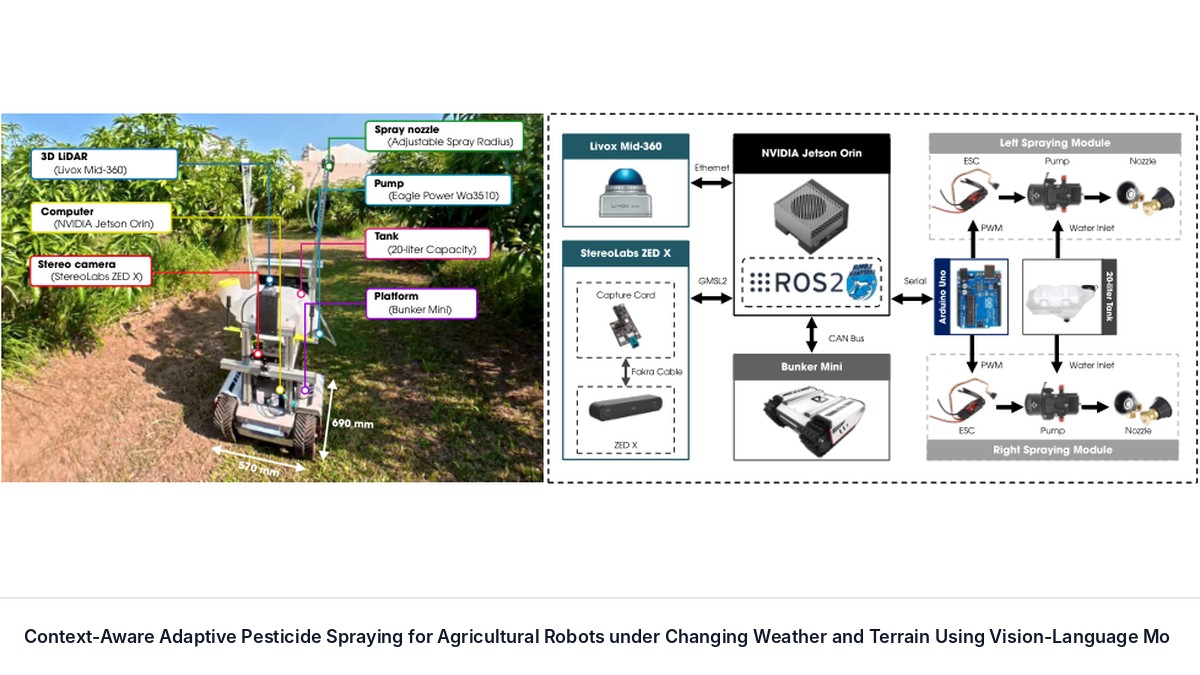
Precision pesticide spraying is essential for optimizing application efficiency and ensuring uniform chemical distribution.