
Compact Latent Coordination for Autonomous Vehicles at Unsignalized Intersections
Gil Lifshits, Igal Bilik, Gilad Katz · N/A · 2026
Framework
N/A
License
N/A
Stars
N/A
Summary
Coordinating autonomous vehicles at unsignalized intersections remains a critical challenge for multi-agent reinforcement learning (MARL) systems, which typically struggle with combinatorial action spaces, reliance on privileged information, or rigid agent designs.
Abstract Summary
Key Points
- Coordinating autonomous vehicles at unsignalized intersections remains a critical challenge for multi-agent reinforcement learning (MARL) systems, which typically struggle with combinatorial action spaces, reliance on privileged information, or rigid agent designs.
- We propose Master-Agent Proto-plan System (MAPS), a hierarchical deep reinforcement learning (DRL) architecture in which a centralized Master agent generates a compact, continuous embedding, denoted as proto-plan, that encodes a global coordination strategy.
- Decentralized Worker agents integrate this embedding with local observations to execute vehicle-specific control, decoupling strategic intent from tactical execution and enabling independent optimization of each module.
- As a proof-of-concept evaluation of this coordination mechanism, we test MAPS across 72 intersection configurations in HighwayEnv.
- MAPS achieves collision-free navigation while significantly reducing average travel time, outperforming state-of-the-art baselines.
Proposed Approach
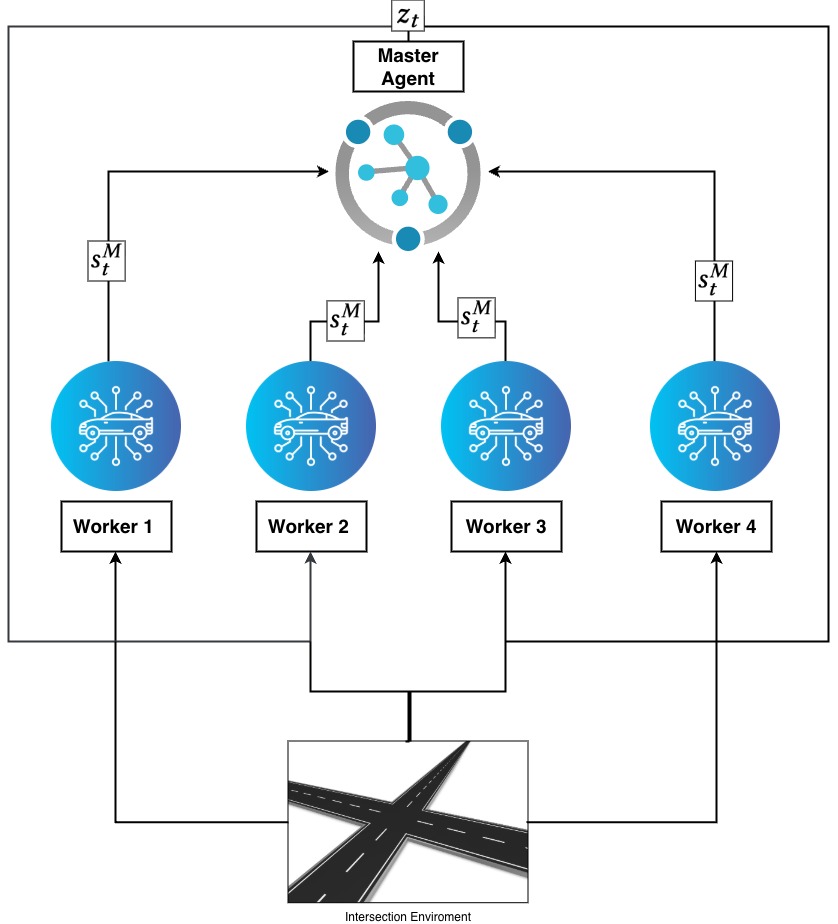
We formulate multi-vehicle intersection coordination as a hierarchical Markov decision process comprising two levels (Figure 1 ): a centralized Master agent that observes the global traffic state and generates a proto-plan embedding $z_{t}\in\mathbb{R}^{d}$ representing the desired coordination strategy, and decentralized Worker agents , each controlling an individual vehicle, that combine the proto-plan with local observations to select vehicle-specific actions.
Experimental Setup
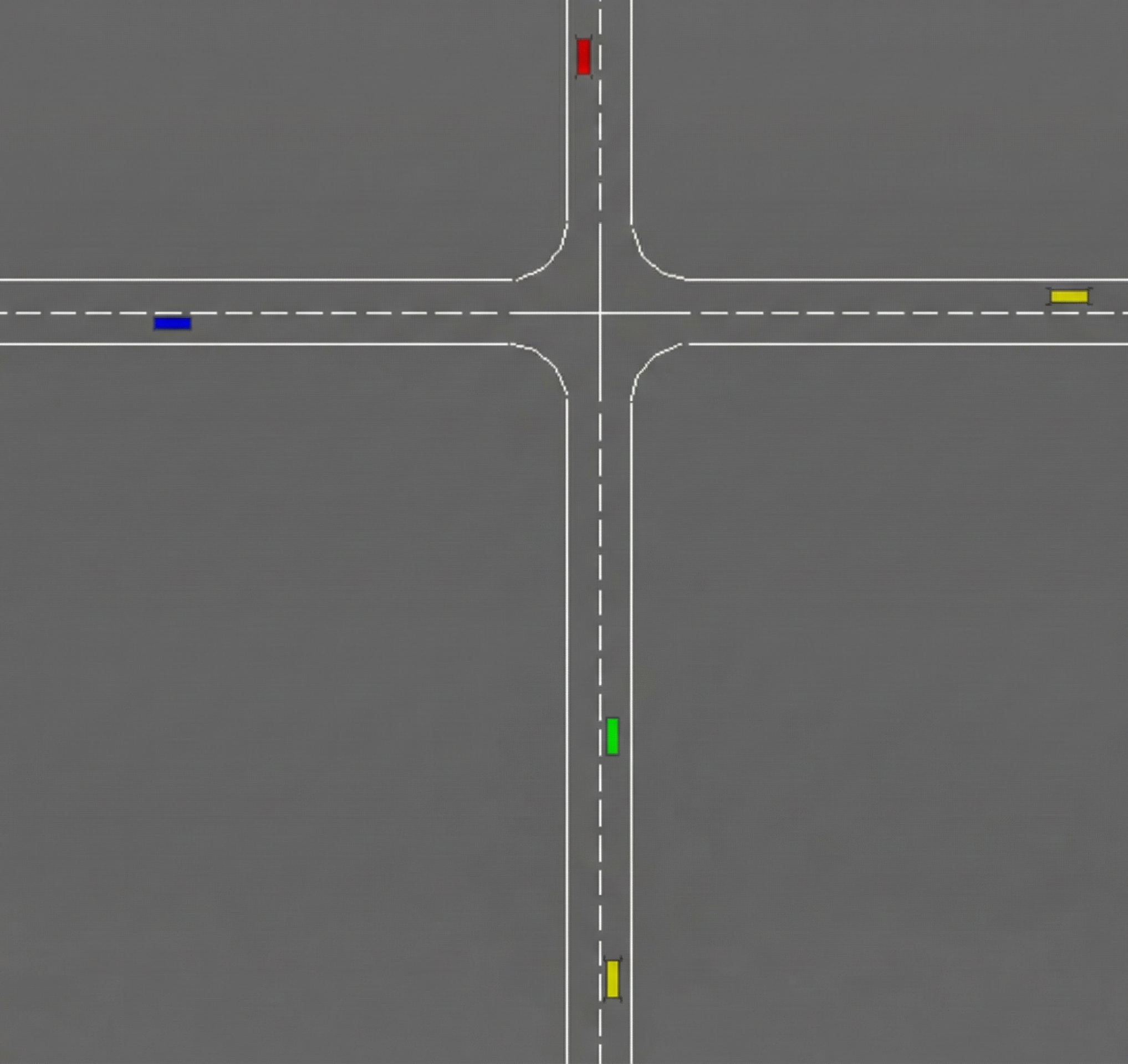
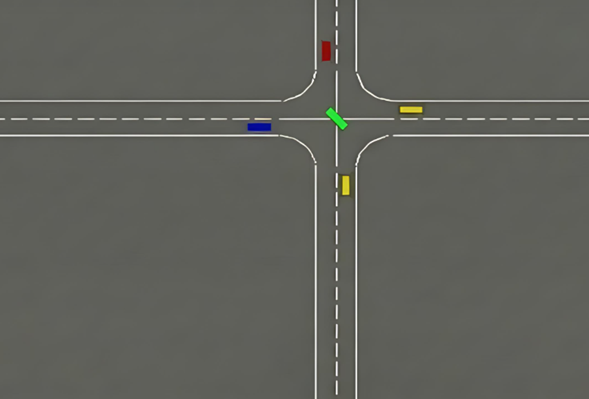
We evaluate our approach using the HighwayEnv simulator [ Leurent(2018) ] , an open-source reinforcement learning environment for autonomous driving research. Its modular architecture permits customization of state representations, action spaces, and reward functions, making it well-suited to our hierarchical framework.
Evaluation Results
Table 1 summarizes the comparative results, and Figure 3 illustrates the learning dynamics during training. MAPS is the only approach to achieve collision-free evaluation while recording the lowest average travel time. MAPS achieves zero collisions during evaluation (100% success rate), compared to 35 collisions (65% SR) for VN-MADDPG and 31 collisions (69% SR) for QMIXwD. The safety advantage extends to training.
Sources and Demonstrations
Figures are reproduced from Lifshits et al. See the full paper for experimental details and the project page, when the paper links one, for demonstrations and videos.
Related Papers
A Browser-Native Digital Test Range for Benchmarking 4D Ocean-Glider Planning Algorithms
Edward Holmberg, Elias Ioup, Mahdi Abdelguerfi
Repeated in-situ evaluation of ocean-glider planners requires scarce vehicles, operators, deployment and recovery resources, and ocean conditions that cannot be reset for competing algorithms.
Aim Short to Reach Far: Your Frozen World Model Can Plan Better Than You Think
Xvyuan Liu, Jianjie Fang, Chen Gao et al.
Planners built on visual world models commonly score each predicted outcome by its distance to the encoded goal image. We show that this target can limit control even with exact dynamics and globally optimal short-horizon search: reaching a goal may require actions that initially move away from it.
D3DWA: Adaptive Weight and Prediction-Horizon for Dynamic Window Approach via Dueling Double Deep Q-Network
Zahra Jooyandeh, Masato Kobayashi, Yuki Uranishi
The Dynamic Window Approach (DWA) is widely used for local navigation, but its performance depends strongly on parameters that are typically fixed before navigation.
Dexterity from Supervised Play
Botao He, Yiming Dou, Yiannis Aloimonos et al.
How can robots autonomously collect the contact-rich experience needed to learn dexterous manipulation?