
D3DWA: Adaptive Weight and Prediction-Horizon for Dynamic Window Approach via Dueling Double Deep Q-Network
Zahra Jooyandeh, Masato Kobayashi, Yuki Uranishi · N/A · 2026
Framework
N/A
License
N/A
Stars
N/A
Summary
The Dynamic Window Approach (DWA) is widely used for local navigation, but its performance depends strongly on parameters that are typically fixed before navigation.
Abstract Summary
Key Points
- The Dynamic Window Approach (DWA) is widely used for local navigation, but its performance depends strongly on parameters that are typically fixed before navigation.
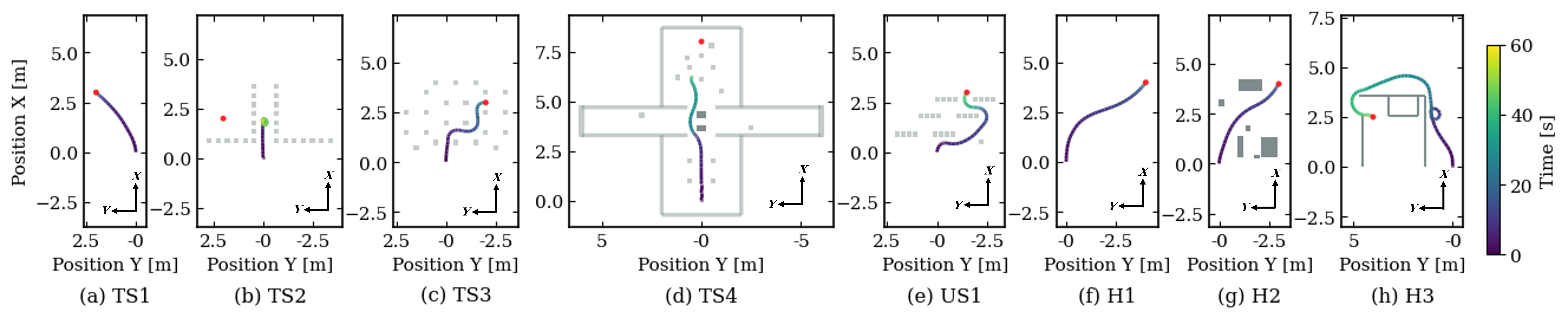
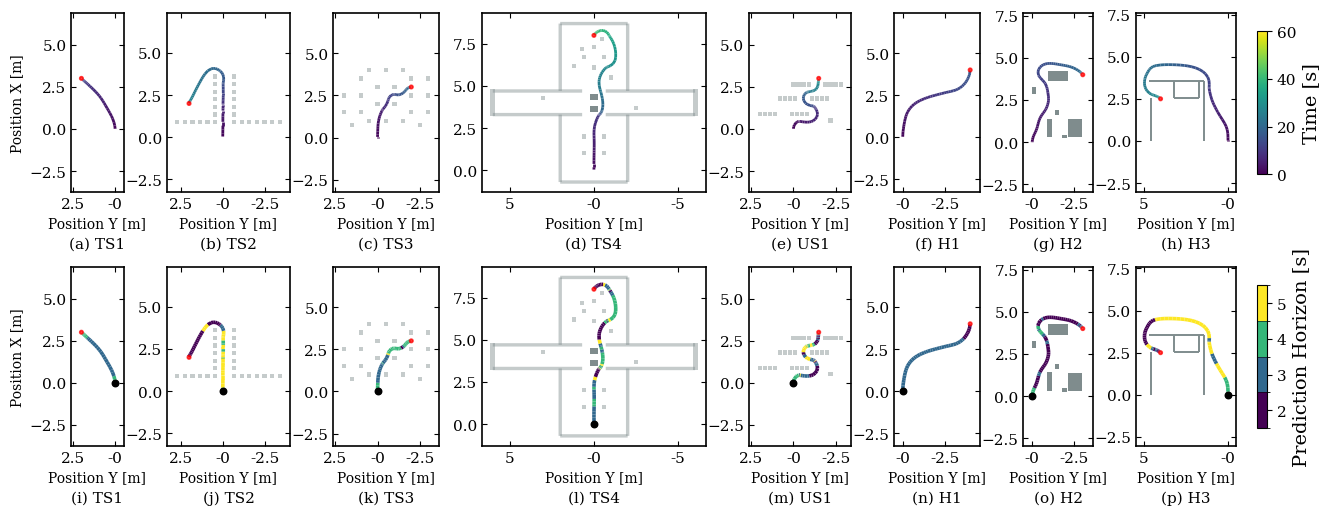
- In particular, the appropriate prediction horizon can vary with local free space: longer horizons support efficient motion in open areas, whereas shorter horizons help preserve feasible motions in narrow or cluttered regions.
- This paper proposes D3DWA, an adaptive DWA framework based on a Dueling Double Deep Q-Network (D3QN), which jointly selects the DWA evaluation weights and prediction horizon from a continuous navigation state at every control step while retaining DWA's trajectory generation and collision checking.
- In eight simulated environments, including unseen layouts, D3DWA reached every goal
- Real-robot experiments further showed that D3DWA completed all three tested configurations, including a constrained case in which the weights-only variant timed out.
Method
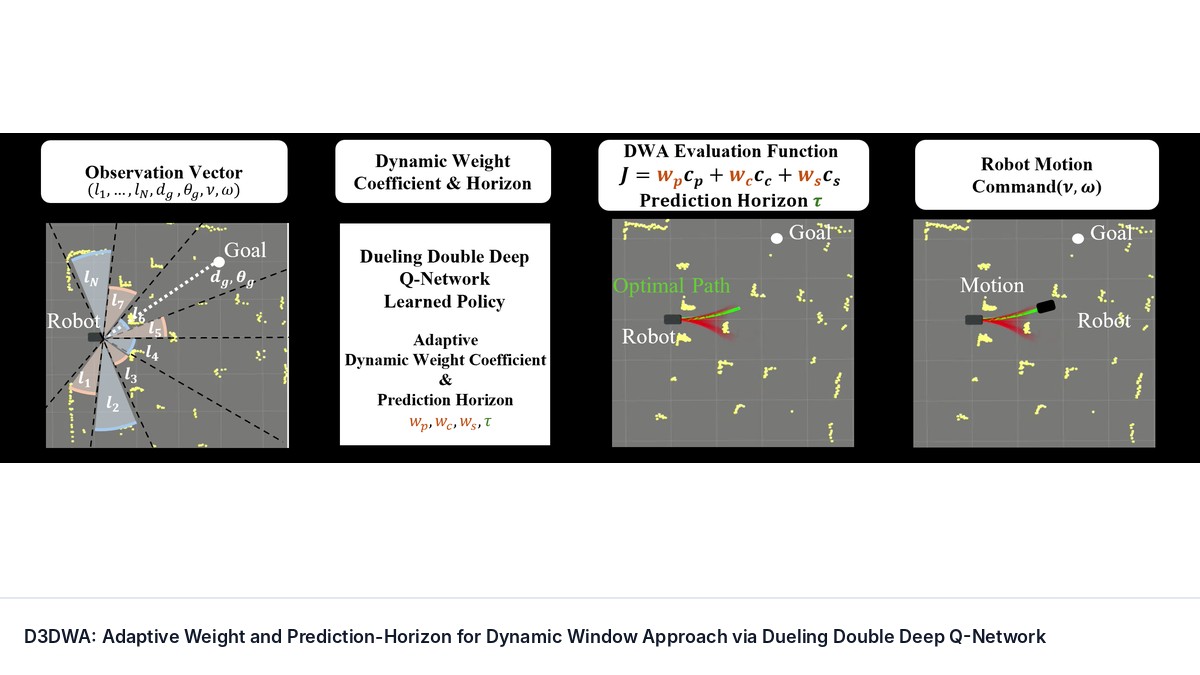
At every D3DWA control step a body-frame observation is built from the lidar scan and wheel odometry; a D3QN agent maps it to a discrete action; the action decodes to a DWA parameter tuple and is published to the planner; and the DWA planner uses that tuple to score and execute a velocity command. Fig. 2 shows the discussed architecture.
DWA forms the dynamic window from the current velocity and the acceleration limits, and draws a grid of $N_{v}\times N_{\omega}$ samples $(v,\omega)$ from it.
Simulation
The simulation system was implemented using the Robot Operating System (ROS) and Gazebo. The parameters used for the planner and reinforcement-learning agent are summarized in Table II . Six methods were compared.
Three fixed-parameter DWA configurations were used following the baseline setting: DWA I $\{w_{p},w_{c},w_{s}\}=\{1,1,2\}$, DWA II $\{1,2,1\}$, and DWA III $\{2,1,1\}$, all with a fixed prediction horizon of $\tau=4$ s. DQDWA [ 2 ] was used as the tabular Q-learning baseline.

Real-World Experiments
The proposed method was evaluated on a physical Kachaka mobile robot in the same room used to construct the simulation environments, as shown in Fig. 7 . Three static-obstacle configurations, denoted as Cases R1–R3, were used to evaluate navigation performance under different spatial arrangements of obstacles. The obstacle layouts and executed trajectories for the three configurations are shown in Figs. 8 – 10 .
Case R1 places five obstacles between the start position and a goal at $(3.0,0.0)$.
Sources and Demonstrations
Figures are reproduced from Jooyandeh et al. See the full paper for experimental details and the project page, when the paper links one, for demonstrations and videos.
Related Papers
A Browser-Native Digital Test Range for Benchmarking 4D Ocean-Glider Planning Algorithms
Edward Holmberg, Elias Ioup, Mahdi Abdelguerfi
Repeated in-situ evaluation of ocean-glider planners requires scarce vehicles, operators, deployment and recovery resources, and ocean conditions that cannot be reset for competing algorithms.
Aim Short to Reach Far: Your Frozen World Model Can Plan Better Than You Think
Xvyuan Liu, Jianjie Fang, Chen Gao et al.
Planners built on visual world models commonly score each predicted outcome by its distance to the encoded goal image. We show that this target can limit control even with exact dynamics and globally optimal short-horizon search: reaching a goal may require actions that initially move away from it.
Compact Latent Coordination for Autonomous Vehicles at Unsignalized Intersections
Gil Lifshits, Igal Bilik, Gilad Katz
Coordinating autonomous vehicles at unsignalized intersections remains a critical challenge for multi-agent reinforcement learning (MARL) systems, which typically struggle with combinatorial action spaces, reliance on privileged information, or rigid agent designs.
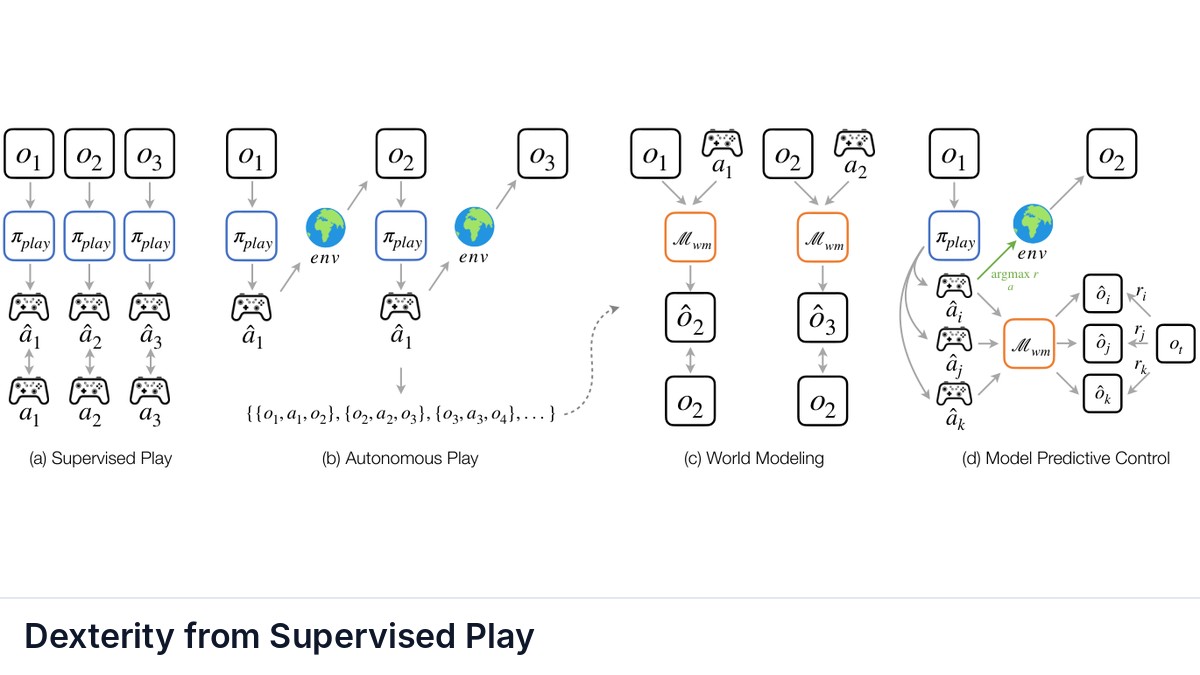
Dexterity from Supervised Play
Botao He, Yiming Dou, Yiannis Aloimonos et al.
How can robots autonomously collect the contact-rich experience needed to learn dexterous manipulation?