
Continual Humanoid Motion Learning
Zhewen He, Hao Huang, Geeta Chandra Raju Bethala, Chong Yu, Tao Chen, Anthony Tzes, Yi Fang · N/A · 2026
Framework
N/A
License
N/A
Stars
N/A
Summary
Humanoid whole-body controllers can now track a diverse set of dynamic motions, but they are typically trained offline and then frozen, so teaching such a controller a new skill tends to erode the skills it already mastered.
Abstract Summary
Key Points
- Humanoid whole-body controllers can now track a diverse set of dynamic motions, but they are typically trained offline and then frozen, so teaching such a controller a new skill tends to erode the skills it already mastered.
- We study continual learning for humanoid whole-body motion, where a single controller must acquire skills from a sequential task stream without revisiting past data.
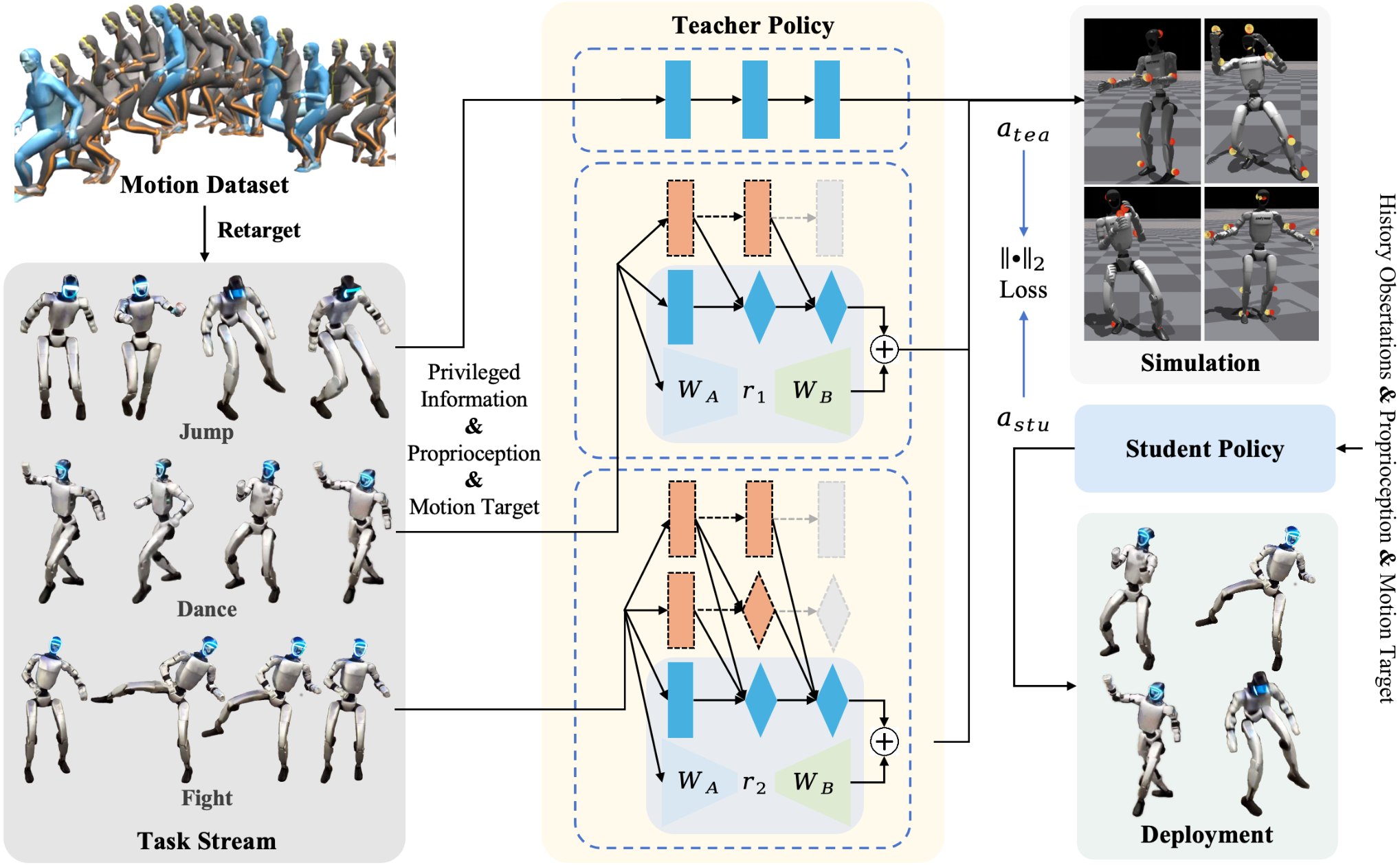
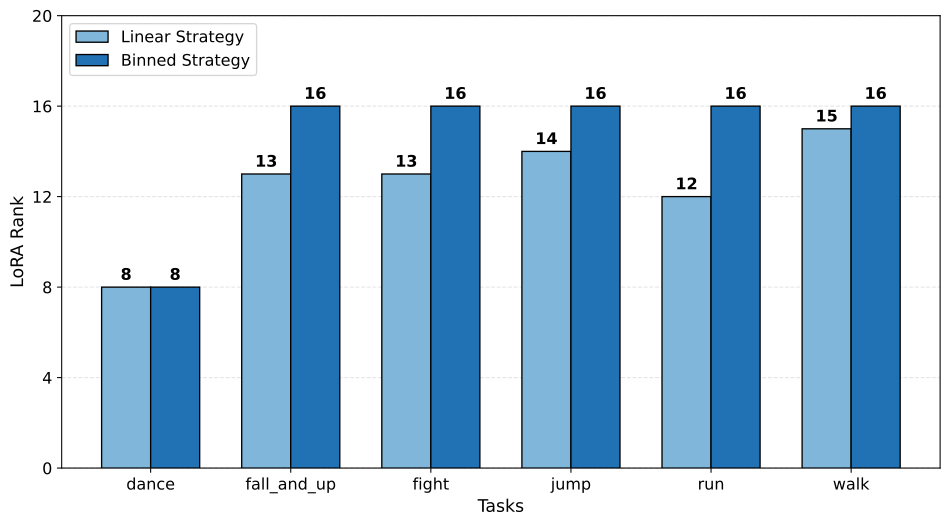
- We introduce Similarity-guided LoRA-PNN, a progressive neural network (PNN) policy that prevents catastrophic forgetting by construction while reusing knowledge across skills through lightweight low-rank adaptation.
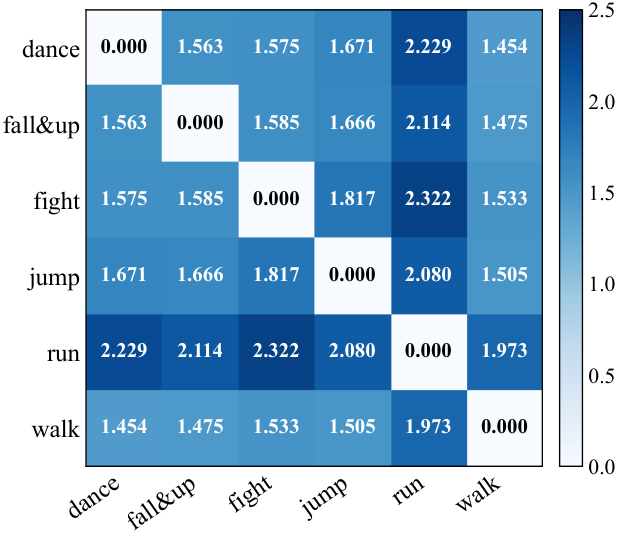
- A two-level motion-similarity measure, built from dynamic time warping aggregated by optimal transport, decides which prior skill to build on and how much new capacity to allocate, yielding strong forward transfer and large efficiency gains.
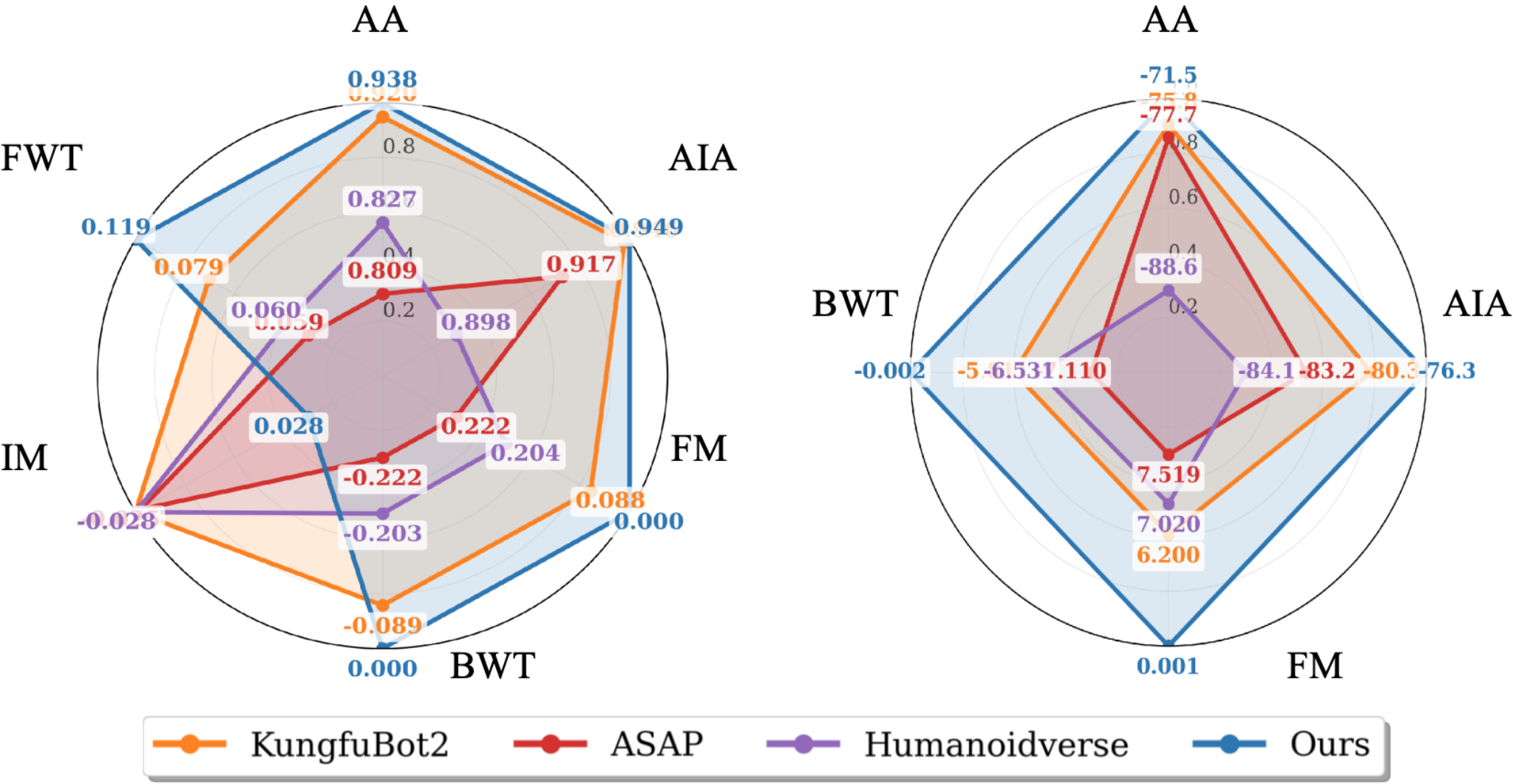
- Across six sequentially learned skill categories, our similarity-guided LoRA policy attains the best forward transfer (0.125 vs.
Method
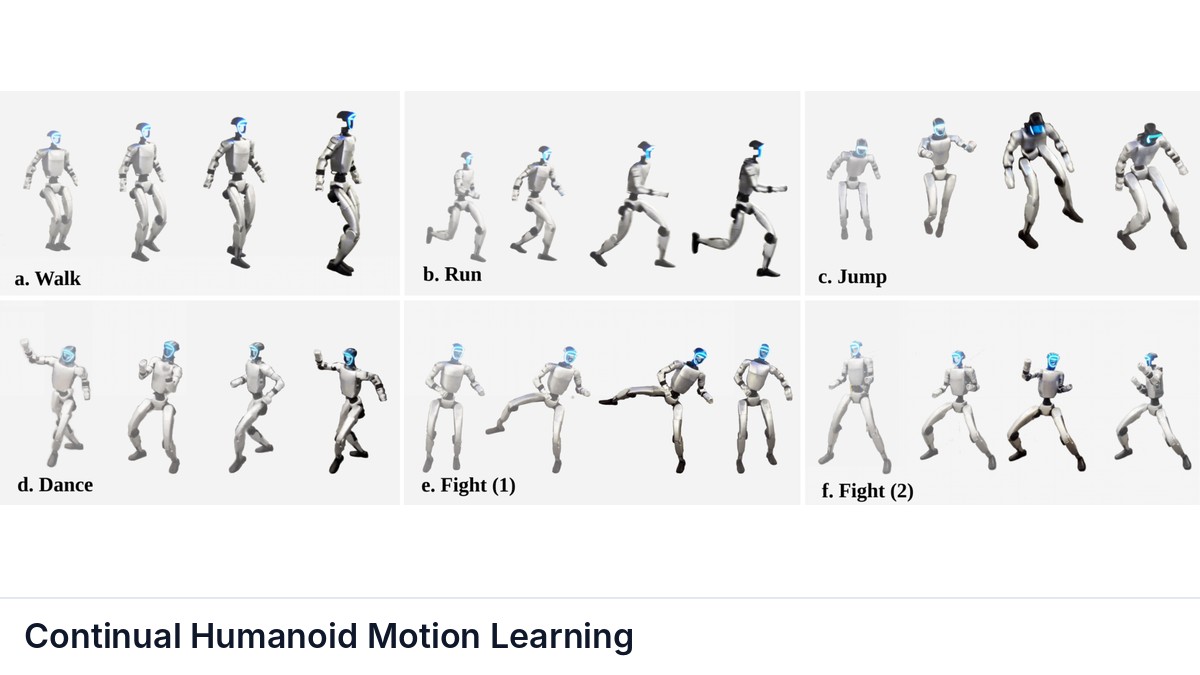
We study continual learning for humanoid whole-body motion, where a single controller must incrementally acquire a growing set of whole-body skills ( e.g . , walking, jumping, and dancing) from a sequential curriculum in which skills are introduced one after another.
Let $\pi_{\theta}$ map humanoid observations (proprioception, root state, contact cues, and optional task commands) to actions, and let $\{\mathcal{D}_{1},\ldots,\mathcal{D}_{K}\}$ be the ordered task stream, where $\mathcal{D}_{k}$ holds the demonstrations for task $k$.
Experiments
We study continual humanoid whole-body motion learning under a task-incremental protocol with a provided task identifier. Let $\mathcal{K}=\{1,\dots,K\}$ be the task set, trained in order $1\!\rightarrow\!2\!\rightarrow\!\cdots\!\rightarrow\!K$.
After learning task $k$, we evaluate the policy $\pi_{k}$ on all tasks $i\leq k$, forming a stage-by-task matrix $A\in\mathbb{R}^{K\times K}$ with $A_{k,i}=\mathrm{Perf}(\pi_{k},i)$. Our suite contains $K=6$ tasks curated from LAFAN1 Harvey et al. (2020) and the Kungfu motion datasets Xie et al.
Motion Data Format and Implementation Notes
This appendix complements Sec. 3.4 with the data format and the implementation constants of the motion-set distance. Each retargeted motion carries the following attributes: Root translation : root_trans_offset $\in\mathbb{R}^{T\times 3}$, the root position over time in a fixed world frame. Root orientation : root_rot $\in\mathbb{R}^{T\times 4}$, the quaternion root rotation over time in a fixed world frame.
Pose parameters : pose_aa $\in\mathbb{R}^{T\times J\times 3}$, axis-angle rotations for $J$ joints.
Hyperparameters and Implementation Details
This appendix expands the summary in Table 3 . Unless otherwise specified, a single hyperparameter setting is shared across all tasks. The motion-distance settings are given in Appendix 6 and Table 3 . All policies are trained with PPO Schulman et al.
(2017) under a shared configuration: fixed rollout horizon, mini-batch count, and learning rate, with multiple PPO epochs per update, generalized advantage estimation, and the standard clipped policy and value objectives (Table 12 ).
Statements and Declarations
The authors have no competing interests to declare that are relevant to the content of this article. Zhewen He designed the method, implemented the code, conducted the simulation experiments, took part in the real-robot deployment, and wrote the first draft of the manuscript. Hao Huang advised on the design of the method and carried out the real-robot deployment together with Zhewen He and Geeta Chandra Raju Bethala.
Chong Yu, Tao Chen, Anthony Tzes, and Yi Fang provided guidance on the research and secured the funding.
Sources and Demonstrations
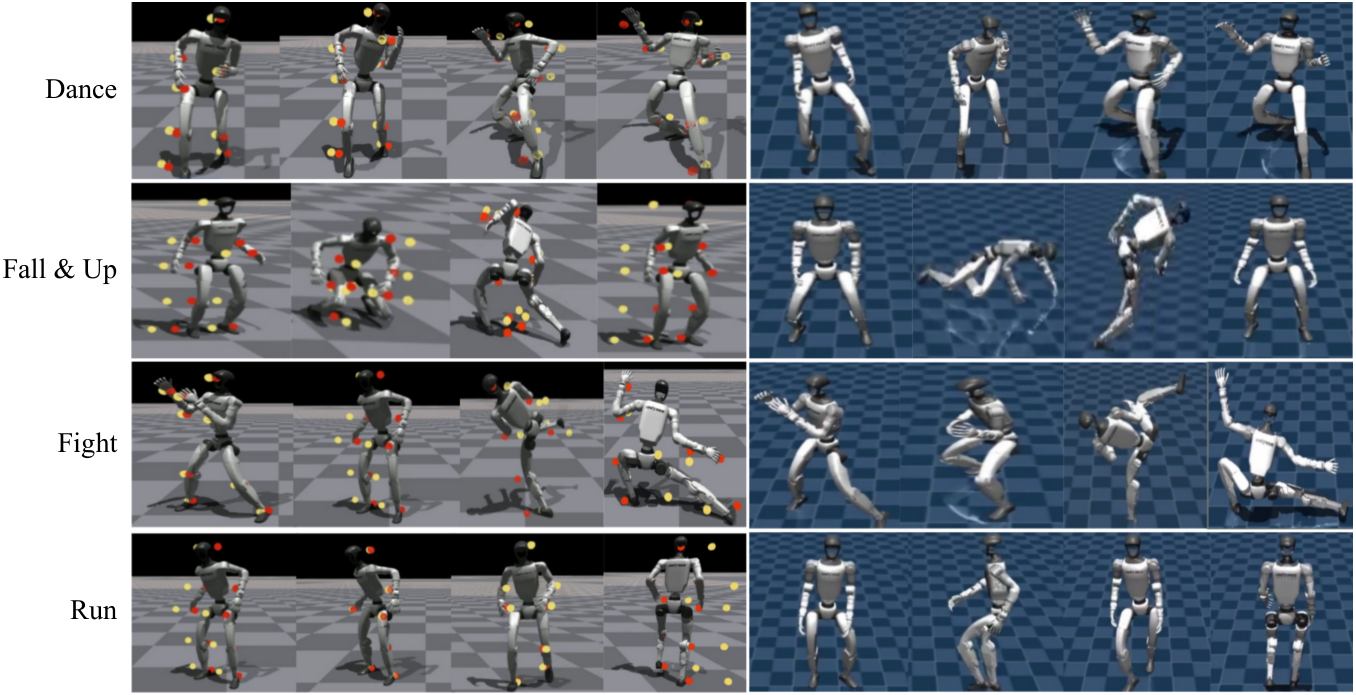
Figures are reproduced from He et al. See the full paper for experimental details and the project page, when the paper links one, for demonstrations and videos.
Related Papers
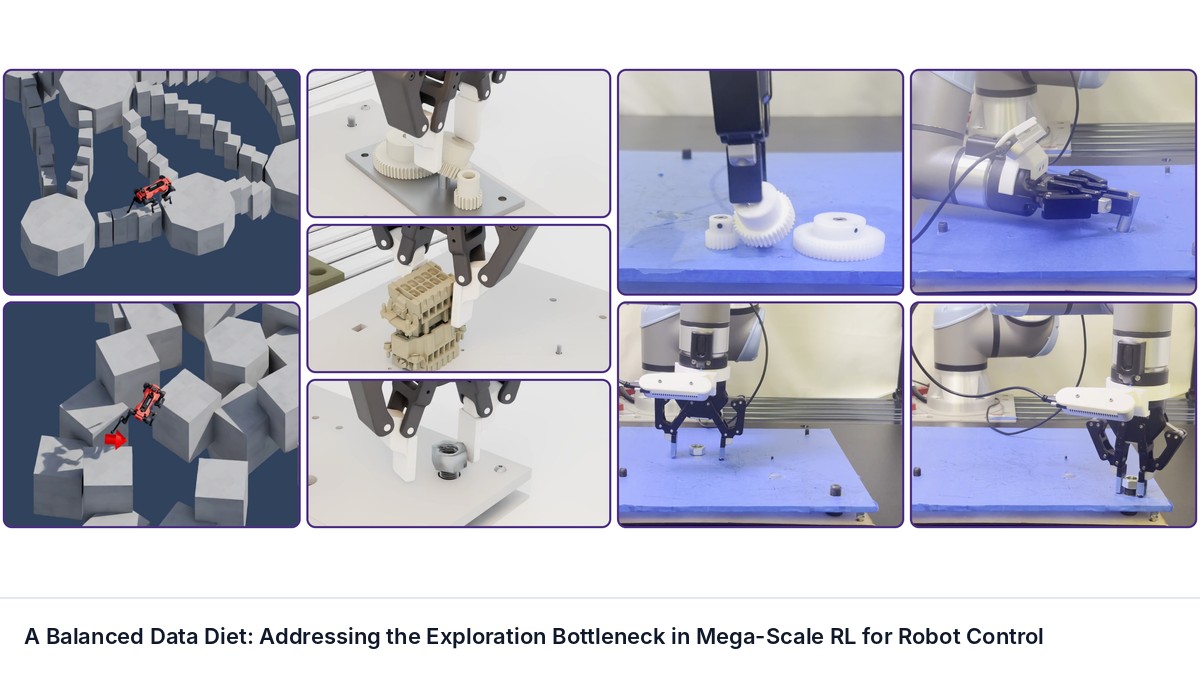
A Balanced Data Diet: Addressing the Exploration Bottleneck in Mega-Scale RL for Robot Control
Octi Zhang, Mateo Guaman Castro, Patrick Yin et al.
General-purpose robots must perform a wide range of tasks from agile locomotion to dexterous manipulation.
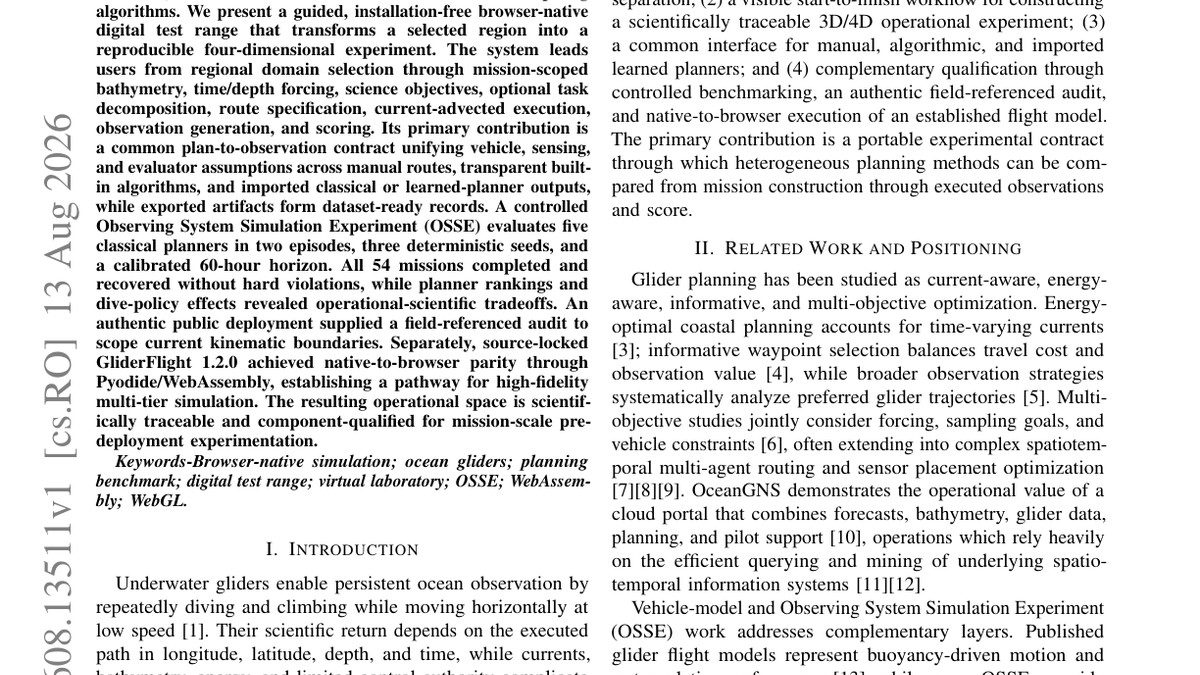
A Browser-Native Digital Test Range for Benchmarking 4D Ocean-Glider Planning Algorithms
Edward Holmberg, Elias Ioup, Mahdi Abdelguerfi
Repeated in-situ evaluation of ocean-glider planners requires scarce vehicles, operators, deployment and recovery resources, and ocean conditions that cannot be reset for competing algorithms.
A Low-Cost, Open Platform for End-to-End Autonomous Driving on a Miniature Ackermann Vehicle
Gustavo Claudio Karl Couto, Eric Aislan Antonelo, Gabriel George Zipperer
This paper presents a low-cost, open experimental platform for research in end-to-end autonomous driving with miniature Ackermann vehicles.
A Mode-Unified, Continuous, and Biomimetic Control Strategy of a Robotic Lower Limb Prosthesis
Hanjun Kim, Sixu Zhou, John Shim et al.
Existing biomimetic lower-limb prosthesis controllers are commonly designed for discrete locomotion modes, requiring separate parameterizations for level walking, ramps, and stairs.