
A Mode-Unified, Continuous, and Biomimetic Control Strategy of a Robotic Lower Limb Prosthesis
Hanjun Kim, Sixu Zhou, John Shim, Xinyuan Guo, Kinsey R. Herrin, Aaron J. Young · N/A · 2026
Framework
N/A
License
N/A
Stars
N/A
Summary
Existing biomimetic lower-limb prosthesis controllers are commonly designed for discrete locomotion modes, requiring separate parameterizations for level walking, ramps, and stairs.
Abstract Summary
Key Points
- Existing biomimetic lower-limb prosthesis controllers are commonly designed for discrete locomotion modes, requiring separate parameterizations for level walking, ramps, and stairs.
- We present a mode-unified prosthesis control framework that represents knee and ankle biomechanics continuously as functions of terrain slope and gait phase across those locomotion conditions.
- Locally optimized ascent and descent polynomial models were unified using radial basis function (RBF) interpolation, preserving the accuracy of the partitioned models while outperforming a global polynomial representation.
- The resulting biomechanics were transformed into continuous and slope-dependent impedance parameters and implemented within a single finite-state-machine (FSM) controller using bilateral sensing for gait-state estimation.
- Experiments with 10 individuals with transfemoral amputation demonstrated terrain-adaptive locomotion from level walking through ramps and stairs up to 35 degrees, including 13 degree ramp and 15 degree stair conditions absent from the underlying able-bodied (AB) dataset.
A Mode-Unified, Continuous, and Biomimetic Control Strategy of a Robotic Lower Limb Prosthesis
|Authors: Hanjun Kim, Sixu Zhou, John Shim, Xinyuan Guo, Kinsey R. Herrin, Aaron J. Young
|Venue: arXiv preprint | Year: 2026
|arXiv: 2610.19183
Abstract
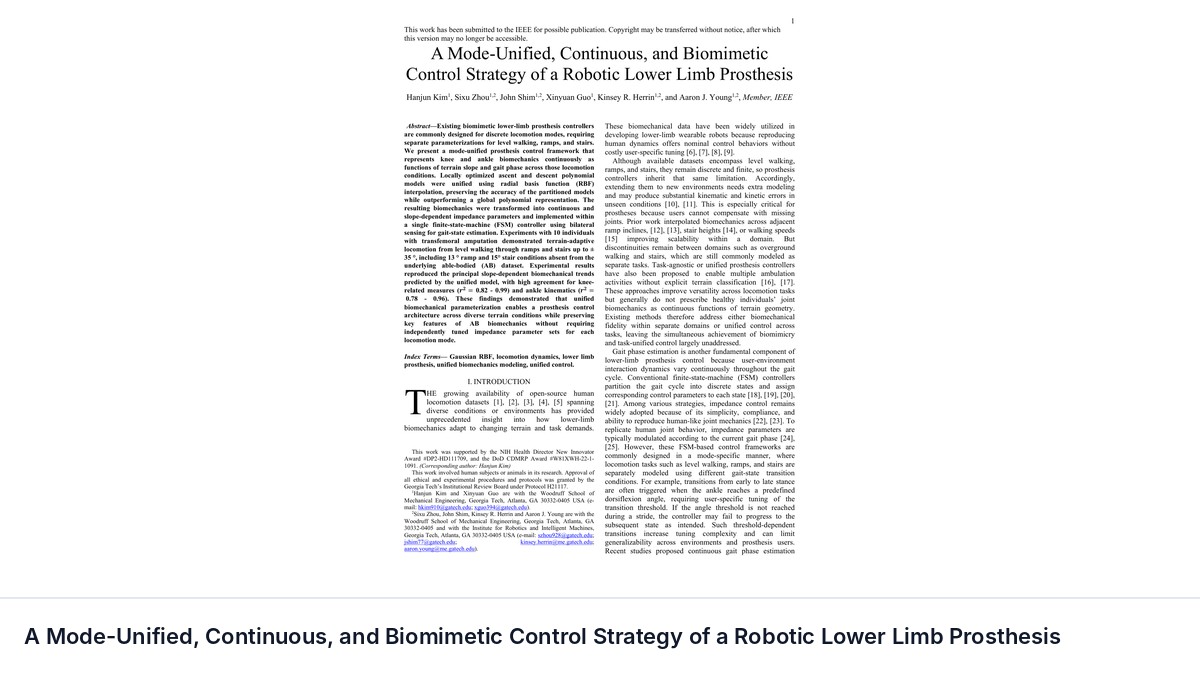
Existing biomimetic lower-limb prosthesis controllers are commonly designed for discrete locomotion modes, requiring separate parameterizations for level walking, ramps, and stairs. We present a mode-unified prosthesis control framework that represents knee and ankle biomechanics continuously as functions of terrain slope and gait phase across those locomotion conditions. Locally optimized ascent and descent polynomial models were unified using radial basis function (RBF) interpolation, preserving the accuracy of the partitioned models while outperforming a global polynomial representation. The resulting biomechanics were transformed into continuous and slope-dependent impedance parameters and implemented within a single finite-state-machine (FSM) controller using bilateral sensing for gait-state estimation. Experiments with 10 individuals with transfemoral amputation demonstrated terrain-adaptive locomotion from level walking through ramps and stairs up to 35 degrees, including 13 degree ramp and 15 degree stair conditions absent from the underlying able-bodied (AB) dataset. Experimental results reproduced the principal slope-dependent biomechanical trends predicted by the unified model, with high agreement for knee-related measures (r-square = 0.82 - 0.99) and ankle kinematics (r-square= 0.78 - 0.96). These findings demonstrated that unified biomechanical parameterization enables a prosthesis control architecture across diverse terrain conditions while preserving key features of AB biomechanics without requiring independently tuned impedance parameter sets for each locomotion mode.
Key Contributions
- Existing biomimetic lower-limb prosthesis controllers are commonly designed for discrete locomoti…
- We present a mode-unified prosthesis control framework that represents knee and ankle biomechanic…
- Locally optimized ascent and descent polynomial models were unified using radial basis function (…
- The resulting biomechanics were transformed into continuous and slope-dependent impedance paramet…
- Experiments with 10 individuals with transfemoral amputation demonstrated terrain-adaptive locomo…
Topics
- locomotion
- reinforcement-learning
- control
- benchmark
Code & Data
No code repository linked in paper metadata.
BibTeX
@article{Kim2026_261019183,
  title     = {A Mode-Unified, Continuous, and Biomimetic Control Strategy of a Robotic Lower Limb Prosthesis},
  author    = {Hanjun Kim and Sixu Zhou and John Shim and Xinyuan Guo and Kinsey R. Herrin and Aaron J. Young},
  year      = {2026},
  eprint    = {2610.19183},
  archivePrefix = {arXiv},
  primaryClass  = {cs.RO},
  url       = {https://arxiv.org/abs/2610.19183}
}
Related Papers
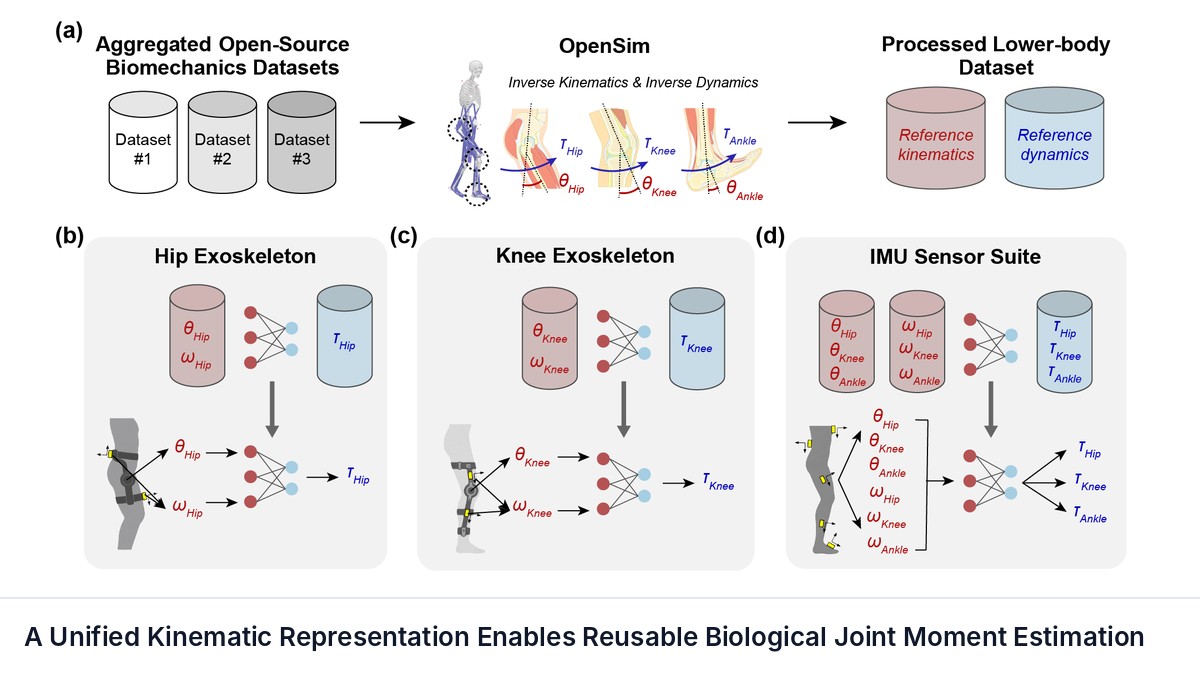
A Unified Kinematic Representation Enables Reusable Biological Joint Moment Estimation
Jinwoo Hwang, Ilseung Park, Changseob Song et al.
Objective: Data-driven models that estimate physiological states, particularly biological joint moments, are widely used in exoskeleton control.
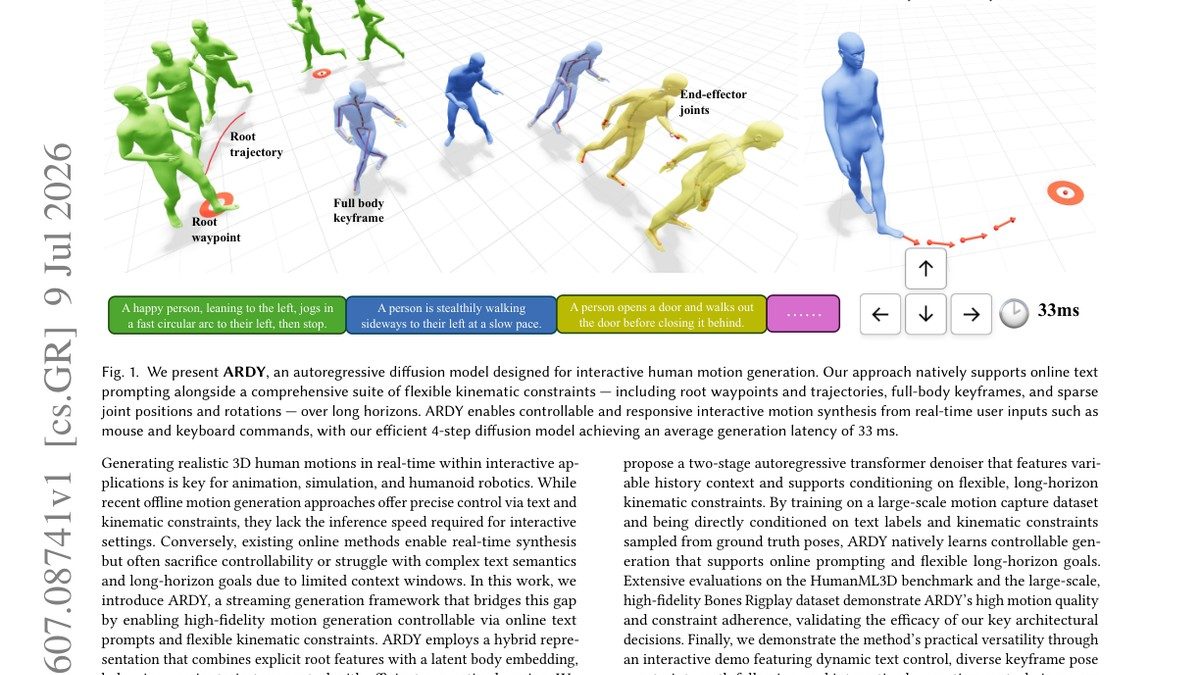
ARDY: Autoregressive Diffusion with Hybrid Representation for Interactive Human Motion Generation
Kaifeng Zhao, Mathis Petrovich, Haotian Zhang et al.
Generating realistic 3D human motions in real-time within interactive applications is key for animation, simulation, and humanoid robotics.
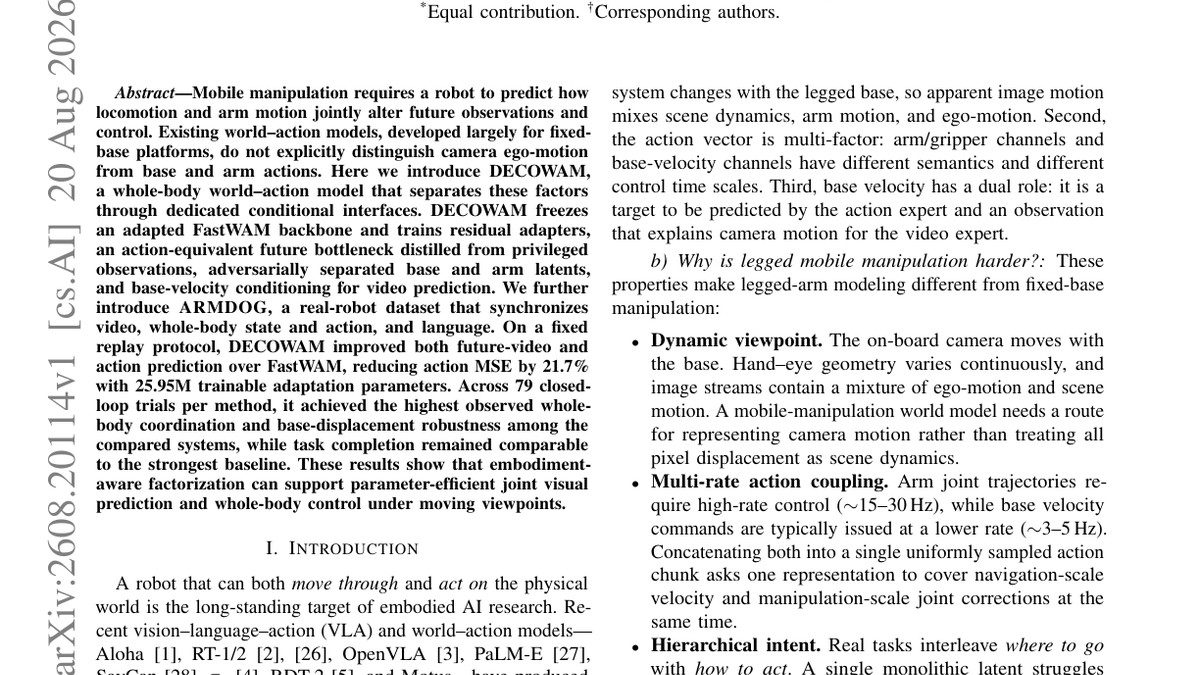
DECOWAM: Decoupled Whole-Body World-Action Model for Legged Mobile Manipulation
Siyuan Ma, Boshi Zhang, Yutian Zhang et al.
Mobile manipulation requires a robot to predict how locomotion and arm motion jointly alter future observations and control. Existing world-action models, developed largely for fixed-base platforms, do not explicitly distinguish camera ego-motion from base and arm actions.
DUET: Decoupled Upper- and Lower-Body Execution for Task-Agnostic Humanoid Loco-Manipulation
Kapalik Khanal, Biswash Khatiwada, Stephen Afrifa et al.
Changing a humanoid robot's manipulation policy should not require retraining the controller that maintains the robot's balance.