
A Unified Kinematic Representation Enables Reusable Biological Joint Moment Estimation
Jinwoo Hwang, Ilseung Park, Changseob Song, Vu Phan, Eni Halilaj, Inseung Kang · N/A · 2026
Framework
N/A
License
N/A
Stars
N/A
Summary
Objective: Data-driven models that estimate physiological states, particularly biological joint moments, are widely used in exoskeleton control.
Abstract Summary
Key Points
- Objective: Data-driven models that estimate physiological states, particularly biological joint moments, are widely used in exoskeleton control.
- However, these estimators are often coupled to device-specific sensor configurations, limiting controller transfer and the use of open-source biomechanics datasets.
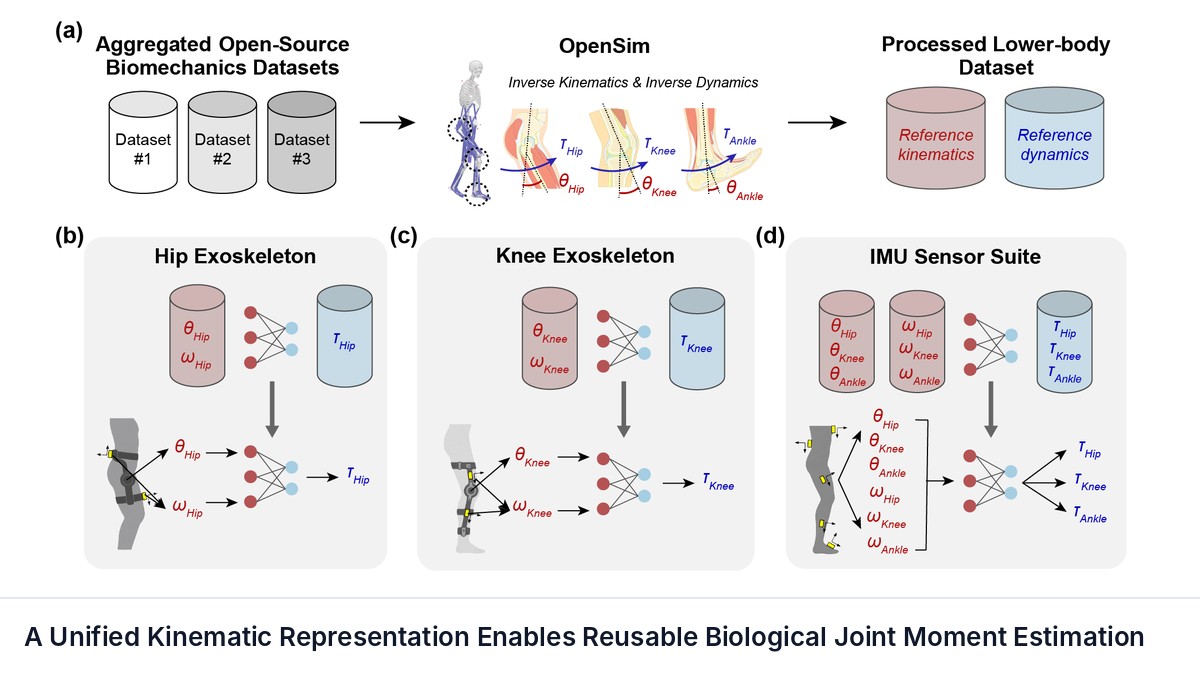
- Methods: We proposed joint kinematics as an intermediate representation that decouples hardware-specific sensing from downstream biological joint moment estimation.
- A joint-moment estimator using joint angles and angular velocities was trained exclusively on open-source biomechanics data and evaluated using kinematics from a hip exoskeleton, knee exoskeleton, and inertial measurement unit (IMU) sensor suite during level-ground, ramp-ascent, and ramp-descent walking.
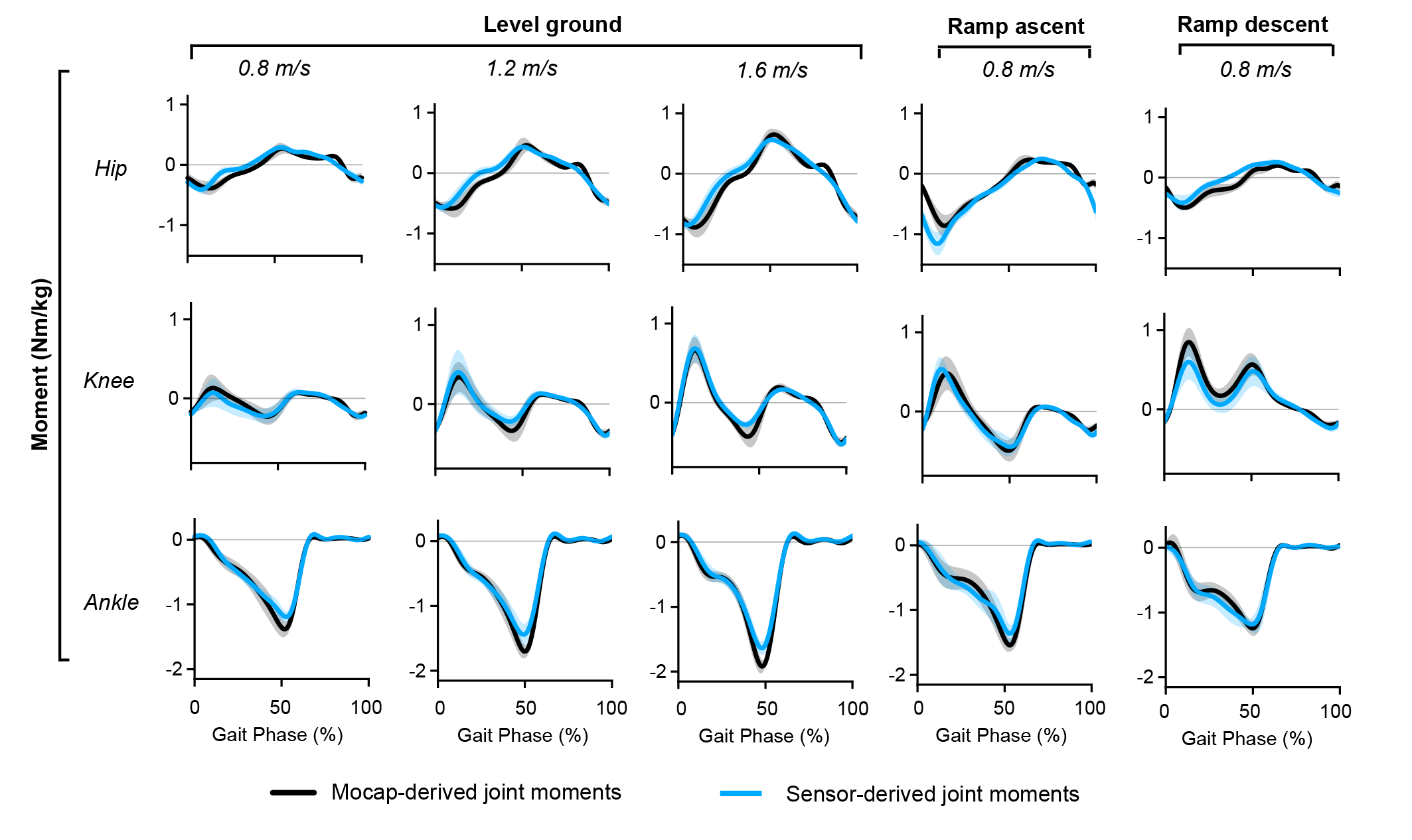
- Results: The estimator achieved an root mean square error (RMSE) of 0.17 Nm/kg and coefficient of determination (R2) of 0.79 using hip exoskeleton kinematics, 0.19 Nm/kg and 0.62 using knee exoskeleton kinematics, and 0.15 Nm/kg and 0.85 using kinematics derived from IMUs across bilateral hip, knee, and ankle joints.
Methods
All biological joint-moment estimators were trained using publicly available biomechanics data (Fig. 1 (a)). The curated database combined level-ground, ramp-ascent, and ramp-descent walking trials from the datasets used in Camargo et al. [ 21 ] , Scherpereel et al. [ 16 ] , and Molinaro et al. [ 9 , 15 ] .
Acyclic activities, such as squatting, and stair-negotiation trials were excluded because they were outside the scope of the present evaluation.
Results
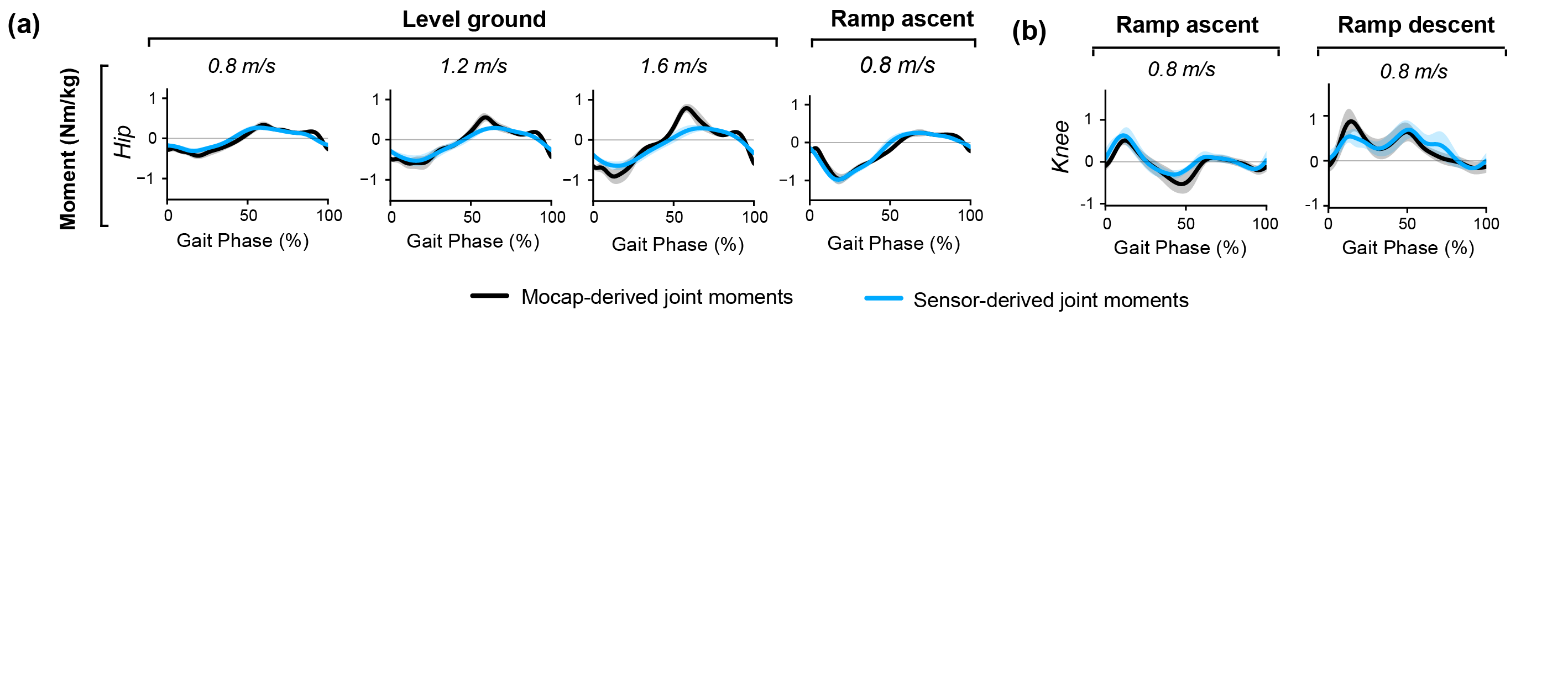
The kinematics-based estimator accurately tracked biological hip moments across level-ground walking speeds and ramp ascent using motor-encoder hip angles and IMU-derived angular velocities (Fig. 2 (a)). Across all four conditions, mean RMSE ranged from $0.12\pm 0.04$ to $0.25\pm 0.08$ Nm/kg, and mean $R^{2}$ ranged from $0.76\pm 0.10$ to $0.84\pm 0.09$.
During level-ground walking, mean RMSE increased with speed from $0.12\pm 0.04$ Nm/kg at 0.8 m/s to $0.25\pm 0.08$ Nm/kg at 1.6 m/s.
Sources and Demonstrations
Figures are reproduced from Hwang et al. See the full paper for experimental details and the project page, when the paper links one, for demonstrations and videos.
Related Papers
A Mode-Unified, Continuous, and Biomimetic Control Strategy of a Robotic Lower Limb Prosthesis
Hanjun Kim, Sixu Zhou, John Shim et al.
Existing biomimetic lower-limb prosthesis controllers are commonly designed for discrete locomotion modes, requiring separate parameterizations for level walking, ramps, and stairs.
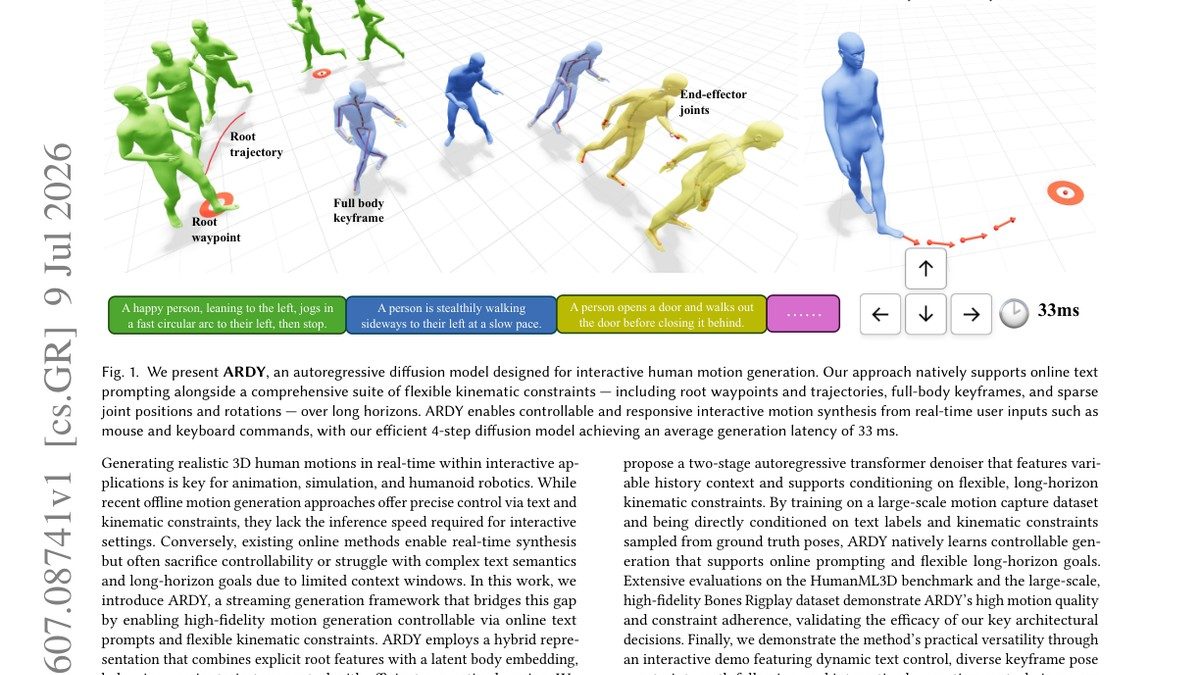
ARDY: Autoregressive Diffusion with Hybrid Representation for Interactive Human Motion Generation
Kaifeng Zhao, Mathis Petrovich, Haotian Zhang et al.
Generating realistic 3D human motions in real-time within interactive applications is key for animation, simulation, and humanoid robotics.
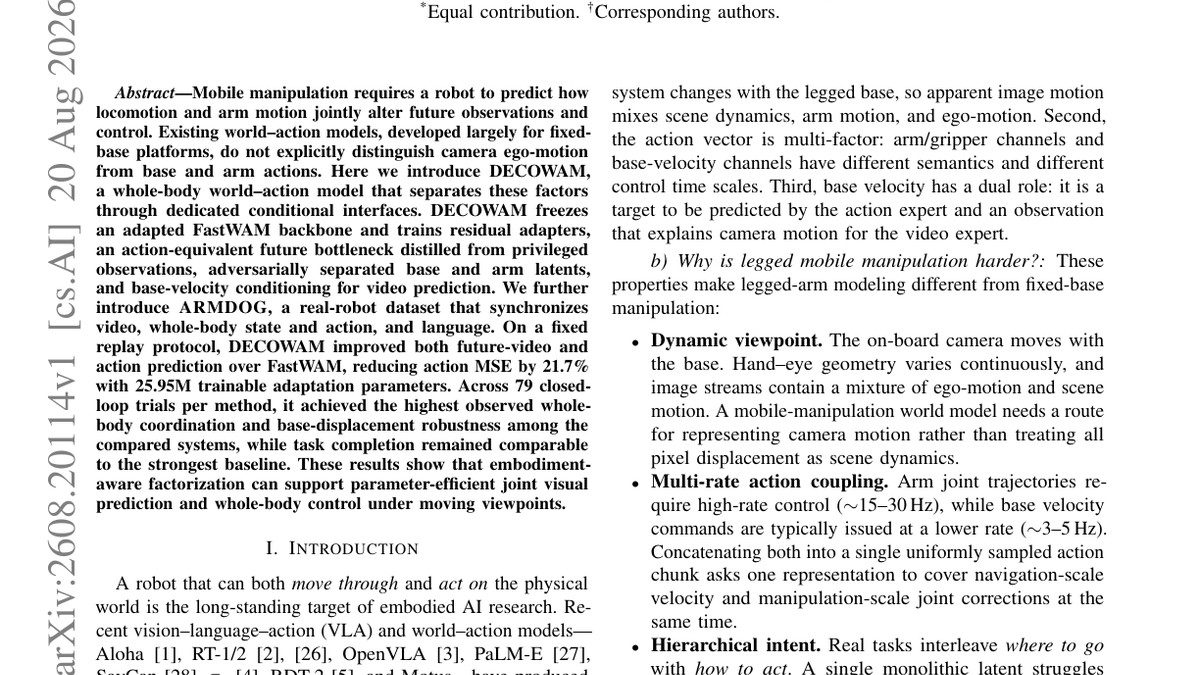
DECOWAM: Decoupled Whole-Body World-Action Model for Legged Mobile Manipulation
Siyuan Ma, Boshi Zhang, Yutian Zhang et al.
Mobile manipulation requires a robot to predict how locomotion and arm motion jointly alter future observations and control. Existing world-action models, developed largely for fixed-base platforms, do not explicitly distinguish camera ego-motion from base and arm actions.
DUET: Decoupled Upper- and Lower-Body Execution for Task-Agnostic Humanoid Loco-Manipulation
Kapalik Khanal, Biswash Khatiwada, Stephen Afrifa et al.
Changing a humanoid robot's manipulation policy should not require retraining the controller that maintains the robot's balance.