
TrackEverything: Long Horizon Dense Tracking via De-Duplicating 3D Scene Representations
Ayush Jain, Sreeharsha Paruchuri, Ishita Gupta, Fan Zhang, Tanner Schmidt, Jakob Engel, Katerina Fragkiadaki, Adam W. Harley · N/A · 2026
Framework
N/A
License
N/A
Stars
N/A
Summary
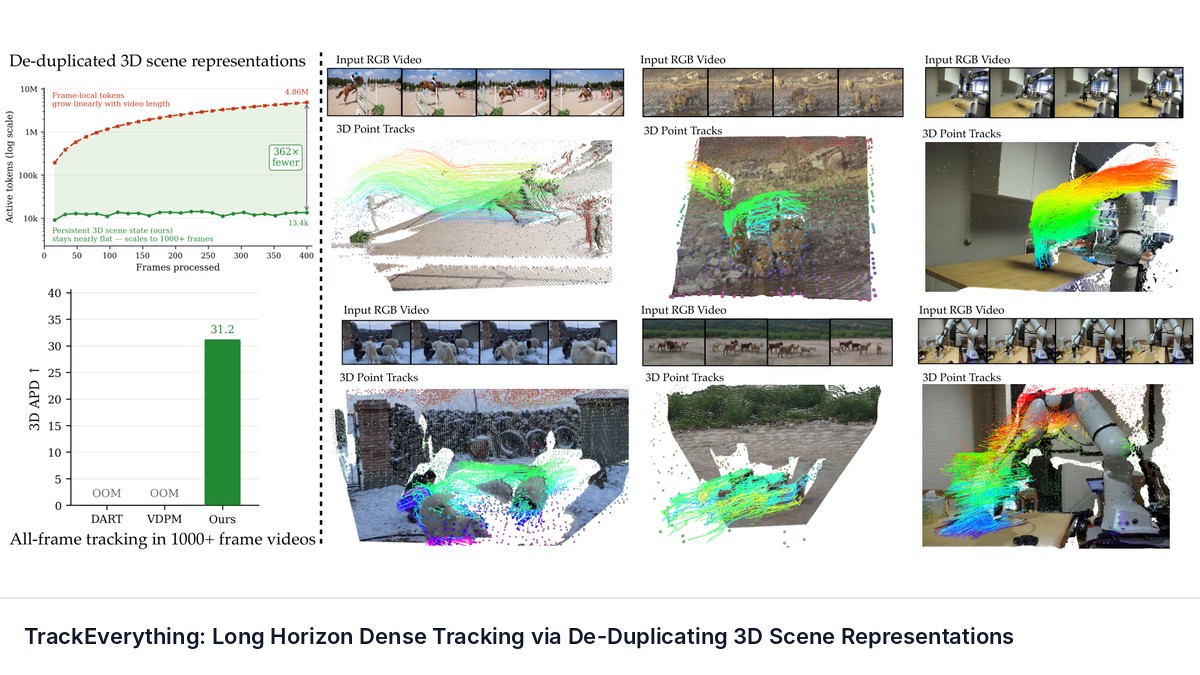
Existing point tracking models face a fundamental tradeoff: they can either track a sparse set of query points over long horizons, or track all points across only short clips.
Abstract Summary
Key Points
- Existing point tracking models face a fundamental tradeoff: they can either track a sparse set of query points over long horizons, or track all points across only short clips.
- We introduce TrackEverything, a 3D point tracker that breaks this trade-off by representing videos as persistent 3D scene tracks in world coordinates.
- Grounded in the insight that videos are 2D projections of an underlying 3D world, TrackEverything decouples model complexity from video duration, allowing it to scale with unique physical scene geometry instead.
- Our approach introduces three key innovations
- First, we employ a voxelization-based de-duplication mechanism at sliding-window boundaries to merge co-located tracks, preventing repeated observations of the same surface from redundantly accumulating.
Method
Given an RGB video $\mathbf{I}\in\mathbb{R}^{T\times H\times W\times 3}$ and per-frame 3D pointmaps $\mathbf{P}\in\mathbb{R}^{T\times H\times W\times 3}$ in world coordinates (obtained from sensors or feedforward reconstruction models such as VGGT-$\Omega$ ( Wang et al., 2026a ) ), our goal is to track all visible scene surfaces over time.
Experiments
We evaluate TrackEverything on standard 3D point tracking benchmarks and compare against both sparse and dense tracking baselines. Beyond benchmarking our own model, we aim to provide a comprehensive evaluation across method paradigms to elucidate the trade-offs in this space. Benchmark.
Sources and Demonstrations
Figures are reproduced from Jain et al. See the full paper for experimental details and the project page, when the paper links one, for demonstrations and videos.
Related Papers
3DThinkVLA: Endowing Vision-Language-Action Models with Latent 3D Priors via 3D-Thinking-Guided Co-training
Jiaxin Shi, Xidong Zhang, Fucai Zhu et al.
We propose a 3D-thinking-guided co-training framework that enables vision-language-action (VLA) models to perform 3D spatial reasoning implicitly during action prediction.
4D Radar Perception Algorithms for Autonomous Driving: A Review
Xumin Wu, Jun Zhou, Jilin Mei et al.
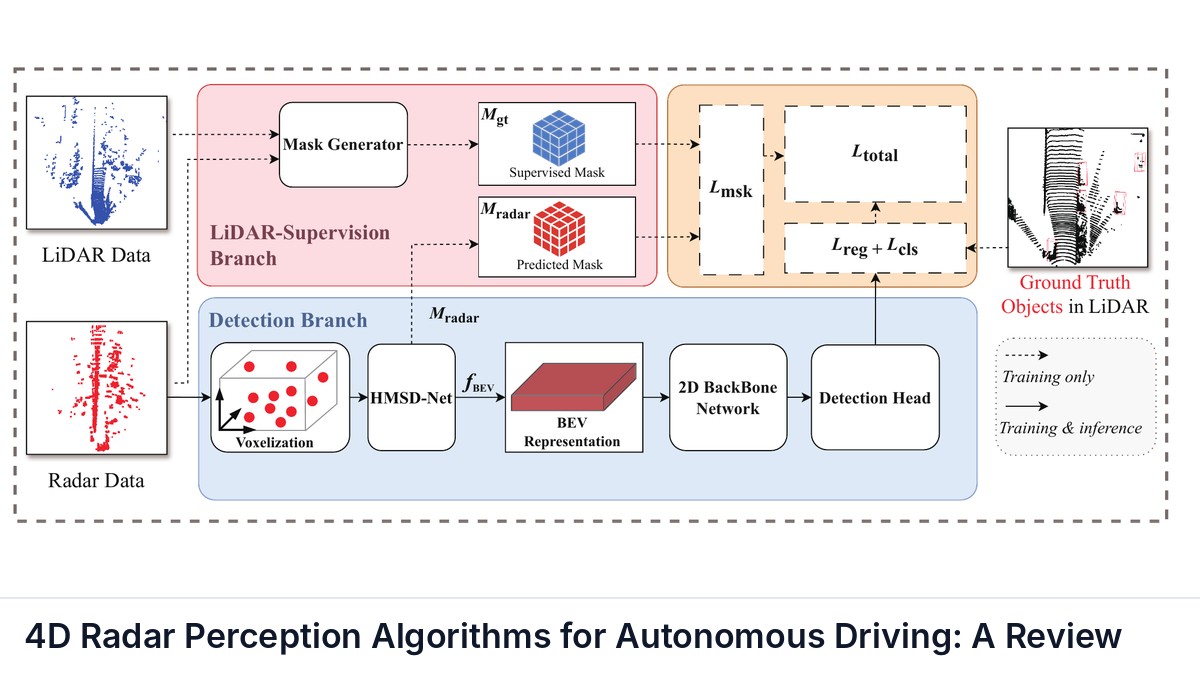
Research on 4D millimeter-wave radar perception algorithms has flourished in recent years, extending from signal processing and object detection to semantic segmentation, motion estimation, occupancy prediction, and dynamic scene reconstruction.
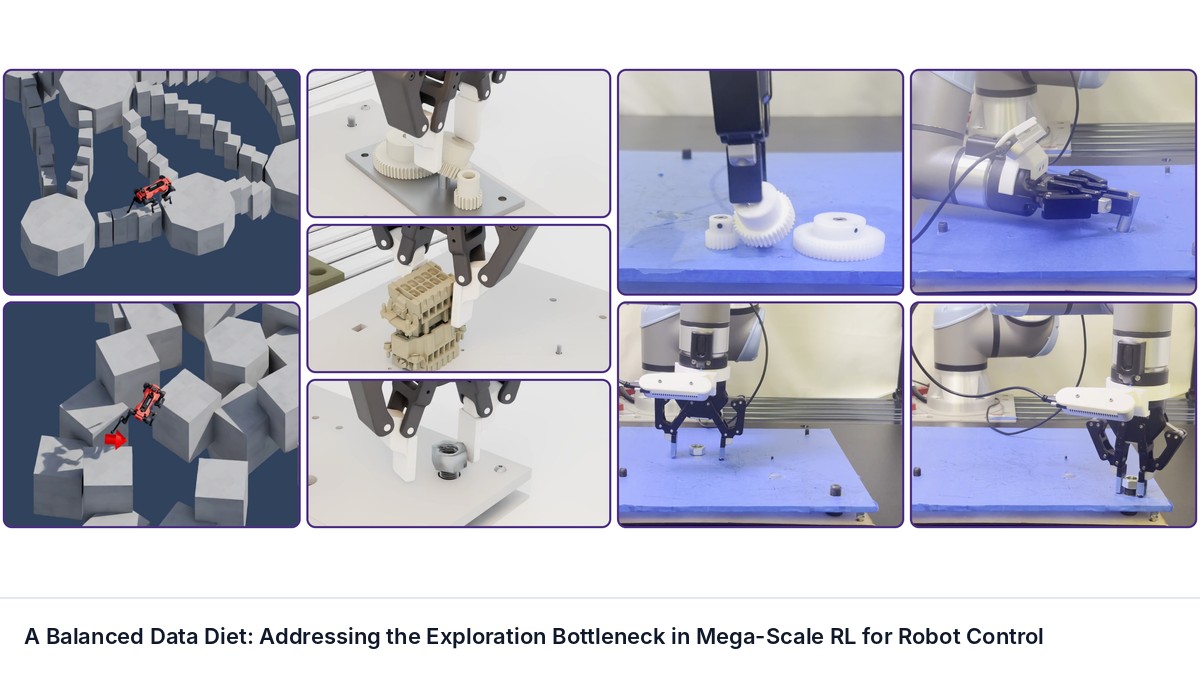
A Balanced Data Diet: Addressing the Exploration Bottleneck in Mega-Scale RL for Robot Control
Octi Zhang, Mateo Guaman Castro, Patrick Yin et al.
General-purpose robots must perform a wide range of tasks from agile locomotion to dexterous manipulation.
A Browser-Native Digital Test Range for Benchmarking 4D Ocean-Glider Planning Algorithms
Edward Holmberg, Elias Ioup, Mahdi Abdelguerfi
Repeated in-situ evaluation of ocean-glider planners requires scarce vehicles, operators, deployment and recovery resources, and ocean conditions that cannot be reset for competing algorithms.