
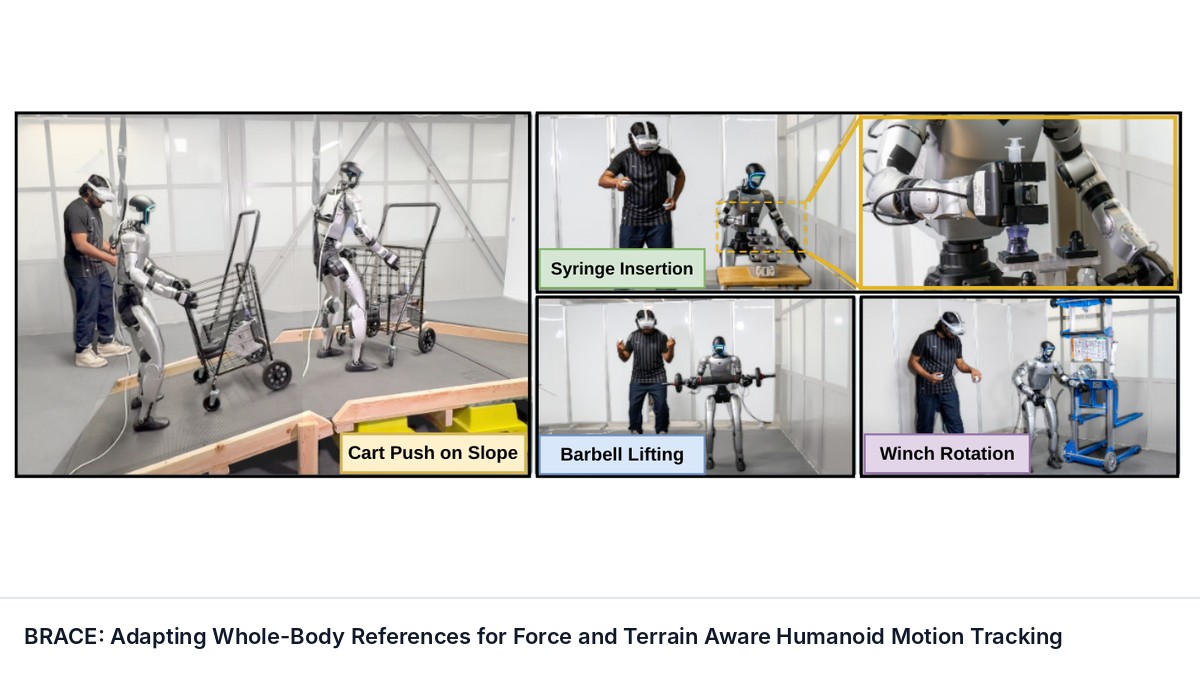
BRACE: Adapting Whole-Body References for Force and Terrain Aware Humanoid Motion Tracking
Sudarshan Harithas, Chen Yu, Juan Borbon, Shubhankar Mondal, Winston Zha, Srinath Sridhar, Dingqi Zhang, Jiuguang Wang · N/A · 2026
Framework
N/A
License
N/A
Stars
N/A
Summary
Whole-body tracking has become the interface through which operators drive humanoid robots, yet the references it consumes are recorded on level ground and carrying nothing, so the tracker is aware of neither the forces the robot must exchange with objects nor the terrain it must stand on.
Abstract Summary
Key Points
- Whole-body tracking has become the interface through which operators drive humanoid robots, yet the references it consumes are recorded on level ground and carrying nothing, so the tracker is aware of neither the forces the robot must exchange with objects nor the terrain it must stand on.
- Existing controllers address one side of this gap: force-capable policies command an end-effector force but prescribe no whole-body pose, while terrain-adaptive trackers treat loads as disturbances to reject rather than wrenches to command.
- We present BRACE, a whole-body tracker that exerts and compensates commanded hand forces from diverse poses while following a flat-ground reference on sloped terrain.
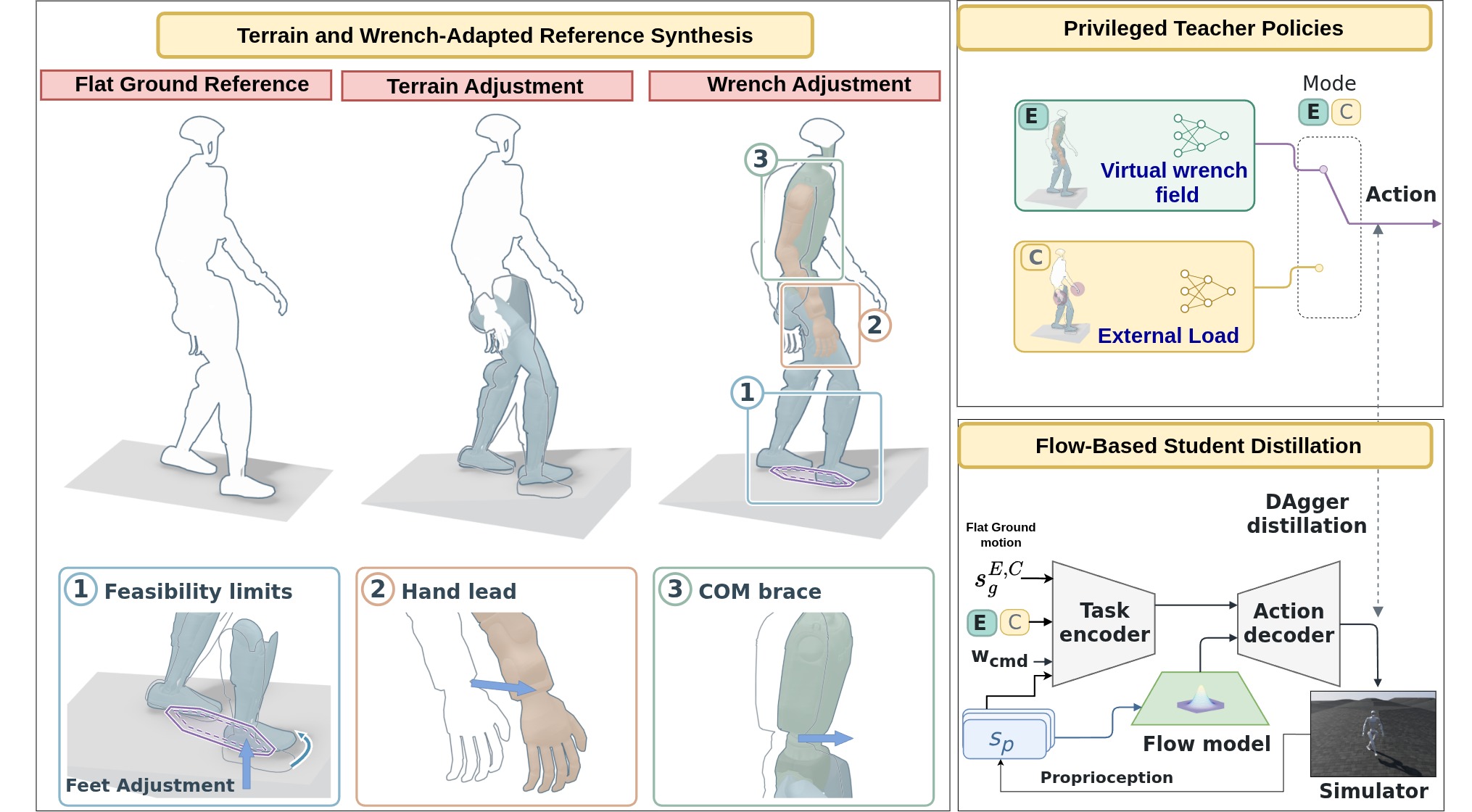
- Rather than leaving the tracker to absorb the load and the slope, BRACE folds both into the reference it follows: terrain conformance lifts footholds and root onto the local surface, and a wrench transformation resolves the hand displacement that produces a force jointly with the center-of-mass and center- of-pressure shifts it induces, bounded by teacher-specific arm-effort limits.
- Separate exertion and compensation teachers are distilled by DAgger into one flow-matching student that runs on proprioception alone, without a height map or measured wrench, so a teleoperator (even in remote locations) can supply a flat- ground trajectory and the robot resolves slope and load onboard.
Method
BRACE enables humanoid whole-body motion tracking under force exertion and force compensation on uneven terrain.
The framework operates given two operator inputs: a flat-ground kinematic reference trajectory $x_{\mathrm{ref}}$ retargeted from human motion capture [ 1 , 2 , 22 , 3 ] , and a set of commanded hand wrenches $w_{\mathrm{cmd}}=\{w_{h}\}_{h}$, where $w_{h}=[F_{h};M_{h}]\in\mathbb{R}^{6}$ specifies the force $F_{h}$ and moment $M_{h}$ for hand $h$.
Experiments & Results
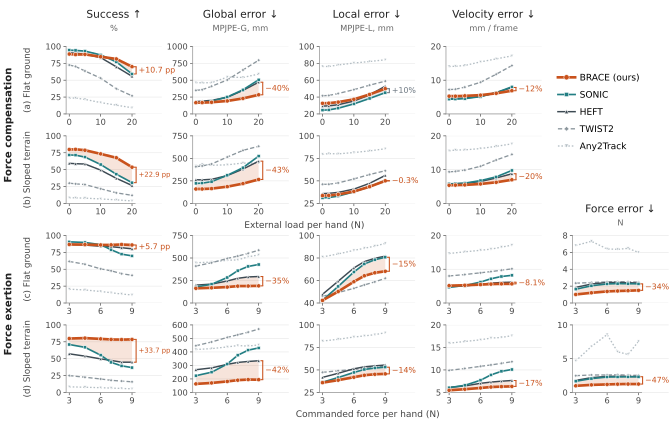
We evaluate the whole-body tracking, force compensation, and force exertion capabilities of BRACE on flat ground and sloped terrain. Fig. 3 summarizes all four settings. Baselines. We compare with the state of the art whole motion trackers SONIC [ 1 ] , TWIST2 [ 2 ] , and Any2Track [ 3 ] , and the payload-oriented HEFT [ 22 ] .
Force-commanding controllers [ 10 , 14 ] are not included: neither accepts a whole-body reference trajectory, so neither admits this protocol without redefining its command interface.
Sources and Demonstrations
Figures are reproduced from Harithas et al. See the full paper for experimental details and the project page, when the paper links one, for demonstrations and videos.
Related Papers

3D Euler-Angle Orientation Control for Two-Ray Fading Mitigation in Maritime Air-to-Sea Communications
Mohammed Bajja, Abdoul Karim A. H. Saliah, Hajar El Hammouti et al.
Maritime Air-to-Sea links are dominated by a line-of-sight ray and a sea-surface reflected ray whose destructive combination produces deep fades. Existing mitigation strategies optimize Unmanned Aerial Vehicle position or trajectory but leave attitude unexploited.
A Balanced Data Diet: Addressing the Exploration Bottleneck in Mega-Scale RL for Robot Control
Octi Zhang, Mateo Guaman Castro, Patrick Yin et al.
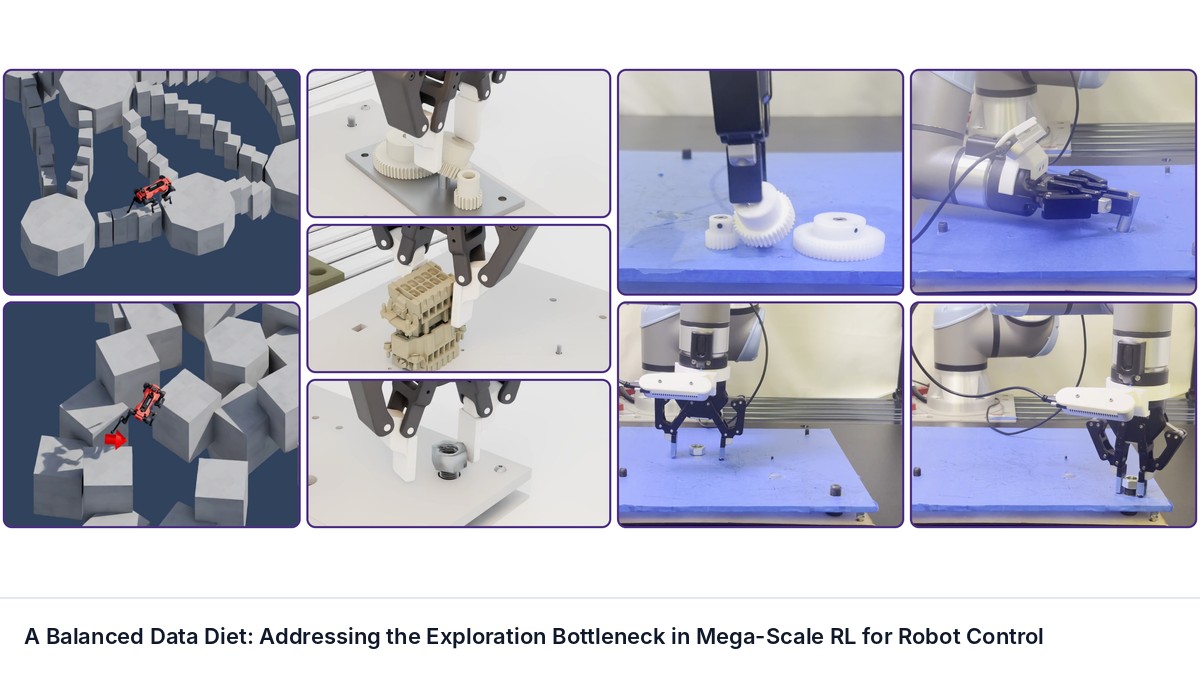
General-purpose robots must perform a wide range of tasks from agile locomotion to dexterous manipulation.
A bioinspired internal model-based online estimator for planar pursuit
Tengyue Liu, Xincheng Li, Sofia Morales Ferreira et al.
Bioinspired feedback controls for pursuit, tracking, and collective motion are often expressed in terms of the relative configuration between interacting agents.
A Biomimetic Gaze Control to Restore Head-Neck Movements
Colin Rubow, Haohan Zhang
Powered neck exoskeletons are developed to restore head-neck motions for those with neck muscle weakness. Current methods using hand-held input devices to control these robotic systems are unintuitive or non-viable for these populations.