
OVMAN: A Task and Benchmark for Open-Vocabulary Motion-Aware Navigation
Dibyendu Ghosh · N/A · 2026
Framework
N/A
License
N/A
Stars
N/A
Summary
Homes change between a robot's visits. Navigation benchmarks pose their goals in the world the agent currently sees, and the two-visit benchmarks that exist score recall or rearrangement rather than navigation.
Abstract Summary
Key Points
- Homes change between a robot's visits
- Navigation benchmarks pose their goals in the world the agent currently sees, and the two-visit benchmarks that exist score recall or rearrangement rather than navigation.
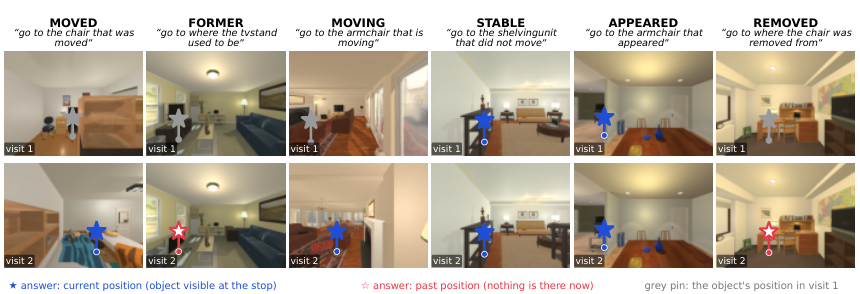
- None of them can express go to the chair that was moved or go to where the vase used to be
- OVMAN is a task in which an agent tours a scene, returns after a scripted change, and must navigate to a goal specified by the change itself.
- Two of its six change relations answer with a place an object has left, where nothing remains to be detected.
Methodology
Let $\mathcal{K}_{v}$ be the set of object instances present in visit $v$, and write the world state as $\mathcal{W}_{v}=\{(k,c_{k},x^{(v)}_{k}):k\in\mathcal{K}_{v}\}$ with identity $k$, category $c_{k}$ and floor-plane position $x^{(v)}_{k}\in\mathbb{R}^{2}$.
An OVMAN episode is a triple $(\mathcal{S},\delta,q)$: a scene $\mathcal{S}$ in state $\mathcal{W}_{1}$, a scripted change $\delta$ that produces $\mathcal{W}_{2}=\delta(\mathcal{W}_{1})$ while the agent is absent, and a query $q=(c,\rho)$ naming a category and a change relation.
Sources and Demonstrations
Figures are reproduced from Ghosh See the full paper for experimental details and the project page, when the paper links one, for demonstrations and videos.
Related Papers
A Browser-Native Digital Test Range for Benchmarking 4D Ocean-Glider Planning Algorithms
Edward Holmberg, Elias Ioup, Mahdi Abdelguerfi
Repeated in-situ evaluation of ocean-glider planners requires scarce vehicles, operators, deployment and recovery resources, and ocean conditions that cannot be reset for competing algorithms.
Aim Short to Reach Far: Your Frozen World Model Can Plan Better Than You Think
Xvyuan Liu, Jianjie Fang, Chen Gao et al.
Planners built on visual world models commonly score each predicted outcome by its distance to the encoded goal image. We show that this target can limit control even with exact dynamics and globally optimal short-horizon search: reaching a goal may require actions that initially move away from it.
Beyond Episodic Evaluation: Memory Architectural Bottlenecks in Sequential Embodied Question Answering
Zikui Cai, Kaushal Janga, Tan Dat Dao et al.
Embodied question answering (EQA) is traditionally evaluated under an episodic formulation, where agents solve each task independently and reset internal state between episodes.
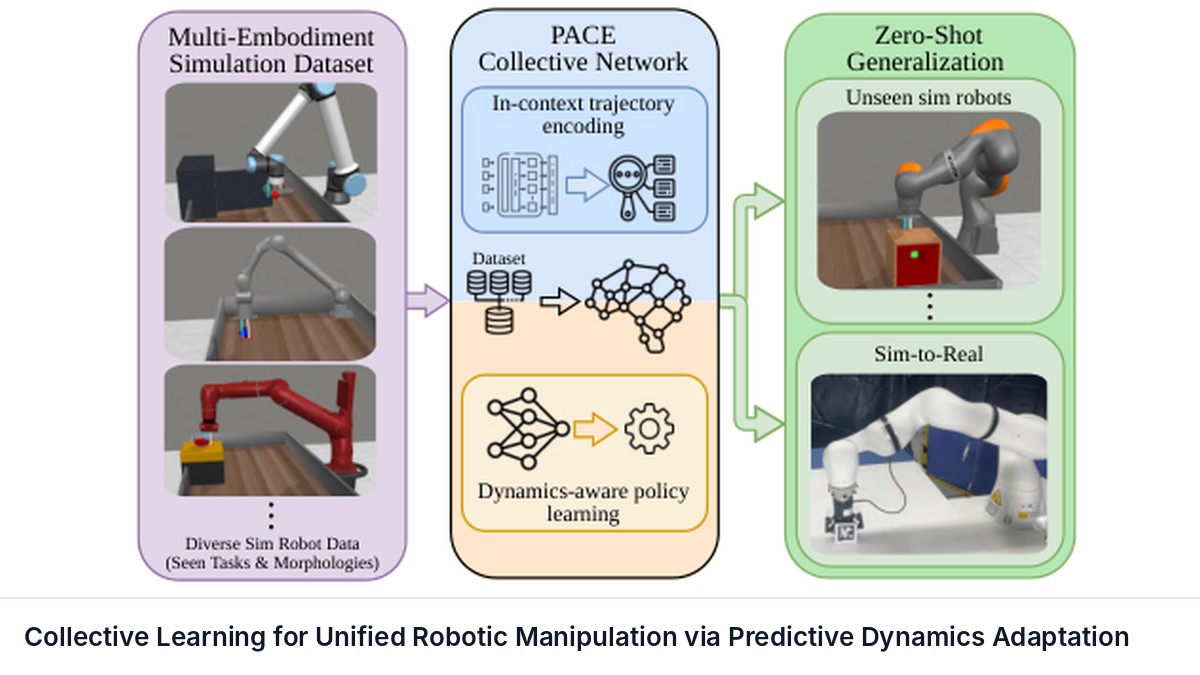
Collective Learning for Unified Robotic Manipulation via Predictive Dynamics Adaptation
Shaocheng Liu, Yuan Meng, Zhenshan Bing et al.
Learning a collective policy for state-based Cartesian manipulation across diverse robotic embodiments presents a fundamental challenge due to embodiment-dependent transition dynamics.