
MAGS-SLAM: Monocular Multi-Agent Gaussian Splatting SLAM for Geometrically and Photometrically Consistent Reconstruction
Zhihao Cao, Qi Shao, Shuhao Zhai, Jing Zhang, Huifang Ma · · 2026
Framework
N/A
License
N/A
Stars
0
Summary
Collaborative photorealistic 3D reconstruction from multiple agents enables rapid large-scale scene capture for virtual production and cooperative multi-robot exploration.
Abstract Summary
Key Points
- Proposes MAGS-SLAM, a novel approach for perception in robotics.
- Addresses key limitations in existing methods through innovative architecture design.
- Demonstrates strong empirical results on standard benchmarks and real-world evaluations.
- Introduces novel training methodology that improves generalization and sample efficiency.
- Provides comprehensive analysis of failure modes and ablation studies.
MAGS-SLAM
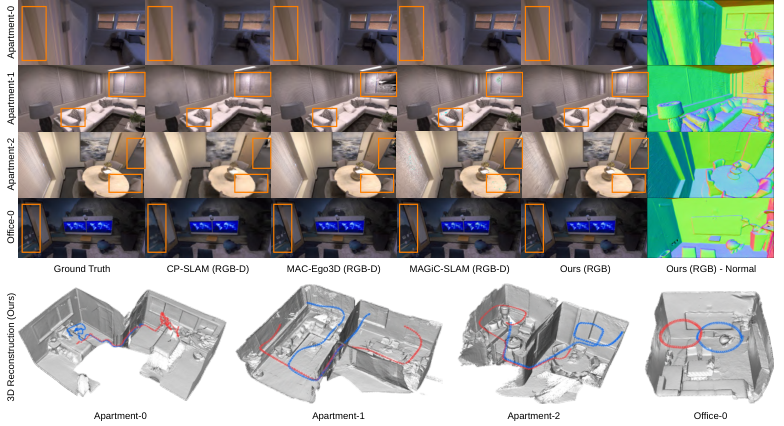
Our MAGS-SLAM framework is a monocular RGB-only multi-agent 3D Gaussian Splatting SLAM system (Fig. 2 ). Each agent runs an independent monocular front-end that builds local Gaussian submaps, while a lightweight coordinator discovers overlaps from compact submap summaries, maintains a global $\mathrm{Sim}(3)$ pose graph, and performs occupancy-aware fusion.
Analysis
As the first RGB-only multi-agent 3D Gaussian Splatting SLAM system based on monocular input, MAGS-SLAM achieves highly competitive trajectory estimation under pure monocular input. Table I reports Absolute Trajectory Error (ATE) RMSE [cm] on the ReplicaMultiagent benchmark.
Despite without depth information, our method matches or outperforms several RGB-D baselines and substantially surpasses previous RGB-only approaches, such as CCM-SLAM [ 13 ] , MultiSLAM-DiffPose [ 46 ] and MA-MASt3R-SLAM [ 48 ] .
Sources and Demonstrations
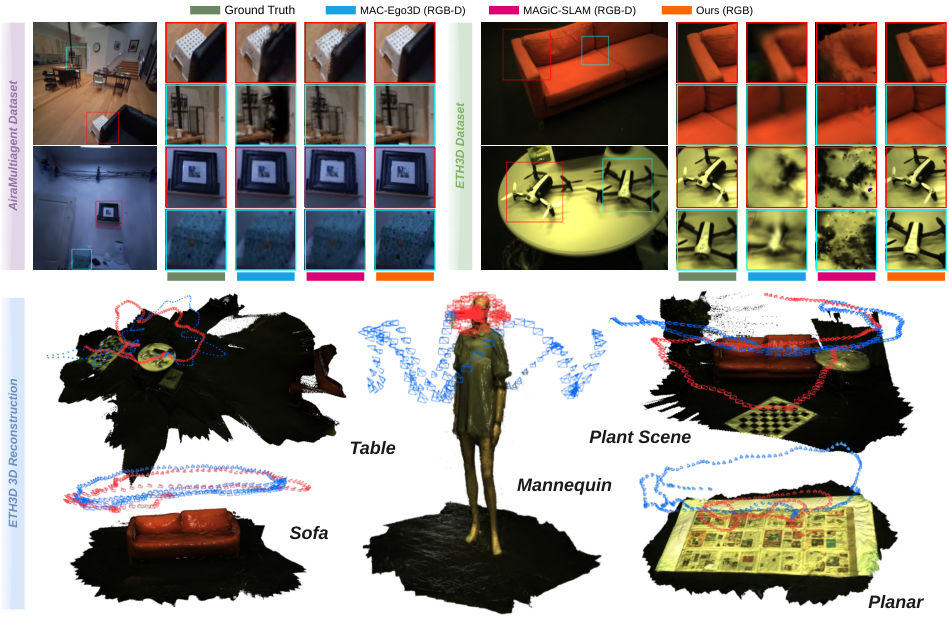
Figures are reproduced from Cao et al. See the full paper for experimental details and the project page, when the paper links one, for demonstrations and videos.
Related Papers
A Heterogeneous Architecture for Robot RL Beyond GPU-Dominant Paradigms
Yufei Jia, Zhanxiang Cao, Mingrui Yu et al.
Simulation-based RL for contemporary robot control is increasingly organized around GPU-resident simulation: physics, rollout collection, and learning are placed on a single GPU-centric execution path
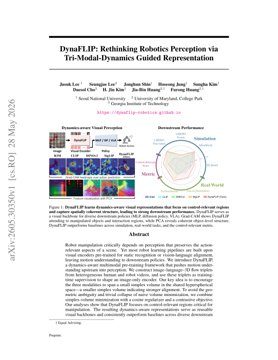
DynaFLIP: Rethinking Robotics Perception via Tri-Modal-Dynamics Guided Representation
Jusuk Lee, Seungjae Lee, Jonghun Shin et al.
Robot manipulation critically depends on perception that preserves the action-relevant aspects of a scene. Yet most robot learning pipelines are built upon visual encoders pre-trained for static recog
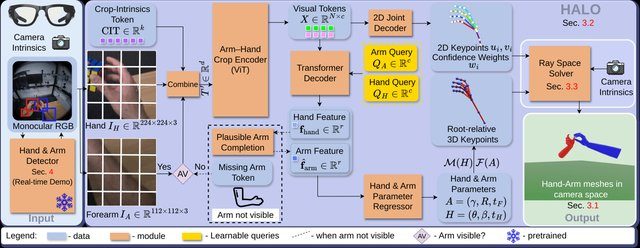
EgoForce: Forearm-Guided Camera-Space 3D Hand Pose from a Monocular Egocentric Camera
Christen Millerdurai, Shaoxiang Wang, Yaxu Xie et al.
Reconstructing the absolute 3D pose and shape of the hands from the user's viewpoint using a single head-mounted camera is crucial for practical egocentric interaction in AR/VR, telepresence, and hand-centric manipulation tasks, where sensing must remain compact and unobtrusive.
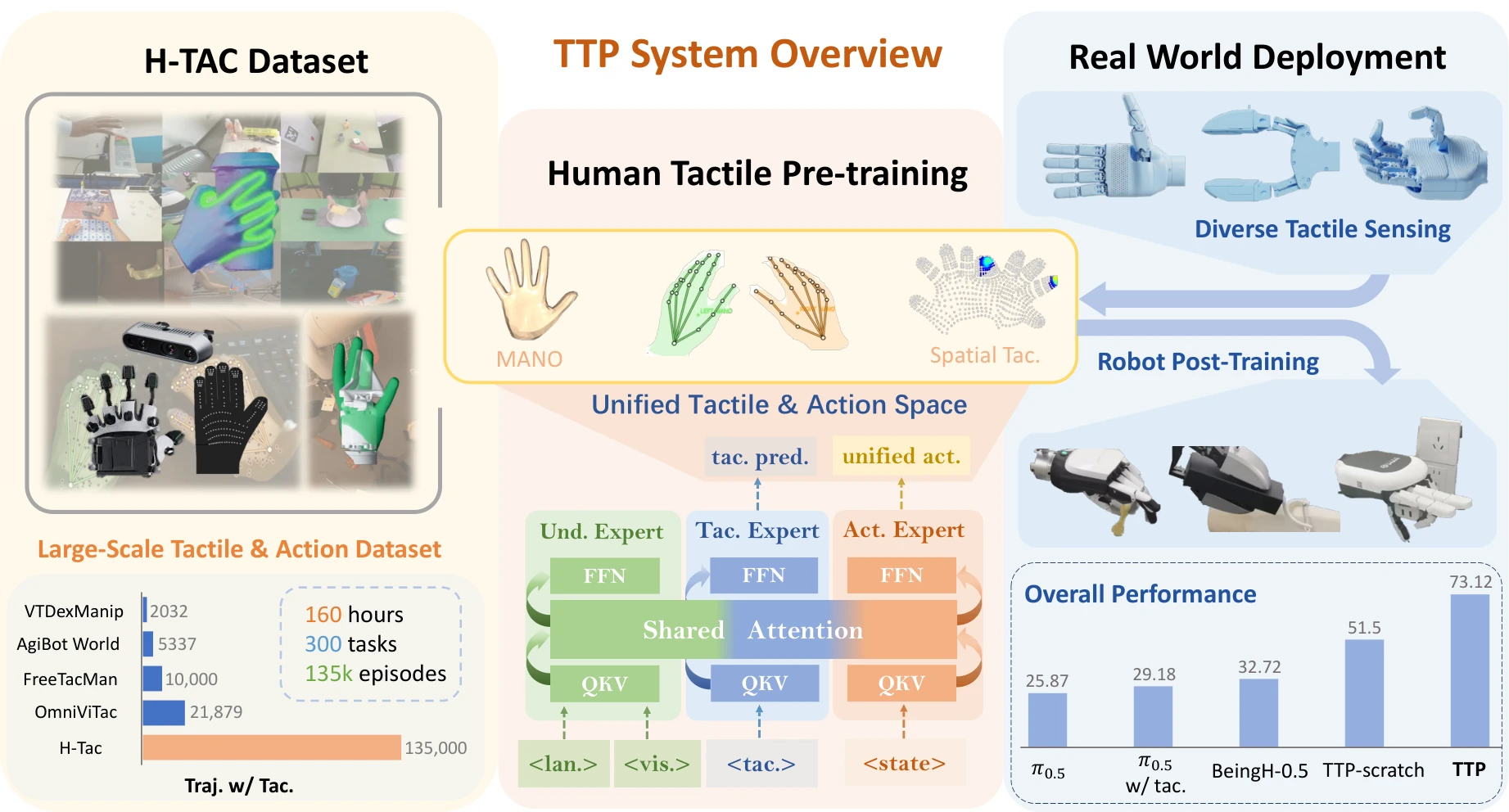
Human-Centric Transferable Tactile Pre-Training for Dexterous Robotic Manipulation
Chi Zhang, Penglin Cai, Ziheng Xi et al.
TTP transfers tactile experience from human demonstrations into robot policies for contact-sensitive manipulation.