
A Heterogeneous Architecture for Robot RL Beyond GPU-Dominant Paradigms
Yufei Jia, Zhanxiang Cao, Mingrui Yu, Heng Zhang, Shenyu Chen, Dixuan Jiang, Meng Li, Xiaofan Li, Yiyang Liu, Junzhe Wu, Zheng Li, XiLin Fang, Tingyu Cui, Shengcheng Fu, Haoyang Li · · 2026
Framework
N/A
License
N/A
Stars
0
Summary
Simulation-based RL for contemporary robot control is increasingly organized around GPU-resident simulation: physics, rollout collection, and learning are placed on a single GPU-centric execution path
Abstract Summary
Key Points
- Heterogeneous CPU-simulation / GPU-learning architecture (UniLab) for robot RL.
- Decouples CPU-parallel simulation from GPU policy updates via unified runtime.
- Supports PPO, SAC, FlashSAC, TD3, APPO on MuJoCoUni and MotrixSim backends.
- Improves end-to-end training efficiency by 3-10x on same hardware.
- Cross-platform support: macOS, AMD ROCm, Intel XPU, reducing CUDA dependency.
UniLab Architecture
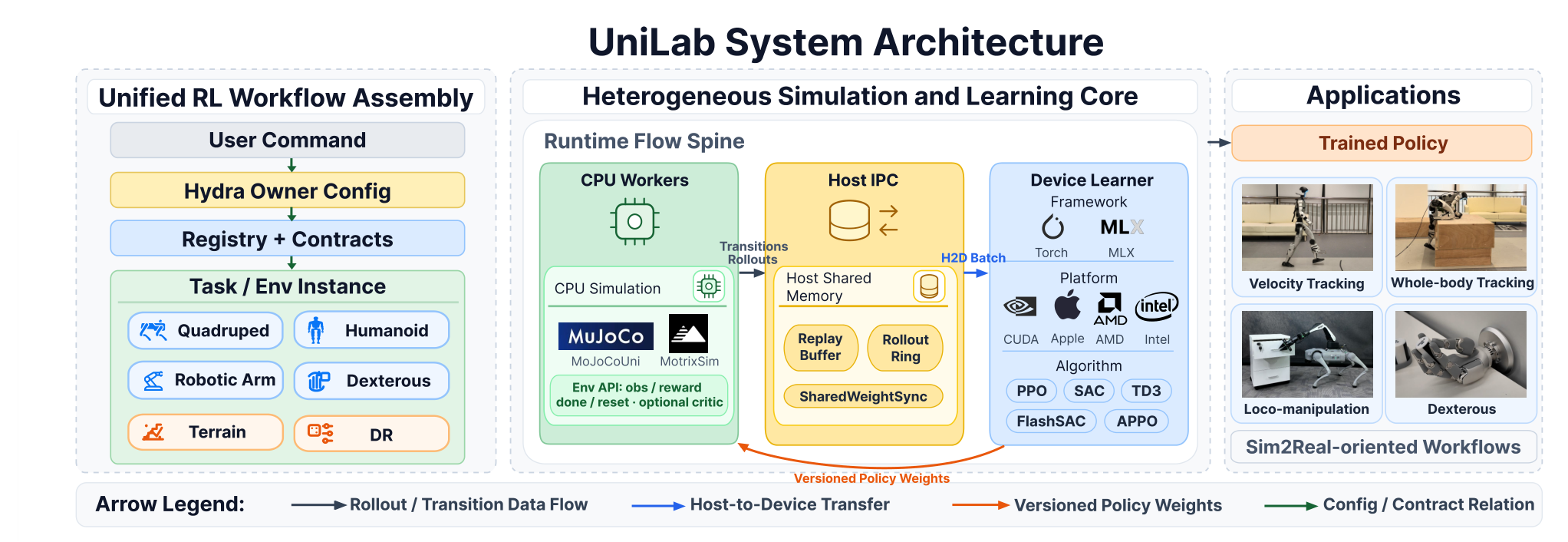
This section describes UniLab as an end-to-end training loop that combines CPU-side batched rigid-body simulation, GPU-side policy and value learning, and a unified runtime for coordinating the data path between them. The design objective is to improve the efficiency of the full simulation-learning loop without requiring GPU-resident simulation.
UniLab follows hardware roles: CPUs generate large-scale simulation data, GPUs perform dense learning updates, and the runtime minimizes coordination cost. This objective induces three requirements.
Experiments
We evaluate three questions: whether CPU simulation provides enough throughput, whether heterogeneous CPU-simulation / GPU-learning improves end-to-end wall-clock efficiency, and whether the result is robust across task families and algorithms. The primary metric is end-to-end training efficiency; throughput measurements explain the mechanism.
Controlled comparisons use the same default Linux hardware: one NVIDIA RTX 4090 GPU, one AMD Ryzen 9 9950X3D CPU, and 64 GB of 4800 MT/s memory.
Sources and Demonstrations
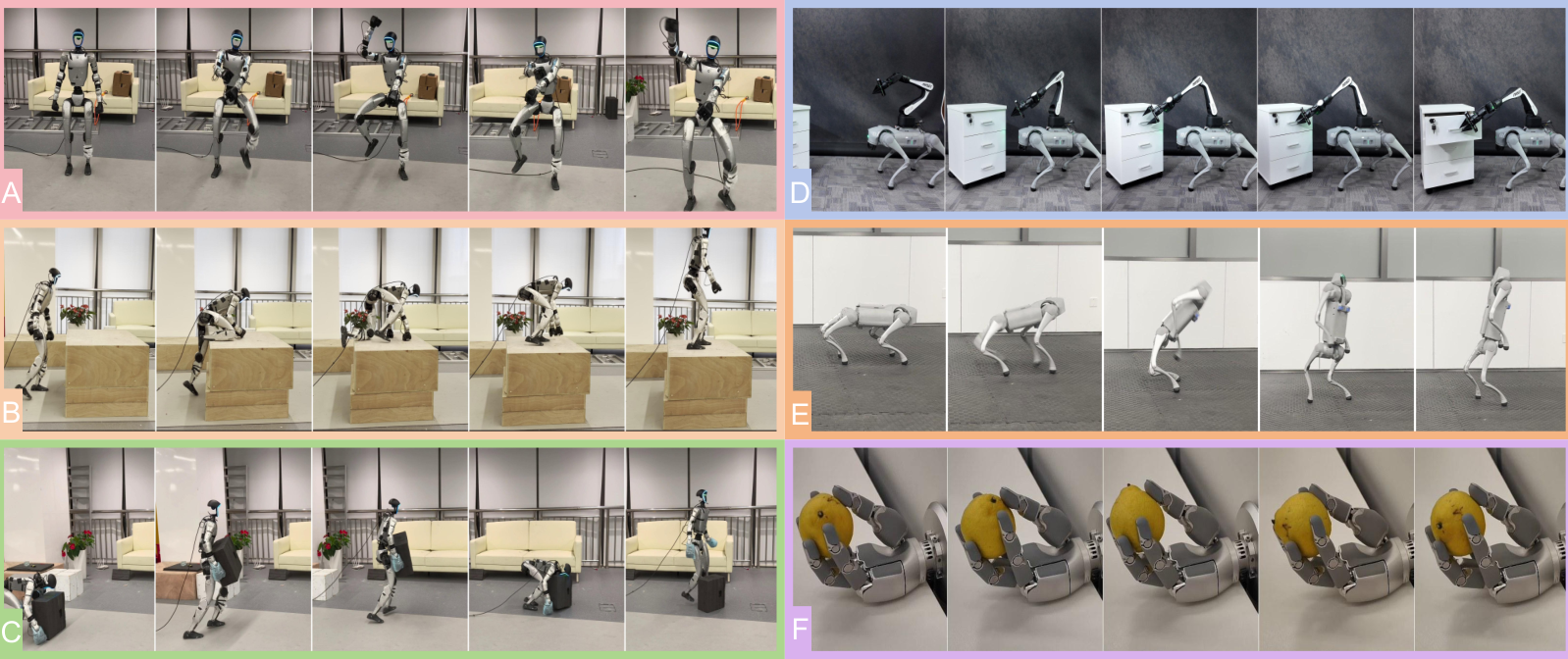
Figures are reproduced from Jia et al. See the full paper for experimental details and the project page, when the paper links one, for demonstrations and videos.
Related Papers
A Balanced Data Diet: Addressing the Exploration Bottleneck in Mega-Scale RL for Robot Control
Octi Zhang, Mateo Guaman Castro, Patrick Yin et al.
General-purpose robots must perform a wide range of tasks from agile locomotion to dexterous manipulation.
A Mode-Unified, Continuous, and Biomimetic Control Strategy of a Robotic Lower Limb Prosthesis
Hanjun Kim, Sixu Zhou, John Shim et al.
Existing biomimetic lower-limb prosthesis controllers are commonly designed for discrete locomotion modes, requiring separate parameterizations for level walking, ramps, and stairs.
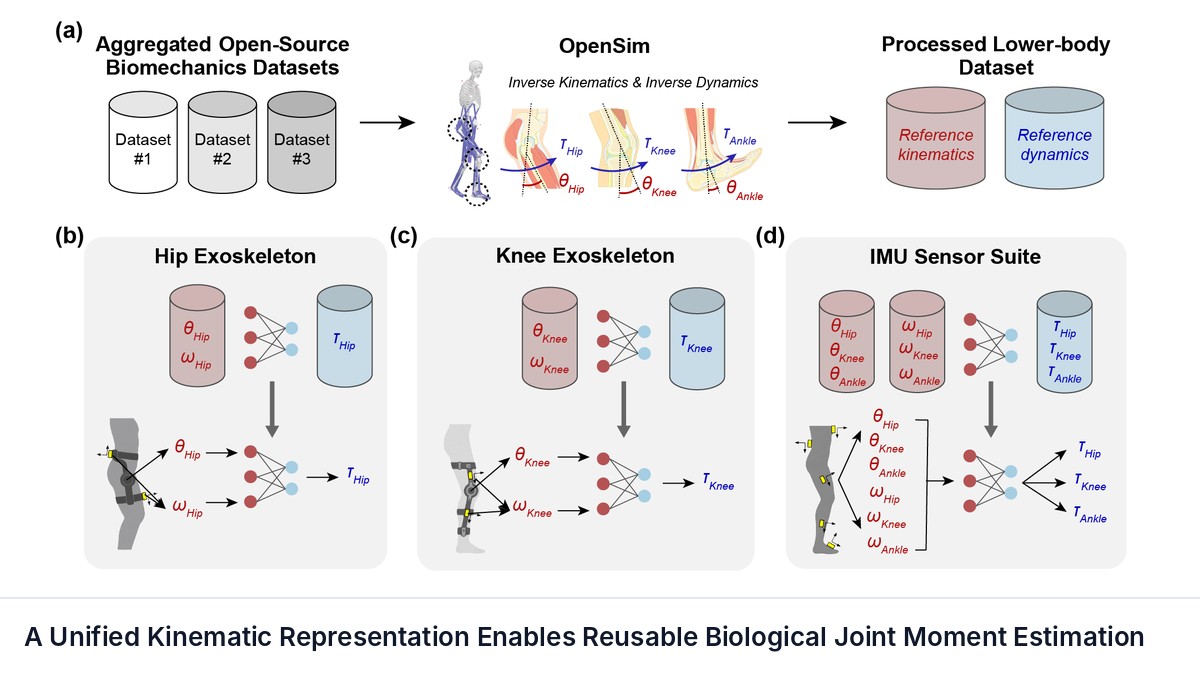
A Unified Kinematic Representation Enables Reusable Biological Joint Moment Estimation
Jinwoo Hwang, Ilseung Park, Changseob Song et al.
Objective: Data-driven models that estimate physiological states, particularly biological joint moments, are widely used in exoskeleton control.
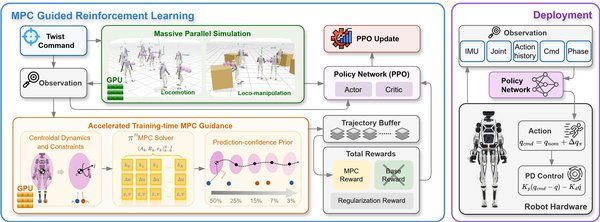
Accelerating and Scaling MPC-Guided Reinforcement Learning for Humanoid Locomotion and Manipulation
Junheng Li, Liang Wu, Sergio A. Esteban et al.
In humanoid motion control, model predictive control (MPC) offers physically grounded prediction and constraint handling, while reinforcement learning (RL) enables robust whole-body skills through large-scale simulation. However, using MPC inside RL often requires time-consuming problem construction or excessive training overhead, making such frameworks difficult to justify in practice. This work studies efficient training-time MPC guidance for humanoid locomotion and manipulation, termed MPC-RL. We introduce a centroidal-dynamics MPC reward formulation that leverages guidance from MPC trajectories in training time. To make this practical in massively parallel RL, we develop π^nMPC, a parallel-in-horizon and construction-free batched GPU MPC solver that operates directly on time-varying dynamics to avoid high memory usage and pre-compilation. Through a variety of comparative studies and hardware validations, we have found that MPC-RL achieves superior performance in locomotion and manipulation skills.