

X-Imitator: Spatial-Aware Imitation Learning via Bidirectional Action-Pose Interaction
Kai Xiong, Hongjie Fang, Lixin Yang, Cewu Lu · · 2026
Summary
Effectively handling the interplay between spatial perception and action generation remains a critical bottleneck in robotic manipulation.
Abstract Summary
Key Points
- Introduces X-Imitator, advancing imitation-learning research.
- Detailed evaluation demonstrates effectiveness on benchmarks and real-world scenarios.
- Provides insights into methodology and architectural choices.
Method
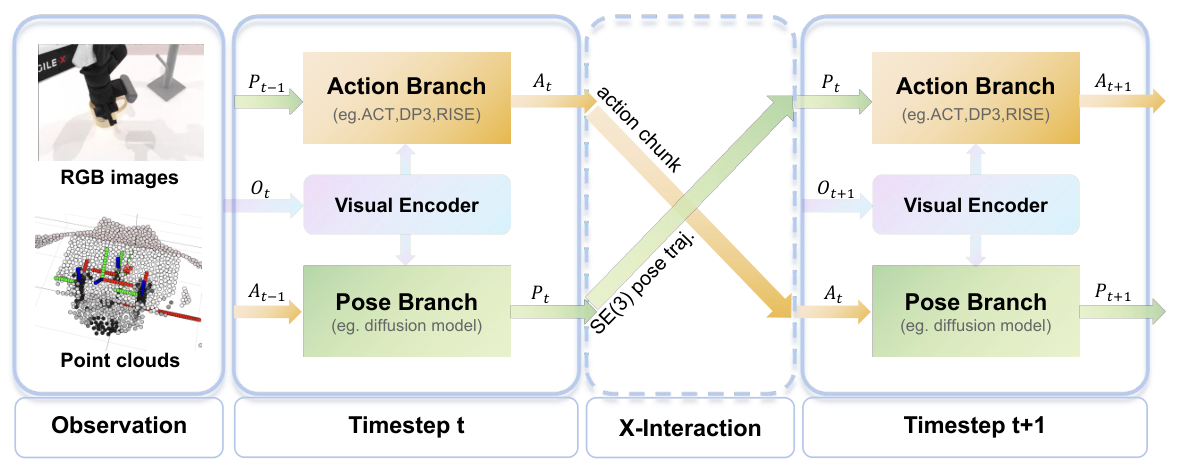
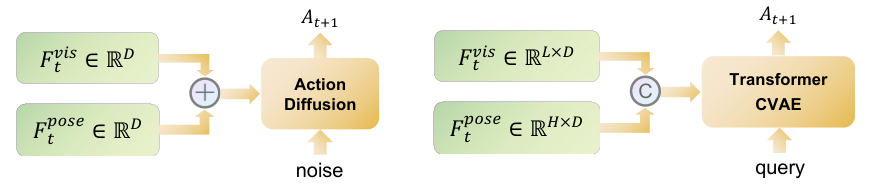
In this section, we formally present X-Imitator, a spatial-aware imitation learning framework with a bidirectional action-pose interaction mechanism, designed to explicitly incorporate spatial information into modern visuomotor policies. Let $\mathbf{O}_{t}$ denote the visual observation at time step $t$, which typically includes RGB-D images and robot proprioception.
Simulation Experiments
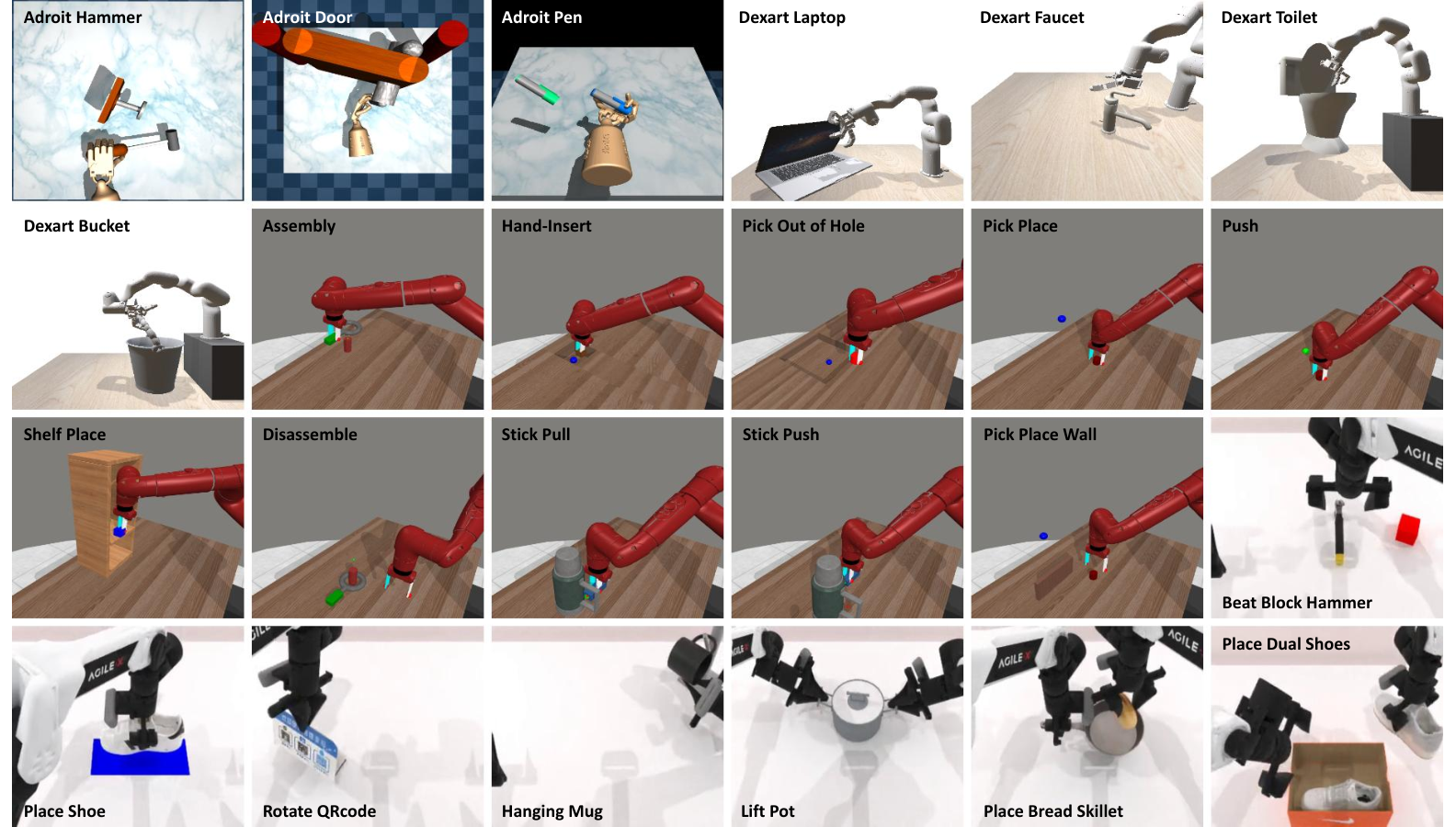
In this section, we empirically evaluate X-Imitator across diverse tasks in several simulation benchmarks. We aim to answer the following research questions: Can X-Imitator improve the performance of various visuomotor policies by leveraging bidirectional action-pose interaction? Does the bidirectional action-pose interaction mechanism lead to better performance than other interactive or non-interactive alternatives?
How does the conditional trajectory length in bidirectional action-pose interaction influence the policy performance? To comprehe...
Real-World Experiments
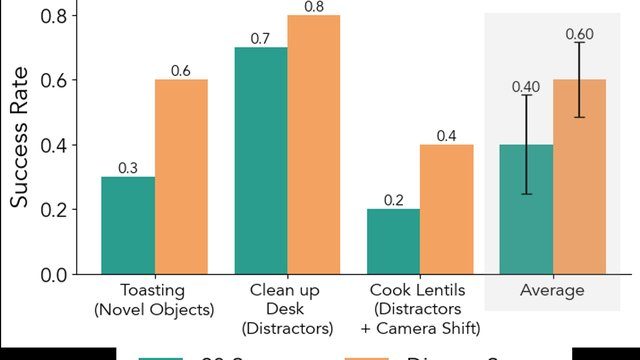
In this section, we aim to answer the following research question. Does the advantage of X-Imitator demonstrated in simulation environments translate to real-world scenarios? Our robot platform consists of a Flexiv Rizon 4 robotic arm with a Dahuan AG-95 gripper. A global Intel RealSense D435 RGB-D camera is positioned in front of the robot, perceiving the robot workspace during manipulation.
Following [ 18 ] , we use sigma 7 haptic device to teleoperate the robot to gather 50 expert demonstrations for each task. As illustrated in Fig.
Sources and Demonstrations
Figures are reproduced from Xiong et al. See the full paper for experimental details and the project page, when the paper links one, for demonstrations and videos.
Related Papers
DROID: A Large-Scale In-the-Wild Robot Manipulation Dataset
Alexander Khazatsky, Karl Pertsch, Suraj Nair et al.
A 350-hour dataset of diverse real-world robot manipulation across 22 robots in 71 scenes, designed to train scalable and generalist imitation learning policies.
LeRobot: A Library for Real-World Robot Learning
Remi Cadene, Simon Alibert, Alexander Soare et al.
Hugging Face's LeRobot is an open-source PyTorch framework providing pretrained models, datasets, and training scripts for imitation and reinforcement learning on real robots, lowering the entry barrier to robot learning.
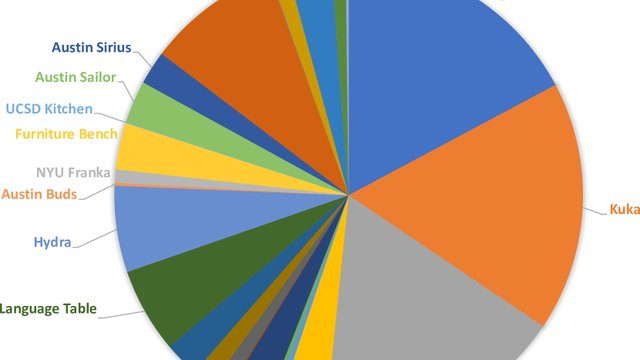
Octo: An Open-Source Generalist Robot Policy
Dibya Ghosh, Homer Walke, Karl Pertsch et al.
Octo is a large open-source transformer-based generalist robot policy trained on 800k trajectories, supporting language-conditioned and goal-image-conditioned control across 9 robotic platforms with efficient fine-tuning on consumer GPUs.
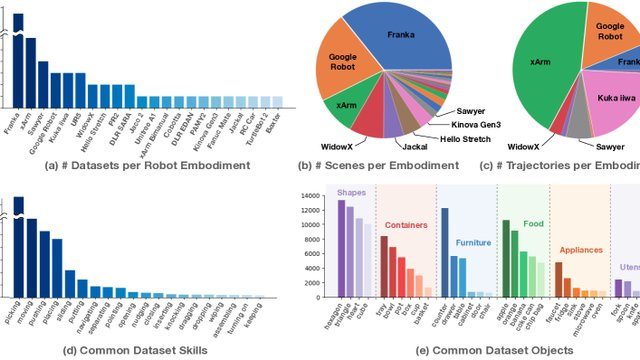
Open X-Embodiment: Robotic Learning Datasets and RT-X Models
Open X-Embodiment Collaboration
The largest collaborative robot learning dataset ever assembled, spanning 22 robots from 21 institutions, enabling training of generalist RT-X policies that exhibit positive cross-embodiment transfer.