
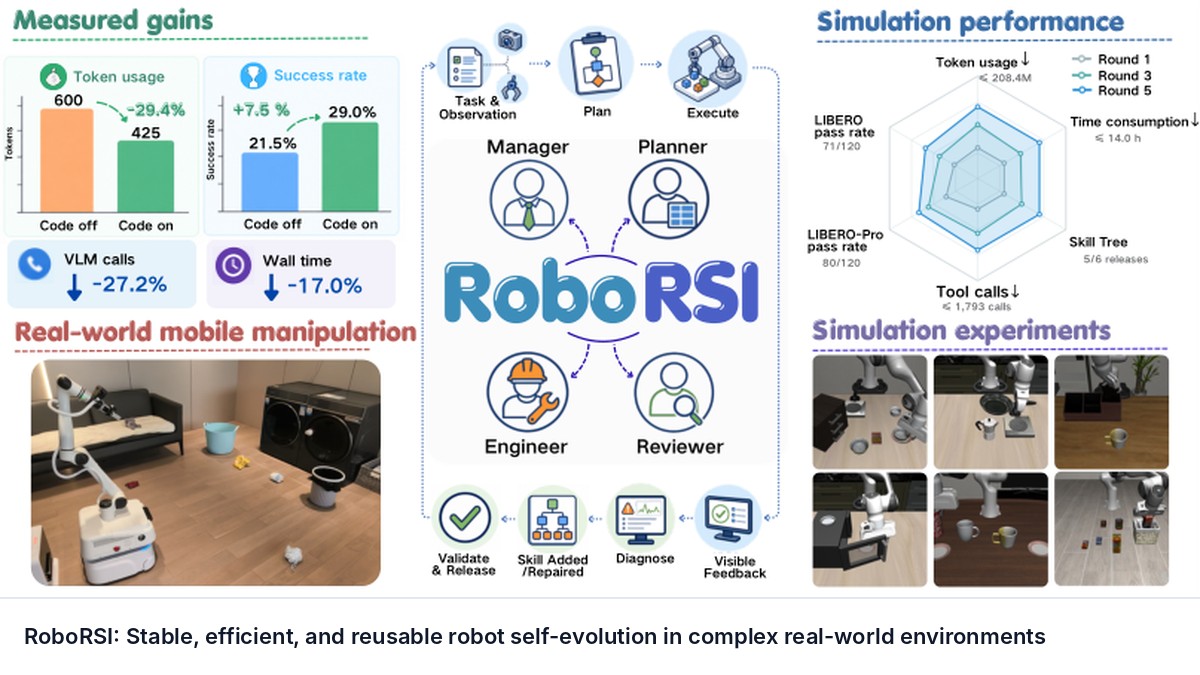
RoboRSI: Stable, efficient, and reusable robot self-evolution in complex real-world environments
Zimo Wen, Yijin Chen, Yuxuan Cao, Wendi Chen, Yanwen Zou, Wenye Yu, Fuhang Kuang, Han Xue, Jun Lv, Chuan Wen, Cewu Lu · N/A · 2026
Framework
N/A
License
N/A
Stars
N/A
Summary
A generalist robot should not only perform diverse tasks but also improve through experience, turning what it learns during execution into capabilities that later tasks can reuse.
Abstract Summary
Key Points
- A generalist robot should not only perform diverse tasks but also improve through experience, turning what it learns during execution into capabilities that later tasks can reuse.
- Robot agents that act through code can already repair programs from execution feedback, yet it remains a central challenge to organize this experience around the task structure that gives it meaning, so that each repair is attributed to the responsible capability, supported by execution evidence, and validated before it is reused.
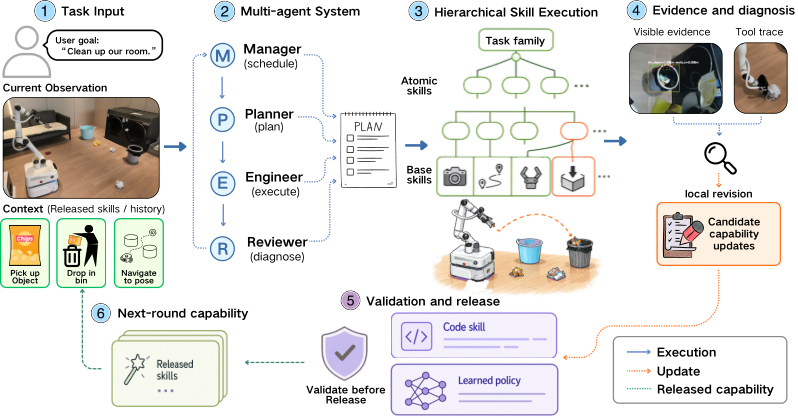
- We introduce RoboRSI, a robot self-improvement system built on Top-Down Skill Refinement (TSR)
- TSR decomposes tasks into compound, atomic, and base skills with scoped responsibilities and explicit input--output contracts, attributes each execution outcome to the responsible branch, and confines revision to that branch.
- Building upon this structure, a Manager, Planner, Engineer, and Reviewer coordinate planning, execution, diagnosis, and the validated release of new skills, while people steer the process through objectives and corrections; stable skill sequences are further consolidated into reusable compound skills.
Method
Consider a coding agent connected directly to robot tools and asked to improve a household cleanup task in a complex real-world home over many runs.
The context fills with records of earlier runs; a failure observed late in a sequence is patched where it appears, for example by adding retries to the release step, although it originated in perception or navigation; and because the objective is implicit in the latest prompt, successive edits optimize for the latest scene.
Experiment
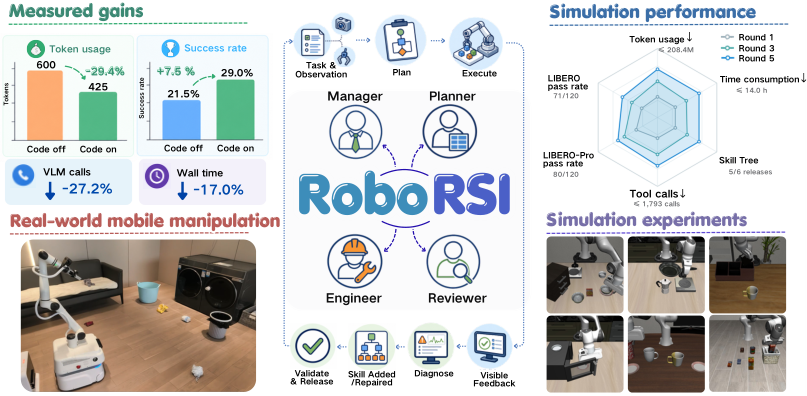
We report physical deployment and simulation results, then compare individual episodes and summarize the ablations. We study household floor cleanup with a WheelSingleArm M1 mobile manipulator. The robot searches for objects, approaches and grasps them, and transports them to designated receptacles. The case study covers 104 physical development runs with 24 hours of cumulative operation.
Before each run, the scene is restored to a common base layout, while the objects and receptacles are partially randomized; the navigation map remains fixed.
Sources and Demonstrations
Figures are reproduced from Wen et al. See the full paper for experimental details and the project page, when the paper links one, for demonstrations and videos.
Related Papers
A Low-Cost, Open Platform for End-to-End Autonomous Driving on a Miniature Ackermann Vehicle
Gustavo Claudio Karl Couto, Eric Aislan Antonelo, Gabriel George Zipperer
This paper presents a low-cost, open experimental platform for research in end-to-end autonomous driving with miniature Ackermann vehicles.
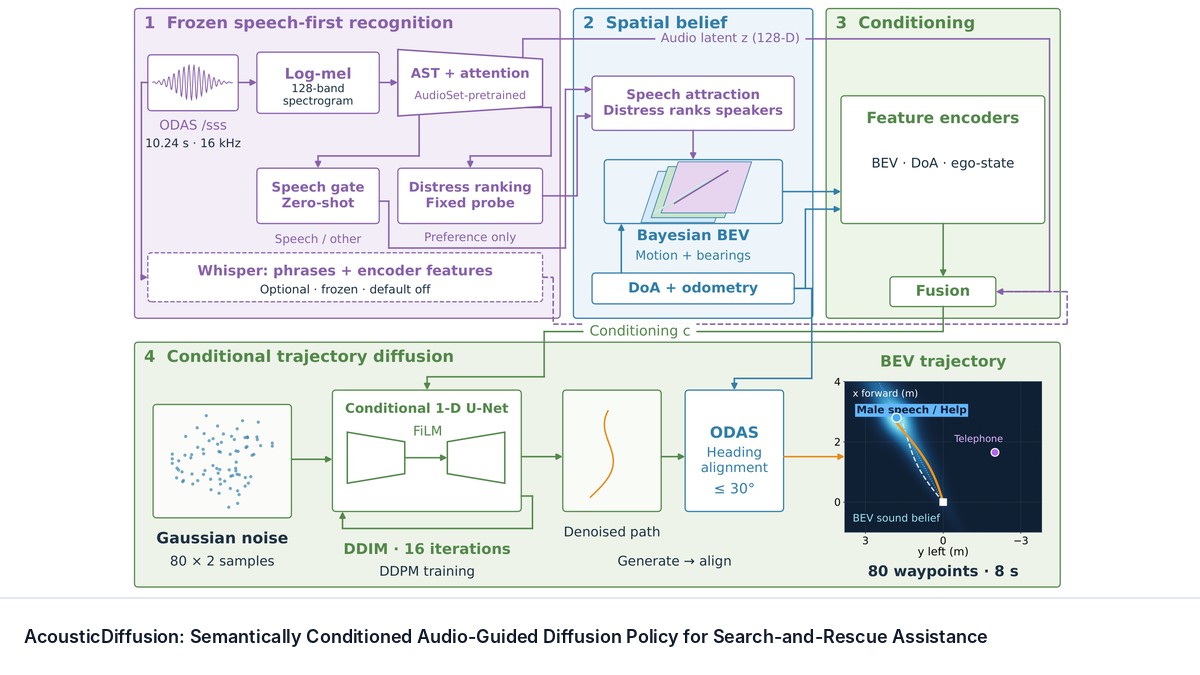
AcousticDiffusion: Semantically Conditioned Audio-Guided Diffusion Policy for Search-and-Rescue Assistance
Iana Zhura, Didar Seyidov, Dmitrii Plotnikov et al.
Navigating toward human callers is an important capability for rescue robots operating where visual contact is degraded or occluded. We present AcousticDiffusion, a semantically conditioned, audio-guided diffusion policy for human-directed navigation.
Aim Short to Reach Far: Your Frozen World Model Can Plan Better Than You Think
Xvyuan Liu, Jianjie Fang, Chen Gao et al.
Planners built on visual world models commonly score each predicted outcome by its distance to the encoded goal image. We show that this target can limit control even with exact dynamics and globally optimal short-horizon search: reaching a goal may require actions that initially move away from it.
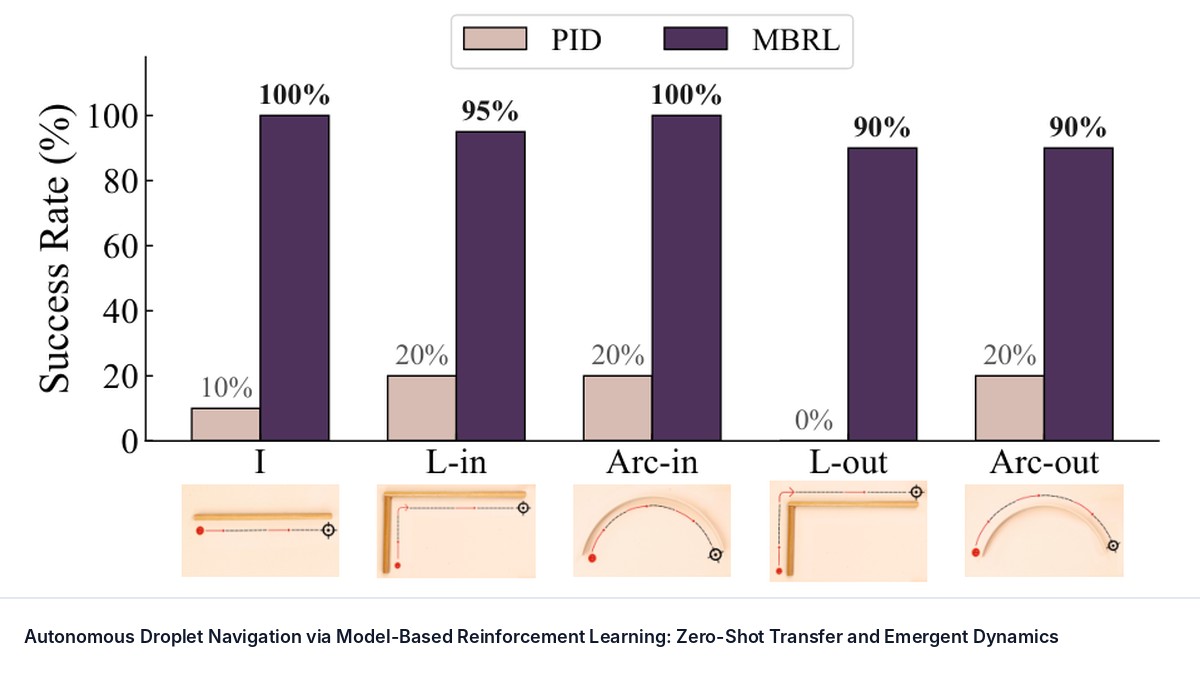
Autonomous Droplet Navigation via Model-Based Reinforcement Learning: Zero-Shot Transfer and Emergent Dynamics
Rajneesh Anand, Mayuresh V. Kothare
Self-driving laboratories (SDLs) are transforming chemical and materials discovery through closed-loop automation, yet automated infrastructure for physical manipulation of soft, deformable matter remains beyond current robotic platforms.