
AcousticDiffusion: Semantically Conditioned Audio-Guided Diffusion Policy for Search-and-Rescue Assistance
Iana Zhura, Didar Seyidov, Dmitrii Plotnikov, Hajira Amjad, Miguel Altamirano Cabrera, Dzmitry Tsetserukou · N/A · 2026
Framework
N/A
License
N/A
Stars
N/A
Summary
Navigating toward human callers is an important capability for rescue robots operating where visual contact is degraded or occluded. We present AcousticDiffusion, a semantically conditioned, audio-guided diffusion policy for human-directed navigation.
Abstract Summary
Key Points
- Navigating toward human callers is an important capability for rescue robots operating where visual contact is degraded or occluded.
- We present AcousticDiffusion, a semantically conditioned, audio-guided diffusion policy for human-directed navigation.
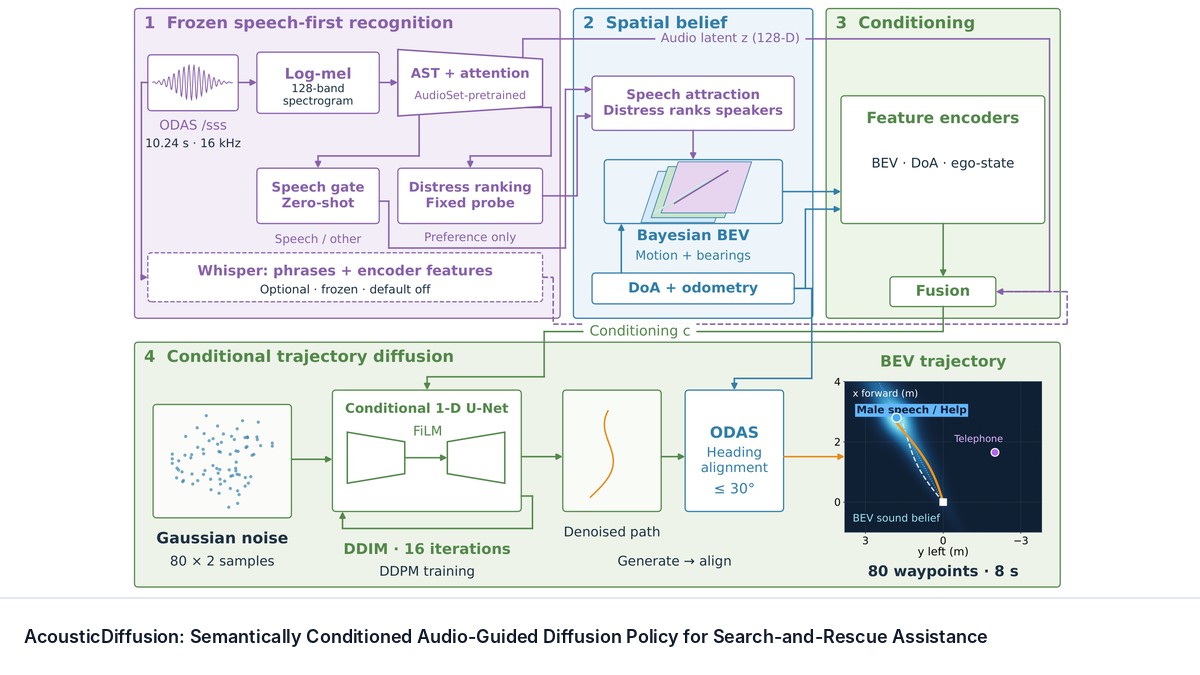
- A frozen pretrained audio recognizer processes 10.24 s windows, with speech gating and distress-aware prioritization converting recognition outputs into source-level navigation roles.
- Microphone-array direction-of-arrival measurements are recursively integrated into a robot-centric Bayesian bird's-eye-view belief field.
- Ego-motion compensation aligns successive observations, progressively constraining source position while preserving bearing-induced range uncertainty.
Method
AcousticDiffusion generates trajectories toward human sound sources using frozen audio recognition, a recursive Bayesian bird’s-eye-view (BEV) field, and a conditional diffusion policy (Fig. 2 ). The system receives ODAS-separated audio, source-bearing observations, and robot odometry.
Speech determines whether a source attracts the robot; distress provides a preference among speakers rather than a prerequisite for approach. The default configuration uses acoustic conditioning without a visual encoder.
EXPERIMENTS AND RESULTS
Speech recordings are drawn from LibriSpeech [ 19 ] , while emotional speech is obtained from RAVDESS [ 20 ] . Fearful speech serves as a proxy for distress; these acted utterances are not literal requests for assistance. Audio is processed in 10.24 s windows, with shorter recordings padded. Successive clips are concatenated without overlapping crossfades.
Synthetic scenes combine a designated caller, competing speakers, and non-speech distractors. A potential-field expert provides trajectory supervision.
REAL-ROBOT EVALUATION
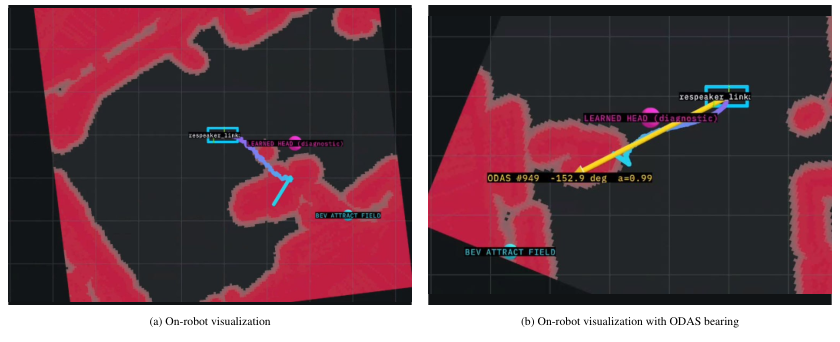
Experiments used a ZSL-1 quadruped equipped with an NVIDIA Jetson Orin NX, a Livox MID-360 LiDAR/IMU, and a 16-kHz Seeed reSpeaker XVF3800 four-microphone array, with ODAS 2.1 supplying direction-of-arrival tracks and separated audio. The array centre sits $0.25$ m behind and $0.30$ m above base_link , rotated $180^{\circ}$ in yaw. All perception, inference, and navigation ran on-board, with no external compute.
Localization fused motor odometry with LiDAR–IMU measurements via planar NDT-OMP scan matching against a prior point-cloud map.
Sources and Demonstrations
Figures are reproduced from Zhura et al. See the full paper for experimental details and the project page, when the paper links one, for demonstrations and videos.
Related Papers
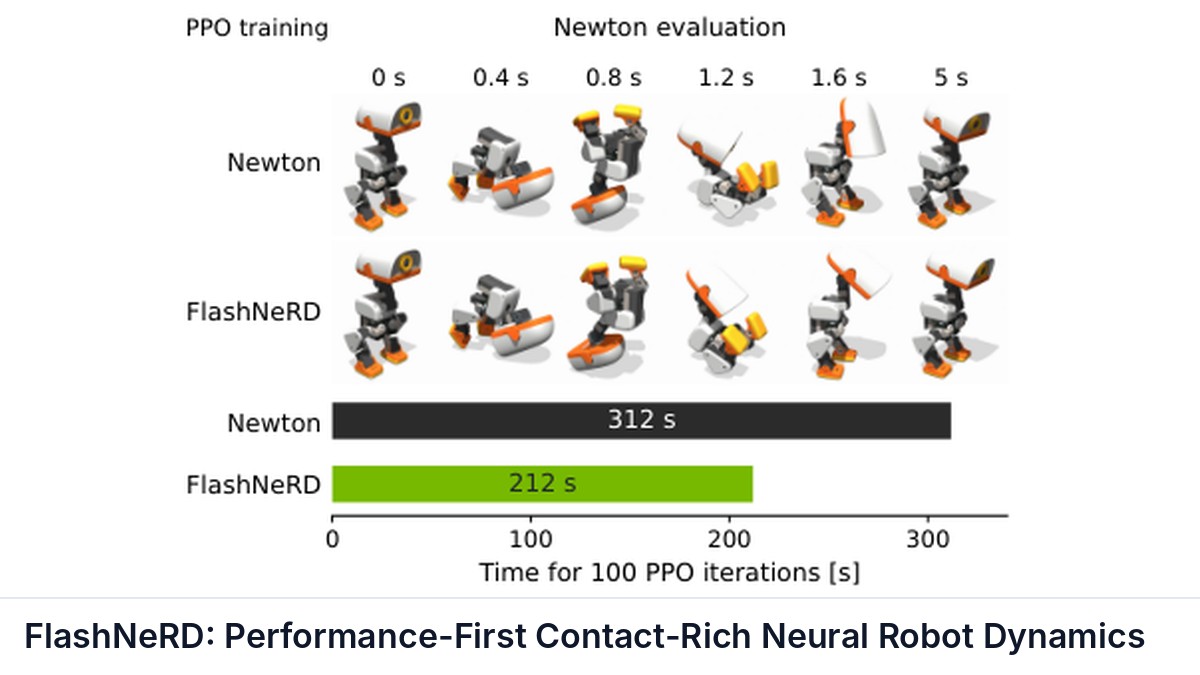
FlashNeRD: Performance-First Contact-Rich Neural Robot Dynamics
Mohammadmehdi Ataei, Mohammad Amin Nabian, Jie Xu et al.
Compared with analytical physics, learned dynamics models promise robot simulation that is faster, inherently differentiable, and easily adaptable to real data.
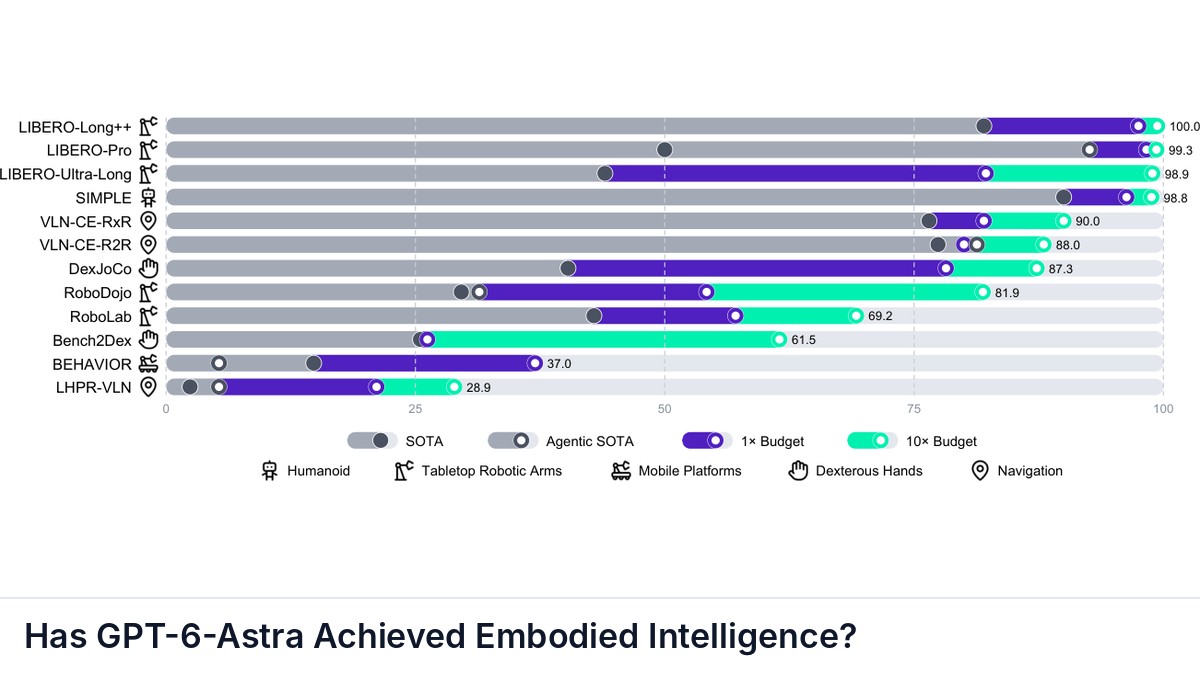
Has GPT-6-Astra Achieved Embodied Intelligence?
SenseNova, Joint Research Team, : et al.
GPT-6-Astra demonstrates a level of competence in robotic manipulation and navigation that challenges the conventional paradigm of building specialized models for individual tasks and embodiments.
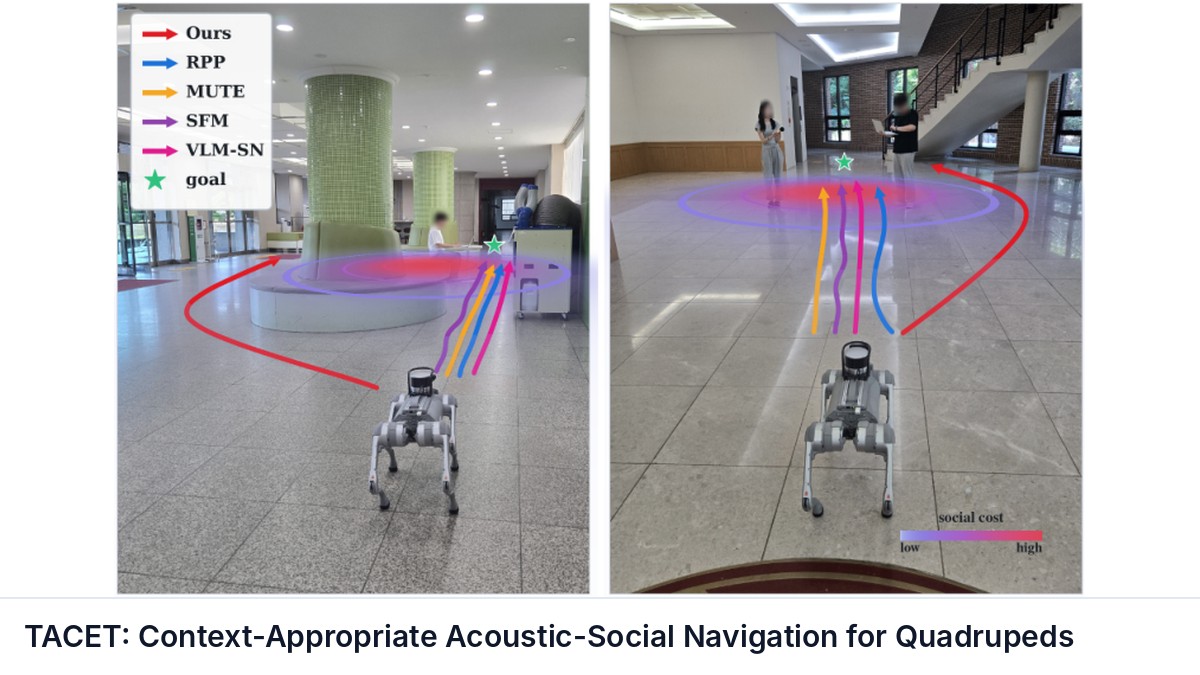
TACET: Context-Appropriate Acoustic-Social Navigation for Quadrupeds
Sungsan Park, Young-Sik Shin, Sanghyun Kim
Quadruped robots entering hospitals, care homes, and quiet offices must be context-appropriate not only in where they move but in how loudly they move: a legged robot's locomotion noise, dominated by foot-ground impacts, is itself a social variable.
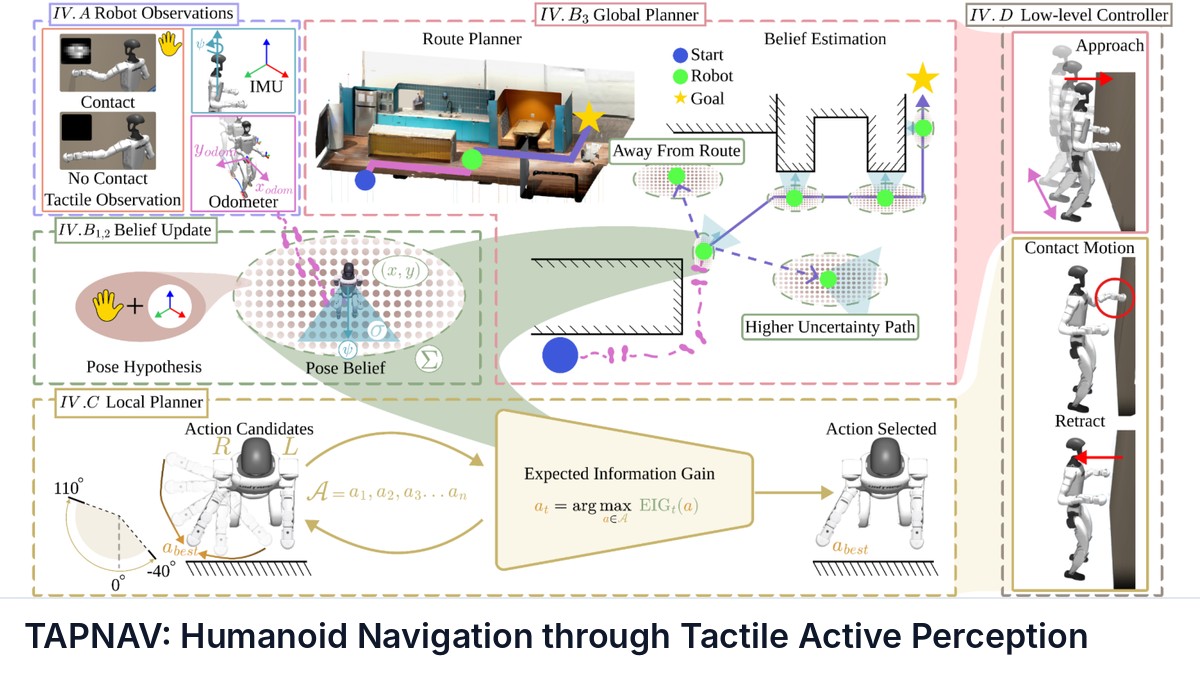
TAPNAV: Humanoid Navigation through Tactile Active Perception
Huaze Liu, Zhenyu Wu, Jaehwi Jang et al.
Navigation in vision-denied environments is challenging for humanoid robots because proprioceptive odometry drifts and localization uncertainty accumulates rapidly.